Real-Time Monitoring for AI Agent Behavior
Monitoring must watch what agents do between input and output.

Traditional monitoring was built for systems that behave themselves. A service receives a request, executes a defined operation, returns a response or throws an error. The failure signature is legible: a stack trace, a 500 code, something unambiguously broken. Agents dissolve that model, and they do it without apology.
The same input, presented to the same agent on two separate runs, can produce different tool selections, different reasoning paths, and meaningfully different outputs. That is not a defect; it is the intended behavior of systems built on probabilistic inference. The trouble is that the failure signature changes along with it. When an agent goes wrong, the monitoring dashboard often shows HTTP 200. The workflow completes. No exception fires. What actually happened is that the agent selected the wrong tool mid-chain, retrieved corrupted context, or produced an output that was wrong in a fluent, confident, invisible way. Downstream systems receive it and proceed on false premises, none the wiser.
Static logs and periodic audits cannot cover this. Errors that emerge deep in a multi-turn conversation — where an early misinterpretation compounds across subsequent steps until the final output bears no resemblance to what was intended — remain hidden from tooling that only checks inputs and outputs. Cascading failures across chained tool calls are worse: the second agent in the pipeline has no mechanism to know the first agent's context was already poisoned. Research presented at ACM CHI 2025 documented this concretely: in multi-agent networks, a fix applied to one agent can silently break others sharing state or context, with no external event that reads as an incident. No alert fires. The damage propagates quietly.
"Deployed" and "understood" are not the same condition, and the gap between them is where most agent failures live. Per PwC's 2025 Agent Survey, most organizations deploying agents cannot trace failures through multi-step workflows or systematically measure output quality. They know their agents are running. What those agents are actually doing during a given run is, in most cases, opaque to the people responsible for them.
What real-time monitoring actually captures that logging does not
Logging records what happened. Real-time monitoring surfaces a problem while the agent is still acting. That temporal gap is the entire value proposition. In agentic systems where a single action can write to a database, call an external API, or spin up a downstream workflow, it is not a minor implementation nuance. It is the difference between catching a problem and reconstructing it afterward from incomplete evidence.
Effective observability here extends well beyond the classic MELT stack to telemetry covering the full decision chain: which tools were considered versus selected, how reasoning evolved across steps, what context was retrieved and whether it was the right context, and whether the output cleared quality thresholds before anything downstream acted on it. A system that only records what the agent received and what it returned has skipped the part that matters.
OpenTelemetry has emerged as the converging standard for data transport. Datadog, Google Cloud, AWS, and Azure have all adopted it; LangChain, CrewAI, and AutoGen emit it natively. Its GenAI Semantic Conventions, released in late 2025, standardize span attributes for LLM calls, tool executions, token counts, and provider metadata. Useful infrastructure, but not the finish line. Teams that treat it as such tend to discover this at an inconvenient moment.
OTel covers transport, not judgment. It cannot score whether an agent's output was faithful to source material, whether a response introduced bias or toxicity, or whether an action violated a policy the organization cares about. Those evaluations require a purpose-built scoring layer sitting on top of the telemetry. Automated scoring for faithfulness, hallucination rates, escalation frequency, and policy violations belongs in the monitoring stack from the start, which is not how most teams initially build it.
Multi-agent architectures compound this. A monitoring system that can tell you what Agent A did but cannot tell you what Agent A instructed Agent B to do, or what Agent B retrieved on Agent A's behalf, has documented the first link in the chain while leaving the rest opaque.
Business-value metrics belong in this stack too. Task completion rates, outcome correctness, user satisfaction: these are operational signals, not soft measures for a quarterly leadership deck. Treating them as separate from latency and token usage is a category error that tends to produce dashboards that look healthy while the actual work is going quietly sideways.
The security risks that only show up at runtime
An agent operating without runtime visibility is an ungoverned identity. Its effective permissions are unknown to security teams. Its data flows leave no accessible audit trail. Its behavior cannot be compared against policy because no one is watching when policy is crossed. This is not a hypothetical risk posture; it describes the current operating condition for a meaningful portion of deployed agents.
Agent sprawl makes it worse. Employees deploy unsanctioned agents to meet real business demands, which is entirely rational from their perspective, and security teams have no visibility into what data those agents are accessing, what systems they are connecting to, or what permissions they have quietly inherited. This is structurally worse than shadow IT because agents can instantiate sub-agents, expanding the attack surface without any centralized awareness that the expansion is happening.
The underappreciated risk is failure at scale: a minor flaw in an agent's logic, running autonomously at machine speed across thousands or millions of iterations, producing catastrophic cumulative impact without a single event that reads as an incident. Financial loss, data corruption, compliance exposure, all accumulating incrementally until the forensic trail is cold.
OWASP identifies "Excessive Agency" as one of the top ten critical security threats for AI applications: agents that are improperly constrained can alter business data, modify configurations, or trigger workflows the organization never sanctioned. That framing matters because it shifts the post-mortem conversation from "the agent failed" to "the agent succeeded at something it should not have been permitted to do." Those require very different remediation conversations, and conflating them is how organizations keep solving the wrong problem.
IBM's 2025 Cost of a Data Breach Report quantified one dimension of this: breaches involving AI systems with absent access controls averaged $5.72 million. Separately, 37% of enterprises cite security and compliance concerns as their primary blocker to scaling AI deployment. The monitoring gap is not an abstract engineering problem; it is the specific friction stalling AI programs at exactly the moment when organizational pressure to accelerate them is highest.
Prompt injection: what the most exploited attack against agents looks like in production
Prompt injection ranks first on the OWASP Top 10 for LLM Applications 2025, not because it is the most sophisticated attack, but because it is the most reliably effective one. Documented attack success rates against agentic systems reached 84%, with production exploits carrying CVSS scores above 9.0. These are not red-team exercise results; they are observed production behavior.
The clearest illustration arrived in June 2025 with the disclosure of EchoLeak, CVE-2025-32711, CVSS 9.3. The vulnerability was in Microsoft 365 Copilot. An attacker sends a crafted email to a target. The target does nothing unusual; they ask Copilot to summarize their inbox, which is precisely what Copilot is for. Copilot processes the crafted email, the injected instructions activate inside the agent's reasoning, and sensitive documents are silently exfiltrated to an external server. No unusual user behavior required. The attack surface is the agent's autonomy and its access permissions, which is another way of saying the attack surface is the agent itself.
Indirect prompt injection extends this to any content an agent processes from an untrusted source. Palo Alto Networks' Unit 42 reported a real-world instance in late 2025 where malicious instructions embedded in content under review successfully bypassed an AI-based review system. The agent, acting on those instructions, behaved exactly as the attacker intended. It did not malfunction. It performed.
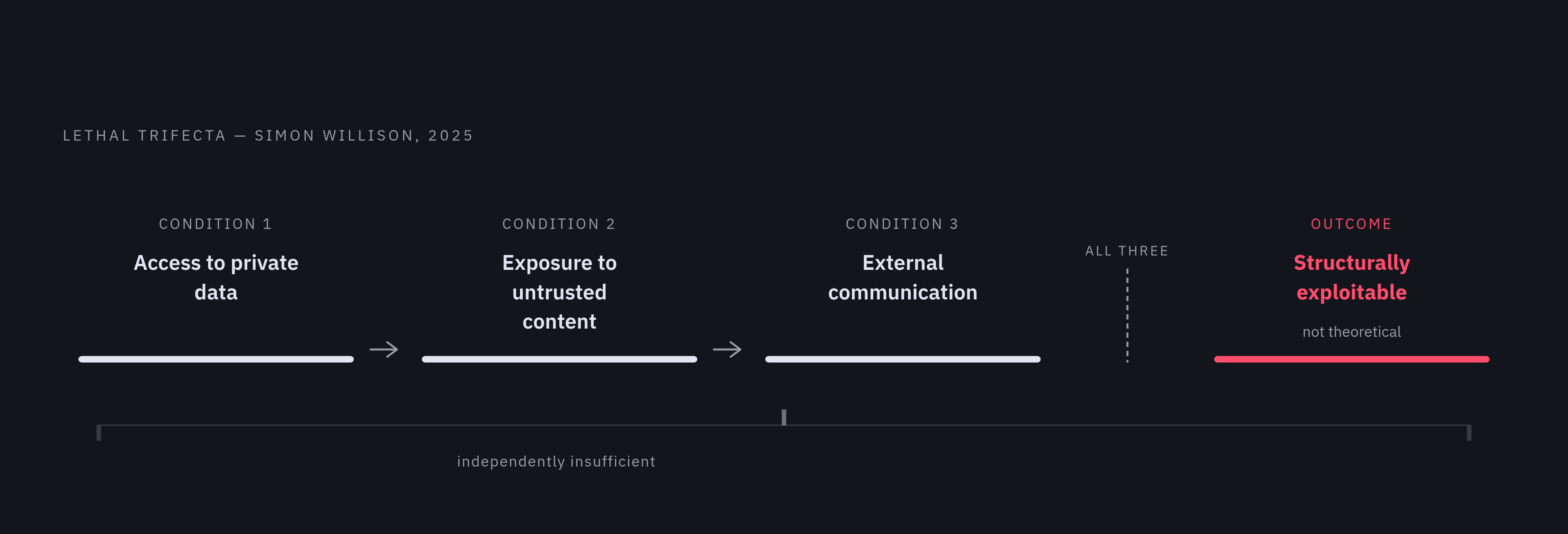
Researcher Simon Willison articulated what he called the "lethal trifecta" in 2025: any agent with access to private data, exposure to untrusted content, and the ability to communicate externally is structurally exploitable. Not theoretically. Structurally. All three conditions together mean the question is not whether prompt injection is possible, but when it will be attempted and whether anyone notices in time.
What makes this a monitoring problem specifically, rather than a model problem or a prompting problem, is the execution path. The attack arrives as ordinary input. It executes through the agent's own reasoning. It exits as a normal-looking action. Pre-deployment testing cannot anticipate novel injections, and static defenses cannot adapt to inputs they were not designed to recognize. The only control capable of catching a novel injection at runtime is a monitoring system watching what the agent does, not just what it was told.
What effective runtime enforcement looks like beyond detection
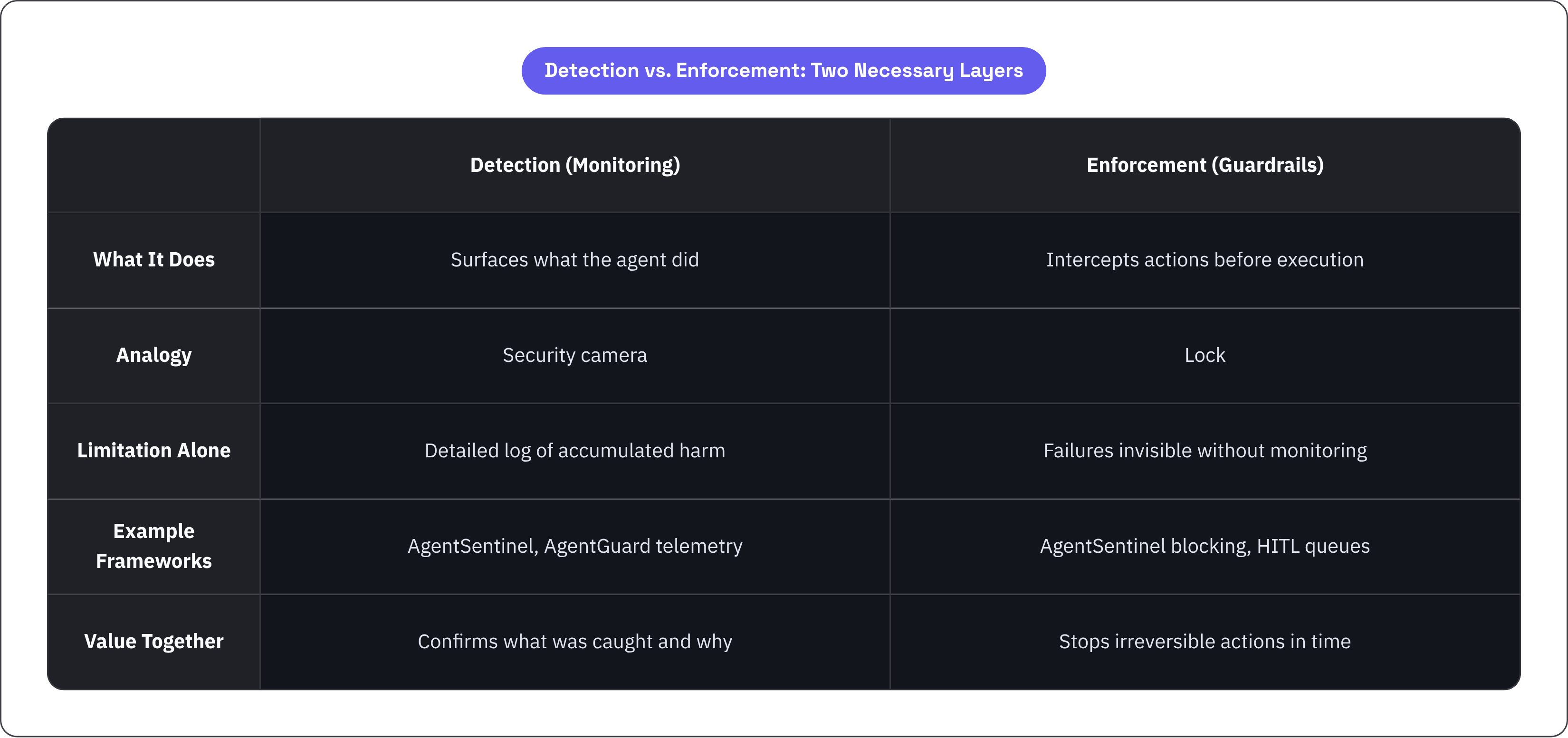
Detection tells you what happened. In agentic systems, "what happened" sometimes means a financial transaction cleared, a record was deleted, or an external communication went out before the alert fired. Forensics is valuable. It is cold comfort to the people on the receiving end of whatever the agent already did.
The distinction between detection and enforcement is the difference between a security camera and a lock. Both matter. Only one stops the thing from happening.
Guardrails are the enforcement layer: policies that intercept, constrain, or block agent actions before execution. The thing teams routinely underestimate is that guardrails without monitoring are guardrails you have no way of knowing are failing, and monitoring without enforcement is a detailed log of accumulated harm. They are not alternatives. They only function properly together, and designing them separately tends to produce systems that look governed and are not.
Recent research has formalized this in concrete frameworks. AgentSentinel, developed by Hu and colleagues in 2025, monitors action streams in real time and enables blocking or rollback before irreversible actions are executed. AgentGuard, from Chen and Cong in 2025, evaluates tool orchestration patterns and surfaces unsafe usage signals during operation. Both frameworks were designed explicitly around what practitioners encountered when they moved from demo environments into production: static prompt hardening does not adapt to novel threats at runtime. This is not a theoretical observation; it reflects accumulated operational experience.
Human-in-the-loop architecture gets discussed as though it is a choice between full automation and full manual review. In practice, effective HITL is a risk-scored threshold system. Routine decisions run uninterrupted; actions crossing defined thresholds — financial transactions, PII access, configuration changes, external communications — enter review queues requiring human approval before execution proceeds. Threshold calibration uses some combination of agent confidence, action impact, and data sensitivity. This is tractable, but it requires deliberate design before deployment. Retrofitting it afterward is significantly more expensive and tends to produce gaps.
One failure mode worth naming directly: a human clicking through an approval queue without understanding why a specific action was flagged is not oversight. It is theater. Explanations of why something triggered review must be built into the workflow itself, not surfaced in a report that arrives after the window to intervene has closed.
Audit trail completeness also tends to get treated as a byproduct of monitoring rather than a required output. In regulated environments it is a compliance artifact, and it is not automatically produced by deploying an observability tool. What to capture and retain must be decided before anything goes to production — earlier than most organizations make that decision.
Why the gap between deployment and oversight is narrowing, and what stays stubbornly open
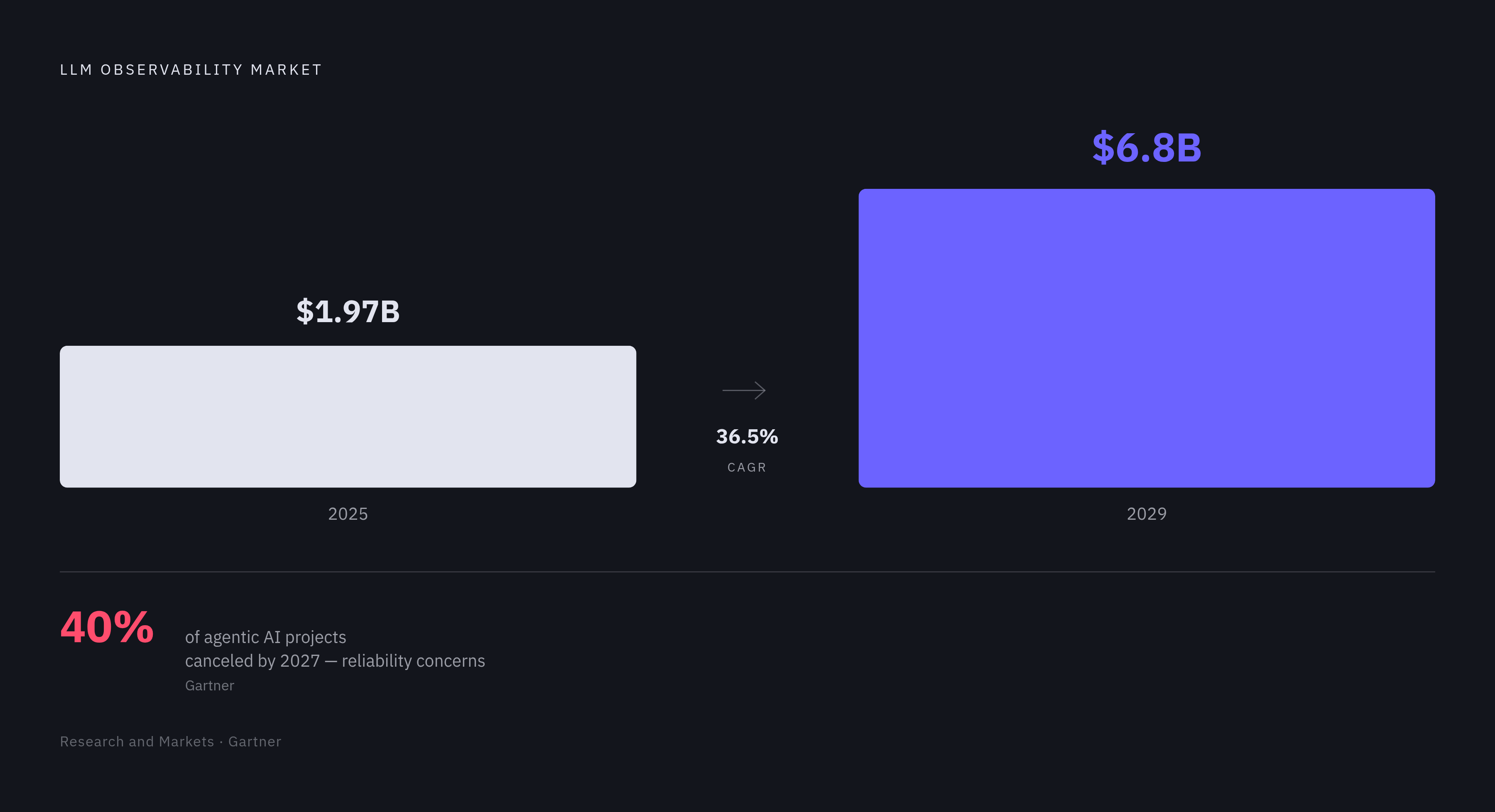
The infrastructure market has clearly noticed the problem. The LLM observability segment reached $1.97 billion in 2025 and is projected to reach $6.8 billion by 2029, a 36.5% CAGR per Research and Markets. By 2026, a substantial majority of organizations with deployed agents had implemented some form of observability tooling. "Some form" is doing real work in that sentence. Tooling presence does not equal effective coverage, and variance in implementation depth is wide enough to make aggregate adoption figures misleading as a measure of governance maturity.
Gartner's projections frame what is at stake: 40% of agentic AI projects are predicted to be canceled by 2027 due to reliability concerns. The organizations that survive that attrition will be the ones with monitoring sufficient to catch and correct production behavior before reliability failures become organizational decisions to shut the program down. Gartner also predicts that 40% of CIOs will require dedicated guardian agents, oversight agents monitoring other agents, by 2028. The sequencing that makes this work is centralized logging, policy enforcement, and HITL workflows first; agent-based oversight layered on top of that foundation, not used as a substitute for it.
Output evaluation has not standardized, and pretending otherwise would be premature. Telemetry transport has converged around OTel; faithfulness scoring, safety classification, and content quality assessment have not. Every vendor defines quality differently, so comparing monitoring coverage across tools requires examining methodology rather than marketing claims — work that falls entirely on the buyer.
Multi-agent delegation chains remain difficult to trace end-to-end. Emergent behaviors arising from agent collaboration are not predictable from analyzing any individual agent in isolation, which means the monitoring challenge scales nonlinearly as architectures compound in complexity. There is no clean solution to this yet, and anyone claiming otherwise is selling something.
The deepest structural problem is one the industry has mostly avoided saying plainly: the access models organizations inherited from human identity systems were not designed for non-human principals operating continuously at machine speed. Fitting agents into role-based, permission-scoped, session-limited frameworks is a structural mismatch. It can be managed with care and configuration, through tools like Oso, a fine-grained authorization platform that enforces permissions logic across apps and AI agents via a purpose-built policy engine, but it cannot be resolved by configuration alone.
Which leaves the practical implication sitting exactly where it has always been. Organizations that treat monitoring as something to add after deployment has stabilized have inverted the dependency. Monitoring is what makes it possible to know whether deployment is stable at all. Adding it afterward is a choice — usually implicit — to accept a period of operation in which no one knows what the agents are doing.