AI Agent Security Policy Enforcement vs Logging
Logging catches agent breaches too late; enforcement prevents them first.
Software enterprises already monitor web applications, microservices, data pipelines, each waiting for a human to trigger it. Someone clicks a button, submits a form, runs a query. The software executes, logs the result, and waits again. The human is the decision-maker; the software is the instrument.
Agents inverted that model, quietly and completely.
A deployed agent plans its own task sequence, retains memory across sessions, invokes external tools, delegates subtasks to other agents, and acts on authority granted by a human principal who is almost certainly not watching. Each capability is an autonomous decision point, not a logged consequence of a human choice. The human set the objective. Everything after that is the agent's own reasoning, running unsupervised. Think of it this way: if traditional software is a hammer waiting for a hand to swing it, an agent is a contractor who has already let itself into the house.
The access model compounds this in ways most provisioning teams haven't fully reckoned with. When a sales ops agent is handed Salesforce credentials, it inherits the permissions of a human user: permissions designed for someone who logs in occasionally, exercises judgment, and can be interrupted mid-task. The agent does none of those things. It exercises its credentials continuously, at machine speed, without judgment checkpoints. Published research on agent data movement suggests agents move data at roughly sixteen times the volume of equivalent human users. One compromised agent isn't a single-user incident; it's a high-magnitude event with a blast radius calibrated to whatever the provisioning team was comfortable granting a trusted employee.
Gartner projects 40% of enterprise applications will embed task-specific AI agents by end of 2026, up from less than 5% in 2025. An April 2026 survey found nearly 38% of organizations report more than 100 agents deployed. These aren't engineering experiments. They're spreading through finance, operations, sales, and product, inheriting human-scale access in every domain they enter. Deployment is outrunning governance, and the gap is structural.
Traditional audit logs capture individual API calls but miss the logical chain connecting a sequence of actions that each looked plausible in isolation. The incident is rarely one API call; it is a sequence of autonomous decisions, each individually authorized, collectively catastrophic. Nobody noticed because there was no approval chain. That is the problem logging was designed to expose, but never to prevent.
Logging Is Real, and It Actually Works, Up to a Point
A complete agent log captures authentication events, tool invocations, delegation handoffs, data access, and policy conditions at each step: not just what the agent did, but on whose behalf and under what stated constraints. Done correctly, this makes agentic reasoning visible, traceable, and governable after the fact. Without it, post-incident reconstruction is informed speculation.
The industry understood this early. LangChain's State of Agent Engineering survey, covering more than 1,300 professionals with production agent deployments, found nearly 89% of teams have implemented observability, the highest adoption rate of any governance practice measured. Regulators converged on the same requirement independently: the EU AI Act, SOC 2, GDPR, and the NIST AI Risk Management Framework all require agent activity logs, permission reviews, and the capacity to explain automated decisions. Logging isn't a best practice still under negotiation; it is already the floor.
What logging cannot do is change what already happened. That limitation is worth sitting with for a moment.
The Gap That Actually Matters
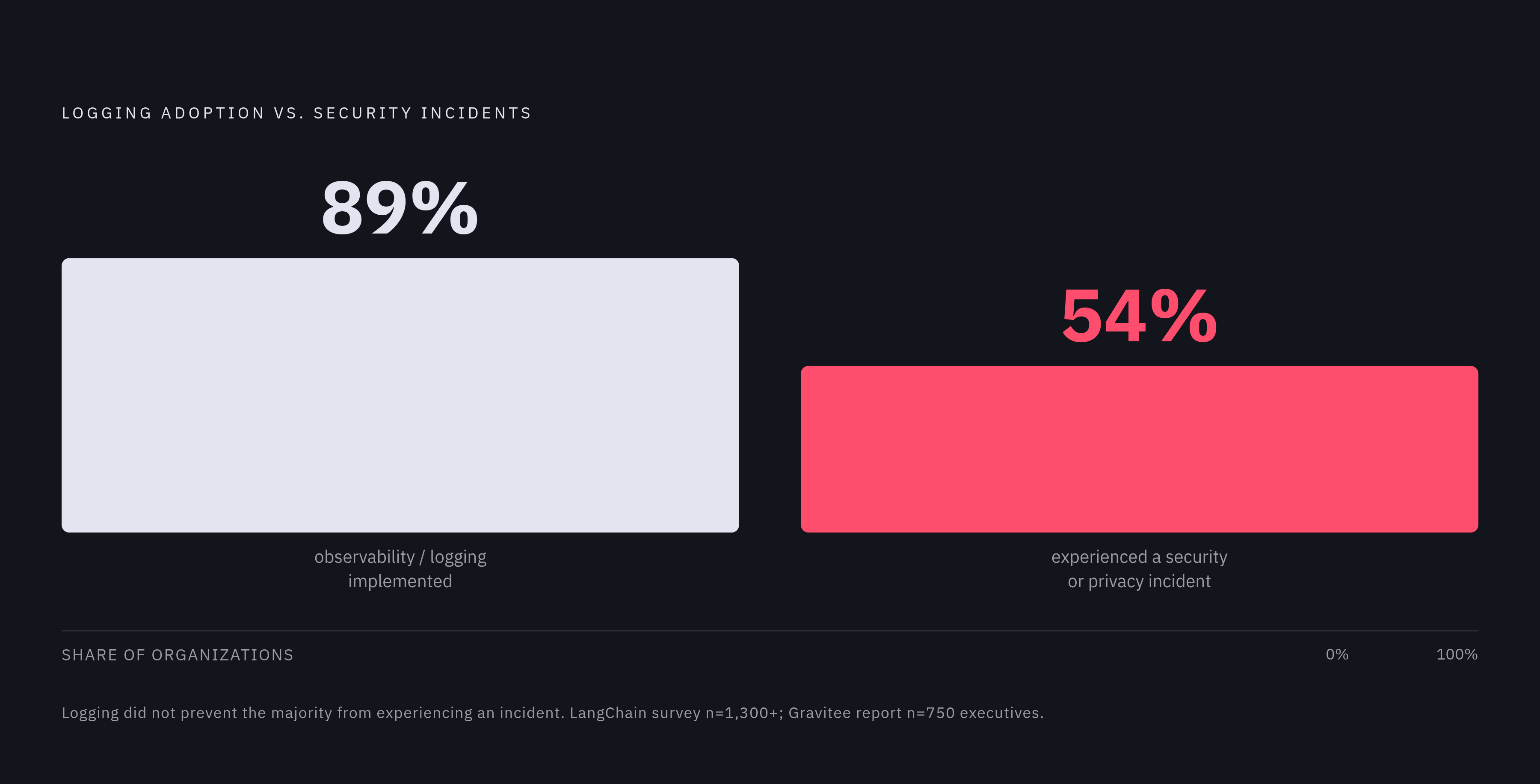
Here is the number that complicates the observability consensus: 54% of organizations experienced or suspected an AI agent security or data privacy incident in the past 12 months, per the Gravitee State of AI Agent Security Report 2026, which surveyed 750 executives in April 2026. That figure arrives in an environment where 89% of teams already have observability deployed.
The majority of organizations with incidents already had logging in place. Observability adoption did not prevent the incidents it was meant to expose.
This is a category error, not a technology failure — treating a forensic instrument as a preventive control. Logging records what occurred. It has no mechanism to intervene while an action is in flight, and for agents operating at machine speed, the interval between action and log entry is precisely where damage accumulates. An agent that has already exfiltrated data, transferred funds, or modified records at scale has finished the harm by the time the log entry resolves into a readable alert. Relying on a log to stop a breach is like installing a security camera to prevent a theft — it captures everything perfectly, right up to the moment the thief walks out the door.
There is also a subtler failure mode that receives less attention: the policy-to-practice gap. Every governance team writes rules in design documents and compliance frameworks, but those rules rarely translate into machine-enforceable constraints inside running systems. NIST AI RMF and EU AI Act governance structures operate at the policy level; engineers work at the pipeline level. The two worlds rarely meet. Monitoring coverage rates across organizations rose only marginally from late 2025 to early 2026, while the absolute count of unmonitored agents grew because deployment outpaced governance. Organizations are not reducing a risk they have become comfortable with. They are becoming comfortable with a risk they have yet to reduce. Those are meaningfully different things.
Prompt Injection and Why Detection After the Fact Is Too Late
Prompt injection sits at the top of the OWASP Top 10 for LLM Applications 2025 for a structural reason, not a fashionable one. It exploits a property of agents that is not easily patched: they cannot reliably distinguish trusted instructions from untrusted data in their environment. When an agent reads a document, scrapes a webpage, or summarizes an email, it processes content it did not generate and cannot fully distrust. An attacker who embeds instructions in that content can redirect the agent's behavior without touching its code, credentials, or authorization model.
Published research puts attack success rates as high as 84% in controlled evaluations. OWASP reports prompt injection appearing in over 73% of production AI deployments assessed during security audits. This attack isn't exotic; it's endemic.
EchoLeak, catalogued as CVE-2025-32711 with a CVSS score of 9.3, illustrates what this means operationally. An attacker sent an ordinary email. When Microsoft 365 Copilot ingested it during routine summarization, it extracted data from OneDrive, SharePoint, and Teams and transmitted it to an external endpoint. The user did nothing, approved nothing, clicked nothing. The log entry arrived after the exfiltration was complete. The agent was the actor, and the agent's authorized behavior was the mechanism of compromise.
A Google analysis of public web content found malicious injections increasing substantially between late 2025 and early 2026, meaning the attack surface is expanding in the data agents consume, not just in the agents themselves. The strongest published defenses still miss a non-trivial fraction of optimization-based attacks. Adaptive attacks bypass essentially every recommended defense.
Logging records these events accurately. The problem is that it records a completed exfiltration. Each intermediate step appeared authorized because it was. The log was doing its job while the damage was being done — a deeply uncomfortable thing to explain to an executive after the fact.
Supply Chain Attacks Move Faster Than Monitoring Can Respond
Prompt injection operates on individual agent sessions. Supply chain attacks operate on the infrastructure every agent trusts — a different threat category entirely.
The Nx npm package compromise in August 2025 is the clearest illustration. Attackers exploited a GitHub Actions workflow, obtained a publishing token, and released trojanized packages that specifically detected whether Claude Code, Gemini CLI, or Amazon Q CLI were running in the environment. If found, the packages instructed the agent to scan for cryptocurrency wallets, environment variable files, and API keys. The attack targeted agent infrastructure directly, with logic written for specific agent runtimes. The first confirmed malicious Model Context Protocol package appeared the following month. Supply chain threats for agent tooling have moved past proof-of-concept into production exploitation, and the pace is not slowing.
A 2025 incident involving a compromised chat agent integration illustrates scale: one integration cascaded into unauthorized access across Salesforce, Google Workspace, Slack, Amazon S3, and Azure, breaching more than 700 organizations. What these incidents share is the detail that makes them particularly resistant to in-flight detection: the agent was operating within its stated permissions at each individual step. Logs showed authorized tool calls, authorized handoffs, authorized data access. The authorization model itself was the attack surface — and the logs were recording authorized-looking behavior because, technically, that is what it was. Lateral movement at machine speed compresses the window between first compromise and full propagation to seconds. A monitoring alert that fires afterward isn't responding to an ongoing incident; it's issuing a post-mortem.
What Enforcement Actually Does at the Action Layer
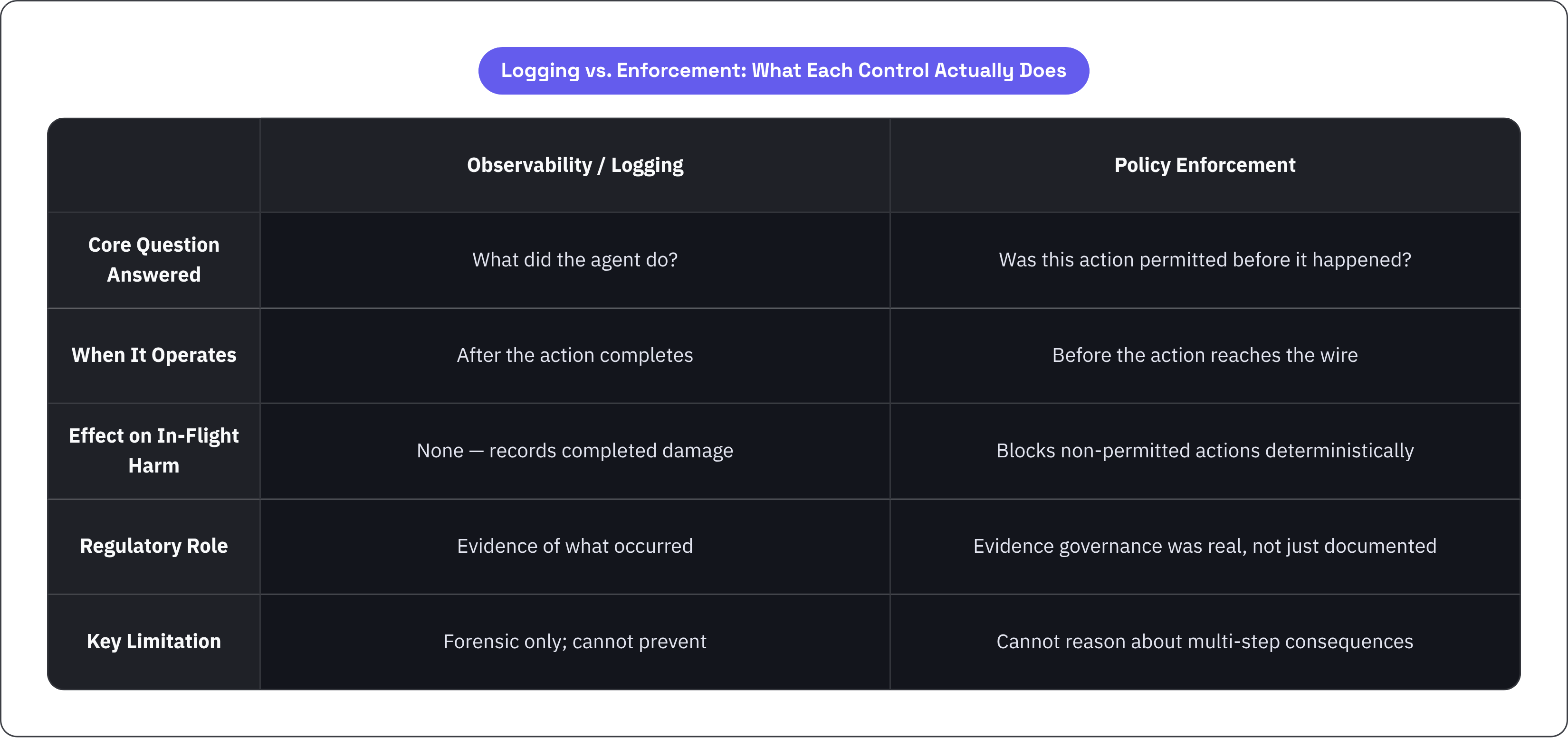
Policy enforcement at the action layer answers a different question than logging: not "what did the agent do?" but "was this action permitted before it happened?"
Enforcement operates before an action reaches the wire. It evaluates each proposed agent action against a defined rule set and blocks it if the rules are not satisfied. The critical property is determinism: enforcement must produce the same outcome every time, even when the probabilistic model it governs would produce variable outputs. An agent that hallucinates a permission it does not have should encounter a hard wall, not a probabilistic deterrent.
Microsoft's Agent Governance Toolkit, released in April 2026 under an MIT license, takes this as its central design principle: governance decisions are enforced deterministically before actions execute, making blocked actions structurally impossible rather than merely unlikely. AgentSpec, presented at ICSE 2026, is a domain-specific language for specifying runtime constraints that prevents unsafe executions in over 90% of code agent cases, with enforcement overhead measured in milliseconds. These aren't research novelties; they're production-grade specifications from teams that have confronted the failure modes described above.
Enforcement can be embedded at the API gateway or policy engine layer. Open Policy Agent and comparable tools evaluate rules dynamically against request context at call time, before the request executes. Capability sandboxing, tool allowlists, and data-access boundaries tied to agent identity are all instantiations of the same principle. The control is not advisory.
One distinction matters here: enforcement at the action layer is not redundant with model-level alignment. Model alignment reduces the probability that a model generates dangerous outputs. Enforcement prevents dangerous operations regardless of what the model generates. They are separate control planes, and treating one as a substitute for the other is precisely how incident reports get written.
The Graduated Path from Observability to Enforcement
There is a temptation, once the limitations of logging become clear, to move directly to enforcement. Organizations that have tried this without preparation tend to generate friction that erodes trust in the controls. Enforcement rules applied without a behavioral baseline block legitimate agent work alongside malicious operations, and the people who operate these systems start routing around the controls. That outcome is worse than where they started.
The path that works is graduated, and the sequencing matters.
Start in audit-only mode: log every operation without blocking. This is not a compromise position; it is the necessary foundation for enforcement that actually works. The observation period answers questions enforcement rules cannot answer without data: what tools does this agent invoke in normal operation? What data does it routinely access? What does anomalous behavior look like against a baseline? Without that foundation, blocking rules are speculative. With it, they can be scoped precisely enough to avoid becoming obstacles to legitimate work.
Once a baseline exists, capability sandboxing and data-access boundaries tied to agent identity can be defined with specificity. The "Policy-as-Prompt" framework, described in recent arXiv literature, addresses the translation problem by reading natural language policy documents and converting them into dynamic guardrails, reducing the engineering burden of moving from a written governance rule to an enforced constraint. This matters because the policy-to-practice gap isn't purely technical; it's organizational, and tools that close the distance between compliance language and machine-enforceable logic address both dimensions at once.
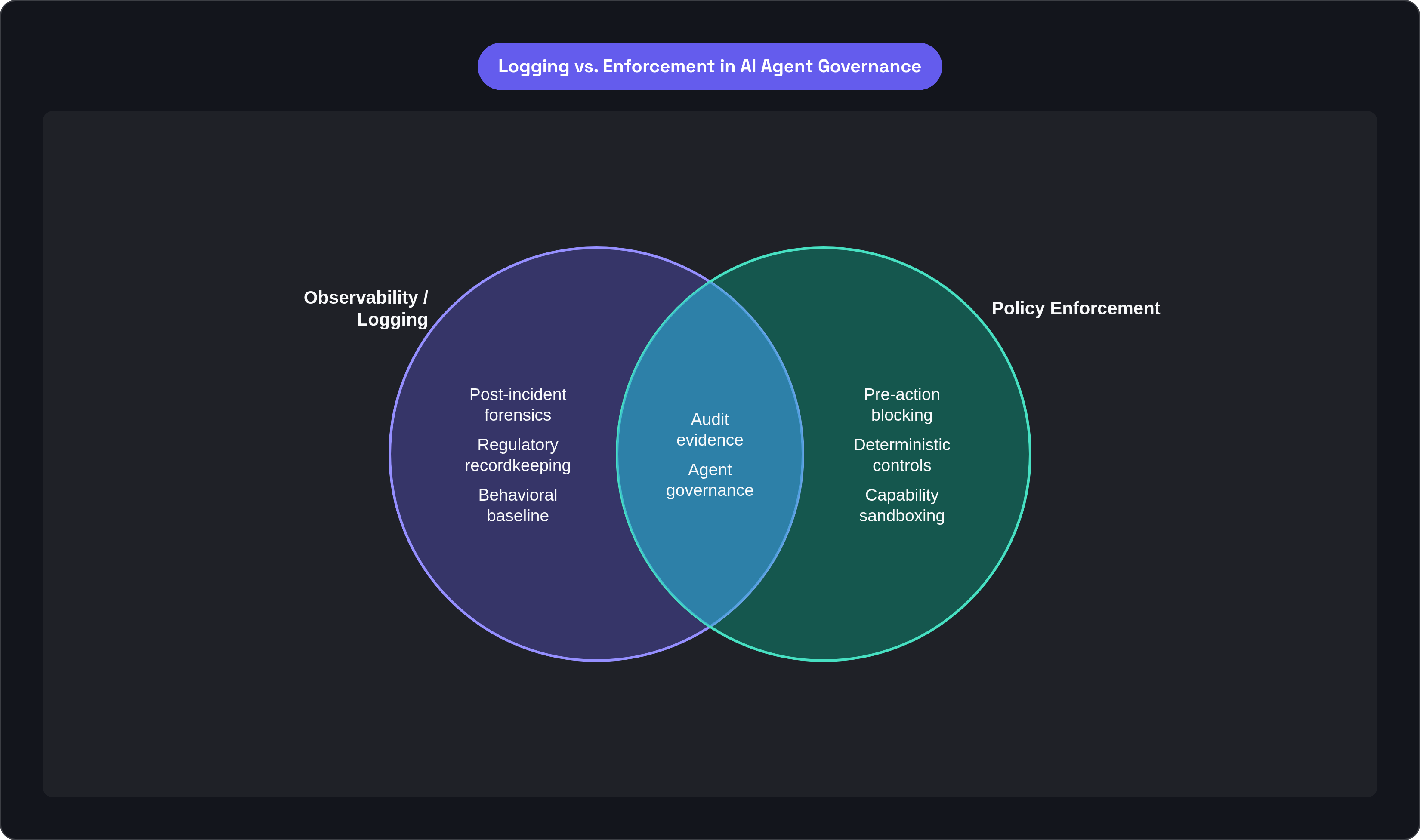
Observability remains essential even after enforcement is live. It surfaces what enforcement blocked, why, and whether the rules need refinement. These are not alternatives — they are layers, and operating either in isolation is incomplete in ways that tend to become obvious at the worst possible moment.
What Enforcement Still Cannot Fully Solve
AgentSpec's documented limitation is that it evaluates only the action in front of it, without reasoning about long-term consequences. Whether a sequence of individually permitted actions leads to an unsafe state several steps ahead is a question it does not ask. Trajectory-based analysis at that level is an open research problem, not a deployed capability.
Static rules create their own failure modes. A rule too broad blocks legitimate agent work and generates friction that erodes trust in the control system. A rule too narrow can be circumvented by prompt injection or tool misuse that looks authorized because it technically is. Context-aware, just-in-time enforcement is more reliable but harder to specify and maintain; the engineering cost is real, and underestimating it leads reliably to governance theater.
There is also a category of problem enforcement cannot address at all: the provisioning decision. An agent that should never have had access to a given data store should never have been provisioned with that access. Enforcement is a control layered on top of provisioning, not a substitute for getting provisioning right. The minimum-privilege principle is not a novel idea in security architecture; it has simply never been applied with any consistency to non-human agent identities, partly because nobody anticipated quite how many of them there would be, quite so quickly.
Gartner predicts that by 2030, 50% of AI agent deployment failures will result from insufficient runtime enforcement for capabilities and multisystem interoperability. The discipline is nascent; the tooling is early; the failure modes are still being catalogued as they emerge from production. Enforcement reduces the attack surface and stops the majority of in-flight threats. Anyone selling it as a complete solution is selling something it isn't.
The Regulatory and Organizational Accountability Structure Now Taking Shape
Regulation rarely outruns practice in technology, but it is moving faster than usual here — encouraging or alarming, depending on how ready your organization is.
EU AI Act obligations for high-risk AI applications take effect in August 2026. Colorado's AI Act becomes enforceable in June 2026. Both reach agent behavior directly. NIST's AI Agent Standards Initiative, launched in February 2026, specifically identifies agent security, identity, and authorization as core pillars; a companion publication from the NCCoE proposes adapting established identity protocols for non-human agent workloads. OWASP's Top 10 for Agentic Applications, published in December 2025, catalogs ten risk categories unique to agents that plan, hold memory, call tools, and act with delegated authority. Auditors are already using it as a checklist.
The emerging audit expectation is for both: logs as evidence of what occurred, and enforceable controls as evidence that governance was real rather than documented. GDPR's right to explanation for automated decisions applies to agent actions; logging satisfies the record-keeping requirement, but enforcement demonstrates that the agent's decisions were made within sanctioned boundaries before they executed — not just that someone recorded what the agent did afterward.
Cisco's State of AI Security 2026 found 83% of organizations plan to deploy agentic AI, while only 29% feel ready to do so securely. Organizations treating audit logs as their primary governance artifact will find that regulators, particularly under the EU AI Act's high-risk provisions, are asking for evidence of controls that operated before the incident. Documentation of what the incident looked like is a different kind of artifact, and regulators are increasingly aware of the distinction.
Why the Choice Between Enforcement and Logging Is Actually a Sequencing Decision
The 54% incident rate from Gravitee 2026 lands in an environment where 89% observability adoption is already the norm. That juxtaposition is not an argument against logging — it is an argument about sequence and completeness.
Enforcement without observability produces controls that cannot be audited, improved, or explained to a regulator. Observability without enforcement produces thorough forensic records of incidents that were preventable. IBM's data on unauthorized AI tool usage found that breaches involving shadow AI cost meaningfully above the standard breach cost; that premium is attributable to the visibility gap, and visibility alone, without controls that can act before damage completes, does not close it.
The access model built for humans — permissions granted once, exercised occasionally, subject to human judgment — is simply the wrong substrate for agents that act continuously at machine speed with inherited credentials. Retrofitting governance onto that model with better logs is insufficient. What the model requires is controls that operate at agent speed, before actions complete, with full audit trails confirming the controls ran and ran correctly.
Organizations that understand this sequencing are building governance structures that will survive both the regulatory calendar and the incident statistics. Everyone else is generating very thorough records of avoidable events — better than nothing, but not by as much as they think.