AI Governance Framework Templates for Enterprises
Most enterprises have documented governance frameworks they don't actually use in practice.

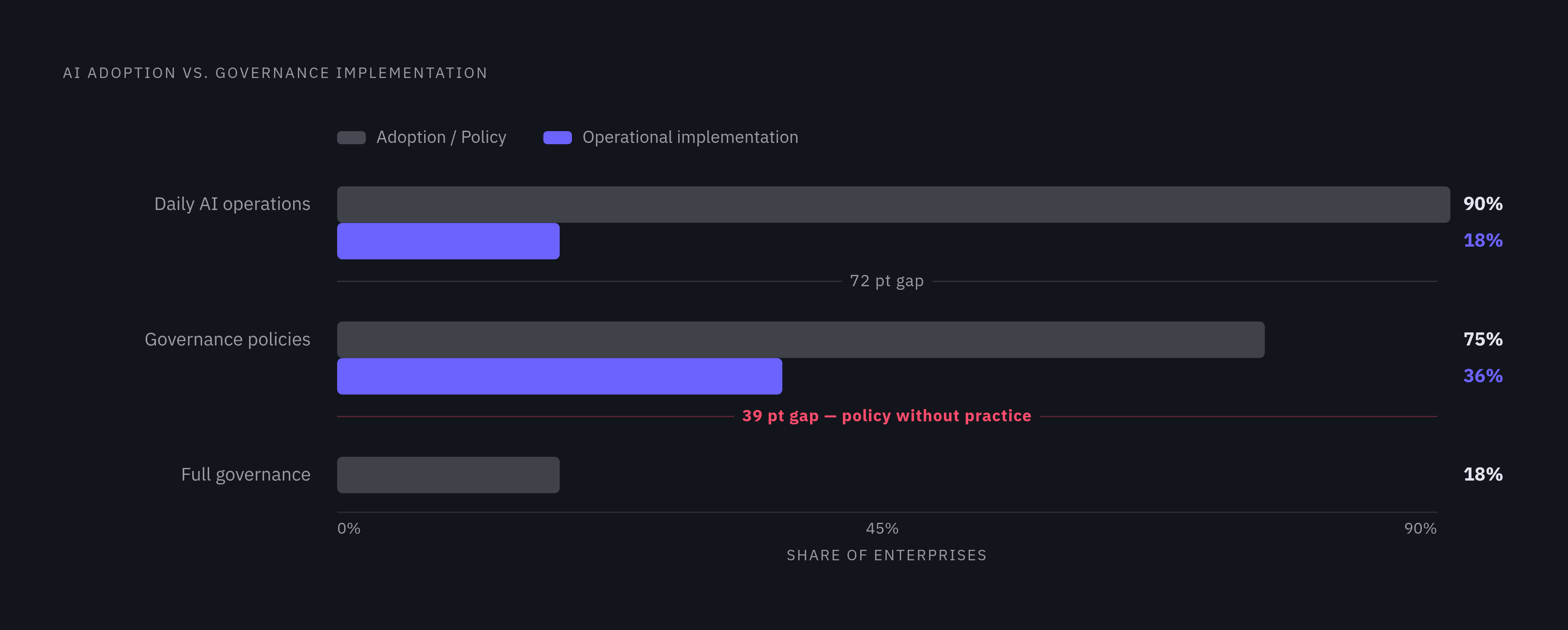
Enterprise AI governance is a solved problem on paper and an unsolved problem in practice. As of 2025, 88% of organizations used AI in at least one business function, according to Aon research, yet only 8% maintain a comprehensive AI governance framework, per Economist Impact research, a figure that drops to 2% among small firms. Ninety percent of enterprises run AI in daily operations; only 18% have fully implemented governance frameworks, per Knostic's 2025 analysis. The gap is not a technology problem. It is an organizational design problem produced, in large part, by treating governance as a documentation exercise rather than an operational control system.
Think of it this way: most organizations have built a beautifully detailed map of a city they have never actually visited.
What enterprise AI governance actually means (and what it has to cover)
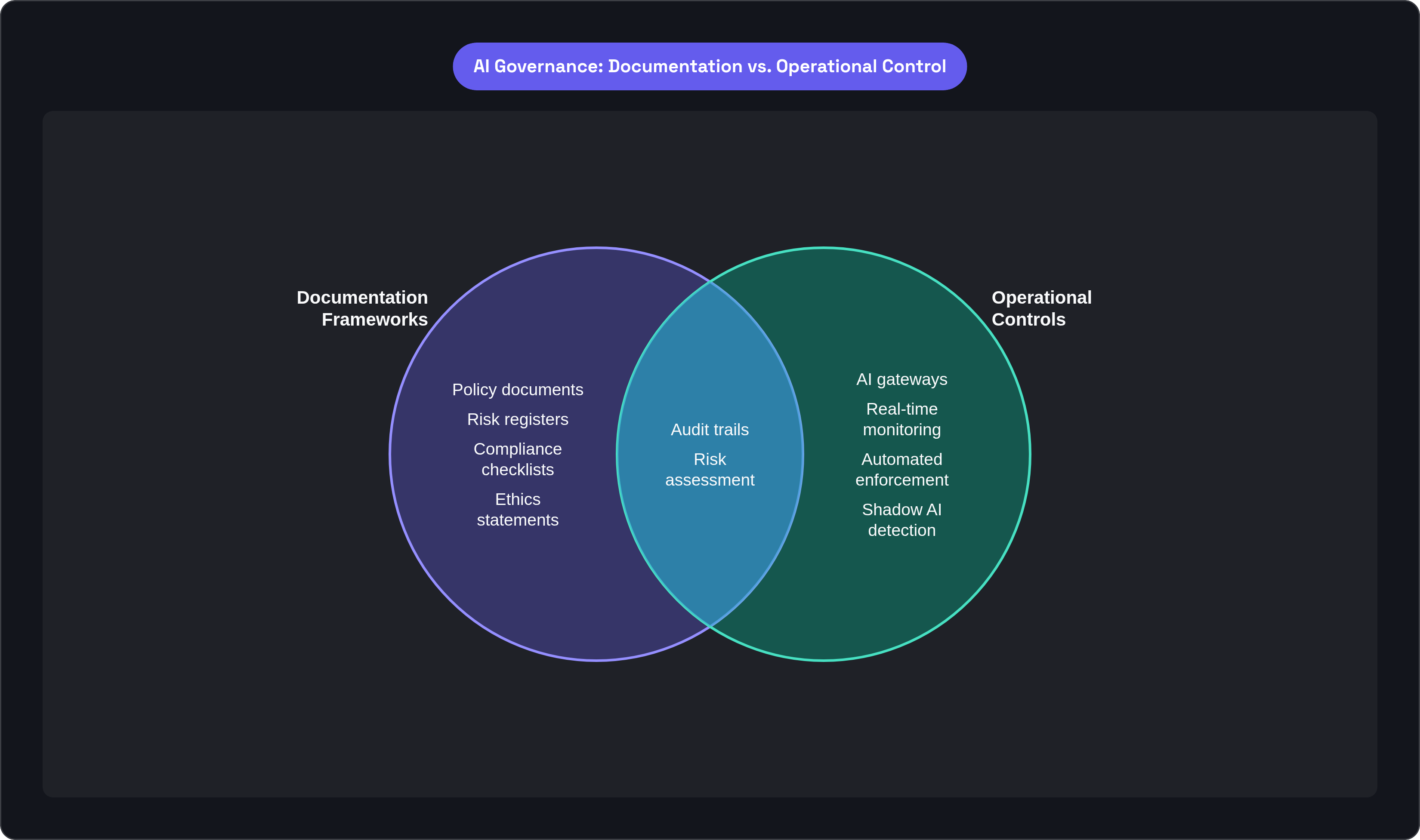
Governance is not a policy document. It is not a compliance checklist, a risk register filed in a SharePoint folder, or an ethics statement on the company website. It is a system of policies, processes, controls, and oversight structures that must span the full AI lifecycle: data sourcing and preparation, model development and evaluation, deployment and integration, runtime monitoring and incident response, and model retirement with a defensible audit trail.
The word "auditable" is load-bearing here. If a control cannot be audited, it is not a control. It is a principle, and principles do not prevent incidents.
AI systems require different governance from traditional software for three structural reasons. First, their outputs are probabilistic and can drift over time without a single line of code changing. A model that was accurate and unbiased at deployment can degrade silently — like a compass that gradually stops pointing north, indistinguishable from a working one until you are already lost. Second, AI agents inherit human-scale access permissions and act at machine speed, which means the window for human intervention that exists in traditional software workflows simply does not exist in the same form. Third, risk is dynamic: a low-risk AI system can become high-risk as usage patterns change, as user populations shift, or as the model is applied to contexts outside its original scope.
A complete governance framework addresses six functional components: policy development, risk assessment, compliance alignment, technical controls, ethical guidelines, and continuous monitoring. These are not checklist items. They are design requirements, and the rest of this piece evaluates both existing frameworks and available templates against them.
The three frameworks enterprises actually use (and what each one does and does not provide)
NIST AI RMF 1.0: the de facto US baseline
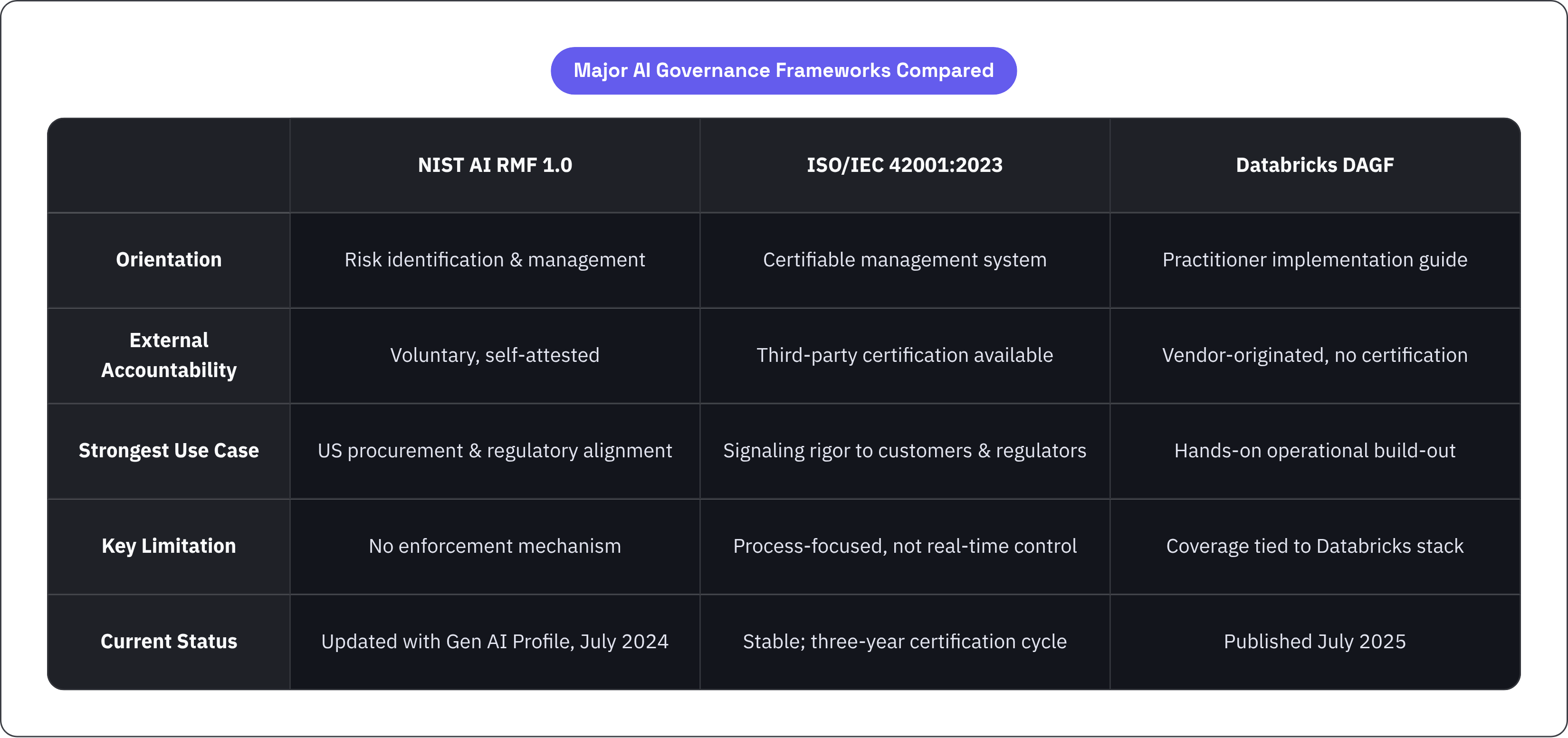
The NIST AI Risk Management Framework organizes AI governance into four functions: Govern, Map, Measure, and Manage. It is voluntary, which is simultaneously its greatest flexibility and its most significant structural limitation. Voluntary frameworks rely on self-attestation, and self-attestation is a ceiling, not a floor.
That said, dismissing NIST AI RMF as toothless would be a mistake. It is increasingly cited in procurement contracts, insurance underwriting, and state legislation. The FTC, CFPB, FDA, SEC, EEOC, and Department of Defense have all referenced it. The July 2024 Generative AI Profile (AI 600-1) added 12 risk categories specific to large language models and multimodal systems, covering confabulation, data privacy, information integrity, intellectual property, and toxic content, among others. A preliminary draft Cyber AI Profile (IR 8596) published in December 2025 bridges AI risk management with the NIST Cybersecurity Framework 2.0. The framework is evolving at a pace that reflects the actual deployment landscape, which is more than most voluntary frameworks can claim.
Its limitation is structural: without an external accountability mechanism, an organization can attest compliance and mean almost anything by it.
ISO/IEC 42001:2023: the certifiable international standard
ISO/IEC 42001 is the world's first AI management system standard. It uses a Plan-Do-Check-Act methodology across 10 clauses and, critically, is certifiable by accredited bodies including BSI, Bureau Veritas, and TÜV. That external certification is a credible signal to customers, investors, and regulators that self-attestation cannot replicate.
Certification is valid for three years with annual surveillance audits required. Enterprises should budget for ongoing compliance costs, not just the initial certification sprint.
Where ISO 42001 provides structural rigor, it also introduces structural inertia. It is designed more for process governance than real-time operational control, and organizations that need to move fast find its requirements better suited to formalizing what they have already built than to governing what they are currently building.
NIST AI RMF and ISO 42001 are complementary, not redundant. NIST identifies and addresses unique risks; ISO 42001 builds the formal management system that governs those processes. Running both is defensible; choosing one and ignoring the other leaves predictable gaps.
The Databricks AI Governance Framework: the practitioner template
Published in July 2025, the Databricks AI Governance Framework (DAGF) organizes governance across five foundational pillars and 43 specific considerations. It is practitioner-oriented, concrete, and current in a way that standards documents published on multi-year revision cycles cannot be.
Its limitation is straightforward: it is vendor-originated. Coverage is strongest where Databricks' own stack is involved. That is not a disqualification, but it is context that any organization adopting it should carry explicitly.
What they all share
The OECD AI Principles, adopted by more than 46 countries, operate at the level of principles rather than controls. The UK's pro-innovation framework is non-statutory and built around five principles. Singapore's Model AI Governance Framework is risk-proportional and pragmatic. All of these are useful reference points.
None of them is an operational control system. That is the shared limitation across every major framework: they define what good governance looks like. They do not enforce it.
What the EU AI Act and the US regulatory patchwork require enterprises to have in place now
The EU AI Act is the most consequential forcing function in enterprise AI governance, and its phase-in timeline is not hypothetical. Prohibited practices and AI literacy obligations took effect in February 2025. General-purpose AI model obligations applied from August 2, 2025. Comprehensive high-risk AI system requirements take effect August 2, 2026, with high-risk systems under Annex III (covering employment, biometrics, and critical infrastructure) provisionally extended to December 2, 2027.
Penalties reach €35 million or 7% of global annual turnover for prohibited practices, and €15 million or 3% for other violations. The Act applies to any entity placing AI on the EU market or whose AI outputs are used in the EU, regardless of where the organization is headquartered.
Columbia Law professor Anu Bradford's "Brussels Effect" argument is directly applicable here: companies generally find it more efficient to comply globally than to maintain separate governance systems per jurisdiction, which makes EU standards the de facto global baseline for enterprises with any EU exposure. That observation has proved durable across GDPR, product safety regulation, and now AI.
The General-Purpose AI Code of Practice, finalized in July 2025, supports GPAI obligations with specific requirements for adversarial testing, incident reporting, cybersecurity, and copyright transparency. These are not aspirational; they are the operational baseline for covered systems.
The US context runs in three concurrent layers. NIST AI RMF is voluntary but referenced in procurement decisions and, increasingly, in litigation. The EU AI Act is mandatory for any organization with EU market exposure. And state-level AI legislation is accelerating, with enforcement deadlines landing in 2025 and 2026 across multiple jurisdictions. More than 75 countries had adopted or begun drafting AI legislation as of July 2025.
Sector-specific obligations sit on top of the general regulatory stack. HIPAA requires that AI systems handling protected health information either run locally or operate through properly configured enterprise services with business associate agreements in place. CMMC mandates data classification and access control for defense contractors handling controlled unclassified information. GDPR, when combined with the EU AI Act, creates layered AI literacy and rights-based data processing obligations. FERPA governs AI use with student educational records in ways that most AI governance templates do not address.
One honest caveat: as of early 2026, the EU's standards development process through CEN-CENELEC had faced repeated delays, and only three of 27 member states had designated both required national authorities ahead of the August 2025 deadline. Enforcement timelines may shift. Building toward compliance now still reduces exposure regardless of whether regulators move on the original schedule; the direction of travel is not in question.
The six components a governance framework template must include to function operationally
Policy development
An Acceptable Use Policy defines what AI systems the organization permits, what it prohibits, and under what conditions. The critical design requirement is specificity: a policy must be specific enough to generate enforceable rules, not just statements of intent. "We use AI responsibly" is a principle. "AI systems processing personally identifiable information must route through approved enterprise services with documented data retention limits and access logging enabled" is a policy. Without operationalization, the former does not prevent anything.
Risk assessment
Risk assessment begins with inventory. Every AI model, dataset, API integration, and embedded AI component must be identified, including shadow AI systems that business units have deployed outside formal IT procurement channels. Shadow AI is not a niche problem; it is where a significant share of enterprise AI actually runs.
Once systems are identified, risk identification maps each against a structured taxonomy. A credit-scoring model carries bias, drift, privacy, and regulatory risk profiles. A code generation tool surfaces intellectual property infringement and security risks. A customer service chatbot raises accuracy, reputational, and data handling concerns. You cannot govern what you cannot see. Discovery is a precondition, not a subsequent step.
Compliance alignment
US enterprises now operate in a layered legal environment that barely existed 18 months ago. Mapping internal controls to external obligations must be dynamic, not a one-time exercise. The EU AI Act's phase-in schedule is known; the mapping must update as each deadline arrives.
Technical controls
This is the component most frequently absent from documentation-heavy governance programs. AI gateways translate policy into enforcement through centralized governance, monitoring, and auditing. Without technical controls, policy compliance operates on the honor system.
For AI agents specifically, this is not a marginal concern. Agents inherit human-scale access permissions and act without waiting for human approval on each action. Enforcement must be automated and real-time. A review process designed for human-speed decisions does not function at agent speed.
Ethical guidelines operationalized as measurable requirements
Transparency requirements must specify what "explainability" means for each AI system, to whom explanations are owed, and in what form. Human oversight mechanisms require defined intervention points, established in advance, rather than retrospective review after an incident has already materialized. Third-party audits provide credibility that internal review cannot; they are a governance mechanism, not a marketing exercise.
Continuous monitoring
Continuous monitoring is the component that determines whether a governance framework is live or latent. Key Risk Indicators for model accuracy drift, bias score changes, data quality degradation, and incident frequency must be defined, tracked, and tied to risk appetite thresholds approved at the board level, not just set by IT teams.
Monitoring without enforcement is logging. Governance requires both.
These six components are interdependent, not sequential. A framework with strong policy development but weak technical controls will fail at the operational layer. A framework with robust monitoring but no enforcement mechanism will generate records of failures rather than preventing them.
Where governance templates available on the market fall short
The template market is not deficient. It is misapplied. RASCI matrices, risk registers, internal audit checklists, incident logs, and risk treatment plans are legitimate artifacts, available from vendors including ITSM Docs and consultancies built by former Big Four staff, and ISO 42001-aligned document packages provide genuine clause-by-clause scaffolding. These are sound starting points.
The problem is what organizations do with them.
A completed risk register is not a monitored risk. An acceptable use policy is not enforced access control. Templates produce documentation; governance requires systems. The gap between the two is measurable: 75% of organizations have adopted AI governance policies, but only 36% have operational implementation frameworks, according to Gartner and McKinsey research from 2025 and 2026. That delta is the template gap expressed as a number.
What templates structurally cannot provide: real-time detection of anomalous agent behavior, automated enforcement of what AI systems can and cannot do, tamper-evident audit logs of every AI action, and visibility into shadow AI systems not captured in the original inventory.
The autonomous agent problem makes this structural gap more acute. Most governance templates were designed before autonomous AI agents became a routine deployment reality. Agents act without human input on each action. The review-after-the-fact model that works adequately for human-operated systems breaks down entirely when a system can execute thousands of actions before a human reviewer could intervene. Access models built for human users do not scale to agents that inherit and exercise identical permissions at machine speed.
Here is the crux of the issue: What do you call an AI governance program with no technical controls? A strongly worded suggestion.
This is not an argument against templates. It is an argument for understanding precisely what they cover and what operational infrastructure must sit alongside them. Organizations that mistake a completed template for an operational governance program are producing a false sense of security that is worse than having no framework at all.
The organizational structure that makes governance operational: the CAIO and what the role actually owns
The Chief AI Officer role has moved from aspirational to structural with measurable speed. Twenty-six percent of organizations worldwide had a dedicated CAIO in 2025, up from 11% two years earlier, according to an IBM study of 2,300 organizations. Among FTSE 100 companies, 48% had a CAIO as of May 2025, with 42% of those hired within the prior year, per Pltfrm's 2025 research. In the US federal government, OMB Memorandum M-24-10 requires federal agencies to designate a CAIO and stand up governance, risk practices, and inventories.
The proliferation is real. What remains inconsistent is what the role actually owns.
A CAIO who owns AI strategy but not model inventories is a spokesperson. A CAIO who owns ethics guidelines but not technical controls is a policy writer. The role has operational weight only when it owns the things that make governance enforceable rather than aspirational: the model inventory (which means knowing what AI systems are actually running across the organization), data lineage (meaning knowing what data those systems were trained and are operating on), and the governance infrastructure that connects policy to enforcement.
The 77% of organizations actively building or refining AI governance programs, per the IAPP AI Governance Profession Report 2025, suggests that awareness of the problem is widespread. The gap between awareness and execution is where the CAIO role either matters or becomes an organizational fig leaf. Enterprises that have placed governance ownership in a role without operational authority have, in practice, done the documentation work without the governance work.
That distinction is precisely what separates the organizations in the 8% from the ones filling out templates and wondering why nothing is working.