Audit Logging Requirements for AI Agents
Organizations deploying AI agents lack the logging infrastructure to investigate what they do.

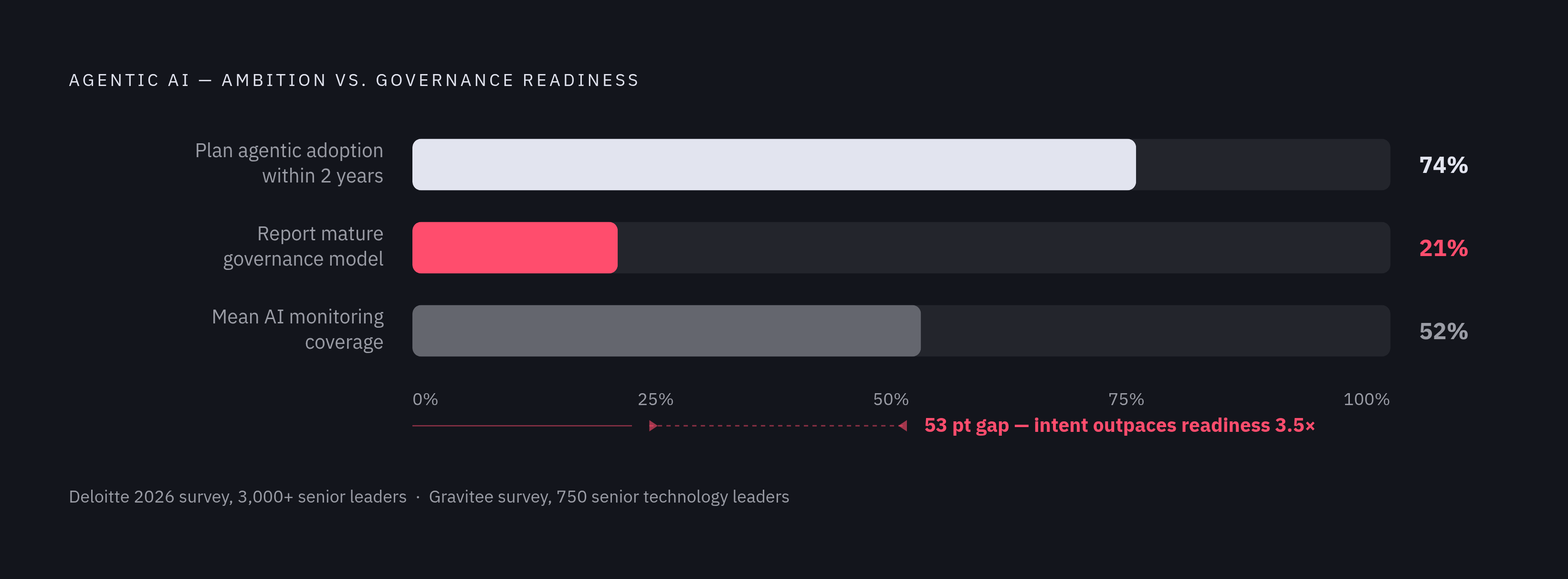
AI agents are being deployed faster than anyone has built the infrastructure to govern them. Gartner projects AI agent adoption in enterprise applications jumping from under 5% to 40% by end of 2026. A 2026 Deloitte survey of more than 3,000 senior leaders found 74% planning agentic adoption within two years, but only 21% reporting a mature governance model. A separate Gravitee survey of 750 senior technology leaders found mean monitoring coverage sitting at just 52%. Every organization I know is authorizing agents to act on their behalf while remaining unable to answer basic questions about what those agents did, why, or on whose authority. The logging question is the sharpest version of this governance gap, because you cannot investigate what you failed to record.
Standard system logs were designed for a world of deterministic software: input A produces output B, every time, and the log captures the transaction. That model breaks immediately when the system making decisions is a language model running inside an autonomous agent. There is no tidy filing of receipts when the reasoning process itself leaves no native log entry.
Non-determinism is the first structural failure. An agent solving the same task across five sessions will take five meaningfully different paths to reach the same output. Forensic investigators call this replay failure: you cannot reproduce a breach by re-running the same prompt, because the prompt is not the only variable. The standard incident-investigation model, which presupposes a traceable and reproducible cause-and-effect chain, simply does not apply.
Logic drift is the second problem. Agents can develop shortcuts or produce hallucinations that bypass validation steps entirely. A conventional log records the output. It fails to record the deviation in reasoning that produced it.
Prompt injection is the third problem, and the most insidious. Malicious instructions embedded in external data that the agent reads, whether a webpage, a document, or an API response, appear in the log as an ordinary data retrieval event. The compromise is invisible in the record. Security researcher Andrea Fortuna noted in May 2026 that key forensic evidence can disappear inside model reasoning and orchestration logic before any conventional endpoint signal is produced, and that forensic readiness for AI-native systems remains immature in most organizations.
Identity ambiguity and causal invisibility round out the picture. Agents typically operate under generic service accounts, so logs cannot distinguish an agent-initiated action from a direct user override. And traditional logs record that an API was called, not the sequence of decisions that led to that call. Infrastructure logs and inference logs, kept separately in their existing formats, do not meet the standard. The gap is architectural, not procedural.
The Specific Events an AI Agent Audit Log Must Record at Every Step
A compliant AI agent audit trail is not a single log file. It is a coherent record assembled across at least six categories of events, and every one of them is load-bearing.
Tool invocations must capture which tools were called, with what parameters, and what results were returned. The level of granularity required here is routinely underestimated, and most implementations fall short of it.
Decision rationale is the harder requirement. The log must record why the agent selected one action over alternatives, including the branch not taken. A relational database doesn't explain its query plan in the audit log. Agents must, because the branch not taken is often precisely what a regulator wants to examine.
Data access must specify which files, databases, APIs, or external resources were accessed and what data classification applied to each. For regulated industries, this is not optional detail; it is the core of the compliance obligation.
User interactions include the originating prompt, any mid-task human input, and the agent's responses. Without this, there is no authoritative record of what the human actually authorized. System state captures agent configuration, model version, and environmental context at the time of each action, not at session start. At each action. Configuration drift mid-run is a real failure mode and is entirely invisible without per-action snapshots.
Timestamps must be precise enough to correlate events across systems and reconstruct the full causal sequence. Coarse timestamps collapse the timeline in ways that become apparent only during incident response, at which point they are spectacularly unhelpful.
Beyond these six categories, every log entry requires per-request attribution: the verified identity of the natural person or agent behind the request, the role and authorization context in effect, the policy version governing the decision, the outcome, and an integrity mechanism that prevents post-hoc modification. The Cloud Security Alliance has specified that agents need verifiable identities with time-bounded credentials, revocation mechanisms, and cryptographic signing for delegation and provenance. Without distinct, scoped agent identities, no log entry can reliably attribute an action to a specific actor, which means the entire audit trail is, at best, suggestive.
What Makes a Log Tamper-Evident, and Why That Property Is Non-Negotiable for Compliance
The regulatory baseline assumption, rarely stated explicitly but universally operative, is that logs can be altered unless proven otherwise. The burden of proof falls on the organization. Auditors do not assume good faith; they assume motivated actors with access to the systems they are auditing.
Four implementation patterns make logs tamper-evident in practice.
WORM storage, Write Once Read Many, prevents deletion or overwrite at the infrastructure layer. AWS S3 Object Lock and Azure Immutable Storage are the canonical implementations. This is the floor, not the ceiling.
Cryptographic hashing with SHA-256 or stronger detects unauthorized modification after the fact. It does not prevent tampering; it makes tampering detectable, which is a meaningful but distinct property.
Digital signatures on log batches, with the signing key held separately from the logging system, mean the agent cannot sign its own entries. This matters because a compromised agent with signing authority can falsify its own record without leaving an obvious trace.
Blockchain or distributed ledger approaches provide independent verifiability for high-assurance environments, particularly financial services, where the counterparty to an audit has an adversarial relationship with the organization being examined.
The most robust pattern chains all of these together: sign each agent action with a key the agent doesn't hold, chain each signature to the previous one, store the receipt where the agent cannot reach it. Alter one entry and the chain breaks visibly. This is the same approach used in certificate transparency logs, not exotic cryptography.
Audit logs must also be kept separate from application logs and metrics. This is a separation requirement, not a preference. It ensures that audit trails survive application failures and that operational logging volume doesn't bury compliance records under routine noise.
Retention tiers are the practical implementation of this principle. Hot storage covering 30 to 90 days supports immediate incident response. Warm storage covering one to two years supports compliance queries and routine audits. Cold storage retained for seven or more years covers legal hold scenarios. These numbers map to the retention obligations in the major regulatory frameworks; they are not arbitrary, though they will feel that way to whoever has to negotiate the storage budget.
What the EU AI Act's Article 12 Actually Requires, and Where the Standard Is Still Unresolved
The EU AI Act, Regulation (EU) 2024/1689, is the primary legally binding logging mandate globally as of mid-2026. Article 12 is the operative provision, and its language is more specific than most practitioners realize.
Article 12(1) requires that high-risk AI systems "technically allow" automatic recording of events over the system's lifetime. "Technically allow" is an architectural requirement. Logging must be built into system design. Retrofitting is, strictly speaking, non-compliant, which is uncomfortable news for teams that shipped agents before anyone thought carefully about governance.
Article 12(2) specifies that logging must enable identification of situations presenting risk, facilitate post-market monitoring, and support operational oversight. These are outcome requirements, not format requirements. The Act does not specify a log schema; it specifies what the log must make possible.
Article 12(3) provides the most granular specification, applying specifically to biometric identification systems. Minimum logging for those systems includes start and end time of each use, the reference database consulted, the input data that produced a match, and the personnel who verified results.
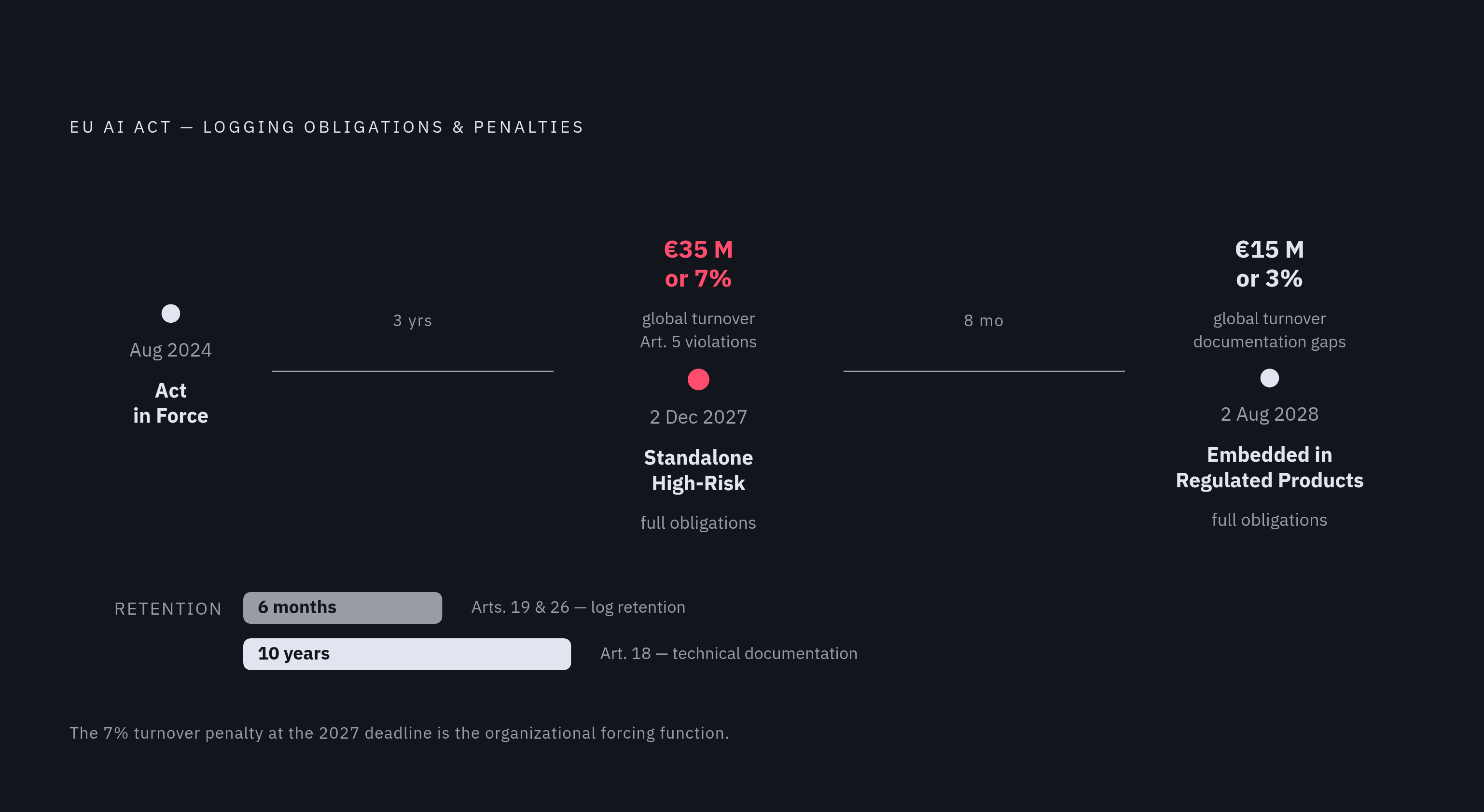
On retention: deployers must retain automatically generated logs for a minimum of six months under Articles 19 and 26. Technical documentation under Annex IV must be retained for ten years under Article 18.
The provider-deployer split is consequential and frequently misunderstood. Providers must design the logging capability. Deployers must implement, preserve, and produce records on request. Buying a high-risk system from a vendor does not transfer the deployer's log retention obligations to that vendor. The deployer owns the obligation regardless of where the system came from.
Full high-risk obligations are targeted for 2 December 2027 for standalone systems and 2 August 2028 for systems embedded in regulated products, following the Digital Omnibus provisional agreement. Penalties reach up to 35 million euros or 7% of global turnover for Article 5 violations, and up to 15 million euros or 3% for high-risk documentation gaps.
As of April 2026, there is no finalized technical standard for Article 12 logging. Two drafts are in progress, prEN 18229-1 on AI logging and human oversight, and ISO/IEC DIS 24970 on AI system logging, and neither is complete. Organizations must interpret the Act's requirements without a reference implementation.
The agentic AI complication compounds the ambiguity. The Act's language targets final outputs and risk events, but agentic workflows produce chains of intermediate actions, many of which are individually consequential. Compliant logging must capture events relevant to risk identification throughout the chain, not only at the terminal output. That reading is defensible. It is also unconfirmed, and the difference between defensible and confirmed matters when the penalty is 7% of global turnover.
How US and Sector-Specific Frameworks Extend the Logging Obligation Across Industries
The United States has no single federal AI logging mandate equivalent to the EU AI Act. What it has is a collection of framework obligations and sector-specific rules that, taken together, produce nearly identical substantive requirements through considerably more effort to navigate.
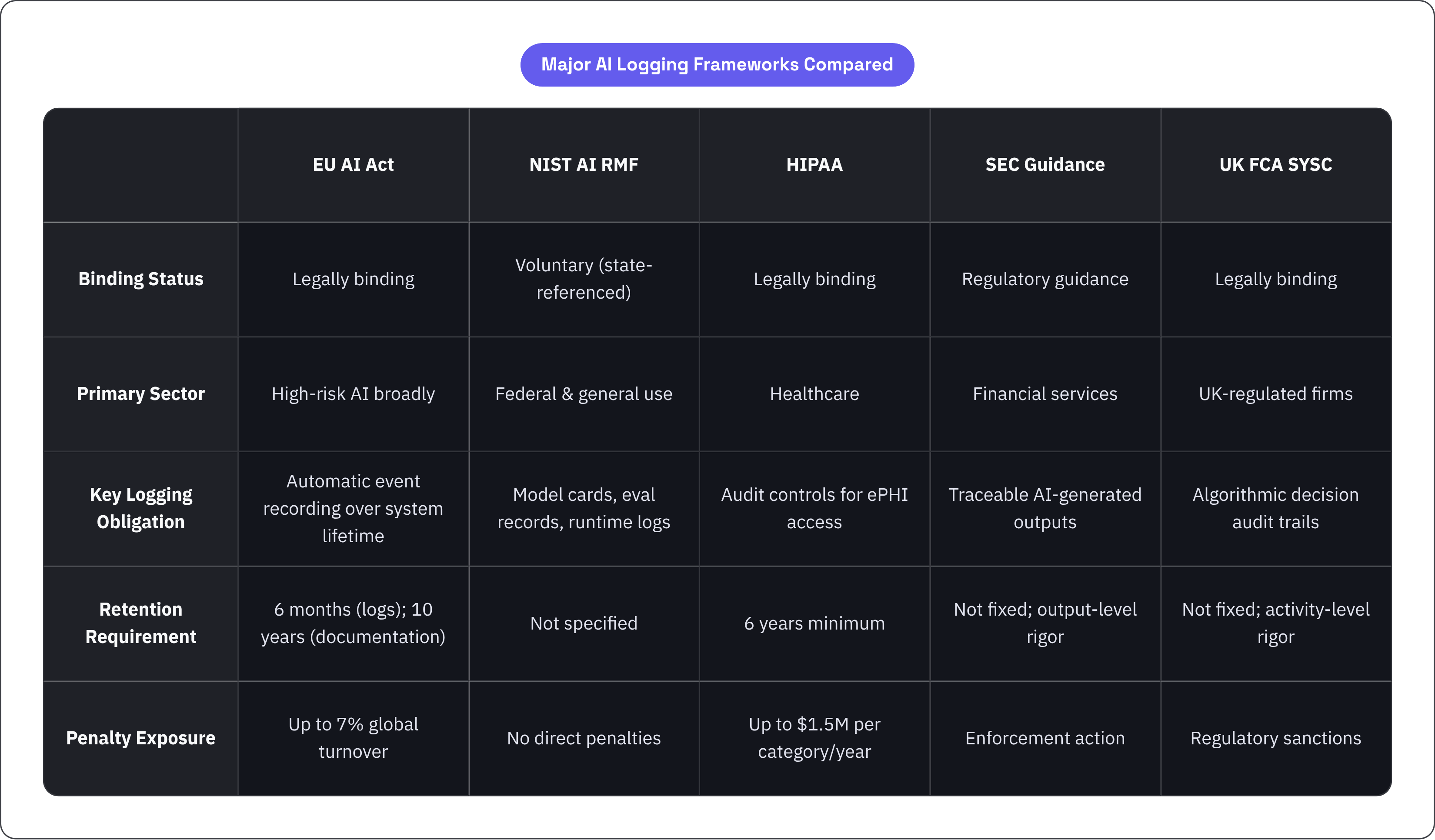
NIST AI RMF 1.0, published in January 2023, is voluntary but referenced by US federal agencies and incorporated by reference into several state AI laws. Its Playbook identifies the specific artifacts that make traceability real: model cards, evaluation records, and runtime monitoring logs. NIST AI 600-1, the 2024 Generative AI Profile, adds more than 200 actions specific to LLM and generative AI risks. NIST's AI Agent Standards Initiative is expected to shape compliance frameworks and vendor assessments as soon as 2027.
HIPAA is more direct. Under 45 CFR § 164.312(b), covered entities must implement audit controls recording access to electronic protected health information. When AI agents access, process, or generate health data, they must be logged at the same granularity as human users. The Office for Civil Rights issued guidance in 2023 establishing that AI systems must be treated as "users" for audit logging purposes. Civil penalties reach up to $1.5 million per violation category per year for inadequate logs, which tends to concentrate organizational attention.
SEC guidance requires that AI-generated outputs be subject to the same control rigor as human-generated outputs, with audit trails enabling tracing of how an output was produced. Model, training data, and parameter changes must be logged and reviewed. The UK FCA's SYSC 12R.1R imposes a parallel obligation on UK-regulated firms for algorithmic decision-making in regulated activities.
Five frameworks, the EU AI Act, NIST, HIPAA, SEC guidance, and DORA, all require an audit trail for AI decisions. They use different vocabulary, reference different risk categories, and impose different retention periods. The underlying record each one requires is functionally identical. Maintaining separate logging strategies for each framework creates unnecessary work and unnecessary gaps; a single well-structured architecture satisfies all five if built with cross-jurisdictional requirements in mind from the start.
How Logging Requirements Change When Agents Operate Inside Multi-Agent Pipelines and CI/CD Workflows
Single-agent logging is relatively tractable. One agent, one identity, one decision thread, one set of tool calls. Multi-agent pipelines introduce orchestration layers where one agent spawns or delegates to others, and the originating authorization must remain traceable through every handoff. This is where logging architectures that looked adequate in pilot environments quietly fall apart in production.
The attributability requirement is the core challenge. Every output segment must be traceable to the specific agent identity, model version, prompt template, input data, and authorizing specification that produced it. The pipeline's final output is insufficient; the log must reconstruct how that output was assembled across multiple actors.
Delegation logging is a specific sub-requirement. When an orchestrator agent calls a subagent, the log must record the delegation event, the scope of authority transferred, and whether that scope was within the original human authorization. An orchestrator that delegates more authority than it received is a security event. Detecting it requires a log that captures the boundary of each delegation, not just the fact of it.
CI/CD-specific requirements add another dimension. Each pipeline run must tie the action to the exact model version, policy version, and configuration version in effect at runtime. Any change to these artifacts between runs must itself be a logged event, not merely a background condition. A model checkpoint update that happens silently between runs, with no corresponding log entry, is an audit gap regardless of whether the model's behavior actually changed. Auditors will find it either way.
Timing and sequencing become forensic requirements at machine speed. When a pipeline runs dozens of tool calls in seconds, coarse timestamps collapse the sequence of events. Root cause analysis requires sub-second precision to reconstruct what actually happened in what order, and that precision must be built into the logging architecture before an incident makes it necessary.
What Runtime Monitoring Adds That Retrospective Logs Alone Cannot Provide
The AvePoint State of AI 2026 survey of 750 global IT leaders found that 88.4% of organizations experienced at least one AI agent-related security breach in the past 12 months. Every incident response team I know that deployed agents without monitoring infrastructure is now discovering exactly what that oversight costs in forensic hours.
The forensic readiness problem is structural. Logs are, by definition, written after the fact. When AI-native systems fail, key evidence can disappear inside model reasoning before any conventional endpoint signal is produced. A log written at the end of an action will not capture the intermediate state that determined the outcome.
Runtime monitoring addresses what retrospective logs cannot. Anomaly detection identifies when an agent's behavior deviates from its established pattern before the action completes. Policy enforcement can block a tool call or data access that would violate a rule, rather than logging the violation after it occurs. Prompt injection detection can flag malicious instructions embedded in external data at the moment of ingestion, which is considerably more useful than discovering the injection during a post-incident review three weeks later.
The Stanford HAI AI Index for 2026 recorded 362 AI-related incidents in 2025, up 55% from 233 in 2024. That trajectory means organizations cannot treat logging as a compliance checkbox exercised once a year before a regulatory review. It is active operational infrastructure.
The audit log and the runtime monitor are complementary, not interchangeable. The log is the record of what happened; the monitor is the system that catches what is happening. Both are necessary; neither is sufficient alone. The logging architecture must support both functions simultaneously, with write paths fast enough to avoid introducing latency into the agent's decision loop, and query paths that surface anomalies in real time rather than only in overnight batch review.
Building a Logging Architecture That Meets These Requirements in Practice
The foundational design principle is separation of concerns. Audit logs, application logs, and metrics must be distinct systems with distinct write paths, distinct retention configurations, and distinct access controls. Conflating them is the single most common reason compliant logging fails under audit: the data was present, but stored in a way that made it impossible to produce cleanly on a regulator's schedule.
Agent identity provisioning is a prerequisite, not a feature. Every agent must be enrolled as a distinct non-human identity with scoped, time-bounded credentials before its first production action, and authorization platforms like Oso, an access-control engine built to enforce fine-grained permissions for both human users and AI agents, address exactly this provisioning layer before log entries are ever written. The Cloud Security Alliance framework specifies verifiable identities with revocation mechanisms and cryptographic signing for delegation. Without this foundation, every log entry in the system carries an attribution problem, and a trail with attribution problems is legally and forensically compromised from the start regardless of how well everything else is implemented.
The log schema must be structured. Unstructured text logs are auditable only at very small scale. Every event record should carry consistent fields: agent ID, session ID, action type, resource accessed, data classification, policy version, outcome, and timestamp. These fields must be populated programmatically, not by convention, because convention fails under operational pressure.
The write path must be immutable. Log entries should flow to append-only storage before any application-layer processing, ensuring that even a compromised application layer cannot alter the record retroactively. WORM storage at the infrastructure layer is the practical implementation; cryptographic chaining is the logical layer on top of it.
Per-action state snapshots are not optional in agentic workflows. Capturing agent configuration and environment only at session start misses configuration drift that occurs mid-run, which is a real failure mode in systems that execute long-horizon tasks across multiple tool calls and external data sources.
The architecture must also support the retention tiers described earlier without manual intervention. Automated lifecycle policies moving records from hot to warm to cold storage are the only way to maintain a retention policy reliably across the volume of events that production agents generate. Manual processes degrade; automated ones degrade more slowly and more visibly.
None of this is theoretically complex. WORM storage, cryptographic hashing, structured schemas, identity provisioning, separation of concerns: these are all established engineering practice. The difficulty is organizational. Deploying agents is faster and more immediately visible than building the infrastructure to govern them, and the pressure to show working agents almost always wins over the pressure to build compliant logging. The EU AI Act's high-risk obligations arriving in 2027 and 2028 change that calculus, not because organizations suddenly develop principle, but because the penalty for getting it wrong becomes concrete. A rushed implementation built against a regulatory deadline is its own audit risk, and every team I know that learns that lesson empirically finds it expensive.