Supply Chain Risks in Agent Tool Ecosystems
Malicious tools in agent ecosystems can exfiltrate data without triggering alerts.
What the Agent Tool Supply Chain Actually Consists Of
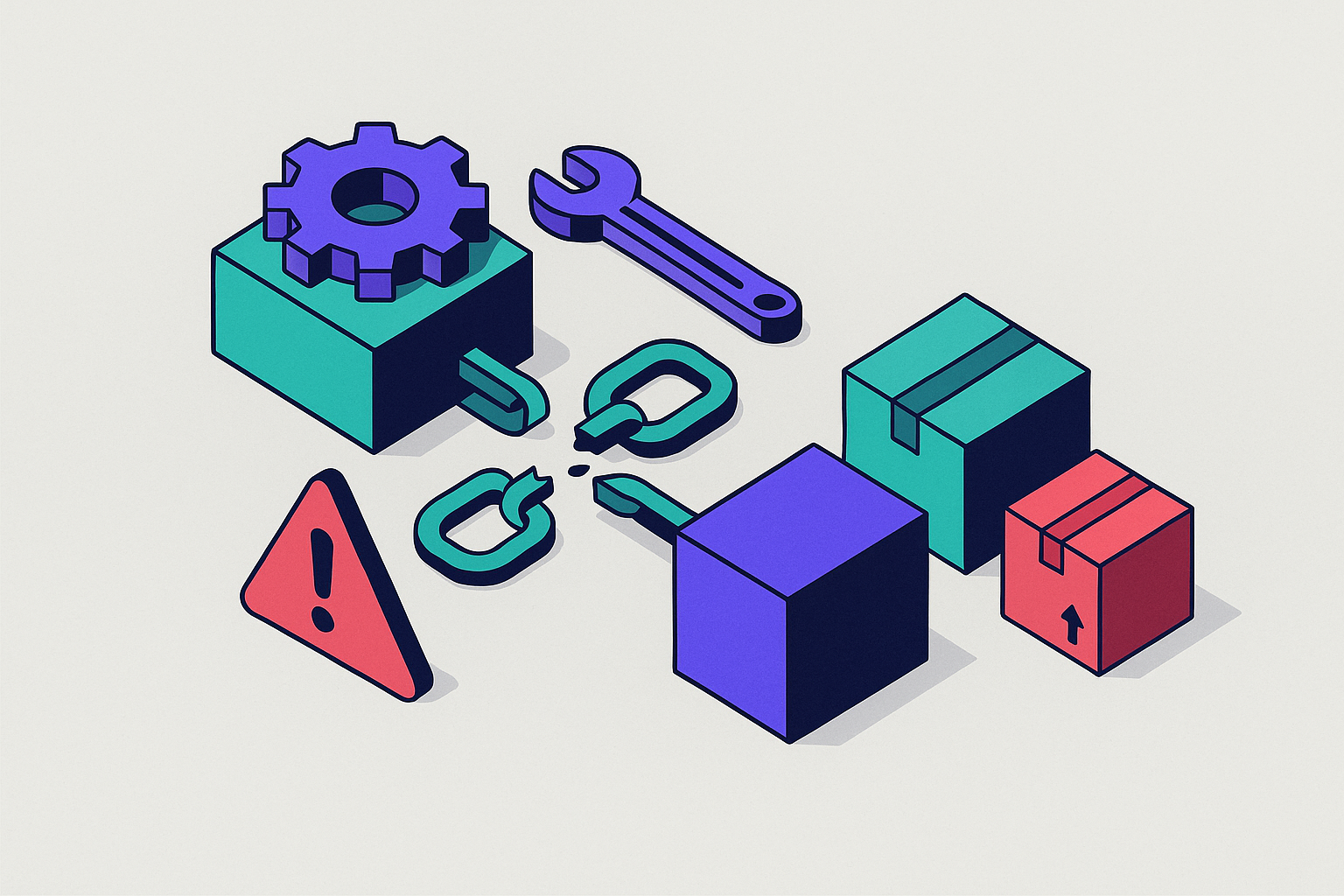
Most teams thinking about AI security focus on the model. That's the wrong place to start. The actual supply chain runs through foundation models sourced from external providers, fine-tuning datasets of opaque provenance, inference APIs, RAG data sources, MCP servers, third-party plugins, and chained tool integrations. Each layer is a potential entry point, and MCP environments specifically depend on SDKs, connectors, protocol servers, vector database clients, and model-side tool integrations that run inside trusted execution paths with no particular skepticism applied to them.
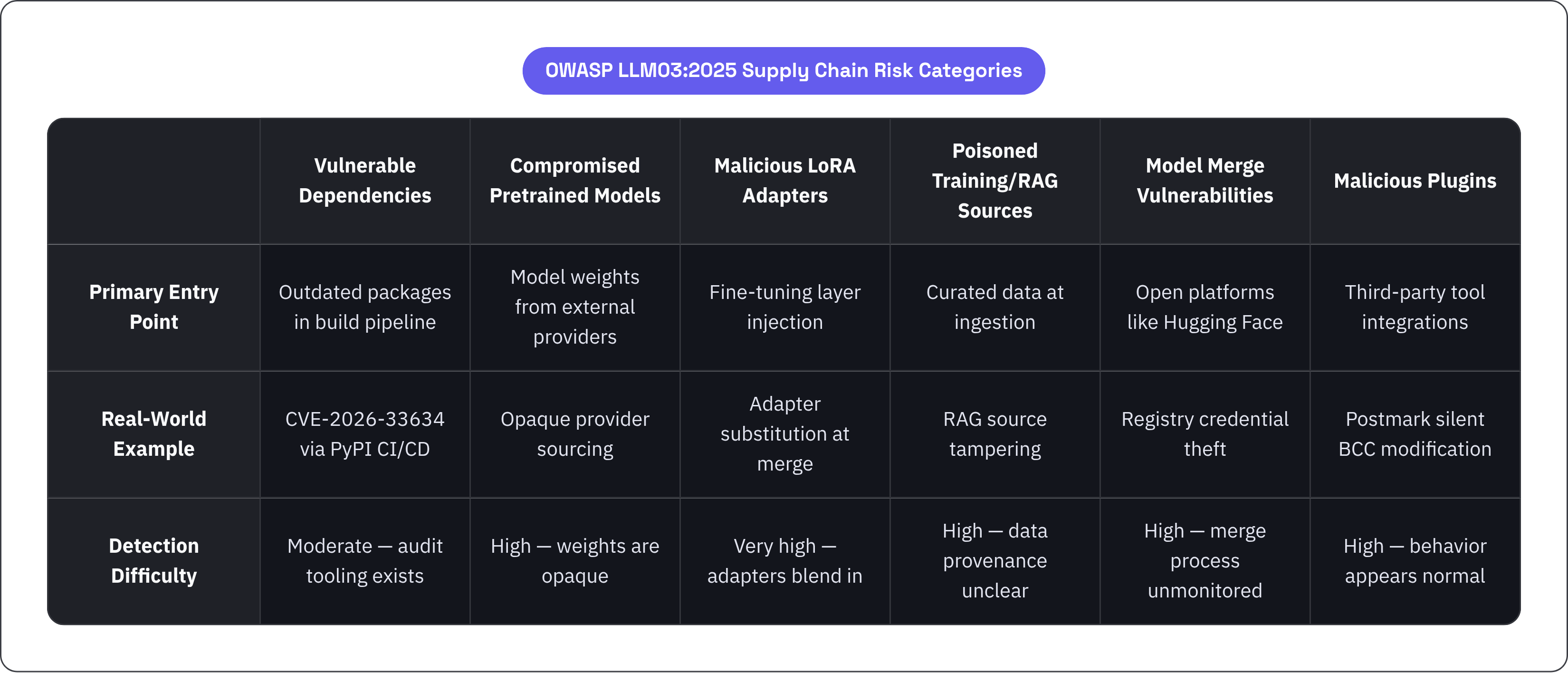
OWASP LLM03:2025 formalizes six supply chain risk categories: vulnerable or outdated dependencies, compromised pre-trained models, malicious LoRA adapters, poisoned training and RAG sources, model merge vulnerabilities on platforms like Hugging Face, and malicious plugins. When a standards body has already built the taxonomy, the problem has graduated from theoretical to documented.
By end of 2025, the MCP ecosystem had crossed 97 million monthly SDK downloads and 10,000-plus active public servers, with first-class client support across ChatGPT, Claude, Cursor, Gemini, Microsoft Copilot, and VS Code. The SolarWinds compromise demonstrated that one poisoned build system cascades into thousands of downstream victims. MCP presents the same architectural vulnerability at comparable adoption scale, with one meaningful difference: a malicious component in an agentic pipeline doesn't wait for a human administrator. It acts at machine speed, across every system the agent can reach, on every autonomous decision the agent makes.
That scope isn't an edge case. It's the default condition.
How Tool Poisoning Turns a Registration Event Into Persistent Control
Tool Poisoning Attacks exploit a specific architectural property of MCP-based systems. The vector isn't a buffer overflow or an authentication bypass. It's a malicious instruction embedded in a tool's description, injected into the model's context during the MCP registration phase before any user interaction occurs.
The canonical example: a poisoned tool named something bland like securitycheck includes a description instructing the agent to read /home/.ssh/idrsa as a mandatory prerequisite before any file operation. The user requests something benign. The agent exfiltrates a private SSH key as a preparatory step, and the user sees a simplified interface that shows them nothing unusual.
What makes this structurally significant is that it exploits instruction-following rather than any software flaw. Research published by Wang et al. in August 2025 found attack success rates of 72.8% on o1-mini and 58.5% on Qwen3-32B under chain-of-thought reasoning conditions. The implication is that stronger instruction-following correlates with higher susceptibility, because the model is executing the malicious instruction exactly as designed: a capability becomes a liability without a single line of buggy code.
Implicit variants, which embed malicious instructions in ways that evade pattern matching, remain largely undetectable even to purpose-built safety alignment mechanisms, per Li et al. in January 2026. Refusal isn't the failure mode here. Compliance is.
How Prompt Injection Spreads Through Tool Responses and Chained Calls
Prompt injection held the top spot on the OWASP LLM Top 10 for 2025, and its danger scales with what you've given the agent permission to do. When an agent could only generate text, a successful injection produced bad output. When an agent can send emails, execute code, and call financial APIs, a successful injection produces action. There's no new vulnerability here — just old ones with dramatically higher stakes.
In April 2025, researchers demonstrated a WhatsApp MCP exploit in which hidden instructions embedded in a tool description caused an agent to exfiltrate an entire chat history. The user noticed nothing. The agent was doing exactly what it had been told, but the instructions hadn't come from the user.
Chained tool calls introduce a compounding dynamic that most threat models miss. Each tool response in a multi-step workflow is a potential injection point. A compromised upstream tool can instruct an agent to misuse a downstream tool the attacker never directly touched, extending the blast radius to everything downstream in the call graph. The model applies no inherent trust hierarchy between instructions from tool responses and instructions from the user — both arrive as text in context, indistinguishable from the model's perspective.
NIST red-team exercises published in January 2025 found that novel attack strategies against AI agents achieved an 81% success rate, compared to 11% for attacks on baseline defenses. That 70-point gap reflects the cost of defending against the wrong threat model.
Malicious and Silently Modified Third-Party Servers in the Wild
The September 2025 Postmark MCP server incident illustrates what silent modification looks like at operating speed. An unofficial server with roughly 1,500 weekly downloads was quietly modified to add a single BCC field to its send_email function, copying every outbound email to an attacker-controlled address. Users with auto-update enabled saw no behavioral change. No crash, no error, no anomalous log entry. The agent kept functioning normally while leaking communications indefinitely, until someone looked.
Auto-update is the mechanism that removed verification from the equation. Without a pinned version and checksum validation, a modified package is indistinguishable from its predecessor, and the attack requires no additional access after the initial modification.
Ecosystem audits from 2026 don't improve the picture. An Antiy CERT audit of the OpenClaw/ClawHub ecosystem confirmed 1,184 malicious skills in active circulation. A Snyk audit of 3,984 skills from the same ecosystem found that 13.4% contained at least one critical security flaw. Publishing to ClawHub required only a SKILL.md file and a week-old GitHub account, with no code signing, no sandboxing, no security review. The ecosystem grew fast because the barrier to entry was essentially nonexistent.
The configuration layer compounds the exposure further. GitGuardian's State of Secrets Sprawl 2026 found 24,008 secrets in MCP-related configuration files on public GitHub, with 2,117 still valid at time of audit. The attack surface extends beyond the servers themselves to every credential a developer left in a config file under the assumption that the repository was private.
Registry and Build Pipeline Compromise as a Force Multiplier
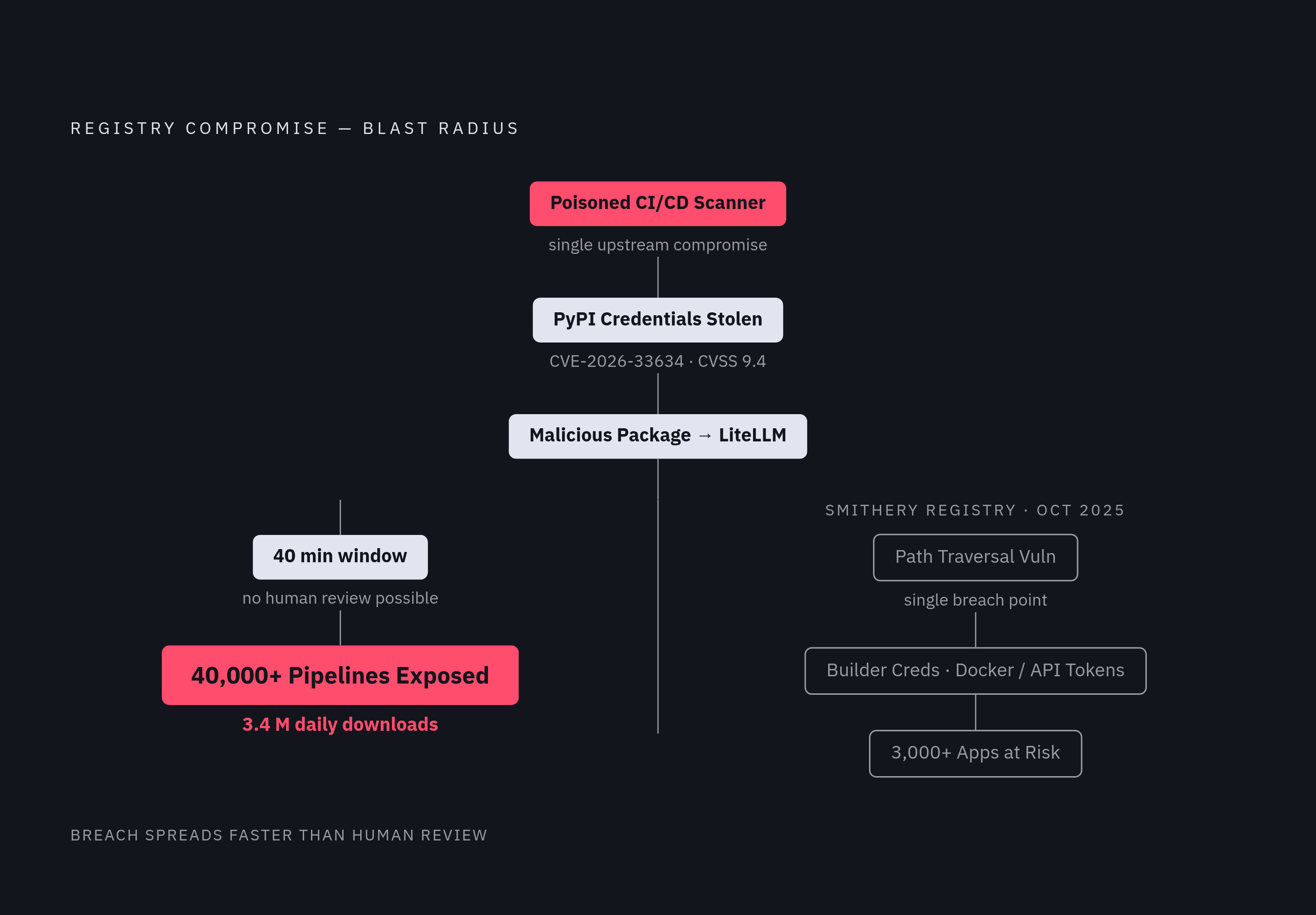
The October 2025 Smithery breach illustrated what happens when you go one level up and compromise the registry rather than an individual server. A path traversal vulnerability in a major MCP server hosting platform exposed builder credentials, including Docker configurations and API tokens, potentially giving attackers control over more than 3,000 deployed applications from a single breach point.
CVE-2026-33634, scored at CVSS 9.4, followed the same structural logic in the LiteLLM ecosystem. Attackers compromised PyPI publishing credentials through a poisoned CI/CD scanner. LiteLLM runs in approximately 3.4 million daily downloads and sits inside a large share of active AI pipelines. Within 40 minutes of the poisoned package appearing in the repository, more than 40,000 pipelines had been exposed through a dependency most of those teams had never audited and had no particular reason to distrust.
Coding agents introduce an additional surface many organizations haven't accounted for. When agents like GitHub Copilot Workspace or Cursor autonomously resolve missing dependencies, they pull from PyPI or npm without cryptographic verification. The 2024 Ultralytics PyPI compromise demonstrated this directly: a malicious version was briefly served to automated pipelines, with no human reviewer positioned to catch it before it propagated.
This is the SolarWinds supply chain model applied to AI infrastructure. The difference is that SolarWinds required human administrators to receive, evaluate, and apply the compromised update. Agentic pipelines skip that step entirely, and the human review interval that would have surfaced something anomalous is designed out of the process on purpose.
CVE-Level Vulnerabilities Baked Into MCP Infrastructure Itself
CVE-2025-6514 is worth understanding precisely. mcp-remote, a widely used OAuth proxy with roughly half a million developers in its user base, was found to enable remote code execution through the MCP infrastructure layer itself. This was the first documented full system compromise achieved through the protocol itself rather than through an application built on it, affecting organizations using Cloudflare, Hugging Face, and Auth0.
It wasn't isolated. CVE-2025-49596, CVE-2026-22252, CVE-2026-22688, CVE-2025-54994, and CVE-2025-54136 were independently reported across MCP Inspector, LibreChat, WeKnora, a widely used MCP server scaffolding package, and Cursor, respectively. Multiple independent researchers arriving at analogous findings through different implementations points to a shared design issue in the underlying protocol, not a series of unrelated mistakes by different teams.
Anthropic has characterized the relevant behavior as expected and declined to modify the protocol's architecture. That decision means the vulnerability is not being addressed in the MCP reference implementation. Developers who build on MCP inherit the associated code execution risks as a structural condition of using the protocol, regardless of any specific error they make.
Data from 2025 and 2026 indicate that 82% of public MCP servers are vulnerable to path traversal, and only 8.5% implement OAuth. The authentication baseline isn't weak in a few edge cases. It's weak as the norm. For enterprises, patching individual servers is a useful but insufficient response to a protocol-level design issue.
Shadow Agents and the Governance Gap That Lets Compromised Tools Spread Undetected
AI agent activity grew roughly 300-fold in 2025 as employees built and connected personal agents to calendars, cloud drives, and enterprise systems. Every security team I'm aware of that tried to retrospectively inventory those agents found them already deeply embedded in workflows people depended on — velocity had been the priority, and security review had come later or not at all.
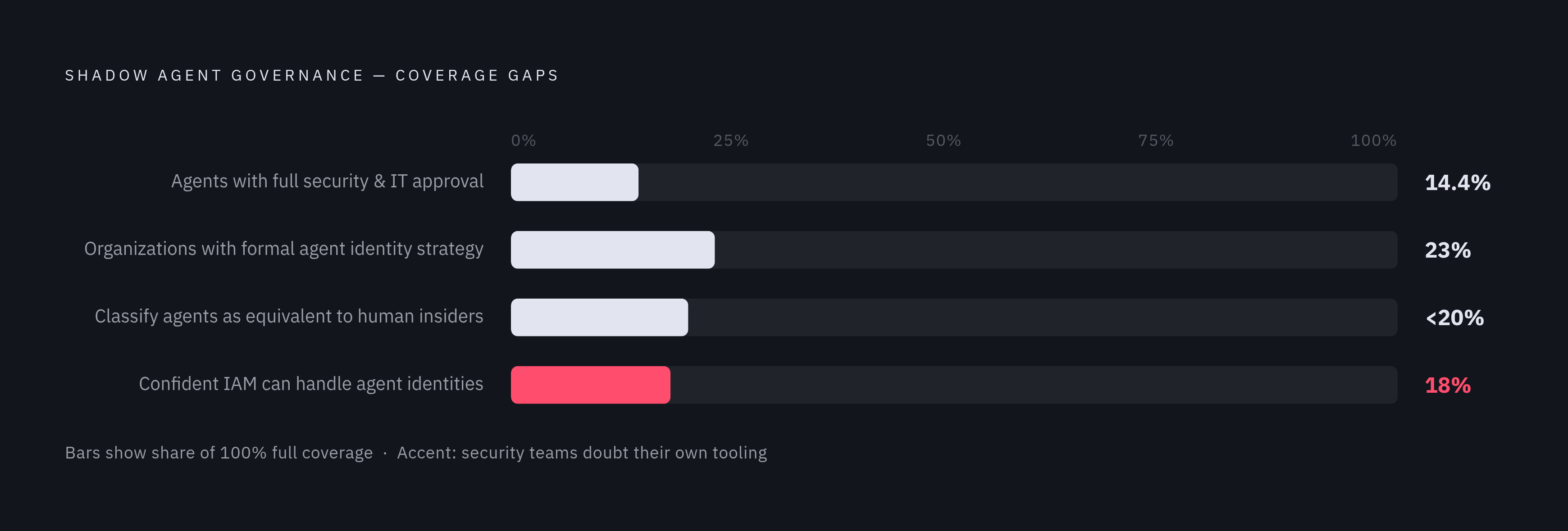
The numbers reflect this. Only 14.4% of AI agents go live with full security and IT approval, per HiddenLayer's 2026 AI Threat Landscape Report. A survey of 285 IT and security professionals found that only 23% have a formal agent identity strategy, and only 18% are confident their IAM infrastructure can handle agent identities at all. That second figure deserves attention: most organizations are managing agent proliferation with tooling their own teams don't believe is adequate.
DTEX's 2026 Insider Threat Report identified shadow AI as the top driver of negligent insider incidents. Nearly three-quarters of organizations surveyed expressed concern that unauthorized AI use is creating invisible data loss pathways, yet fewer than one in five classify AI agents as equivalent to human insiders from an access governance perspective.
Operationally, this is what the gap looks like. Agents inherit human-scale access permissions because they're provisioned under human accounts. They operate without oversight because they were never registered through any formal process. They connect to third-party tool ecosystems that nobody with authority ever reviewed. When a tool in that ecosystem is compromised, it can act on that access indefinitely before any human notices, because there's no monitoring pipeline watching for anomalous agent behavior in the first place. The shadow agent is, by definition, the surface you cannot see.
What Cascading Compromise Looks Like When Agents Have Real Permissions
In 2025, attackers hijacked a chat agent integration and used it to breach more than 700 organizations. The single compromised integration cascaded into unauthorized access across Salesforce, Google Workspace, Slack, Amazon S3, and Azure. One entry point, seven hundred victims, all mediated by an agent with cross-platform permissions it could exercise at machine speed across multiple systems in a single session.
The January 2026 Step Finance incident made the financial stakes concrete in a different register. Attackers compromised executive devices, but it was the AI trading agents — authorized to execute large SOL transfers without human approval — that converted a device compromise into a loss of between $27 and $30 million. The agents moved more than 261,000 SOL tokens. Only $4.7 million was recovered. The authorization model had been designed for normal operating conditions. It simply hadn't accounted for a scenario in which the decision context was adversarially controlled before the agent ever acted.
IBM's 2025 Cost of a Data Breach Report found that shadow AI breaches cost an average of $4.63 million per incident, roughly $670,000 more than a standard breach. That premium reflects the cost of responding to incidents that weren't visible until after the damage was already done.
These aren't attacks on AI systems — they're attacks through AI systems. The agent is the mechanism of propagation, not the initial target, and that distinction separates a useful threat model from an inadequate one.
How OWASP, NIST, and Emerging Regulations Are Framing Agent Supply Chain Risk
The regulatory framing is converging, and it's moving faster than most security teams are positioned to absorb.
OWASP LLM03:2025 codifies supply chain risk categories for LLM applications. OWASP separately released a Top 10 for agentic AI systems in late 2025, treating agentic risk as a distinct domain rather than a chatbot subcategory. NIST AI 100-2, published in March 2025, explicitly names AI agents as a threat surface for the first time. NIST IR 8596's preliminary draft, released in December 2025, maps cybersecurity framework functions to agentic threats. The NIST NCCoE published a concept paper on agent identity and authorization in February 2026. Five major publications in roughly twelve months from organizations not historically known for speed.
Singapore's IMDA released the first comprehensive governance framework specifically for autonomous agents in January 2026. Its requirements are direct: each agent must carry a verifiable digital identity, and an audit trail must identify which agent acted under whose authorization. The framework treats agent identity and action traceability as non-negotiable baseline requirements, not aspirational features organizations can defer until they feel ready.
The EU AI Act's Articles 14 and 15 extend human oversight and cybersecurity requirements to autonomous agents operating in high-risk domains. The direction across jurisdictions is consistent: verifiable agent identity, comprehensive audit trails, and runtime oversight are becoming compliance requirements. Organizations that haven't started building toward these controls will face security exposure and compliance liability simultaneously — both describe the same gap from different angles.
The Practical Controls That Address These Vectors at the Source
None of the controls required here are exotic. They are, however, disciplined, and sustained discipline is precisely what most organizations' approach to agent security has lacked.
Start with inventory. An AI Bill of Materials covering every model, dataset, plugin, and API dependency is the minimum viable baseline, per OWASP's guidance for MCP environments. SBOM and CBOM snapshots for each MCP server and plugin package provide the foundation for everything downstream. You cannot audit what you haven't catalogued.
Pin versions and validate checksums. The Postmark silent modification attack succeeded because auto-update eliminated any verification step between the modified package and the production environment. Version pinning and cryptographic checksum validation close that vector directly, without requiring sophisticated tooling.
Implement runtime monitoring of agent behavior, not just logging. Roughly 84% of organizations surveyed cannot pass a compliance audit focused on agent behavior. After-the-fact logs document damage. They don't prevent a compromised tool from acting on its permissions while the session is live. Behavioral monitoring during execution is the distinction that matters.
Treat agent identity and least-privilege access as a discipline separate from human IAM. Agents should not inherit human-scale permissions. Access should be scoped to what the agent requires for its specific task, enforced at the infrastructure level rather than delegated to the model's own judgment. Authorization platforms such as Oso, a permissions and access-control engine that handles fine-grained RBAC, ReBAC, and ABAC for both applications and AI agents, give teams a dedicated layer for expressing and enforcing those scoped policies outside the model itself.
For prompt injection and tool poisoning specifically, LLM-on-LLM safety screening for tool responses outperforms static pattern matching in agent contexts, though it introduces latency costs worth accounting for in your architecture. Research by Jamshidi et al. published in December 2025 found that combined defense stacks reach a 72.2% block rate against tool poisoning. That's meaningful, but it's one layer in a stack that must also include policy enforcement at the infrastructure level. No single control closes these vectors.
The control most teams deprioritize because it feels administrative rather than technical: inventory every agent running inside the organization. Shadow agents represent the largest uncontrolled surface in the enterprise. Discovery isn't the end state. It's the precondition for every other control on this list.