AI Governance and Risk Management Fundamentals
Most AI governance exists only on paper, leaving organizations exposed to rapidly expanding risks.

AI governance is one of those disciplines where the theory is elegant, the documentation is voluminous, and the actual implementation is, to be charitable, sparse. Eighty-eight percent of organizations reported using AI in at least one business function in 2025, yet only 8% maintain a comprehensive AI governance framework globally, dropping to 2% among small firms. That is not a lagging indicator. It is an active risk condition running in production right now.
What AI governance actually needs to cover
There is no universally agreed definition of AI governance, but serious frameworks converge on the same functional terrain regardless of terminology. Any governance program worth the paper it is printed on must address: risk identification and classification across the AI lifecycle; access and permissions governing what systems can touch, read, and act on; transparency and explainability of model behavior; monitoring and incident detection at runtime, not merely at deployment; audit trails capturing who or what did what, when, and under what authorization; bias and fairness evaluation for consequential decisions; and third-party and supply chain risk from vendor models and external APIs.
The NIST AI Risk Management Framework organizes this into four functions: GOVERN, MAP, MEASURE, and MANAGE. GOVERN applies across all lifecycle stages; the other three operate at specific stages and system contexts. It is a structurally sound model, and it is entirely voluntary, with no enforcement mechanism attached to it.
ISO/IEC 42001:2023 offers a plan-do-check-act management system built around 38 controls. It provides the operational "how to run and evidence it" layer that legal instruments like the EU AI Act define in principle but leave unspecified in practice. One critical caveat: ISO 42001 certification does not equal EU AI Act compliance. They are different instruments occupying overlapping terrain, and conflating them is a mistake every compliance team I have spoken with has made at least once.
The MIT AI Risk Repository, updated in April 2025, now catalogs 1,612 classified risks, including a new subdomain specifically addressing multi-agent risks. That addition is a signal. The risk surface is expanding faster than most governance checklists acknowledge, and the checklists themselves are often still catching up to risks from two generations of AI systems ago.
The regulatory pressure organizations are now governing under
Eighty-six percent of governance, risk, and compliance professionals report awareness of upcoming AI regulations, yet most efforts remain concentrated on policy drafting rather than execution. Awareness is nearly universal; readiness is not. That asymmetry is worth naming directly, because it is easy to mistake the former for the latter.
The EU AI Act is the most consequential binding framework currently in force. It establishes four risk tiers: banned applications (effective February 2025); high-risk systems; limited-risk systems; and minimal-risk systems. High-risk applications, spanning healthcare, employment, education, and law enforcement, face strict obligations under Articles 9 through 15, covering risk management, transparency, and monitoring. Most provisions carry a main compliance date of August 2, 2026. Biometric, critical infrastructure, education, employment, and migration categories follow in August 2027. Penalties for Article 5 violations reach €35 million or 7% of global annual turnover, whichever is higher. The Act also carries extraterritorial scope, applying to any organization placing AI systems on the EU market or affecting EU users, regardless of where the organization is headquartered.
The regulatory landscape beyond the EU is fragmenting rather than converging. South Korea enacted its AI Basic Act. Japan passed its AI Promotion Bill in February 2025. China published AI Safety Governance Framework 2.0 with structured risk categorization. The United States, under Executive Order 14179, has taken a notably different posture, emphasizing the removal of barriers to AI development. The OECD AI Principles, adopted by more than 46 countries, provide a soft-law baseline, but soft law is, by definition, soft. Stanford's AI Index reported that regulatory activity in the U.S. alone has more than doubled, even absent a federal AI statute; sectoral and state-level requirements are accumulating regardless.
For global organizations, compliance is not a single target. It is a portfolio of overlapping, sometimes conflicting obligations. Every multinational I have encountered treating it as a single project to complete has been surprised by this repeatedly.
Where governance programs stall: the documentation trap
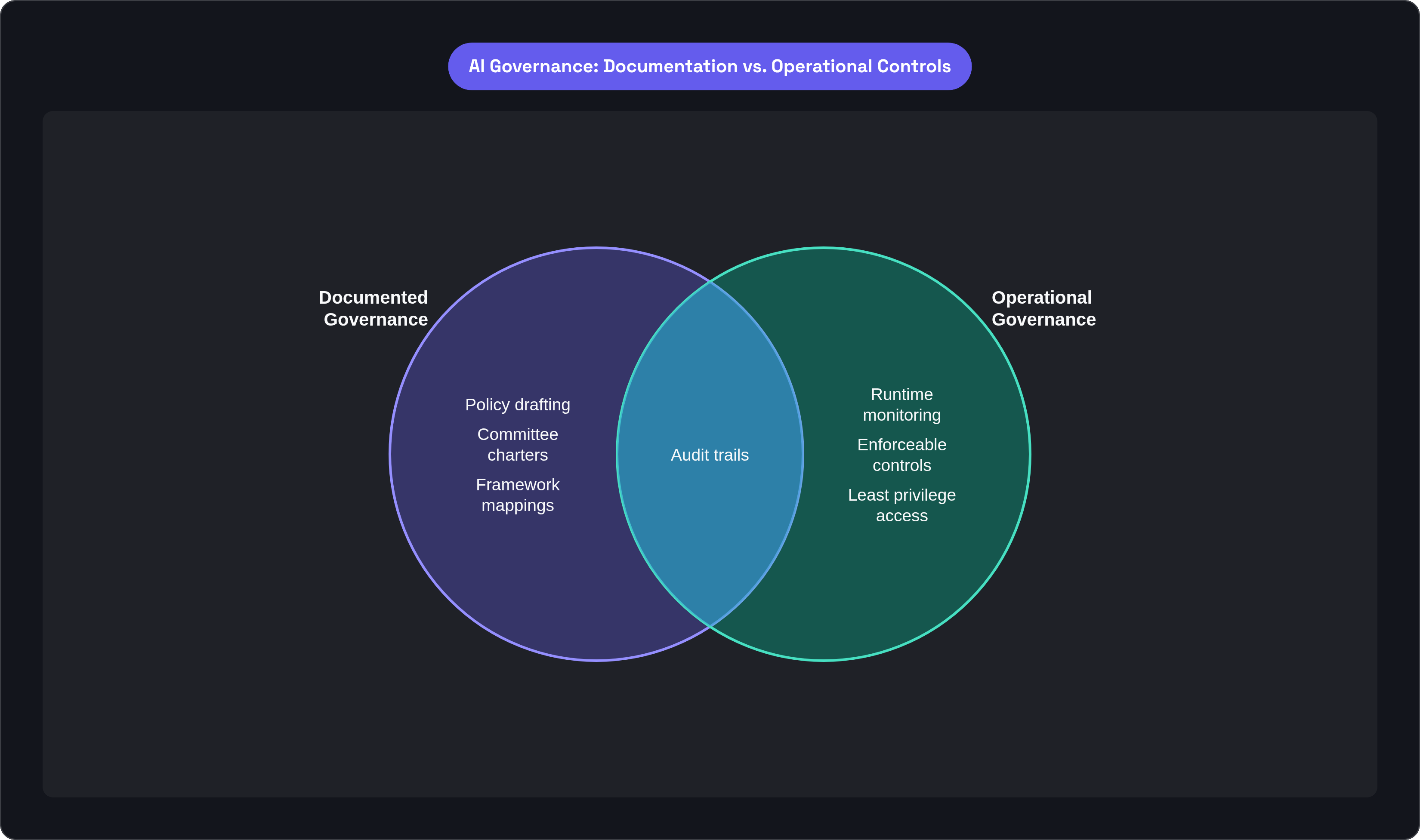
Only 25% of organizations have fully implemented AI governance programs, despite widespread awareness of AI risks, according to AuditBoard's survey of more than 400 GRC professionals. The other 75% are not ignoring governance. They are producing its artifacts: policies, risk registers, committee charters, framework mappings. The documentation is happening. The controls are not.
Several structural dynamics explain why. Policies are typically written by legal, compliance, or strategy teams who do not control production systems. There is no enforcement layer connecting the written rule to the running system. AI systems are frequently deployed through shadow channels, purchased by business units, embedded in SaaS tools, and integrated by individual contributors, outside the governance process entirely. Forty-two percent of organizations lack policies to govern employee use of AI at all, which means the starting condition for many organizations is not "governance exists but is incomplete." It is "governance was never extended to cover what people are actually doing."
Only 12% of organizations report feeling very prepared to assess, manage, and recover from AI governance risks; 75% lack dedicated plans to address generative AI risks specifically. Fifty-five percent of organizations report having an AI board or dedicated oversight committee, according to Gartner's 2025 poll of more than 1,800 executive leaders. A committee is another documentation-layer artifact. It is evidence that a meeting occurred, not that a control was implemented.
The documentation trap is self-reinforcing by design. Audits check for policies. Policies exist. Nothing surfaces the execution gap until an incident does.
What the risk looks like when execution fails
AI incidents increased by 56.4% in a single year, with 233 reported cases in 2024 spanning data breaches, algorithmic failures, and sensitive information exposure, according to the Stanford AI Index. That is not a projection. It is an observed trend from the immediate past.
Thirteen percent of organizations reported breaches involving AI models or applications in the IBM Cost of a Data Breach report. Among those organizations, 97% had no proper AI access controls in place. That near-universal absence of access controls among breached organizations is the clearest empirical evidence of the execution gap available. It is a governance implementation failure, not a governance design failure.
Consider what failure looks like in a concrete case. A federal judge allowed a nationwide class action to proceed against Workday in May 2025, alleging AI-powered screening tools disproportionately filtered out applicants over 40. Immediate rejections occurring during non-business hours suggested automated decisions with no human review, precisely the scenario governance frameworks are designed to prevent and rarely enforce. This is not a hypothetical risk profile. It is an active litigation.
A bias study published in Nature, cited in Stanford's October 2025 reporting, found that AI-generated resumes for hypothetical female candidates were consistently portrayed as younger and less experienced than male counterparts, with identical qualifications rated higher for older men. The risk here is embedded in model behavior, not merely in deployment decisions. That distinction matters because it points toward the need for ongoing monitoring rather than pre-deployment review.
The cybersecurity dimension compounds this. AI accelerates the speed and scale of adversarial attacks, increases the operational complexity of failures, and amplifies third-party dependencies in ways that are dynamic. These cannot be assessed once at deployment and checked off a list. Public trust in AI companies declined from 50% to 47%, per the Stanford AI Index. Reputational cost compounds regulatory and legal exposure; they are not separate ledgers.
Why AI agents make the execution gap more urgent
AI agents are proliferating across engineering, finance, product, and sales functions, often without central visibility into what is running or what it has access to. The governance gap widens specifically here, and understanding why requires attention to the structural difference between human users and autonomous systems.
Agents inherit access from the human accounts or service credentials they operate under. Human access models were designed for humans: people make deliberate, visible decisions at human speed. Agents act on every permission they hold, continuously, at machine speed, without judgment about whether a permission should be exercised. A human with access to a sensitive database decides, each time, whether to query it. An agent with the same access will query it whenever its task logic calls for it, which in some configurations is constantly, and the logs will record that it did without recording whether anyone intended that behavior.
The MIT AI Risk Repository's April 2025 addition of a multi-agent risks subdomain formally recognizes that agent-specific risk is a distinct and growing category, not a footnote to existing AI risk taxonomies.
Most written AI policies describe what employees should or should not do with AI tools. They were written for humans, not for systems that act autonomously on behalf of employees. The practical consequences of this mismatch include: policy violations that no human initiates and no log captures in governance-relevant terms; sensitive data access that was technically authorized but never intended for autonomous use; and audit trails that record what happened but not what policy applied or whether it was violated.
The accountability question is genuinely hard. When an agent acts, who is responsible: the user who deployed it, the team that provisioned access, or the vendor who built it? Neither governance frameworks nor organizations deploying agents at scale have resolved this.
What operationalizing governance actually requires
Both the NIST AI RMF and ISO/IEC 42001 point toward continuous, lifecycle-spanning governance, not a point-in-time assessment. ISO 42001's plan-do-check-act structure implies ongoing improvement cycles. NIST's MAP, MEASURE, and MANAGE functions apply at specific lifecycle stages, meaning governance must be embedded in development and deployment workflows, not appended afterward. These frameworks agree on this point, which makes the near-universal failure to implement it all the more instructive.
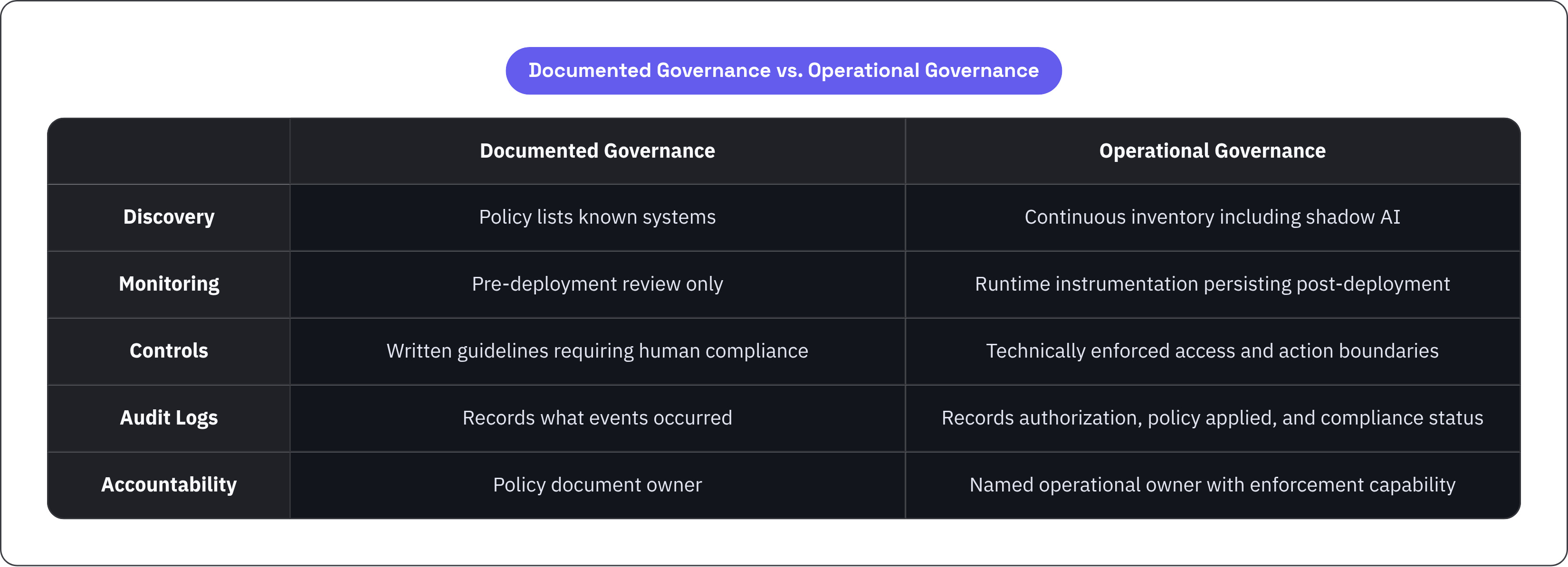
Four requirements separate operational governance from documented governance.
Discovery: an organization must know what AI systems and agents are actually running, including those deployed outside central IT oversight. This is the prerequisite for everything else, and it is frequently missing.
Runtime monitoring: behavior must be observed after deployment, not just before. Model drift, anomalous outputs, and policy violations occur in production. Catching them requires instrumentation that persists after the deployment checklist is completed.
Enforceable controls: rules must be enforced by the system itself, not by guidelines that depend on human compliance. Access restrictions, action boundaries, and automated policy enforcement are the operative mechanisms. A technically enforced policy is a control; one that is not is merely advice.
Complete audit logs: records must capture what happened, under what authorization, and whether it was within policy. System logs capture events; governance logs must capture the governance-relevant interpretation of those events. These are not the same thing.
The EU AI Act's requirements for high-risk systems under Articles 9 through 15 map directly onto this operational layer. Risk management, transparency, and monitoring are not documentation tasks; they require live infrastructure. Investigating after an incident is forensics, not governance. Operational governance means detecting and preventing violations before they produce harm or regulatory exposure.
Board-level attention without operational infrastructure does not close the gap. Sixty-seven percent of directors said boards should spend more time on AI in the next 12 months, per PwC's 2025 survey. Every board committee I have reviewed that formed without enforcement capability left the execution layer exactly as it was.
How organizations can close the gap between what governance says and what systems do
Start with inventory, not policy. An organization cannot govern what it cannot see. The first task is mapping every AI system and agent in production, including those embedded in SaaS tools and deployed by individual teams, then classifying each by the EU AI Act's risk tiers and by data access scope. This is unglamorous work. It is also the foundation without which everything else is decorative.
Align policy to enforcement points, not to documents. Every written rule should have a corresponding technical control or monitoring check. If a rule cannot be monitored or enforced, it is aspirational, not operational. That distinction should be explicit in how governance programs are designed and audited.
Build monitoring into deployment pipelines as a structural component, not a post-deployment addition. Fewer than one in ten organizations integrate compliance reviews directly into development pipelines. That is the architectural fix most programs skip, and it is also where the regulatory requirements under the EU AI Act will eventually force the issue for high-risk systems.
Apply least privilege specifically to autonomous systems, distinct from how it is applied to human accounts. Agents should be scoped to what they actually need for their defined tasks, not to what their human owners happen to hold. This requires deliberate provisioning, which in turn requires that someone knows the agent exists and what it does.
Treat audit logs as a governance instrument rather than an IT artifact. Logs should be structured around governance questions: what authorization existed, what action was taken, what policy applied, whether the action was within bounds.
Assign clear ownership for the operational layer, not merely for the policy document. McKinsey's research found that only 28% of organizations assign direct AI governance responsibility to the CEO. The accountability gap at the top of the organization produces the operational gap in the systems.
Governance maturity is not a destination. As AI systems evolve and agent deployment accelerates, controls require the same iterative improvement that ISO 42001's plan-do-check-act cycle and NIST's MANAGE function both prescribe. Every organization I have seen treat governance as a project to complete has found that the risk surface moved by the time they finished.