Firewall for AI Applications in Enterprise Deployments
Enterprises need a new firewall layer to inspect AI prompts, not packets.
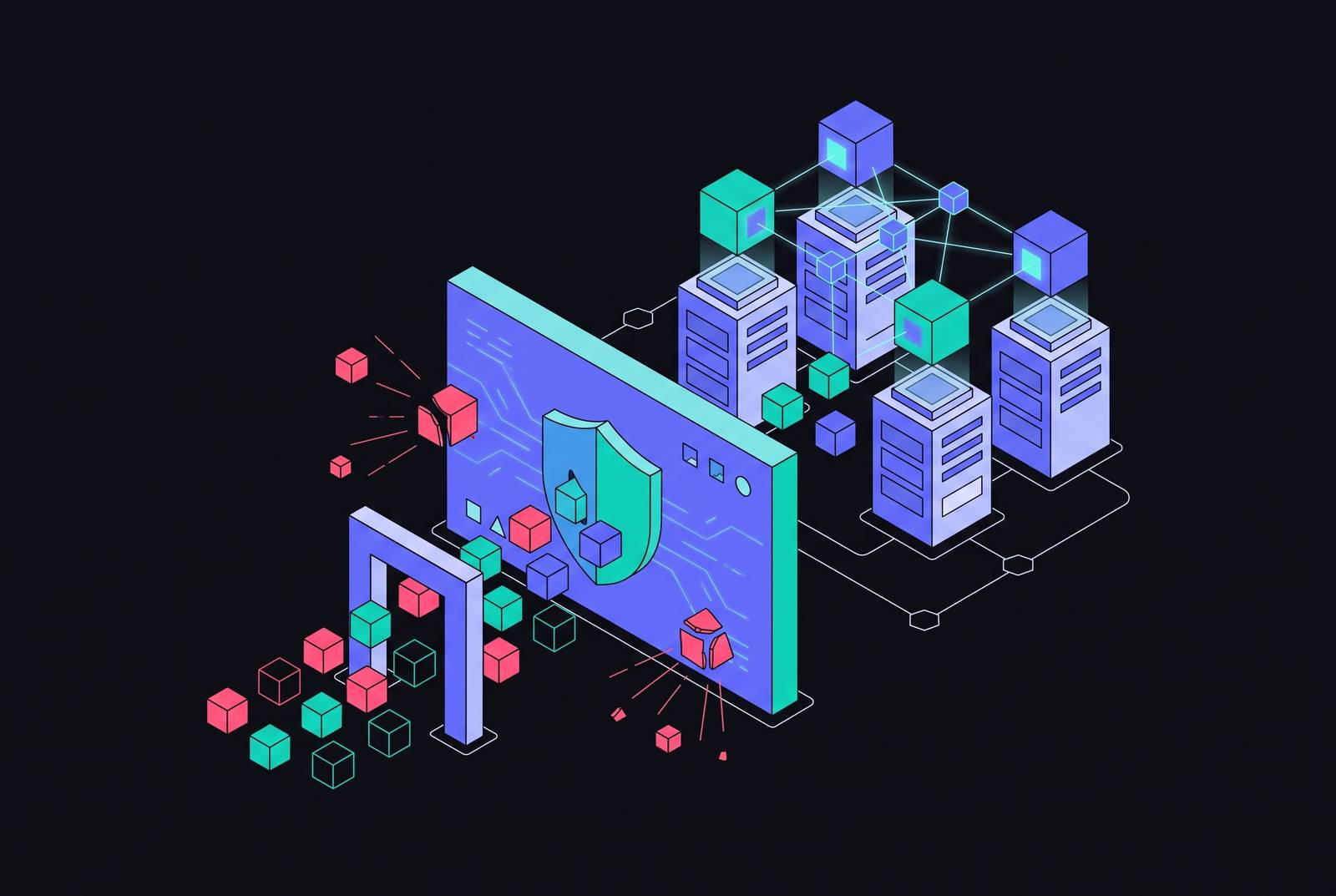
Every enterprise firewall built before AI applications became widespread was designed to answer one question: should this packet cross this boundary. AI applications break that question entirely, because the thing that needs inspecting is a prompt, not a packet. It's a sentence. A large language model doesn't care what port you're on; it cares what you typed, and what it decides to do because of what you typed. That's a different animal, and it needs a different cage.
Two products now share the name "AI firewall," and conflating them will get someone fired. The first kind, call it Category A, is a traditional next-gen firewall (NGFW) with machine learning bolted on to catch AI-assisted attackers, better phishing detection, faster malware fingerprinting, that sort of thing. It still filters network traffic. The second kind, Category B, sits between users (or agents) and the AI application itself, inspecting the actual content of the interaction: prompts, responses, tool calls, the works. These aren't rivals fighting for the same budget line. They cover different layers of the stack, and most enterprises serious about this will end up buying both. This piece is about Category B, because it's the newer, weirder, and considerably less solved half of the problem.
The urgency isn't hypothetical. Prompt injection, data exfiltration through AI tools, jailbreaks, system prompt leakage, and agents granted more authority than anyone intended are among the threats named in the OWASP Top 10 for LLM Applications 2025. None of those threats existed in a form a web application firewall (WAF) or API gateway was built to catch. EY found that AI showed up in 48% of Fortune 100 board risk disclosures in 2025, up from 16% the year before. AI's presence in 48% of Fortune 100 board risk disclosures in 2025 is governance catching up to a problem that started as an engineering curiosity and is now a line item on a risk committee's agenda. That's governance catching up to a problem that started as an engineering curiosity and is now a line item on a risk committee's agenda.
How AI agents inherit human-scale permissions and act on them at machine speed
Agents aren't chatbots that answer questions and go back to sleep. They call APIs, read and write files, execute code, send messages, and chain these actions together without waiting for a human to click "approve" each time. That autonomy is the entire selling point, and also the entire problem.
An employee spins up an agent, and the agent inherits that employee's credentials, OAuth tokens, and permissions wholesale. Same access, no adjustment. So now there's an entity with the reach of a full-time staffer, minus the judgment, minus the fatigue, minus the hesitation before doing something dumb at 2 a.m. Attackers have already shown how fast that gap can be exploited. CrowdStrike's 2026 Global Threat Report clocked average eCrime breakout time (the time from initial access to lateral movement) at 29 minutes in 2025, a 65% jump in speed from 48 minutes the year before. If a human intruder can move that fast, an agent with standing, broad access doesn't need to be malicious to cause damage. It just needs to be wrong, and fast.
Static access policy assumes a few things that agents violate by design. Role-based access control assumes a person with a job title and a predictable set of tasks; agents consume whatever they can reach, without the social or procedural friction that usually slows a human down. Audits assume discrete sessions with a beginning and an end; agents run continuously, so there's no natural checkpoint to review. And permission chaining, an agent using tool A's output as tool B's input as tool C's trigger, creates capability nobody explicitly granted and nobody explicitly reviewed. IBM's Cost of a Data Breach 2025 report found that 97% of organizations hit by an AI-related incident had no AI access controls in place at all. That's the pattern for nearly all organizations, not an edge case. That's nearly everyone.
The conclusion follows directly: enforcement has to happen while the agent is acting. A post-incident audit is a eulogy. By the time anyone reads the log, the file's already gone.
The prompt injection attack: why content inspection inside AI interactions is non-negotiable
Prompt injection works because a language model can't reliably tell the difference between an instruction from its developer and an instruction hidden inside a document it was just asked to summarize. A webpage, an email, or a PDF can carry a buried command, and the model may follow that command as if the developer typed it directly. It's the equivalent of SQL injection for AI systems, except the "query language" here is natural language, and natural language is a lot harder to sanitize than a database string.
It's ranked first on the OWASP Top 10 for LLM Applications 2025, with attack success rates running anywhere from 50% to 84% depending on how the system's configured. That's not a lab curiosity. In June 2025, a vulnerability tracked as CVE-2025-32711, nicknamed "EchoLeak," showed how this plays out in production. Attackers embedded malicious instructions in a crafted email, and when Microsoft 365 Copilot processed it, the instructions triggered data exfiltration from OneDrive, Teams, and SharePoint, routed through an automated mechanism within the Microsoft 365 environment. No user clicked anything. The model did something nobody asked it to do, quietly, and it worked.
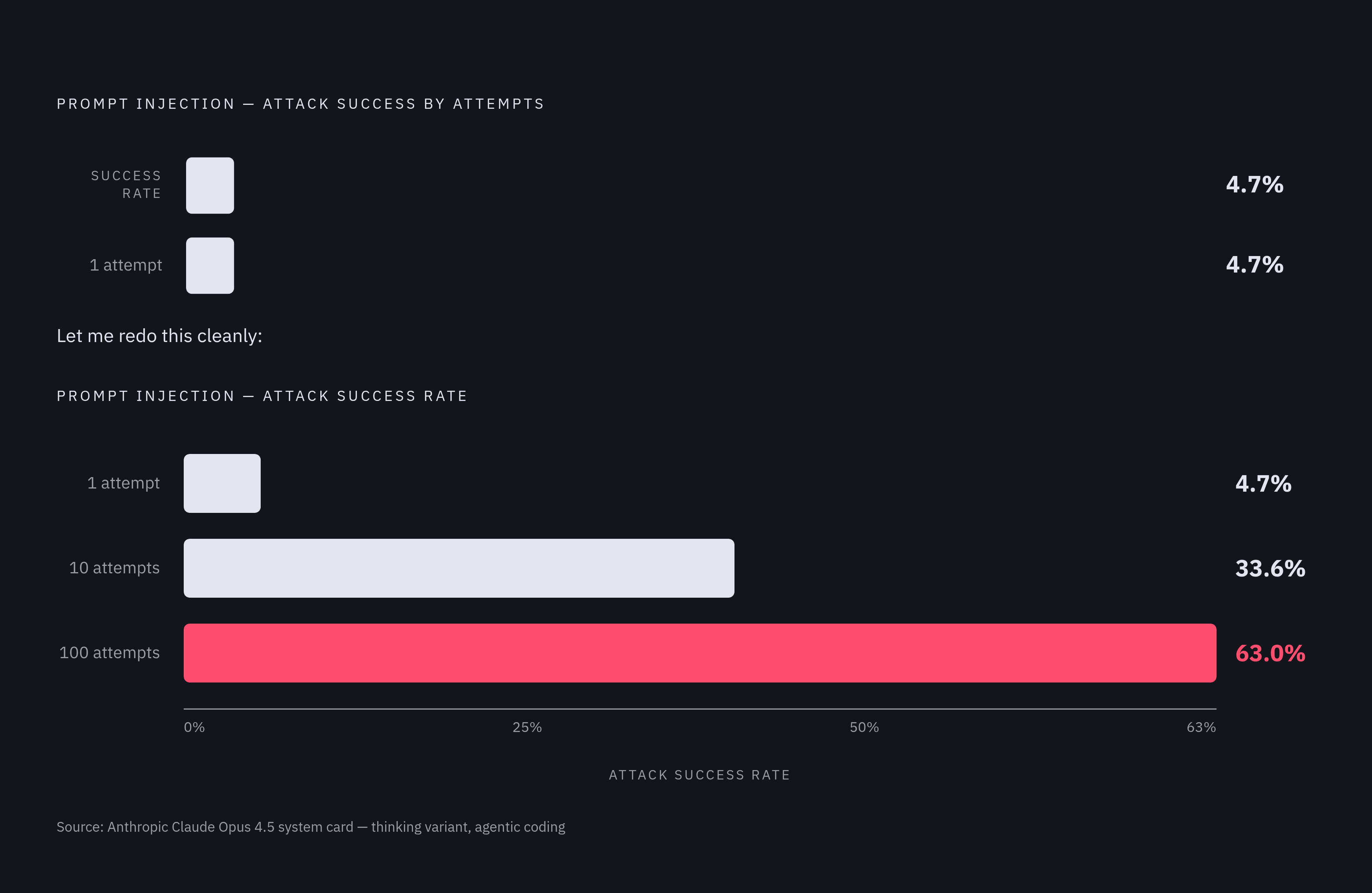
When the model is given tools and allowed to act autonomously, the odds only get worse with persistence. Anthropic's Claude Opus 4.5 system card measured indirect prompt injection success in agentic coding environments: 4.7% at a single attempt, 33.6% at ten attempts, and 63.0% at a hundred attempts for the "thinking" variant. Attackers don't need to succeed once. They need to succeed eventually, and a hundred attempts against an automated system costs the attacker almost nothing.
Detection tools help, but they're not a finish line. Lakera Guard, a purpose-built detection product, scores 92.5461% on Lakera AI's own PINT benchmark, which sounds strong until you notice that leaves 7.5439% of inputs misclassified. Running that error rate against millions of daily prompts in a large enterprise turns the leftover gap into an open door. Detection has to sit alongside behavioral monitoring and access controls, not stand in for them. And none of this happens at the network layer. A firewall inspecting packets has nothing to say about a sentence hidden inside an email attachment.
Shadow AI as the operational forcing function: agents and tools employees deploy without security review
Shadow AI is what happens when employees decide company policy is slower than their to-do list, so they just start using a chatbot, a browser extension, or an unsanctioned copilot without asking anyone first. It's the modern cousin of shadow IT, except it moves faster and touches more sensitive data by default, because these tools work by reading and summarizing whatever's put in front of them.
The scale here is a step change. Verizon's breach research report documented shadow AI use tripling in a single year, from 15% to 45% of employees. Separate surveys from Salesforce and PagerDuty put unauthorized AI tool use at 66-67% of employees. Meanwhile Netskope's Cloud and Threat Report found the volume of data sent to SaaS generative AI apps grew sixfold in a year, from roughly 3,000 to 18,000 prompts per month in the median organization, with 47% of users accessing these tools through personal accounts rather than anything IT provisioned or can see.
IBM's global breach cost study tied shadow AI to 43% of AI-related security incidents. That's real money attached to tools nobody approved.
Blocking doesn't fix this because most AI platforms run over HTTPS. Most AI platforms run over HTTPS, so a standard firewall rule can't see inside the traffic without SSL inspection deployed, and plenty of organizations haven't set that up. Block the whole domain instead, and legitimate productivity tools go down with the bad ones, which just pushes employees toward workarounds that are even harder to see. Many organizations have no formal policy governing employee use of external AI tools, and many can't even inventory which AI tools are in use across the organization. Enforcement without discovery is theater. A firewall that only blocks the tools it already knows about leaves unknown, unapproved tools completely unaddressed.
The AI agent supply chain: MCP servers, plugins, and skills as a new attack vector
Agents rarely work alone. They pull in external tools, plugins, "skills," and increasingly MCP (Model Context Protocol) servers at runtime, and each of those connections is a door someone else built, that the enterprise now has to trust without having inspected the lock.
AIR Security scanned more than 140,000 live AI skills pulled from a public marketplace and GitHub, and found that roughly 12% depended on at least one untrusted external resource, a share that adds up to millions of installations once scaled across the ecosystem. Some of what they found was outright impersonation: skills posing as products from trusted names like Anthropic and OpenAI, built specifically to slide past platform review, with at least one capable of running arbitrary code once installed. Skills posing as products from trusted names like Anthropic and OpenAI, built specifically to slide past platform review, with at least one capable of running arbitrary code once installed, are a supply chain attack wearing a familiar logo. That's a supply chain attack wearing a familiar logo.
MCP adoption grew rapidly during 2025, and much of that growth happened outside any formal security review, which is the kind of trend that should keep a security leader up past midnight. The OWASP GenAI Security Project responded by publishing the OWASP Top 10 for Agentic Applications 2026 on December 9, 2025, formally naming supply chain risk alongside planning, tool use, identity, code execution, memory, inter-agent communication, cascading failures, human-agent trust, and rogue agent behavior. Ten categories, and supply chain earned its own explicit slot.
A firewall watching only what a user types into an agent is watching half the movie. The agent also fetches content on its own, and it may follow instructions buried in that fetched content without asking permission first.
What an AI application firewall must do: the functional requirements
Stripped of the marketing decks, a real AI application firewall needs to do seven concrete things, not vaguely support them, actually do them.
It has to find every agent and AI tool running inside the organization, including the shadow ones nobody filed paperwork for. A static list from six months ago is worthless when developers and employees are standing up new agents weekly.
It has to inspect prompts and responses at the content layer, catching injection attempts, sensitive data patterns, jailbreak attempts, and dangerous output like malware slipped into generated code or unauthorized data pulled into a response. Palo Alto Networks' Prisma AIRS 3.0, one point of reference for what production systems attempt, claims prevention against more than 30 prompt injection and jailbreak techniques.
It has to give agents their own identities rather than borrowed human credentials, with least-privilege rules governing what each agent can call, read, or write, tied to the agent itself rather than to whoever happened to deploy it.
It has to watch behavior continuously and in real time, not in a weekly batch review, because a 29-minute breakout window doesn't wait for Monday's report.
It has to enforce policy with a complete audit trail, logging every action an agent takes for compliance and forensics. IBM's Cost of a Data Breach 2025 found 63% of breached organizations had no AI governance policy at all going in, making the audit trail a compliance obligation.
It has to inspect the supply chain itself, watching which external tools, plugins, and MCP servers an agent connects to at runtime, flagging untrusted or impersonating dependencies before the agent ever acts on instructions coming from them.
And it has to work the same way everywhere: cloud, SaaS, and on-premises. Shadow AI tends to live in SaaS. Production agents tend to live in cloud infrastructure. The seams between those environments are exactly where incidents slip through. Gartner projects AI governance spending will hit $492 million in 2026 and cross $1 billion by 2030, which says the market has already concluded that adapted network tools aren't going to cut it.
How the leading enterprise firewall platforms approach AI security today
Palo Alto Networks built Prisma AIRS (AI Runtime Security) as a purpose-built platform, separate from its Strata NGFW line, covering AI application, model, data, and agent protection specifically. The AI Runtime Firewall component defends inline against prompt injection, sensitive data leakage, insecure output like embedded malware or malicious URLs, and denial-of-service attacks aimed at the model itself. Version 3.0 adds agent discovery across cloud, SaaS, and endpoints, agent identity assignment, red team simulation, filtering across eight categories of toxic content, prevention across more than 30 prompt injection and jailbreak techniques, and scanning for sensitive data patterns. Gartner named it a "Company to Beat" in the AI Security Platforms category of its June 2026 AI Vendor Race, for the second year running. This one sits squarely in Category B.
Check Point's ThreatCloud AI and Quantum NGFW line sit mostly in Category A. ThreatCloud AI aggregates telemetry from more than 150,000 connected networks, processed through more than 50 AI engines, and independent Miercom testing put its malware block rate at 99.9% and phishing and malicious URL blocking at 99.7%. Gartner named Check Point a Leader in its 2025 Magic Quadrant for Hybrid Mesh Firewalls, and the Quantum portfolio scales from branch offices to hyperscale environments via Maestro orchestration, managed centrally through the Check Point Portal. Whether Check Point's current coverage extends meaningfully into prompt-layer inspection, the way Prisma AIRS does, should be confirmed directly against current documentation before assuming parity.
Fortinet's FortiGate combines NGFW functionality with SD-WAN, ZTNA, and its FortiOS operating system into one unified stack across distributed branch environments, with FortiGuard AI supplying real-time threat intelligence and custom security processors handling deep packet inspection and encrypted traffic at speed. That's a strong Category A story. Its specific reach into LLM or agent-layer inspection isn't something to assume from marketing copy alone.
Cisco Secure Firewall is woven into Cisco's broader networking stack as part of its Hybrid Mesh Firewall architecture, extending policy across data centers, cloud, branch networks, and remote sites, backed by Talos threat intelligence. Again, primarily a network-layer play, and any claims about coverage at the layer where AI applications run need to be checked against the vendor's own current documentation rather than inferred.
None of this is a ranking. Fortune Business Insights projects network security will hold 32.39% of the broader market in 2026, with large enterprises accounting for 62.22% of AI-in-cybersecurity spend. The buyers renewing their NGFW contracts are the same buyers who now need Category B coverage, and that overlap is going to keep pushing every incumbent named above to extend further into the AI application layer, whether or not they've fully arrived yet.
Where the current generation of AI application firewalls falls short
Detection accuracy is the honest first crack. A benchmark score in the low-to-mid 90s sounds like a strong grade until it's applied to millions of daily prompts, at which point the misclassified fraction becomes a standing population of undetected attacks, not a rounding error to shrug off.
Coverage of the agent supply chain lags behind coverage of the prompt itself. Vendors have gotten reasonably good at inspecting what a user types into a chat window. Fewer have built equally mature inspection of what an agent independently fetches from an MCP server or third-party plugin, and that's precisely the layer where impersonation and untrusted dependencies do their damage.
Identity is still catching up to reality. Plenty of deployments still let agents run on inherited human credentials well after procurement, because retrofitting distinct machine identities onto agents that already exist in production is slower and more disruptive than anyone budgeted for.
Governance and tooling remain out of sync. Spending on AI governance is rising fast, but a majority of organizations still lack a formal policy for employee AI use, and a large share can't even produce a full inventory of what's running. A firewall, however well built, can't enforce a policy that doesn't exist yet, and it can't protect an asset nobody told it about.
None of that is a case against buying these tools. It's a case for reading the fine print before assuming the box is checked.