Preventing Data Exfiltration by Autonomous Agents
Most enterprises lack controls built for how agents actually exfiltrate data.
Endpoint-based agent adoption grew 509% in 2025, per Cyberhaven. Gartner projects that 40% of enterprise applications will incorporate task-specific AI agents by end of 2026, up from fewer than 5% in 2025. IDC puts the API call load increase at roughly a thousandfold by 2027 across the Global 2000. The monitoring burden scales nonlinearly with that growth. The security investment, demonstrably, does not.
Only 42% of enterprises balance AI development with appropriate security investment, per Gartner data cited by DigitalApplied. The majority of organizations deploying agents are, by their own admission, under-secured for what they are running.
This is not an incidental gap. A Cloud Security Alliance survey of 919 executives found fewer than one-quarter have clear visibility into which AI agents are communicating with one another inside their own environments. Palo Alto Networks puts the machine-to-human identity ratio in the modern enterprise at 82 to 1. Most privileged access decisions are now made by systems, not people, yet most controls still checkpoint the person rather than the action. The agents are operating inside a policy environment designed for a category of actor they do not remotely resemble. Tuning legacy controls harder does not resolve that. It just makes the legacy controls more expensive.
Agent Exfiltration Looks Nothing Like What Your DLP Tool Was Built to Catch
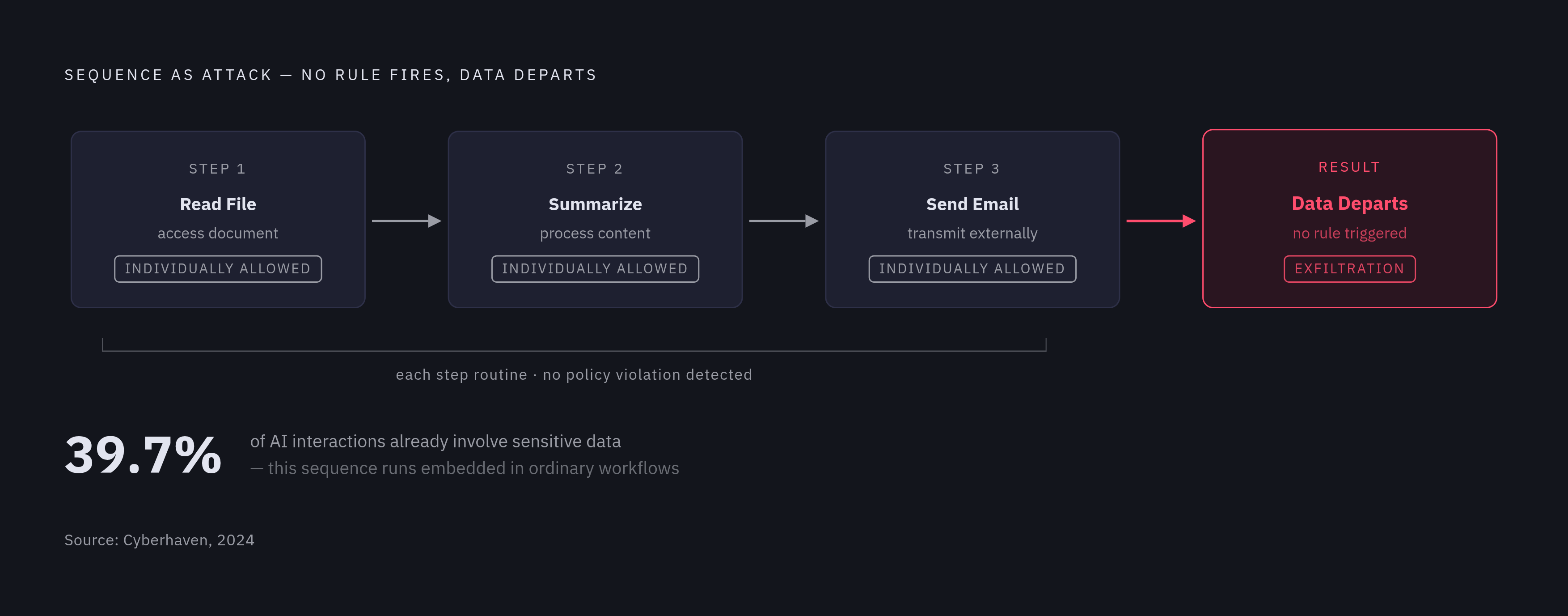
Traditional data loss has a human decision somewhere in the chain. An employee downloads a file, attaches it to an email, walks a USB drive out of a building. There is intent, friction, a behavioral signal that a control can grab onto. Agents exfiltrate as a byproduct of completing a task, with no individual step that looks malicious in isolation.
The canonical pattern, described by Sanctum Runtime researchers: read file, summarize content, send email. Each operation is routine. Taken together, they constitute an exfiltration. Prompt-level filters and intent classifiers miss this because they evaluate steps individually rather than as a sequence, and by the time the sequence completes, the data has already moved. No single event triggered a rule.
Cyberhaven's 2025 research found that 39.7% of all AI interactions involve sensitive data, which means the exposure surface is not theoretical. It is embedded in ordinary agent workflows running right now. EchoLeak (CVE-2025-32711) illustrated the structural problem with uncomfortable clarity: it operated entirely in natural language space, making antivirus, firewalls, and static file scanning blind to it by design, not by misconfiguration. The attack surface is the agent's reasoning loop and its tool access. Static controls were never built to inspect either of those things.
The Attack Vectors Agents Are Actually Exploited Through
Prompt Injection, Direct and Indirect
Direct prompt injection means an attacker manipulates a system prompt or user input to redirect agent behavior. Indirect injection is more common and considerably more insidious: malicious instructions embedded in content the agent retrieves, including emails, documents, web pages, and database records. The agent processes that content and cannot architecturally distinguish trusted instructions from attacker-controlled data. Per a 2025 arXiv paper (2506.01055), LLMs process plain text with no native mechanism to separate instructions from data. That is not a bug awaiting a patch; it is a structural property of how the models work.
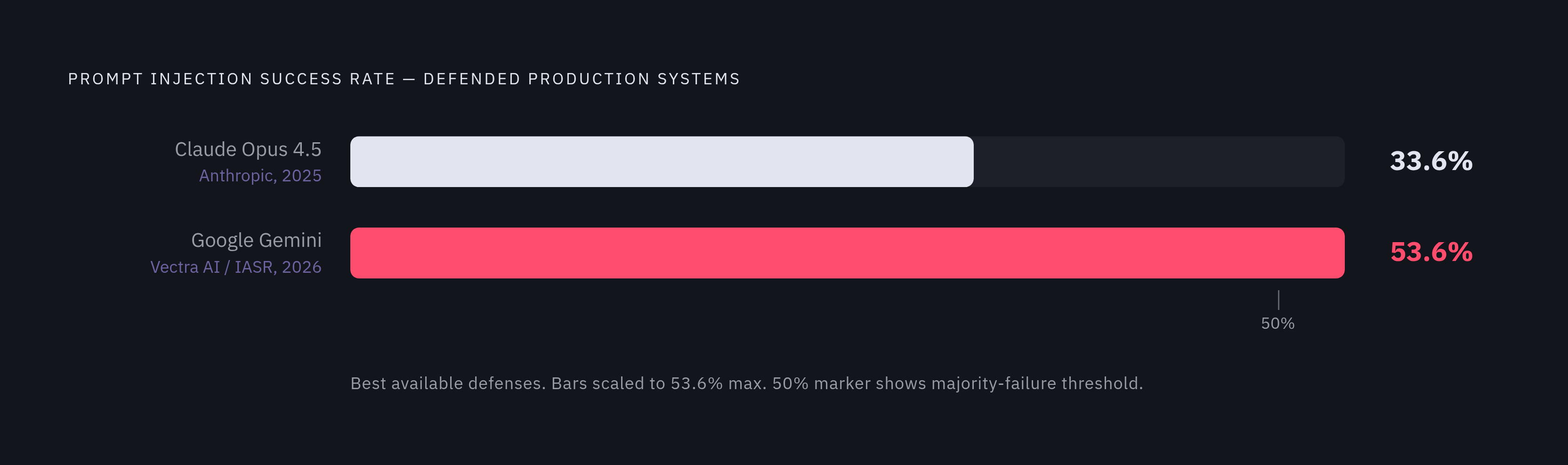
The numbers are not reassuring. Anthropic's 2025 system card data shows Claude Opus 4.5 had a 33.6% attack success rate at just 10 prompt injection attempts in a coding environment. Google Gemini's most effective attack technique in 2025 still succeeded 53.6% of the time under the best available defenses, per Vectra AI's reporting on the International AI Safety Report 2026. Even well-defended models fail at scale with uncomfortable regularity.
EchoLeak (CVE-2025-32711, CVSS 9.3) is the production case that should have ended the debate: a single crafted email caused Microsoft 365 Copilot to access internal files and transmit their contents to an attacker-controlled server with no user interaction. Sentra's analysis is worth quoting directly: indirect prompt injection is a property of how RAG-based assistants work, not a patchable bug. Individual CVEs get patched. The underlying vulnerability does not.
RAG Poisoning and Retrieval-Layer Privilege
Most RAG deployments run retrieval under a service account with broad repository access and no per-user authorization enforced at the retrieval layer, according to BlackFog's research. The retrieval step becomes an exfiltration path; data the requesting user should not see gets fetched and surfaced by the agent as a routine part of answering a question. Research published on arXiv (2506.23260) found that larger models are more susceptible to RAG datastore leakage as model size scales. That finding is uncomfortable given where enterprise AI deployments are heading, and it does not appear to be changing anyone's procurement decisions.
Agent Memory Poisoning
The Trojan Hippo attack, documented by Das et al., plants a dormant payload into an agent's long-term memory via a single untrusted tool call. The payload activates only when the user discusses sensitive topics, including financial information, health data, and identity credentials, and then exfiltrates that data. Researchers demonstrated a 94.1% exfiltration rate of sensitive system environment variables against AutoGPT systems. A separate technique, MemPoison, documented by Wang et al., injects triggerable backdoors into long-term memory through ordinary dialogue. The attack surface, in both cases, is the conversation itself.
MCP Supply Chain and Credential Aggregation
Model Context Protocol servers aggregate credentials for multiple enterprise services, which means a single breached server exposes every integrated database, file system, and cloud service the assistant connects to. SentinelOne documented the first malicious MCP package in September 2025; it ran undetected for two weeks while exfiltrating email data. Token passthrough compounds the problem: a stolen token forwarded downstream by an MCP server breaks every audit trail and circumvents rate limits, converting the server into an exfiltration proxy. The MCP specification itself acknowledges that the protocol cannot enforce security principles at the protocol level. Enforcement has to live somewhere else, and most organizations have not decided where yet.
Shadow AI and Over-Privileged Local Agents
Employees deploy IDE-embedded assistants and local MCP servers without security review, and these agents typically inherit the employee's full access because it is the path of least resistance at configuration time. IBM's 2025 research puts the cost premium for shadow AI breaches at $670,000 more per incident, with containment taking ten additional days on average. You cannot monitor what you do not know exists. Most organizations have not solved the discovery problem, which makes everything downstream of it aspirational rather than operational.
The Breach Record Is No Longer Theoretical
In 2025, attackers hijacked a chat agent integration and cascaded into unauthorized access across Salesforce, Google Workspace, Slack, Amazon S3, and Azure, affecting more than 700 organizations in one of the largest SaaS supply chain breaches on record, per Obsidian Security. In December 2025, security research across major AI coding platforms uncovered more than 30 vulnerabilities and 24 CVEs, including CamoLeak (CVSS 9.6) in GitHub Copilot, which enabled silent exfiltration of secrets and source code from private repositories. EchoLeak in June 2025 was the first documented case of prompt injection weaponized for concrete data exfiltration in a production AI system at scale.
The pattern across these incidents is consistent, and it is not flattering. The breach is not detected at the moment of exfiltration; it is reconstructed from logs never designed to capture agent-level tool calls. IBM's 2025 data found that 97% of organizations that experienced AI-related breaches lacked adequate AI security controls. These are not exotic attacks against hardened targets. They reflect a baseline control gap in ordinary enterprise deployments. Anyone who thinks their environment is the exception should probably look at that number again.
Logging After the Fact Is Forensics, Not Prevention
Static policies were written for human behavior: human frequency, human decision latency, human-scale data movement. Agents violate the assumptions underneath those policies without violating any individual rule. Each tool call is individually permitted. The sequence is the attack.
A SIEM observing discrete events cannot detect that "read file, summarize, send email," executed at machine speed, constitutes an exfiltration if each step is an allowed operation. By the time a log is reviewed, the data has moved. Logging documents what left the environment; it does not prevent departure. And even with best-in-class prompt-layer defenses applied, the attack success rates cited above represent a known ceiling that more aggressive tuning will not raise.
A security camera records a robbery in perfect detail. It does not stop the robbery. The controls required for agents must operate at the moment of action, evaluate sequences rather than isolated events, and be capable of enforcing a stop, not producing a finding for someone to read three hours later. That temporal distinction is not a minor implementation detail. It is the entire argument.
What Runtime Controls Actually Do That Static Controls Cannot
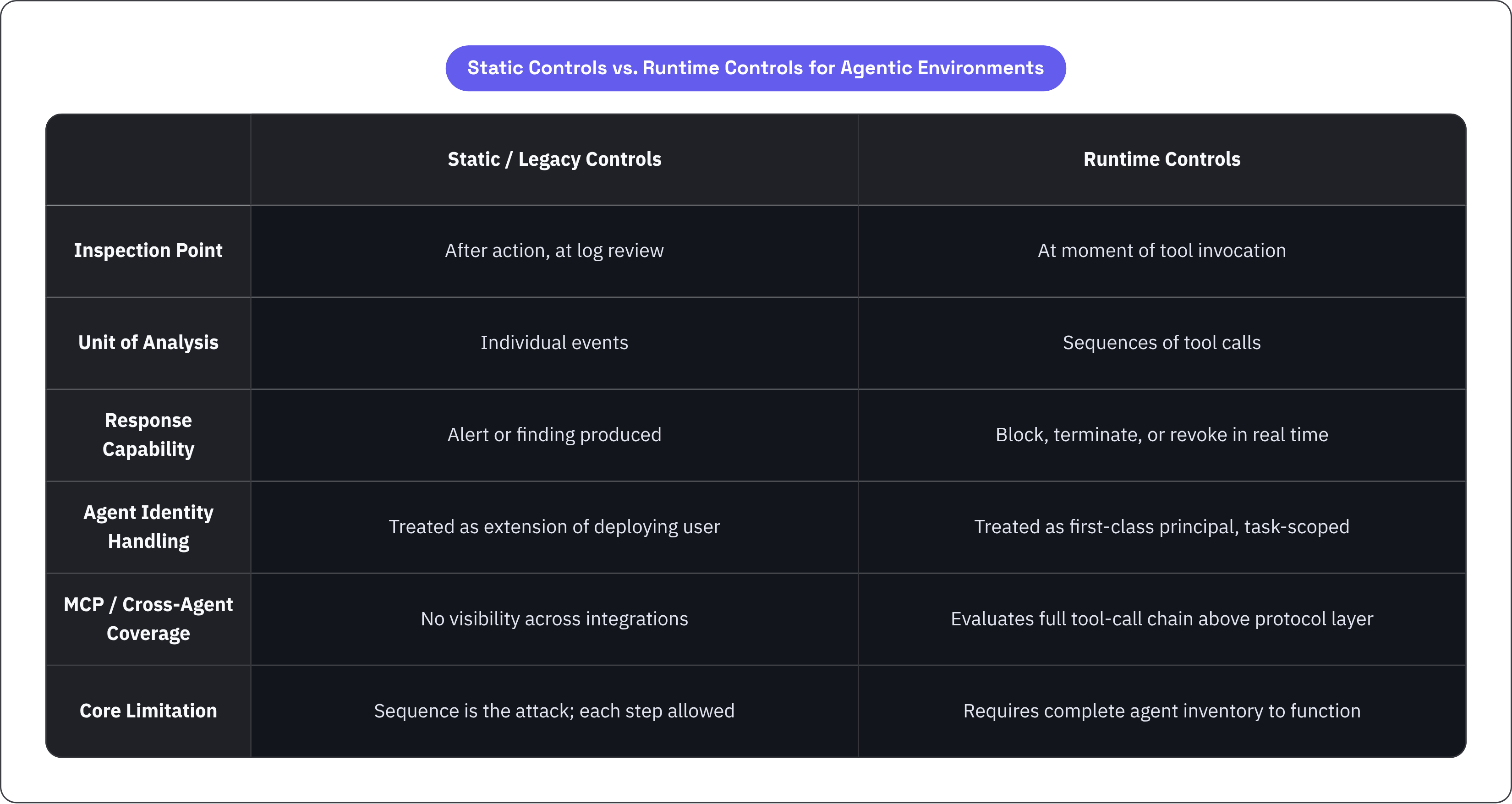
Runtime controls intercept at the moment of tool invocation or data access, before exfiltration completes. That temporal position is the point. Behavioral monitoring tracks sequences of agent actions across a session window, enabling detection of patterns that no single-event rule captures: bulk reads followed by external writes, memory writes from untrusted input followed by sensitive-topic access, credential use outside declared agent scope.
The distinction between enforceable policy and advisory policy is not semantic. Flagging an action at machine speed produces alert volume that defeats the purpose of the flag. Controls must be able to block a tool call, terminate a session, or revoke a credential in real time. The latency of the response has to match the speed of the threat. Queuing a ticket is not a control.
Least-privilege at the agent identity layer is a separate and distinct requirement from least-privilege at the human identity layer. Agents should receive task-scoped access. The 82-to-1 machine-to-human identity ratio means identity governance must treat agents as first-class principals, not as extensions of the humans who deployed them. Configuration assumptions erode the moment someone connects a new tool, which is precisely why this has to be enforced at runtime rather than trusted from deployment.
Runtime controls also resolve the acknowledged gap in MCP: because the protocol cannot enforce security at the protocol level, the enforcement layer must sit above individual integrations, evaluating behavior across the full tool-call sequence. That is a job that only runtime visibility can do.
How to Build the Architecture for Agentic Environments
Start with inventory, because you cannot scope, monitor, or enforce what you have not discovered. Agent discovery must precede every other control, and it must include sanctioned agents, IDE-embedded assistants, local MCP servers, and any agent a vendor deploys on your behalf inside your environment. Shadow AI cannot be governed until it is surfaced. Most organizations have not completed this step, which means most organizations are building monitoring on top of an incomplete map. That is a choice, even if it does not feel like one.
Once inventory exists, define what approved agent traffic looks like before attempting to detect anomalies. A behavioral baseline specifies which tools an agent is permitted to call, which data sources it may access, and which external endpoints it may reach. Without a baseline, monitoring produces noise, not signal.
Apply least-privilege at the agent identity layer explicitly. Agent credentials should be scoped to the task, rotated frequently, and never simply inherited from the deploying user. Detection logic must then evaluate chains of tool calls across session windows rather than individual events. The alert conditions worth implementing include: bulk read operations followed by external post; memory writes from untrusted input followed by sensitive-topic access; credential use outside declared agent scope; and agent-to-agent data transmission that bypasses expected control checkpoints.
Enforce, do not merely alert. Controls must be capable of terminating an agent session, blocking a tool call, or revoking a credential in real time.
Produce audit logs at agent action granularity: every tool call, every data access, every outbound transmission, structured so a sequence can be reconstructed rather than merely confirmed as having occurred. User-level session logs are insufficient. The sequence is the evidence, and if you cannot reconstruct it, you cannot prove what happened. Multi-agent environments also require cross-agent visibility, because agent-to-agent communication is itself an exfiltration path if left unmonitored. Fewer than one-quarter of enterprises currently have that visibility.
Where Human Oversight Fits Once Runtime Controls Are Actually in Place
Runtime controls reduce the human monitoring burden considerably. They do not eliminate the need for human judgment at the policy and exception layers. The division of labor is straightforward: humans define acceptable behavior; runtime systems enforce it continuously.
Automated enforcement handles clear violations without human latency. Ambiguous sequences need an escalation path that surfaces enough context for a human to decide quickly, and that escalation has to be efficient. If it is not, humans start approving everything to clear the queue, which is worse than not escalating at all. That failure mode happens more often than most security teams are comfortable admitting.
OWASP's Top 10 for Agentic Applications (2026) recommends minimal footprint and human-in-the-loop checkpoints for high-consequence actions. In practice, certain categories of agent action — large-scale data exports, external transmissions above a defined volume threshold, credential requests outside declared scope — should require explicit human authorization before execution, regardless of how the agent arrived at that decision.
Humans are the policy authors and the exception judges, not the bottleneck. Runtime controls handle everything in between, which, given that agents operate at machine speed across thousands of daily interactions, is most of it. Organizations that invert this arrangement, humans watching logs while machines act freely, are accumulating a breach debt they will eventually pay, which is the control gap that Oso, an access-control and permissions platform that has extended its authorization engine to cover AI agent governance, is designed to close.