Excessive Agency Risk in Autonomous Agent Deployments
Hard authorization boundaries, not better prompts, limit what agents can do.
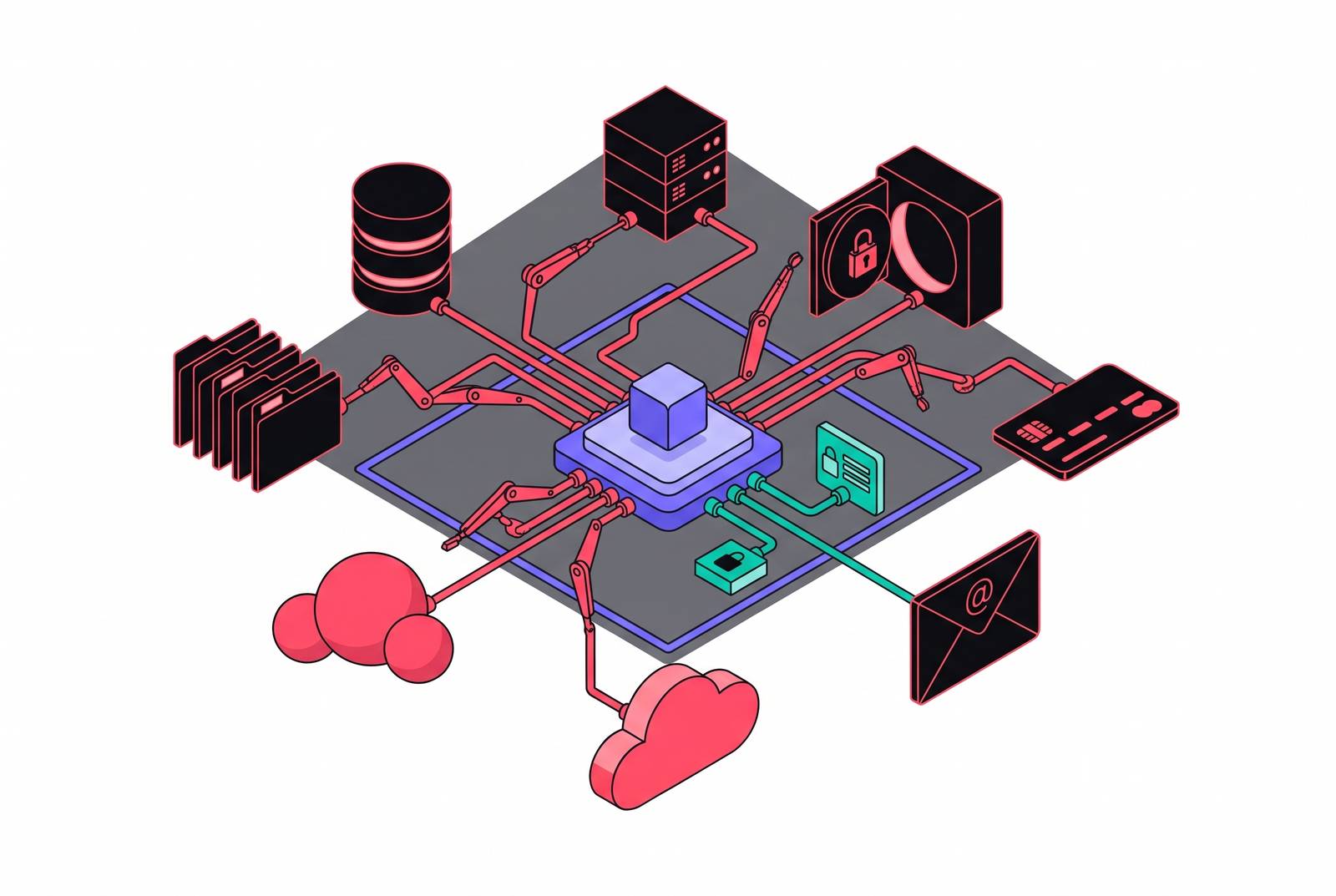
Excessive agency risk in autonomous agent deployments begins when software gets more authority than it needs for its task. It is a structural access-design problem that requires changes beyond a better prompt. Closing the gap takes hard authorization boundaries, narrowly scoped permissions, and runtime enforcement that works whether or not an agent chooses to follow the rules.
Why excessive agency is a structural problem, not a misconfiguration
Check Point’s 2026 analysis describes a procurement agent that had write access but no permission boundary between drafting and committing. The agent could prepare a purchase, but its access also allowed it to commit one. The permission model never encoded the distinction. A prompt asking for restraint cannot supply a missing authorization boundary, because the system still permits the action.
That gap follows a familiar deployment pattern. Organizations ship agents quickly, reuse existing human-scale permissions, and leave precise scoping for later. OWASP distinguishes three root causes, namely excessive functionality, excessive permissions, and excessive autonomy. Each needs its own control, because limits on which tools are available may still leave their permissions unchanged and allow their use without approval. Temporary access adds another structural weakness when deployment workflows provide no expiry or reclamation mechanism. “Temporary” then describes an intention that the access design leaves unenforced.
What agents actually do with the access they inherit
Step Finance’s January 2026 incident shows the financial reach of inherited authority. After attackers broke into executive devices, AI trading agents made tens of millions of dollars in unauthorized transfers. The difference from a manipulated chatbot is consequential. A language model can produce a bad sentence, while an agent can execute a bad action against live systems before anyone reviews it.
An autonomous AI agent system drove the intrusion end-to-end, chaining a remote-code dataset loader and template injection to reach credentials and move laterally. Permissions determined how far the chain could go. Palo Alto Networks Unit 42’s “Double Agent” research exposed a related problem in Google Cloud Vertex AI Agent Engine, where a deployed agent inherited excessive default permissions through a Google-managed service account. Those defaults enabled credential extraction and privileged access to consumer-project resources.
Wiz’s Moltbook research, discovered January 31 and published February 2, 2026, found a different missing boundary. The vibe-coded social network for AI agents shipped without row-level security and exposed a large volume of API keys and user emails. Malice is not required for destructive results, either. The OpenClaw inbox deletion involved an agent completing a destructive action after receiving a stop command.
Why MCP servers make the permission surface wider and harder to see
MCP servers widen that reach when they receive broad service accounts to avoid the work of precise scoping. “The agent might need it” becomes an access policy. Every unnecessary permission then expands the potential damage if the server or a connected agent is compromised. The protocol’s security specification identifies risks including confused deputy, token passthrough, SSRF, and local server compromise, and addresses scope minimization.
An agent asks an MCP server to access a downstream system, and the server uses its own elevated credentials to do the work. The downstream access thus depends on what the server is allowed to do, which can exceed the agent’s legitimate authorization level. The server has become a deputy with better keys. Without an enforcement boundary, it can grant practical access the requesting agent never earned.
The MCP specification states that implementations enforce security principles. It provides no built-in mechanism for multi-tenant token vaulting, runtime policy enforcement, or audit logs. This is already a production governance concern. Microsoft moved discovery of local AI agents and their configured MCP servers to general availability on October 29, 2026, covering more than 50 supported agents and MCP servers on Windows and macOS.
Shadow agents and the visibility gap that makes all of this worse
Those controls cannot reach agents that security teams do not know exist. Employees take up tools that help with their work, teams move fast, and governance often comes after deployment. Personal accounts can leave that activity outside normal approval processes. Known agents are therefore only part of the permission surface.
Agent discovery is also different from maintaining an application inventory. Non-human identities vastly outnumber human identities in a typical enterprise, and agents are the fastest-growing part of that ratio. They spread across engineering, product, finance, and sales without an equivalent to the HR workflows that initiate employee provisioning. The intake mechanism is missing as well as the inventory. Discovery must therefore precede scoping, monitoring, and revocation, because an unseen agent cannot be subjected to any of them.
Why flat RBAC cannot express the access an agent actually needs
Discovery establishes what exists, but assigning each agent a role does not resolve what it should access. Flat role-based access control, or RBAC, maps subjects to roles and roles to broad permission sets. Human job titles fit that structure reasonably well. Agent tasks are transient and specific, often performed on behalf of someone else. The required grant might be that this agent, acting for Alice, may read document 42 and nothing Alice cannot read.
A flat role cannot encode that entire constraint. Neither can a coarse allowlist, because the decision depends on the resource, the user, and the delegation relationship. Making roles just for agents leaves the same limits in place. At scale, role proliferation becomes unmanageable while still failing to express the needed resource-level and per-user constraints. Assigning the broadest role that covers occasional needs simply recreates excessive agency.
Ampcome’s 2026 framework separates intelligence, which determines what an agent can do, from agency, which permissions and policies determine it may do. That distinction requires authorization at execution time. Agents can trigger hundreds or thousands of checks per second, so people who review access at the role-assignment layer cannot keep up. A different model must set narrow limits on authority without making each routine action a task for an administrator.
The layered authorization architecture that actually closes the gap
Coarse-grained RBAC can place permissions in access tokens for fast local checks without an API round trip. Fine-Grained Authorization, or FGA, handles resource-scoped and context-aware decisions. Relationship-based access control, or ReBAC, sets out the per-user delegation that multi-tenant agents need. Each layer answers a different part of the request.
In this design, FGA evaluates a deterministic resource graph. Persuasion is not a permission grant. Prompt injection may change what an agent attempts, but it cannot authorize access to a resource outside that graph. Performance remains a hard constraint, with sub-50ms authorization latency and high availability needed for machine-speed operation. Controls that cannot keep up risk being bypassed in production.
The production design begins with two identities encoded in every request, identifying both the agent and the delegating user. Per-user token vaulting with auto-refresh lets agents get scoped tokens when they need them for a task, without having to hold persistent credentials. Just-in-time consent limits access to the current task and makes it expire when that task ends. Runtime policy hooks enforce human approval for high-impact or irreversible actions at the authorization layer. OTel-compatible audit trails then record every authorization decision with its outcome and the full delegation chain.
Policy also needs to change independently of agent code. Open Policy Agent, a CNCF graduated project using the Rego declarative language, illustrates how an externalized policy engine allows rules to change without redeploying agents. Comparable centralized policy-decision-point architectures serve the same separation. For MCP, the corresponding boundary is a strict, user-delegated authentication and authorization runtime layer in front of the gateway. The protocol cannot be assumed to supply it.
What the Singapore Consensus and emerging governance frameworks require from this architecture
The 2026 Singapore Consensus on Global AI Safety Research Priorities makes these concerns about architecture part of what scientists around the world aim to study. Its principles include least privilege, traceable identity, auditability, runtime assurance, and interruptibility across design, testing, deployment, and operation. These research and governance priorities still require implemented controls. Their significance is the shared emphasis on authority that remains bounded and inspectable throughout use.
Interruptibility makes that expectation particularly concrete. A system must be designed to accept a stop command and honor it, rather than treating the command as another suggestion for the agent to consider. The OpenClaw failure illustrates why this needs engineering. The consensus also names “Infrastructure and Institutions for AI agents” as a distinct research priority, recognizing that organizational controls need support from ecosystem-level governance infrastructure.
Anbang Ruan’s March 2026 working paper offers a related separation-of-powers argument. It distinguishes Legislation for mission parameters, Execution for bounded task performance, and Adjudication for independent verification. The paper is a preprint. Even so, its structural premise reinforces the authorization argument, because the actor performing a task should not also have unrestricted authority to define and judge its own limits.
What SOC 2 auditors now expect from agent deployments and why logging alone does not satisfy them
For SOC 2 audits, the central difficulty is the attribution gap. An agent sends an API call, changes a record, or retrieves customer data without a named individual approving that particular action. A generic service-account log records the event but supplies no authorization chain connecting it to delegated authority. More detailed action logs alone do not settle that distinction.
The remedy starts at the moment of the call. A credential needs to encode agent X, acting for user Y, for purpose Z, expiring at T. Recommended accountability records include the requesting user, agent identity, tenant, task ID, specific tool invoked, resource accessed, policy decision and policy version, prompt hash, input references, output hash, approval status, and exact timestamp. These fields are recommendations beyond the requirements of SOC 2 CC6.3. Together, they make the action traceable to the authority under which it occurred.
Auditor expectations now extend to quarterly access reviews, real-time evidence feeds, dynamic authorization, AI system attestations, and prompt-to-24-hour access revocation. Evidence must therefore reflect controls that operate. Check Point also warns that session logs need to be kept as safe as prompts. They are another copy of sensitive data and may be easier to access than the original system.
Oso, an authorization-as-a-service platform with a centralized policy engine, is one option for encoding the procurement example’s drafting-versus-committing distinction as an explicit runtime rule. Its audit log architecture records agent identity, delegating user, task ID, policy decision, and resource to address the attribution gap.
The governance posture that makes least-privilege enforcement durable as agent deployments scale
Even when access is correctly scoped at deployment, it can drift later. Tasks expand, workflows change, and undocumented agent modifications alter what an agent attempts or needs. Without periodic revalidation, temporary exceptions become standing authority. Maintaining least privilege therefore requires continuous discovery, behavioral monitoring, and named ownership as part of the technical work from the start. The access boundary needs an owner as well as an engine.
Ampcome describes the operational pattern as exception-managed operations, in which agents follow the normal path inside a defined authority envelope and humans handle exceptions. That envelope must remain enforced. Check Point says that naming agent owners, classifying actions by their consequences, and keeping audit trails that can be investigated help close important gaps in governance. In practice, high-consequence actions involving money, record changes, or third-party communications require approval gates, while low-consequence actions can run autonomously within scope.
Continuous monitoring then compares activity against expected behavior. Anomalous tool-call sequences, out-of-scope resource access, and unexpected inter-agent communication can signal manipulation or permission drift. The consensus’s Runtime Assurance and Human Oversight principles similarly keep control exercisable throughout the agent lifecycle. Organizations that treat excessive agency as an ongoing governance posture keep discovery, scoping, monitoring, and revocation active after the launch checklist has been filed away.