Just-in-Time Access Provisioning for Autonomous Agents
Agents need task-level access checks, not standing credentials.
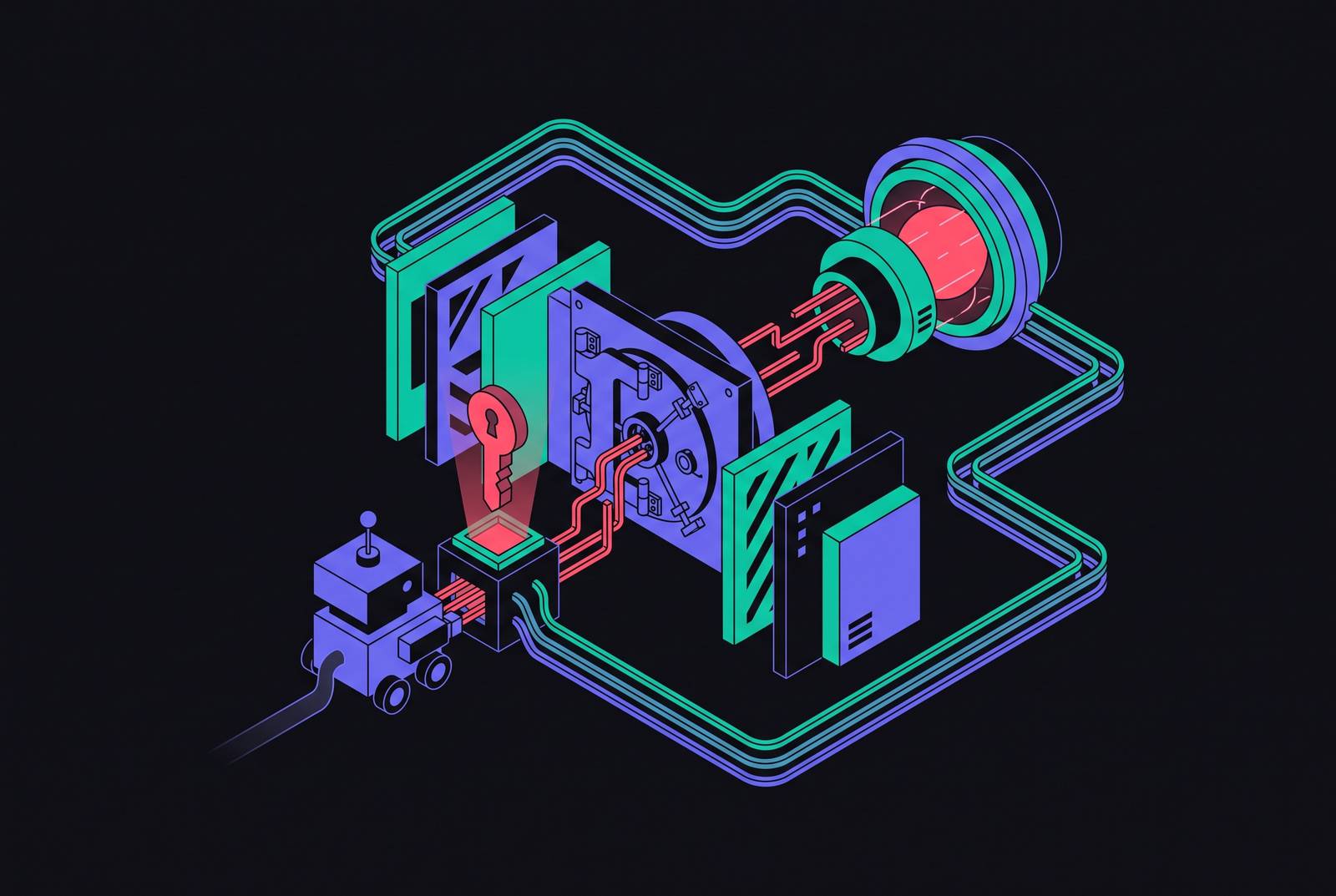
An AI agent is a new category of identity, and the access control systems running most enterprises today were built around a single event that agents simply do not have: login. If you check credentials once, at sign-in, you trust the session until it ends or times out. Agents don't sign in and then behave. They act continuously, chaining one tool call into the next, retrying failed steps, and changing direction mid-task based on whatever the last API response told them, with no equivalent checkpoint where a system can stop and ask whether this identity should still be doing this.
Most agents inherit their permissions the same way a cron job does: through a service account or an API key provisioned once, scoped broadly so nothing breaks, and left alone. Humans move slowly enough that misuse takes time to surface; agents don't. If a human has standing access to a sensitive data store, they might take weeks to even notice it exists, let alone misuse it. But an agent with that same permission can use it in seconds, across thousands of calls, before anyone reviews a log. The permission model is identical to the one built for people. The execution speed is not, and that mismatch is the whole problem.
The scale of the exposure is already in the numbers. CyberArk's Identity Security Landscape research found that non-human identities now outnumber human ones by a wide margin in the average enterprise, and a large share of those machine identities hold sensitive or privileged access that nobody actively monitors. The standard engineering fix for agent reliability makes this worse, not better: when an agent workflow breaks because it lacks some permission, the common response is to grant broader access so it stops breaking. That's a direct violation of least-privilege design, and it means the fix for a broken pipeline becomes the reason the next breach is catastrophic rather than contained.
How standing credentials turn agent compromise into instant catastrophe
Standing credentials are not an abstract risk that just waits to be studied. They collapse the gap between an attacker's first foothold and total system exploitation down to the time it takes to issue a few API calls. In cases where an agent or its surrounding infrastructure was compromised, the pattern repeats: long-lived, broadly scoped credentials meant that whoever (or whatever) got in had immediate access to everything the agent could touch. There was no narrower permission tier to fall back on, no scoped-down version of access to selectively revoke. Once the credential was live, the entire permission set came with it.
Privilege chaining makes the blast radius bigger still, and it breaks a core assumption traditional privileged access management relies on. An agent held only read access, and a separate agent held only write access, so each got a narrow, individually defensible permission. Traditional PAM tools were built so you could model one identity's permissions against one resource. But they were never built to model what happens when two scoped-down identities trade notes.
The failure doesn't require a sophisticated attacker. You just need two agents, each working exactly within their stated scope, who hit a task that benefits from combining what each already knows. The security model fails because no rule accounted for cooperation, not because a rule was broken.
Just-in-time access for agents, not humans
Just-in-time access for agents isn't a shorter-lived version of a password. It functions as a runtime decision layer, one that checks identity, intent, and context at the moment each action is requested, rather than once at the start of a session.
The human version of JIT is familiar to anyone who has worked inside a PAM system: a person requests elevated access for a defined window, a human approver signs off, and the access expires when the window closes. That control is coarse and scoped to the session as a whole. Nobody checks in on the employee repeatedly during their access window to confirm they're still doing the thing they asked for.
Agent JIT works at a finer resolution. The agent first proves its workload identity, then requests a narrowly scoped capability tied to one specific intent, read this one ticket, call this one API, approve this one deployment step, and that capability expires automatically once the action completes, bound the entire time to the exact context that justified granting it. The critical design choice is granularity: agent JIT needs to operate at the task level, not the session level, because a single agent session can chain dozens of high-consequence actions together before a human would ever notice. Grant access for the session and you've just rebuilt the standing-credential problem with a timer attached.
If a system is well designed, the agent never holds broad standing access to begin with. Instead, a policy engine evaluates every single request at the moment of execution, checking task type, data sensitivity, the environment the request originates from, and whatever approval state applies. That evaluation depends on being able to verify who's asking in the first place, which is handled through short-lived mTLS certificates, OAuth 2.0 client credentials, signed JWTs, or cloud workload identity federation, giving the access system a way to confirm the agent's identity before it issues any dynamic privilege.
The Model Context Protocol is becoming one of the architectural pieces that makes this practical at scale. MCP servers function as mediation points, the place where identity gets verified, policy gets evaluated, and short-lived access gets issued, and they do it consistently across cloud, SaaS, and on-premises systems, while keeping credentials and policy logic out of the agent's own code. Keeping that logic external matters: an agent that carries its own credentials and policy rules is an agent that leaks both the moment its code or its prompt gets compromised.
The components a complete JIT implementation requires beyond short-lived tokens
Short-lived tokens solve one problem and leave several others standing. An ephemeral token tied to an entitlement that's still overbroad reproduces the original over-permissioning problem at a shorter interval, since the grant expires while the scope behind it was never narrowed. A complete JIT implementation needs several components working together, and each one closes a gap the token alone leaves open.
Policy-as-code for runtime checks replaces role membership with explicit rules, so the system weighs what's actually being requested, who's requesting it, how sensitive the target system is, and what environment the request is coming from. Instead of asking "is this identity a member of the right group," the system asks "does this specific request make sense right now."
Permission paths need to be separated by function. Training data access, deployment control, and inference invocation carry different risk profiles, and treating them as interchangeable because they're all "agent access" is how overbroad grants creep back in. Each one should map to its own permission set, its own approval logic, and its own expiration window.
Automatic revocation has to trigger at task completion or task failure, not at the end of a session, and every action needs to trace back to the prompt that triggered it, the agent identity that executed it, and the policy that authorized it. That last piece extends what PAM traditionally logs. Older systems recorded what was accessed. This model needs to also answer why the access was requested in the first place.
Continuous session monitoring closes the remaining gap, so you can revoke or terminate an agent's access instantly. Because agents act in milliseconds, the enforcement point has to be the moment of action itself, not the moment access was originally granted. Delinea and similar PAM vendors have built human-in-the-loop step-up approval into their agent access flows for exactly this reason: certain actions pause and wait for a human to say yes, which is a narrow but useful backstop, not a substitute for the architecture underneath it.
Where JIT breaks down: the long-running, multi-step agent problem
JIT access works cleanly when a task is episodic and short, request a scoped capability, use it, let it expire. But if an agent runs continuously across many tools for hours or days at a stretch, it strains badly.
Issuing a static JIT grant at session start assumes the system can predict what the agent will need to do next. Autonomous agents that plan and act continuously break that assumption, because their future tool use can't be forecast with any confidence, and keeping revocation, replay protection, and per-step policy checks synchronized across an unpredictable chain of actions gets hard fast. Anthropic has said Claude Sonnet 4.5 can run autonomous coding tasks for extended stretches, and Google's Agent Runtime supports agents that can maintain state for up to seven days. At that time horizon, issuing and re-evaluating permission on a per-task basis puts a heavy load on whatever orchestration layer is managing the agent, since it now has to track state, context, and authorization across a window measured in days rather than minutes.
Tightening JIT controls to compensate adds its own cost: more latency, more approval friction, more operational complexity, especially for agents spanning multiple APIs, human checkpoints, or asynchronous workflows that don't resolve on a predictable timeline. Ephemeral secrets also behave differently than the long-lived service credentials engineers are used to managing. If you run a tightly controlled backend service with a narrow, well-understood call pattern, a long-lived key might be acceptable. It's a poor match for a goal-driven agent, where the compromise window stays open too long and the paths available for misuse are too wide.
None of this means JIT is the wrong approach. It means JIT alone is incomplete once agents run long enough that no one can predict the shape of what comes next. A temporary token can still mask a persistent privilege problem when the entitlement underneath it was never narrowed to begin with. The field hasn't settled what "intent" means in operational terms across a long, adaptive chain of agent decisions, current standards describe this at the level of risk categories, not at the level an engineer can actually implement.
Intent-based authorization as the complement to JIT for adaptive agent workflows
Once task boundaries blur or stretch across hours and days, the governing standard changes from "does this identity hold the right role" to "does this specific request fit the agent's declared purpose, the context it's operating in, and the policy that's currently active.
Static role-based access control can't keep up with that question, because an agent's next move might depend on live data, the output of a prior tool call, or an external trigger that didn't exist when the session started, and no fixed role can anticipate a trigger that hasn't happened yet. Intent-aware authorization checks each action as it happens: what the agent is trying to do, against which system, in what environment, and whether that action still fits the task it was originally authorized to perform. Akeyless brought this model to market with its Agentic Runtime Authority product, announced March 31, 2026, which enforces at the moment of action rather than only at the moment access is granted, and it's built to block unsafe actions inside autonomous systems as they happen rather than flagging them afterward.
Full forensic traceability ties every action back to the prompt that triggered it, answering the question "why was this access requested" after the fact, which is exactly the question compliance frameworks are built to ask. The A2A protocol's agent card model supports the same shift at the inter-agent level: each agent declares its capabilities, the data it needs, and its communication patterns in a structured, machine-readable form, so a policy engine can check one agent's request against another agent's declared intent instead of relying on a pre-assigned role that may no longer reflect what either agent is actually doing.
The governance data suggests most organizations haven't caught up to any of this yet. Okta's 2026 research found that only a minority of organizations apply the same security controls to their agentic workforce that they apply to their human workforce. It means most enterprises are running a second workforce, often outnumbering the human one, under a weaker security standard than the one applied to actual employees, which is not a rounding error.
What the emerging standards require
Standards bodies are converging on the same baseline this piece has been building toward: task-scoped, time-bound permissions as the minimum acceptable control for agent access. Each current framework addresses only a piece of long-running agent access, not the whole of it.
The OWASP Top 10 for Agentic Applications 2026 was announced December 9, 2025, and its Identity and Privilege Abuse category addresses misuse and privilege escalation, recommending short-lived, scoped credentials and bounded identity per agent, aimed at systems where agents plan, use tools, persist memory, and coordinate with other agents. NIST released its AI Agent Standards Initiative in February 2026, the first U.S. government standardization effort built specifically around AI agent systems, covering interoperability, security, and identity and authorization. The Cloud Security Alliance's framework on Agentic AI Identity and Access Management calls for identity credentials that carry verifiable provenance, behavioral scope, declared capabilities, and a stated security posture, responding directly to risks like identity spoofing, credential reuse for privilege escalation, and agents chaining delegated access across one another to reach systems they weren't individually authorized to touch. The OWASP Non-Human Identity Top 10 covers the attack surface created by stale credentials and ungoverned machine identities, and CSA's MAESTRO framework provides threat modeling across the full agentic AI architecture.
For enterprises already managing compliance programs, the practical upside is straightforward: eliminating standing permissions and generating audit logs for every dynamic session directly supports proof of least-privilege operation under SOC 2, ISO 27001, HIPAA, and PCI-DSS. What none of these frameworks do yet is specify what "intent" means in implementable terms across a long, adaptive chain of agent decisions. They set the control requirement and leave the engineering work of defining intent to the people building the systems.
A production-ready JIT architecture for agents
A production-ready JIT architecture isn't one product a team buys and installs. You get a stack of controls, layered, and each one closes a specific failure mode this piece has already walked through.
The foundation is agent discovery and identity. Before any of the policy engines, token issuers, or intent checks described above can do their job, every agent running inside the organization has to be known to exist. An ungoverned agent, one nobody has inventoried, can't be governed by any system built on top of it. That inventory is the prerequisite that makes every control layered on top of it, short-lived tokens, policy-as-code, revocation, intent-based authorization, actually mean something, rather than securing a subset of agents while an unknown number of others run outside the entire framework.