Human-in-the-Loop Controls for High-Stakes Agent Actions
Companies must choose which agent actions need human approval to prevent irreversible mistakes.
What human-in-the-loop actually means for agents
Agents don't just talk anymore. They act: send the email, delete the file, wire the payment, push the code. That shift is why "human-in-the-loop" stopped being an ML labeling term and turned into something closer to a survival tactic, and why the question every team building agents now has to answer isn't whether to add a human checkpoint, but exactly which actions deserve one. Get the answer wrong in one direction and an agent deletes a production database at 2 a.m. Get it wrong in the other and every approval request needs a human. Automation exists in name only. Most teams get this backwards: they gate the easy-to-reverse stuff because it's easy to gate, and wave through the irreversible stuff because nobody built the checkpoint in time.
The phrase used to describe something narrower: a person checking labeled training data, or reviewing a model's output before it shipped. That made sense when the worst outcome was a bad sentence in a chatbot reply, something you could catch and rewrite before anyone saw it. Agents changed the stakes. The "output" now is a completed bank transfer or a deleted customer record, and there's no undo button on the real world.
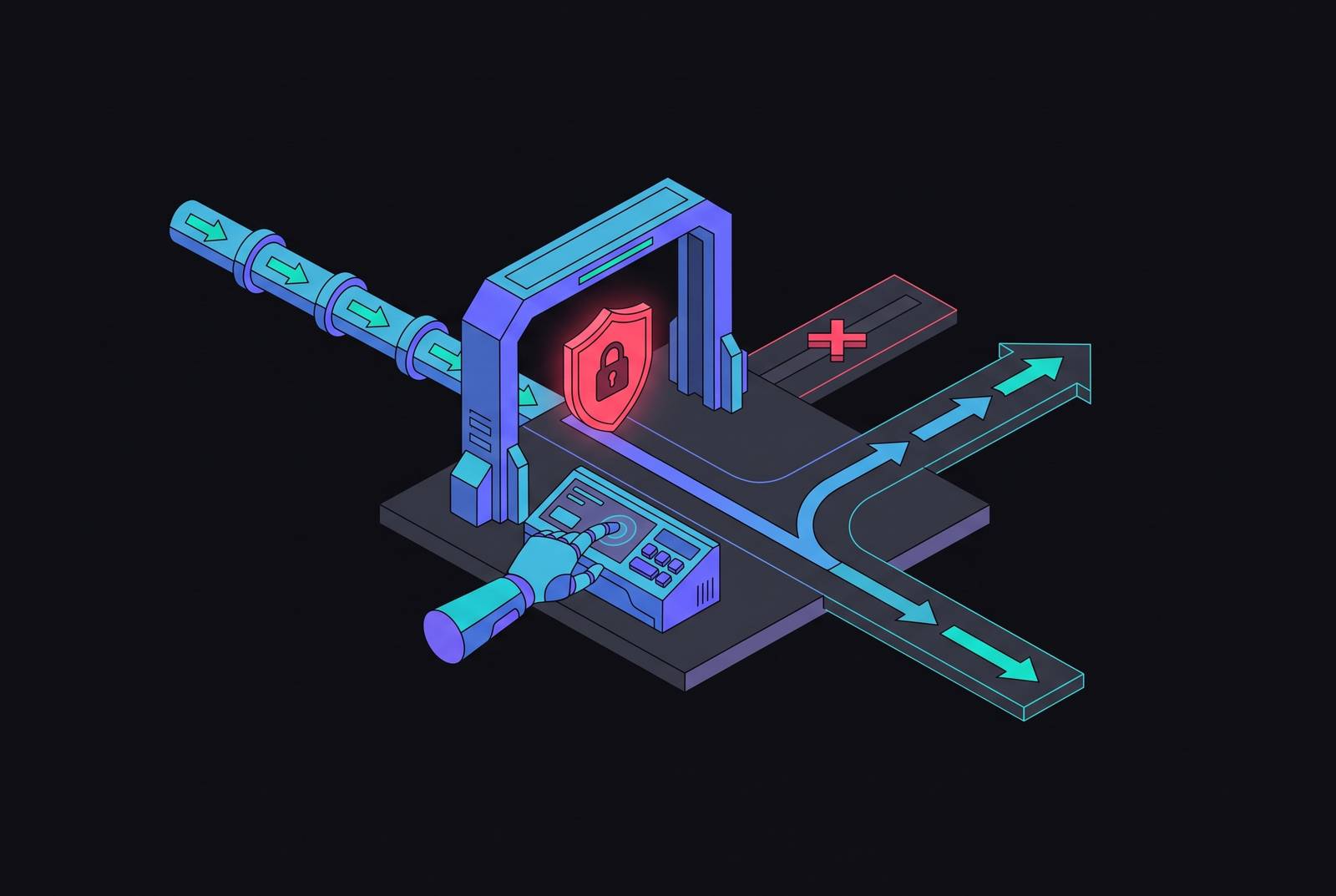
The current definition is specific: a person reviews and approves a particular agent action before it fires. Not a review of what the agent said it would do, not a look back at the transcript afterward. An actual gate sitting between decision and execution, blocking the second one until a human clears it.
Three modes cover the territory, and treating them as interchangeable is where most designs go wrong. Human-in-the-loop (HITL) means the system pauses and waits for a yes before it moves. Human-on-the-loop (HOTL) means the agent acts on its own while a person watches and can step in during or right after, which works fine when mistakes are cheap to reverse and expensive to prevent. Fully autonomous means no checkpoint at all, reserved for low-risk, high-volume, routine stuff nobody wants a human rubber-stamping a thousand times a day.
HITL is supposed to apply selectively, to actions that are genuinely high-risk or hard to walk back. That's the part almost everyone glosses over. Slap an approval requirement on every action an agent takes and the automation might as well not exist, because a human is now the bottleneck on every single step. According to AvePoint's State of AI Report, 95.5% of organizations took at least one action to mitigate agent-related security risk after an incident, and adding human-in-the-loop controls was the most common response. Notice the tense: that's organizations reacting to an incident that already happened, discovering after the fact that a bad action propagates through connected systems before anyone's even looked at a dashboard.
Deciding which actions need a human checkpoint, the blast-radius framework
Forget how smart the agent seems. Intelligence isn't the variable that matters here. The question that decides whether an action needs a gate is how bad it gets if the agent is wrong, and how hard that badness is to clean up afterward. Call it blast radius: if this action goes sideways, what does undoing it actually cost, in hours, in dollars, in a phone call to a regulator?
Run the audit starting from the action itself, not the agent. List every action a given agent can take, then for each one ask what reversing it requires, whether that's a click, a restore job pulled from backups, a legal disclosure, or nothing at all because it never left a mark. That single question sorts almost everything on its own.
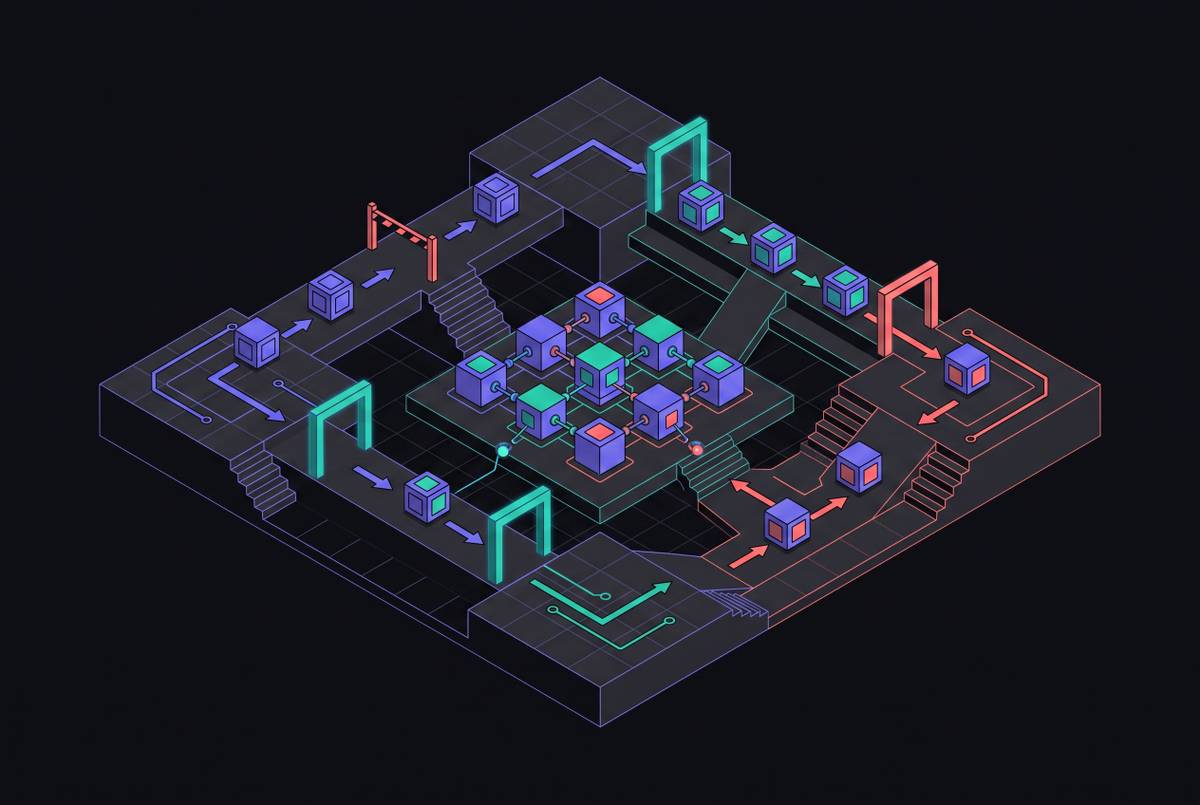
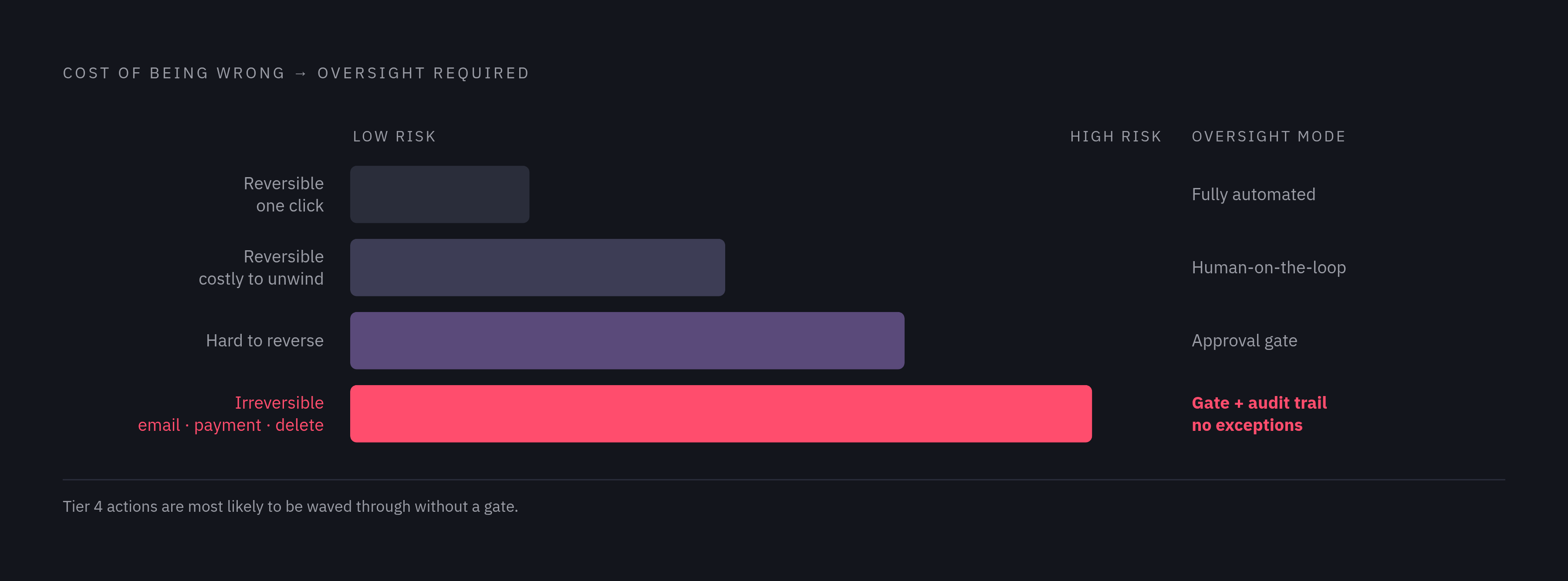
Four buckets fall out of the exercise, and they map to a rising cost of being wrong. Fully automating an action is fine when a click can reverse it. Actions that are reversible but expensive to unwind, meaning someone loses an afternoon fixing it, call for human-on-the-loop monitoring rather than a full stop. Actions that are hard to reverse without real effort get a mandatory approval gate. Actions that can't be reversed at all get a mandatory gate plus a logged audit trail with no exceptions, covering a sent email, an executed payment, a deleted record, and exposed customer data.
One agent will often live in more than one bucket depending on the step. A booking agent checking flight availability is low-stakes; the same agent committing a payment two steps later is not, and needs a different level of scrutiny at that exact moment, not the level assigned to the agent as a whole. The oversight model has to move with the workflow, step by step, or it ends up protecting the wrong thing. Gartner has projected that governance gaps will cause roughly half of AI agent deployment failures by 2030, which turns this classification exercise from a compliance checkbox into a "does the company still exist in five years" question.
Four implementation patterns and when each one fits
Interrupt-and-resume works synchronously: the agent hits a predefined checkpoint, saves its full workflow state, and waits for a person to approve, reject, or edit before it continues. The mechanism only holds together because of durable state persistence, checkpoints that store everything the agent needs so execution can pause mid-task and pick back up without starting over. Engineers get bitten by one detail constantly: on resume, the interrupted step re-runs from its own top, so anything with a side effect (a charge, a database write) sitting before the interrupt point needs to be idempotent, or it fires twice. The agent itself never decides when to pause, either. Pause points get set by the orchestrator ahead of time, because an LLM's judgment about when it needs supervision is exactly the judgment nobody should trust it to have. This pattern is built for irreversible, high-stakes moves: sending the email, moving the money, deleting the record.
Async review lets the agent act first and logs the decision for a human to look at later, without blocking anything in real time. It fits when speed takes priority over prevention and the action is reversible anyway, but someone downstream, compliance, an auditor, still needs a paper trail. This pattern catches bad actions only after the fact. It stops nothing on the way in.
Approval tiers by risk threshold hardcode the logic instead of leaving it to a case-by-case judgment call. A finance agent might handle routine account queries with zero friction, then require sign-off the moment it touches a transfer, a refund, or an account change. The threshold that trips the gate can rest on a confidence score or simply on the type of action requested. Either is legitimate, as long as the rule is written down somewhere and can be audited later, rather than living in one engineer's head and dying the day that engineer quits.
Hard stop for infrastructure lets an agent analyze a system, draft a plan, even write out proposed changes, but anything that would actually touch production gets frozen until a human signs off. The agent behaves like a genuinely useful assistant that's never handed the trigger. This is the right call for infrastructure and security work specifically, where one bad command cascades through a dozen dependent systems before anyone notices the first one failed.
Latency is a real cost here, not a footnote to wave away. Every synchronous checkpoint adds wait time, and in a pipeline with five or six steps, those delays stack into something a user notices. Picking the right pattern per tier is a performance decision as much as a safety one, and pretending otherwise just moves the cost somewhere less visible.
What the 2025 AI Agent Index shows about how production systems implement this
The 2025 AI Agent Index looked at 30 deployed agentic systems, which makes it the closest thing available to an empirical snapshot of how this plays out in production, rather than how it reads in a vendor pitch deck.
The autonomy split breaks cleanly. Chat-first assistants (Anthropic's Claude, Google's Gemini, OpenAI's ChatGPT) are at the low end, turn-based, waiting on the next prompt before doing anything else. Browser agents are at the high end: Browser Use and Perplexity's Comet execute multi-step tasks autonomously once given an instruction, with no way for a user to step in mid-run, accounting for 2 of the 5 browser agents studied and 5 of the 30 overall. Enterprise platforms look like a middle tier on paper but often land close to full autonomy in practice: six of the thirty systems studied, including enterprise platforms like Glean, Google's Gemini Enterprise, IBM's watsonx, Microsoft's Copilot Studio, n8n, and OpenAI's AgentKit, often operate at high autonomy levels with no human involvement during the actual task.
The stop-mechanism numbers deserve the closest read in the whole index. Only 20 of the 30 agents document any pause or stop mechanism at all, so a third of the sample gives operators no documented way to halt a running process, full stop. Four agents, Alibaba's MobileAgent, HubSpot's Breeze, IBM's watsonx, and n8n, execute autonomously with no documented stop option whatsoever. For some enterprise platforms, the only lever available is shutting down every agent at once or retracting the whole deployment, a blunt instrument for what should be a targeted, single-action problem.
Where approval gates exist, they cluster around the highest-risk categories specifically, which is the one piece of good news in the dataset. Developer-focused agents require explicit confirmation for sensitive moves like file edits or command execution (3 of the 30 studied). Browser agents gate authentication and payment steps specifically rather than everything (4 of the 30). A handful offer a "watch mode" for real-time human oversight during critical actions, five of the thirty, including ChatGPT Agent and ChatGPT Atlas. The pattern across the index holds steady: production systems gate selectively on the riskiest action types. They don't blanket-approve everything, and they don't autonomize everything either.
Tooling available for teams building HITL into agent workflows
LangGraph handles interrupts two ways: static breakpoints set at compile time, and dynamic interrupts a node can raise mid-run based on what it's seeing. Both pause execution, save the graph's state to a checkpoint store, and resume from a command rather than restarting the whole workflow from scratch.
Google's Vertex AI Agent Development Kit is designed to support human-in-the-loop integration within agent workflows. AWS Bedrock AgentCore, which went into preview in July 2025 and reached general availability that October, handles managed orchestration with access controls and observability built in for agent systems running at scale.
Microsoft's Magentic-UI, an open-source research prototype released in May 2025, gives researchers a testbed for studying oversight mechanisms directly: co-planning, co-tasking, action approval, and memory among its interaction modes. Plans need approval before they run, and higher-risk actions require explicit confirmation. Scoping approval requirements specifically to sensitive categories, financial transactions, data changes, anything with a real consequence attached, is a common design principle in agent frameworks built for production use.
Galileo takes a different angle, aimed less at building the pause mechanism and more at showing teams whether their pauses are actually working. Galileo takes a different angle, aimed less at building the pause mechanism and more at giving teams visibility into whether their oversight is working across production agent deployments.
None of these tools solve the whole problem alone, and buying one isn't the finish line. Runtime monitoring, policy enforcement, and audit logging all need to work the same way no matter where the agent runs, whether that's inside Microsoft 365, Google Workspace, or something built in-house from scratch. The same risk-tiering logic has to travel across that whole surface. That need produces the platform layer that the individual HITL tools depend on to function at all, functioning not as a competitor to them but as the infrastructure beneath their operation.
Where HITL is already non-negotiable, healthcare, finance, legal, and customer service
Healthcare puts the checkpoint exactly where it belongs. An agent can pre-screen a medical image for anomalies all day long, that's pattern-matching and nothing more, but a physician reviews and confirms the actual diagnosis before anything happens to a patient. The gate sits at the diagnosis, not the image processing, because the diagnosis is the step that decides what treatment a person receives.
Finance runs the approval-tier pattern almost by definition. Agents flag suspicious transactions or recommend a loan gets approved; human underwriters review for compliance, for fairness, for bias the model might carry without knowing it's carrying it, before anything actually executes. Routine queries move without friction. Disbursements stop for a human signature, every time, no exceptions carved out for a good track record.
Legal work leans on agents for triage: prioritizing cases, flagging potential threats that need a closer look. The final call stays with an officer, because that judgment requires context and ethical weighing an agent has no mechanism for producing, no matter how good its pattern-matching gets.
Customer service runs on the confidence-threshold model directly. Agents field the routine questions, summarize the conversation so far, suggest what to do next. The moment confidence drops or the topic turns regulatory, the conversation escalates to a human, full context intact, no starting over. A CX study by SurveyMonkey found that 79% of respondents strongly prefer a human over an AI agent for customer service. Trust here is a constraint the design gets built around from the first line of the spec.
Regulation is converging on the same conclusion from a different direction. The EU AI Act's Article 14 requires human oversight to be effective and staffed by people who are actually trained for it. NIST's AI Risk Management Framework, voluntary as it is, calls for oversight that gets measured and documented, carried through in practice and not just sketched on an architecture diagram somewhere.
Automation bias, the failure mode that can hollow out a HITL checkpoint
Putting a human in the loop doesn't automatically mean the loop works. The International AI Safety Report 2026 names the failure mode directly: automation bias, the tendency of people to over-trust an automated system's output and discount evidence that contradicts it.
It appears in two ways. Omission errors happen when the human misses a problem because the automated system didn't flag it, so nobody thought to go looking on their own. Commission errors happen when the human acts on bad advice the system handed over, because it arrived dressed up as a recommendation, and recommendations have a way of feeling like facts once they're sitting on a screen in front of you. A rubber stamp with a heartbeat behind it is still a rubber stamp. The heartbeat is decoration.
Aviation solved a structurally identical problem decades ago through Crew Resource Management: structured briefings, standard phrasing everyone uses the same way, challenge-and-response checklists, debriefs with no finger-pointing attached. It measurably cut human-factor accidents and became the global standard, because the industry stopped assuming a person watching a dial was the same thing as a person actually thinking about the dial.
Most organizations building agent oversight right now skip that lesson. They put a person "in the loop," call the job done, and never train anyone on what a real challenge to the agent's recommendation is supposed to sound like. No structured friction gets built in anywhere, and nothing actually makes a human pause before hitting approve. Put a person in front of a screen with an approve button and a habit, and you haven't built oversight. You've built a witness.