Change Management for Enterprise AI Agent Rollouts
Establish governance and oversight infrastructure before rollout, not after the first incident.
AI agents are moving through engineering, finance, product, and sales teams faster than the frameworks meant to govern them. Gartner projects that by the end of 2026, roughly 40% of enterprise applications will carry task-specific agents, up from under 5% in 2025. Salesforce's Agentic Enterprise Index found the average number of agents active per organization nearly tripled over the past year. The market backing this shift is worth billions today and expected to be many times larger within a decade, which means the cost of botching a rollout is climbing just as fast as the technology itself. This is largely an organizational problem, and most companies are sequencing the work in the wrong order.
Why most failures trace back to organizational decisions, not technical ones
The easy story is that the model wasn't good enough, or the integration broke, or the vendor overpromised. That story is usually wrong. Analysis of enterprise deployments from 2024 and 2025 found that scope creep and bad data account for the large majority of agent failures, and neither of those is something a better model fixes. Research on multi-agent systems, published by Cemri and colleagues in 2025, found something almost embarrassing for the industry: the same underlying model often performs better alone than it does coordinating with other agents in a multi-agent setup. The failure sits in how the workflow was designed, separate from what the model can compute.
Ask most executives what's holding their AI program back and they'll say skills. A large majority name a lack of skilled personnel as their top implementation obstacle, and most think their own users need more training. Fair enough, but that framing points the finger in the wrong direction. The gap has more to do with workflow design, governance, and the unglamorous work of change management that nobody wants to own than with model engineering itself. Forrester's 2025 data found that only about a quarter of employees understand foundational concepts like prompt engineering, meaning companies are handing agents to a workforce that hasn't been taught to talk to them yet.
Data compounds the problem before a single user ever sees an output. Many enterprises still can't move the data an agent needs from one system to another without manual patchwork, and inconsistent data undermines agent reliability at the source. Buying a better model doesn't fix a data pipeline held together with duct tape. Redesigning how the rollout is sequenced and governed matters more here than shopping for a smarter vendor.
The shadow AI problem that poor rollouts create
Give employees a slow, clunky, or gatekept official AI tool, and they will go find a better one on their own laptop. This reflects what happens in every organization when the sanctioned path is worse than the unsanctioned one, rather than any failure of discipline.
IBM's 2026 Institute for Business Value study found that nearly all enterprises now say AI sprawl is raising both security risk and operational complexity. A strong majority of executives believe their company has already suffered a data leak or breach tied to an unapproved AI tool, and a meaningful share admit they couldn't shut down a rogue agent immediately if they needed to. Active agents inside the Microsoft 365 ecosystem grew sharply year over year, a visible proxy for how fast this sprawl outpaces governance built for tools that wait for a human to click "approve." Gartner expects shadow AI to be a contributing factor in a large share of enterprise AI failures by 2027.
There's a structural reason people go around the system instead of through it. Microsoft's 2026 research found that only a small fraction of AI users get rewarded for reinventing how they work with AI when the results aren't guaranteed in advance. So experimentation goes underground instead of into a sanctioned pilot where someone might actually learn from it.
This matters more with agents than it ever did with software, because of how agents inherit access. An employee who ignores a permission boundary is a one-off incident, something HR handles over coffee. An agent doing the same thing runs as a repeatable, autonomous pattern at machine speed, every hour, without anyone in the loop noticing until the audit. Agents don't forget a workaround, don't hesitate before using excess access, and don't apply judgment about when to escalate a decision to a human. That makes visibility and enforcement a prerequisite for scaling, not a nice-to-have bolted on after the first incident.
What governance infrastructure needs to be in place before agents go wide
A significant share of enterprises have no formal plan for supervising their agents at all. Governance built after the incident report arrives too late; the point of infrastructure is that it exists before it's needed.
Five things need to be true before an organization scales past its first pilot. Discovery means knowing every agent running inside the company, including the ones a scrappy team spun up without telling IT. Monitoring means real-time visibility into what approved agents are actually doing and which systems they're touching. Anomaly detection means catching a deviation from expected behavior before it turns into a customer-facing mess. Policy enforcement means rules that apply at runtime, distinct from rules sitting in a PDF nobody reads. Audit logging means a complete, tamper-evident record of every action an agent takes, because "we're pretty sure it did X" doesn't hold up to a regulator or a board.
Ownership matters just as much as the tooling stack. Companies that assigned clear ownership before scaling were far less likely to roll back a deployment than companies that only figured out who was in charge after something broke in production. The EU AI Act and NIST's AI Risk Management Framework are both tightening the screws here, requiring oversight that's measurable and demonstrable, not just declared. Major EU AI Act obligations phase in through 2025, 2026, and 2027, so the compliance clock is already running whether or not the internal governance plan is ready.
Evaluation infrastructure has to exist before the first production task. That means a labeled test set, defined quality thresholds, and alerting configured to catch drift, because the agent count inside most organizations is climbing nearly threefold year over year and nobody's manually checking each one. And access controls need to be built for agents from scratch, separate from repurposed human permission models. A person with excess access might not use it. An agent will, because it has no concept of restraint. Least privilege isn't best practice for agents; it's the baseline requirement.
How to sequence the rollout in phases that build on each other
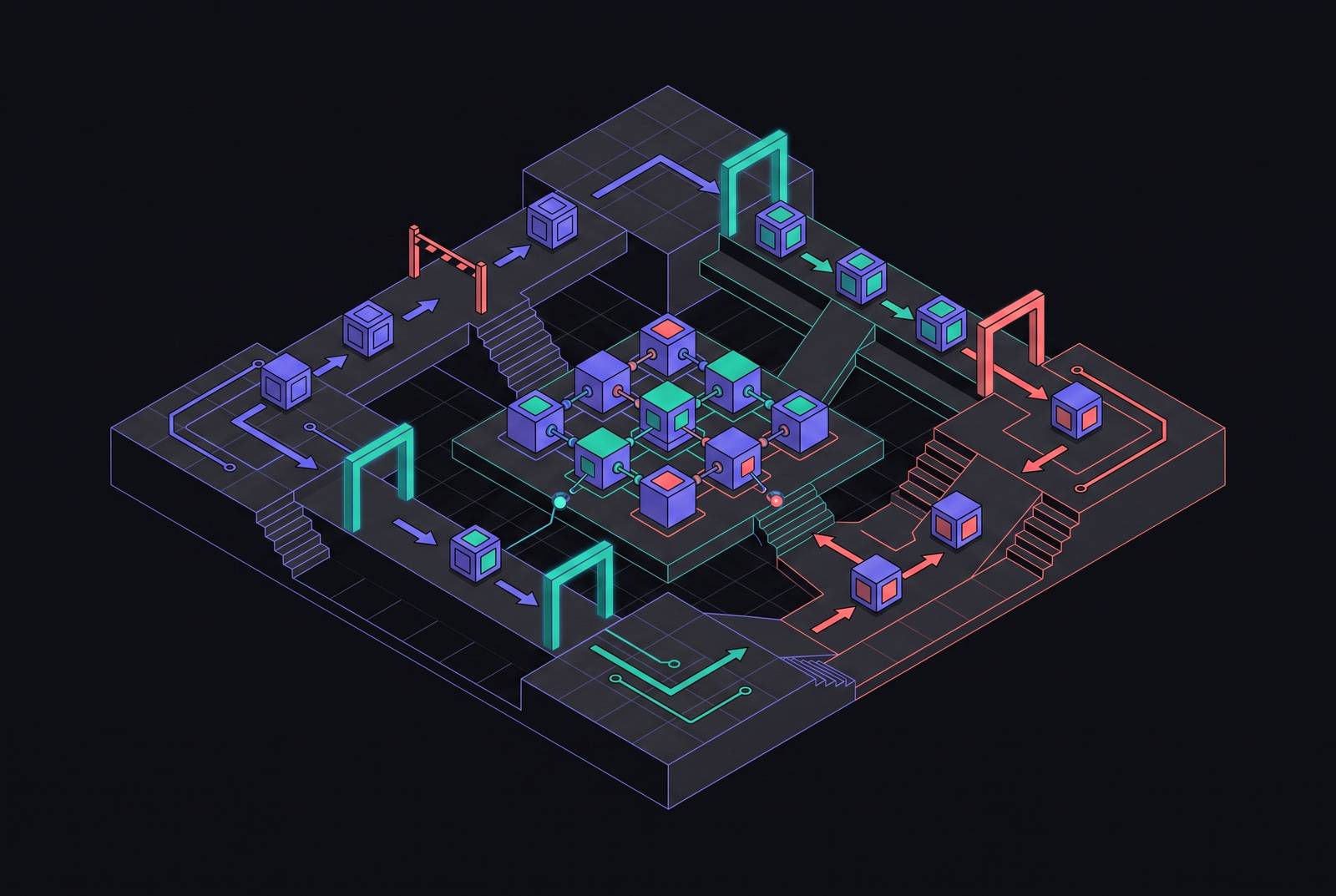
Gartner's staged model is a decent map for where this is headed. Stage one, in 2025, is nascent adoption: isolated agents, under 5% of enterprise apps integrated. Stage two, by 2026, ramps to roughly 40% of apps carrying task-specific agents. Stage three, by 2027, moves into multi-agent systems handling complex tasks that span multiple applications at once.
The governance and observability work described above belongs in stage one. Retrofitting it during stage two is exactly the pattern behind the failure rates cited earlier, and it's an expensive way to learn a lesson that was foreseeable from the start.
Start with internal-facing tasks that are lower stakes and reversible, well short of the customer-facing workflow or the decision that can't be undone. Pick pilots where clean process documentation already exists before the agent gets built, and where success metrics get defined before deployment rather than reverse-engineered from whatever the agent happens to spit out. BDO Colombia's rollout is a useful case: it delivered measurable workload reduction and process optimization across administrative workflows inside 90 days, and that speed was possible precisely because documentation and metrics were locked in before the build started, not scrambled together afterward.
McKinsey's 2025 research backs this up directly: organizations that define measurement criteria before deployment see substantially larger cycle-time reductions than those that don't. The measurement isn't just there to keep score after the fact. It shapes what actually gets built.
The gate for expanding a pilot should be blast radius rather than the calendar. Move a workflow forward when the cost of a failure is bounded and recoverable, full stop, regardless of whether three months have passed or a stakeholder is impatient for a demo. Gartner projects that a large share of agentic AI projects will get canceled by the end of 2027 over cost and unclear value, and pre-defined success criteria are the main thing standing between a project and that fate.
Human-in-the-loop as a trust-building mechanism, not just a compliance checkbox
Most people think of human-in-the-loop as a box to check for compliance. That undersells what it actually does. HITL is the primary mechanism through which an organization builds real confidence that its agents behave the way they're supposed to.
AvePoint's 2026 State of AI report found that nearly all organizations that had an agent-related security incident took action afterward, and human-in-the-loop was the most common fix they reached for. That's a reactive pattern, and reactive is always more expensive and more disruptive than building oversight in from day one. But it tells you something useful: when things go wrong, this is the lever companies trust to make it right.
Three oversight modes exist, and they map to three different risk levels. Human-in-the-loop puts a person in the decision seat for individual high-stakes actions. Human-on-the-loop lets the agent act while a human monitors and can step in, so the agent proceeds unless stopped. Fully autonomous means the agent acts on its own and review happens after the fact. The choice between these three should hinge on blast radius, meaning how hard the action is to undo, rather than on how sophisticated the agent seems. A very capable agent making an irreversible decision still needs a human in the loop; a modest agent doing something trivially reversible doesn't.
McKinsey's 2026 trust research found only about a third of enterprises meet their own governance bar for autonomous agents, and security topped the list of reasons they hesitate to scale further. The regulatory floor is rising to match: Article 14 of the EU AI Act and NIST's framework both demand oversight that's trained, measurable, and provable, beyond what a policy statement alone can promise.
There's a change-management payoff buried in all of this. When employees can see that a human still holds the final say on the decisions that matter, resistance to the agent drops. Oversight functions as more than risk control — it's the signal that makes adoption possible in the first place.
The employee resistance problem and what actually moves it
Resistance gets talked about less than it should, and invested in even less than that. Most leaders name it as a major barrier, yet only a small minority of enterprises put real money behind change management to address it.
The 2026 WRITER and Workplace Intelligence survey, covering more than 1,600 executives and knowledge workers, puts numbers to the friction. A large majority of organizations report AI adoption challenges, a double-digit jump from the year before. More than half of C-suite leaders admit AI adoption is generating real internal tension. And roughly three in ten employees admit to actively resisting or quietly undermining their company's AI strategy, with the number skewing higher among younger workers, the group least likely to have the political capital to raise concerns openly.
This resistance isn't irrational. A large share of executives have said plainly they plan to cut headcount among employees who don't or can't adopt AI, so the fear driving the pushback is grounded in something real. Worse, companies that build up a small class of "super-users" while everyone else falls behind create exactly the internal split that makes broad adoption harder. The Wharton and GBK Collective study from October 2025 found that among employees already lagging, distrust and resistance loom far larger as barriers than they do for active users, and that gap widens without someone deliberately intervening.
A memo alone won't move the needle. Framing the agent as a collaborator rather than a replacement correlates with higher adoption. Executive buy-in that shows up in behavior, beyond a town hall speech, correlates with meaningfully higher ROI, per Accenture's research. Feedback loops that put employee pilot experience in front of decision-makers keep resistance from going underground, because resistance with a legitimate outlet is resistance that gets addressed instead of buried. And Microsoft's 2026 data found that organizational factors, separate from individual attitude, account for the large majority of AI's real impact. The system matters more than anyone's personal enthusiasm for it.
Building the reskilling infrastructure that makes adoption stick
Reskilling tops the list of workforce strategies business leaders name for the next 12 to 18 months, according to Microsoft's 2025 Work Trend Index Annual Report. Fair enough, but PMI's 2026 analysis makes a sharper point: what looks like a skills gap is often an execution gap. Companies haven't built the organizational muscle to deliver upskilling at scale, so the program stalls no matter how good the training content is.
Three distinct layers need to exist, not one blanket program. AI literacy is the shared baseline: what agents are, how they work, where they break, so employees can give useful feedback during a pilot instead of shrugging. AI adoption is the redesign of roles and incentives so agents get embedded into how work actually happens, instead of sitting as an optional extra nobody touches. AI-specific technical capability is the narrower set of skills, workflow design, prompt engineering, evaluation, that a smaller group needs to actually run and improve the deployments.
BCG's Build for the Future x AI 2025 study found that the small share of companies realizing substantial financial gains from AI also post dramatically stronger financial performance and shareholder returns than the laggards. The reskilling investment is one of the clearest lines separating that group from everyone else, arguably as much as any technology decision they made. LinkedIn's Work Change Report projects that by 2030, a large majority of the skills used in most jobs will have changed, which means reskilling isn't a one-time initiative tied to a single agent launch. It's a permanent capability an organization either has or doesn't.
Two design choices separate programs that stick from ones that fade. Reskilling tied to specific workflows and specific roles works better than a general AI literacy course everyone sits through once and forgets. And the super-users who emerge early should get used as internal coaches, beyond being paraded as productivity case studies; their real value is in what they can teach the next person, not in what they alone produce.