ISO IEC 5338 Compliance Readiness for Enterprise Agent Programs
Autonomous agents expose gaps in ISO/IEC 5338's process model that enterprises must close now.
ISO/IEC 5338:2023 does not tell you what to believe about artificial intelligence. It tells a company how to build and run an AI system without losing track of who decided what, when, and on what evidence. That distinction matters because most of the public conversation around AI compliance treats every standard as a values document, a list of principles an organization can nod along to in a slide deck. 5338 is closer to a blueprint than a mission statement. It specifies the work products, the decision points, and the role assignments an organization needs to move an AI system through its life cycle in a controlled way, from first scoping to final retirement. It was built on ISO/IEC/IEEE 15288 and 12207, the existing systems and software engineering process standards, rather than invented from scratch as a parallel AI-only regime. That inheritance is the whole point: 5338 extends process models that engineering organizations already run, and layers onto them a set of "AI particularities," attention points specific to machine learning and heuristic systems that traditional software process standards never had to cover. Those particularities include protecting sensitive training data, naming new risk categories like transparency and unwanted bias, managing predictability during experimental development stages, and making sure the right skill sets sit on the right parts of the project. None of that is governance in the sense of a charter or a policy statement. It is process engineering applied to a class of systems whose behavior is learned rather than written, and the standard's entire structure follows from that one adjustment. Where ISO/IEC 42001 sets up how an organization governs its use of AI as an institutional matter, 5338 sets up how a team actually executes an AI system's life cycle, stage by stage, with defined boundaries and defined outputs. Every gap examined in this piece is a process gap, not a policy gap, and that framing holds from scoping through retirement.
Governance challenges of autonomous agents
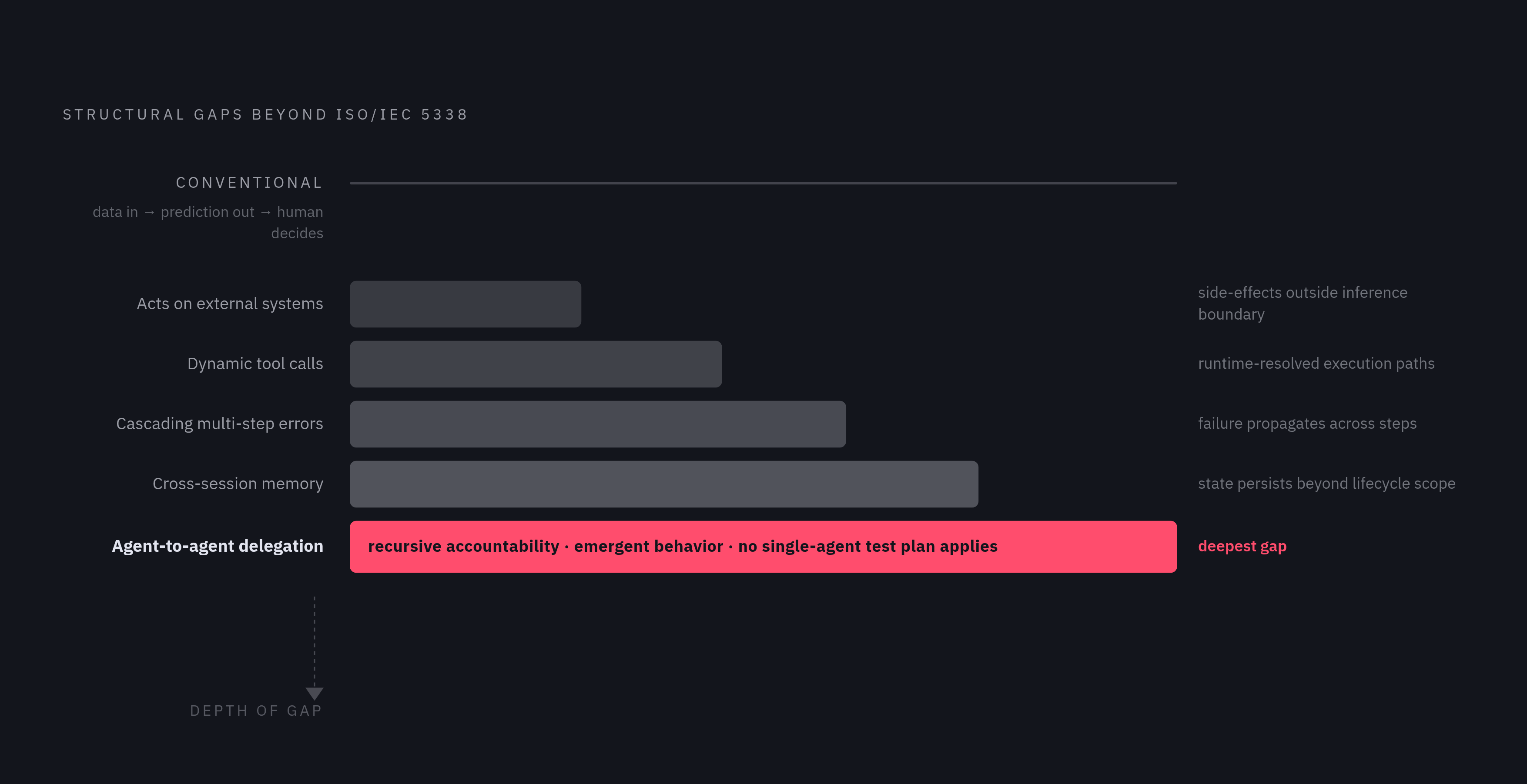
Conventional AI systems, the kind 5338's process model was built around, run on bounded inference: data goes in, a prediction or classification comes out, and a human decides what happens next. Autonomous agents break that loop open. An agent plans a sequence of actions, calls tools to execute them, observes the results, and replans, often taking several of those steps before any person reviews what happened. Each step can touch a live system, a database, an email account, another agent, before a human ever sees the chain of reasoning behind it. Agents also call tools dynamically rather than through a fixed interface, execute multi-step plans where an early mistake cascades into later ones, carry state across sessions instead of resetting with each query, and in growing numbers delegate pieces of a task to other agents. None of those five properties, acting on external systems, dynamic tool calls, cascading multi-step errors, cross-session memory, and agent-to-agent delegation, were part of the deployment pattern 5338's authors had in view when they adapted 15288 and 12207 for machine learning systems.
Research on agentic governance gaps bears this out directly: current frameworks, 5338 among them alongside the NIST AI RMF, ISO/IEC 42001, and the EU AI Act, reference autonomy and agentic use to varying degrees but none define a distinct regulatory category for agentic AI systems. The lifecycle process model at the center of 5338 predates agentic deployment as a paradigm. Three risk categories sit entirely outside what any existing compliance-tier framework was built to catch: multi-agent orchestration, where accountability chains become recursive as agents delegate to other agents; cross-session state accumulation, where an agent's working memory grows with every interaction and becomes harder to audit over time; and emergent behavior that only appears when multiple agents interact, which no single-agent test plan can surface in advance.
The tool-calling layer compounds the problem on its own. The Cloud Security Alliance's research found that 92% of large-enterprise CISOs and CIOs lack full visibility into their AI agent identities. When the tool-integration layer an agent depends on is unauthenticated, any claim to validate that agent's behavior in production is incomplete from the start, because there is no reliable record of what the agent actually called and what it got back. The mismatch is structural and it is a matter of speed: agentic AI went from research curiosity to enterprise deployment paradigm in roughly eighteen months, while governance frameworks move on multi-year cycles shaped by regulatory negotiation and standards consensus. The frameworks built specifically for agents, AIUC-1, the CSA Agentic Profile, and OWASP's agentic security work, all date from 2025 or later, and all remain reference material. Enterprises running 5338 against an agent program are adapting a process model to properties it was never designed to handle, and that adaptation work is the actual compliance task in 2026.
The adoption-governance mismatch driving urgency in 2026
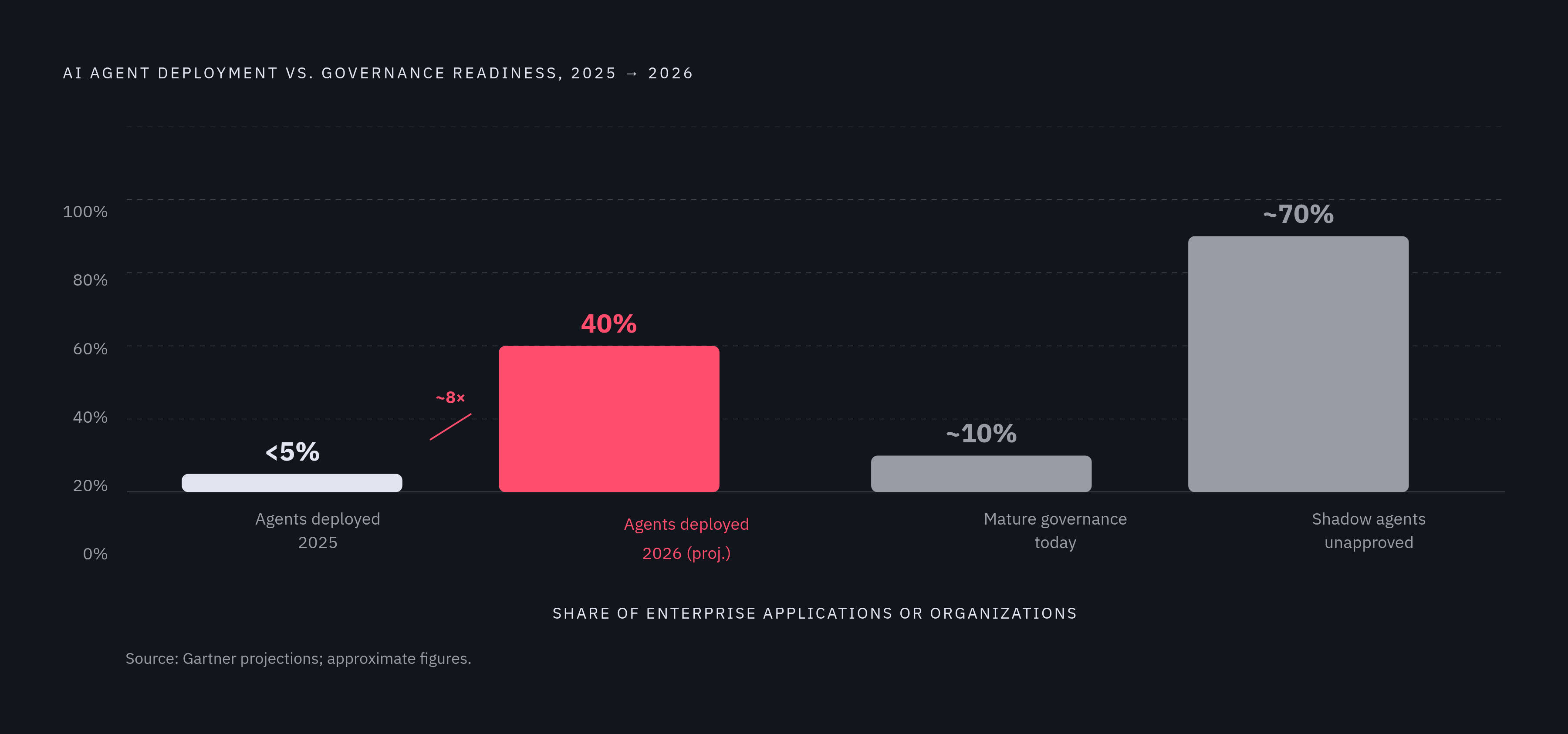
The gap between how fast agents are being deployed and how fast governance can be built around them is not an abstract risk sitting somewhere in the future. Deloitte research cited by Evolvance found that most organizations plan to adopt agentic AI within two years, but only a small minority currently run a mature governance model for AI agents. Adoption intent is near-universal, but the governance base is thin, and that is why agentic AI counts as the most urgent governance challenge facing enterprises in 2026, not a looming one. A Cloud Security Alliance survey found that most large-enterprise CISOs and CIOs lack full visibility into their agent identities, and even more of them doubt they could detect or contain a compromised agent if one turned up. Both findings describe a direct failure of the operational monitoring and continuous validation processes 5338 requires, measured in the field.
Industry analysts project task-specific AI agents will appear in roughly two-fifths of enterprise applications by the end of 2026, up from fewer than one in twenty in 2025. That rate of deployment is outrunning both the pace at which companies adopt relevant standards and the pace at which they build the internal governance muscle to run those standards day to day. Shadow agents make the gap worse rather than just wider: a significant majority of enterprises already have agents or agentic workflows running that their own security teams never approved and do not know exist. 5338's first requirement, defining what systems sit inside the lifecycle scope, cannot be satisfied while an unknown population of agents operates outside anyone's inventory. Regulation is closing in on the same timeline. The EU AI Act sets penalties of up to 7% of global annual turnover for prohibited AI practices, and its staged obligations arrive on a schedule that tracks the same lifecycle checkpoints 5338 defines, from initial risk classification through ongoing operational monitoring. If both the deployment curve and the enforcement calendar move this fast, you cannot treat compliance as a project to start later, once the agent program has matured. What follows is a process-by-process look at where that readiness gap actually sits, starting with the stage most agent programs never complete.
Scoping and discovery: the process stage most agent programs skip
5338 treats scoping as the first substantive compliance act, not a parallel workstream that can run alongside everything else. Before an organization applies a single other process in the standard, it has to define its AI system lifecycle stages and process boundaries. It has to know what systems exist. That sounds like a formality until the discovery data is examined: a large majority of enterprises are running agents or agentic workflows their own security teams never approved and do not know about. You cannot draw lifecycle boundaries around systems you have not found, so for most enterprise agent programs, the standard's entry requirement is unmet before any downstream process even starts.
The DIP-AI framework, developed at Universidade Federal de Goiás, PUC-Rio, and the Centro de Excelência em Inteligência Artificial, combines ISO 12207, 5338, and Design Thinking methods, and its research identifies problem comprehension and domain characterization as the point where AI innovation projects most often fail. A failure at that discovery stage does not stay contained there. It travels forward as a quality defect through every lifecycle stage that follows, because each later process, data governance, validation, monitoring, inherits whatever blind spots scoping left behind.
Closing that gap takes three concrete actions. An enterprise needs a full inventory of every agent or agentic workflow running anywhere in the business, including shadow deployments that security or IT never signed off on. It needs a named process owner assigned to each agent's lifecycle, because 5338 requires explicit role assignment, and you cannot make that assignment until discovery has happened. And it needs documentation of each agent's integration points: what systems it can read from, write to, or call, which becomes the foundation for the tool-layer security review that MCP exposure makes unavoidable. The platforms enterprises already use for agent deployment, Microsoft Copilot Studio, Salesforce Agentforce, Google Agentspace, AWS Bedrock Agents, ServiceNow AI Agents, and UiPath Agentic Automation among them, get evaluated regularly for governance and audit features, but none of them ship native discovery tooling that covers a multi-platform agent estate. Every one of those platforms leaves cross-platform inventory as a gap, and closing it takes dedicated tooling built for that purpose. The enterprises that treat agent discovery as running infrastructure, continuously checking for new and shadow deployments, are the ones actually meeting 5338's lifecycle boundary requirement as an ongoing process. Without that inventory, every subsequent stage of the standard, data governance, validation, monitoring, operates against a population of agents that is unknown and therefore ungoverned.
Data readiness and provenance: where 5338's training-data requirements meet agents' runtime data consumption
5338 requires organizations to manage data acquisition, preparation, and provenance across the full system lifecycle, and for conventional machine learning systems that requirement is front-loaded. Training data gets curated, frozen, and documented before the system ever goes live, so data governance is largely a pre-deployment concern that gets revisited only when the model is retrained. Agents do not work that way. An agent retrieves documents, queries databases, calls external APIs, and receives tool outputs in the middle of live operation, and every one of those runtime inputs is a data event the standard's provenance requirements apply to just as much as training data. Enterprise agent programs face a governance problem conventional ML compliance simply never had to solve: the data an agent acts on is live and often uncontrolled, not curated in advance.
5338's data requirements cover three things: assessing whether data is suitable, well-sourced, and good enough for training and testing; protecting sensitive training data, one of the AI particularities the standard calls out explicitly; and maintaining a traceable record of what data was used at each stage of the system's life. Applied to an agent, all three requirements have to extend into every operational session, not just the training phase, because an agent's runtime inputs change what it does in ways a frozen training set never could. Cross-session memory makes the problem worse over time rather than better: an agent that retains context across interactions accumulates a provenance chain that grows with every session, and the basic audit question, what context did the agent actually have when it made this decision, gets harder to answer the longer the agent has been running.
Three concrete steps close most of this gap. The first is a data lineage map covering every source an agent can query or retrieve from at runtime, not only the data used to train it. The third is retention and provenance logging for whatever memory store holds an agent's cross-session state, so that state is auditable. The MCP authentication gap raised in the scoping section reappears here in a different form: unvalidated outputs from unauthenticated tool endpoints are, by 5338's own definition, ungoverned data inputs, and no amount of training-data documentation compensates for a runtime pipeline that nobody can verify.
Verification, validation, and testing: why continuous validation is harder for agents than for models
5338 asks for three things at this stage: verification, confirming the system meets its technical requirements; validation, confirming it performs as intended in its actual operational context; and continuous validation, confirming it stays within acceptable behavior as the data and context around it keep changing. That third requirement, continuous validation, is the right principle for an agent program, and it is far harder to execute against an agent than against a conventional model.
For a conventional machine learning model, continuous validation is a comparatively mechanical exercise: monitor the distribution of outputs, rerun a benchmark dataset periodically, and flag drift through statistical comparison. The model is deterministic given its weights, so a change in output distribution is a real signal. Agents do not offer that stability. Validating an agent means checking the individual outputs at each reasoning step, checking whether it called the right tool with the right arguments, checking whether the full sequence of actions in a multi-step plan achieved its goal without producing some unintended side effect along the way, and checking whether its behavior changed when a task got handed off to a sub-agent. A plan can be valid at every individual step and still produce an outcome that violates policy once all the steps compound, and no standard test suite built for single-shot model outputs is built to catch that kind of compositional failure.
The MCP authentication gap recurs at this stage as a different kind of problem. When tool outputs are unauthenticated and uncontrolled, there is no reliable record of what inputs the agent actually had during a given task. Reconstructing why it acted the way it did after the fact is impossible by construction. To close that gap, you need test harnesses built to evaluate agent behavior at the level of the whole plan, and you need adversarial sequences designed to trigger policy violations across multi-step execution. That is the shape continuous validation has to take for agents: a process built around sequences and compounding effects, not a process built around checking one output against one benchmark and calling the system sound.