Regulatory Compliance for Enterprise AI Agents
Most enterprises run AI agents without the governance to control or stop them when things go wrong.

Gartner puts a number on it: 40% of enterprise applications will run task-specific AI agents by the end of 2026, up from under 5% in 2025. That's an extraordinary pace for any enterprise technology category.
Deloitte surveyed 3,235 business and IT leaders across 24 countries last August and September. Seventy-four percent expect moderate or extensive agent adoption within two years, and only 21% think their governance can handle it. That's most of a room agreeing the warning light is on while nobody moves toward the dashboard.
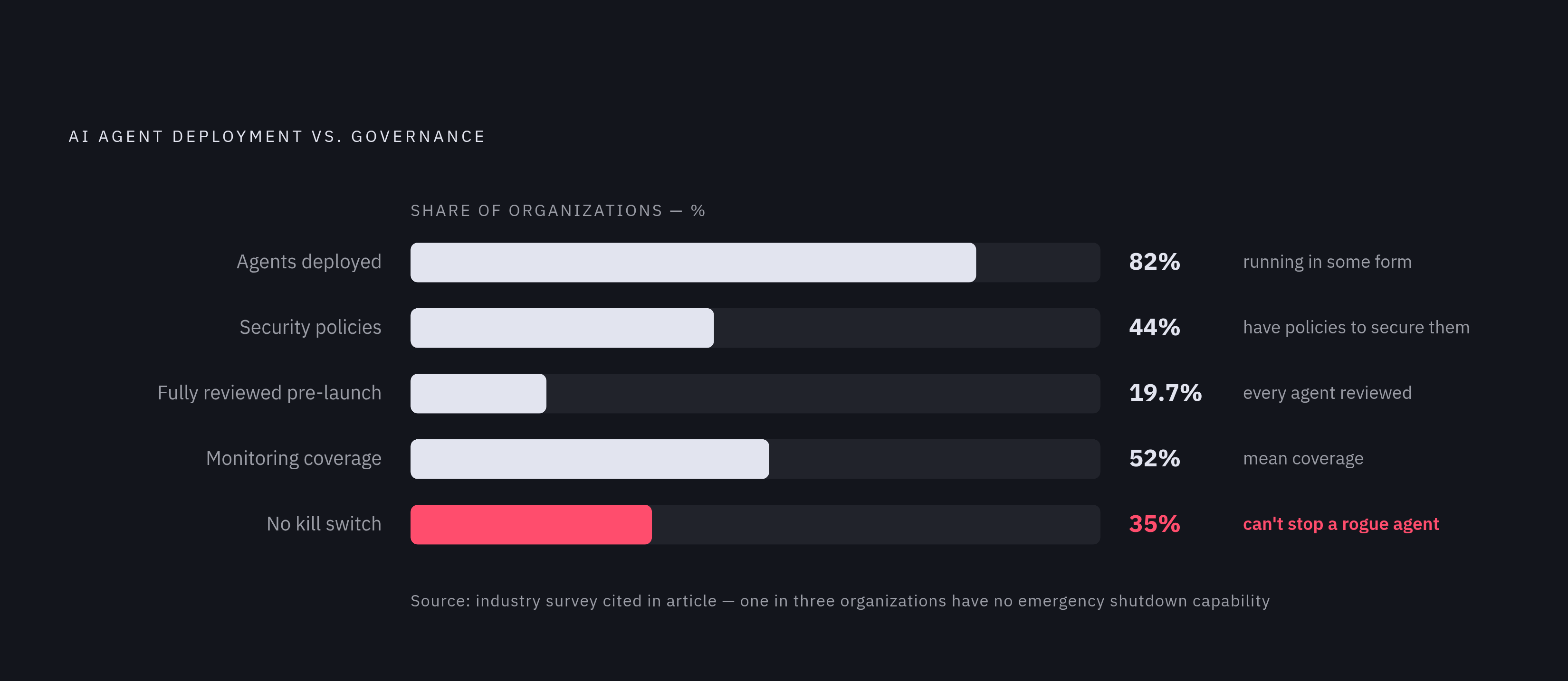
Ground level looks worse than the survey suggests. Eighty-two percent of organizations already run AI agents in some form, but only 44% have policies to secure them. gravitee.io research puts mean monitoring coverage at 52% across enterprises, which means roughly half of all agents in production run with no one reliably watching what they do. Only 19.7% of organizations say every agent got fully reviewed before going live; another 59.1% say "most" did, and I'd love to know what happens to the rest.
Here's the number that should worry a board more than any other: 35% of organizations admit they couldn't shut down a rogue agent if one showed up tomorrow. Incident response sits in nearly every framework touching AI as a baseline requirement, so this is a documented miss on something that already exists on paper. In practice, ownership of that kill switch is rarely established in advance.
This doesn't come from people not trying. The IAPP AI Governance Profession Report 2025 found 77% of organizations actively building or refining AI governance programs, climbing to nearly 90% among those already deploying AI. Deployment moves at software speed and governance moves at committee speed, and those two clocks have never once run at the same pace, in any industry, ever.
What the financial exposure from non-compliance looks like in practice
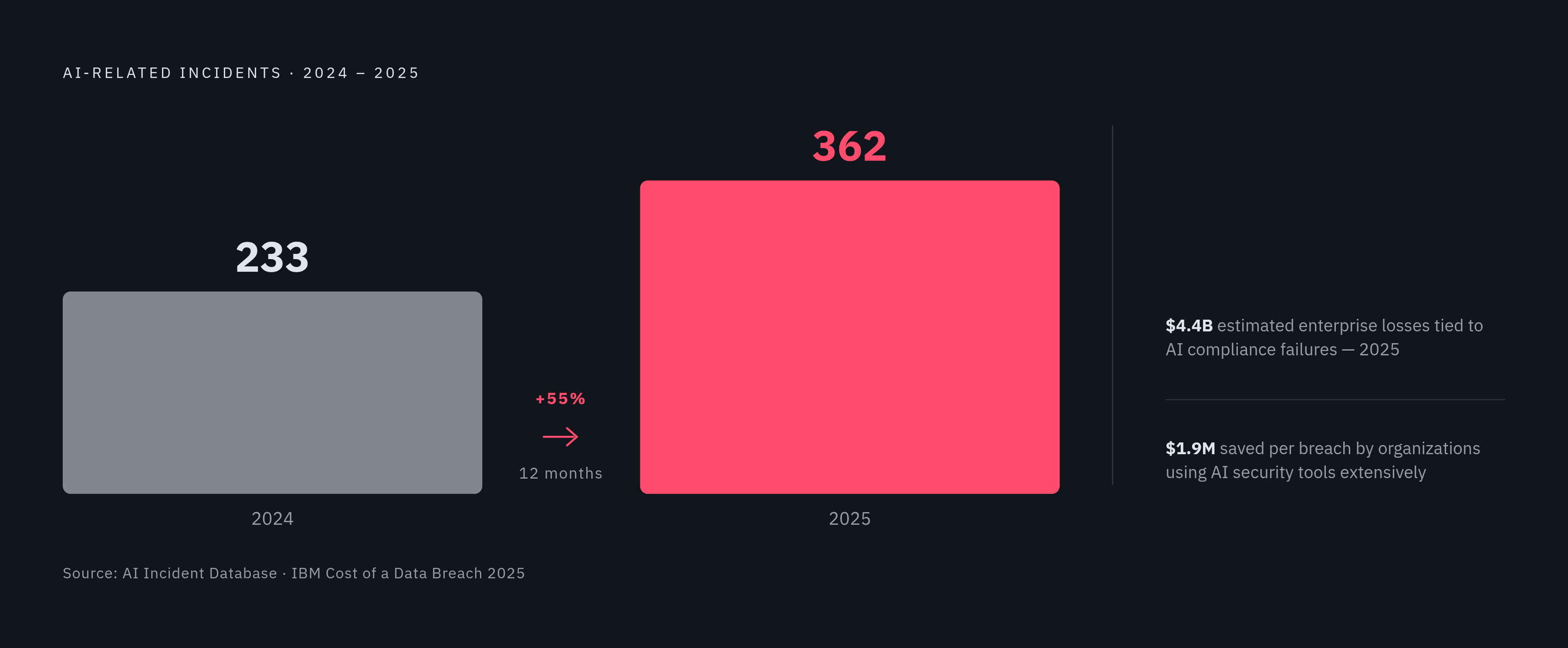
Enterprises lost an estimated $4.4 billion in 2025 tied to AI compliance failures. That figure covers breach costs, operational failures, and regulatory remediation spread across departments that never signed up to own AI risk. Legal teams that once owned compliance risk in isolation now share it across functions that weren't designed to carry it.
CSA research found 64% of companies above $1 billion in revenue reported losses over $1 million from AI system failures in 2025. Eighty percent of surveyed organizations documented risky agent behavior directly, meaning unauthorized system access or data exposure, the sort of thing that used to require a disgruntled employee with a grudge and now just needs one misconfigured tool call on a Tuesday.
Sector numbers sharpen the picture. Banking absorbed more than $3.2 billion in compliance-related fees in 2024. Healthcare breaches now average $7.42 million in 2025. And the ceiling under the EU AI Act runs up to €35 million or 7% of global annual turnover for violations tied to high-risk provisions. Almost nobody actually hits that number, but it still sets the tone for every negotiation happening underneath it.
There's a counterweight worth naming, because it's not all grim math. Organizations that use AI security tools extensively save roughly $1.9 million per breach compared to those that don't. Compliance spending behaves like the insurance policy you resent paying every single year, right up until the one year it saves the company.
What should actually worry a planner is the trend line, not the snapshot. AI-related incidents jumped from 233 in 2024 to 362 in 2025, a 55% increase in twelve months. That's the pool regulators draw enforcement precedent from, and it's growing faster than legal departments are staffing to track it.
The EU AI Act's risk-based framework and what it actually requires of agent deployments
The EU AI Act sorts systems into tiers: prohibited uses under Article 5, high-risk systems under Annex III, everything else landing in limited or minimal risk. An agent can fall into any tier depending on what it does and where it runs. What the vendor calls it on the box has no legal weight.
Article 5's prohibitions have been binding since February 2, 2025, no grace period attached. If an agent talks to users, makes recommendations, or shapes a decision in a banned way, that's already live law.
High-risk designation covers critical infrastructure, employment decisions, education, law enforcement, and biometric identification. A surprising amount of ordinary enterprise software sits right in that zone: HR screening tools, credit decisioning agents, customer risk scoring systems. Nobody on the engineering team wrote "this is a high-risk AI system" in the spec doc. The Act doesn't care what anyone thought at the time.
Compliance at that tier means conformity assessments before deployment, a risk management system maintained across the product's whole life, and technical documentation explaining how the thing works and how it was tested. It means human oversight, three words that sound simple until you try bolting them onto an architecture built to run unattended precisely because that's the efficiency pitch. Article 12 requires automatic logging for traceability. Article 13 requires transparency: users get clear information about how the system functions and decides. Article 14 requires "effective" human oversight, and nobody in Brussels has pinned down what "effective" means for an agent running six hours without a person in the loop. That single word is already contested in compliance circles, and enforcement hasn't even had its first real test yet.
Multi-agent setups don't get a pass either. The Act extends obligations to every agent in a chain performing a high-risk function, so an orchestrator can't claim its own compliance while waving off its sub-agents. A chain is only as compliant as its weakest link, and the weak link is almost always the sub-agent nobody thought to document because it seemed "internal."
Foundation model providers, OpenAI, Anthropic, Google, Mistral, carry their own obligations under the GPAI provisions: technical documentation, copyright compliance, training data summaries, incident reporting. None of that relieves the enterprise building an agent on top of those models. Deployment-layer obligations sit with the deployer, full stop, and Teams that assume the model vendor's paperwork covers their own deployment obligations are reading the law wrong.
Timing matters here. The EU AI Act phases in obligations on a rolling timeline — prohibitions first, then GPAI requirements, with full enforcement and penalties following — which sounds manageable until you account for how long a proper conformity assessment actually takes to run.
There's a real, unresolved tension underneath all of this: a high-risk agentic system with untraceable behavioral drift cannot currently meet the Act's essential requirements. The law asks for a level of auditability that most deployed agent architectures simply don't produce. That's the actual design problem facing anyone running a high-risk agent in the EU today.
One thing that trips people up constantly: the word "agent" never appears anywhere in the EU AI Act's text. Not once. The regulation binds agentic deployments anyway, because it regulates by function, not by name. That pattern repeats across nearly every framework in this piece. Rules govern what a system does, never what marketing decided to call it that quarter. Ask a regulator to define an "agent" and watch them point back at the word "system" instead.
How the U.S. regulatory patchwork applies to agents without a federal AI law
There's no federal AI law in the U.S. People keep hearing that and mentally translating it to "no regulation," which is expensively wrong for whoever bets a compliance program on it. Sector regulators are stretching existing frameworks over AI without waiting for Congress. The SEC, NYDFS, and federal banking regulators have all folded AI governance into cybersecurity rules that already existed.
More than 25 states have introduced or passed AI-related legislation. California and Colorado sit furthest along. Colorado's AI Act requires deployers of high-risk AI systems to run risk management programs, complete impact assessments, and disclose to consumers when AI is making a consequential decision about them. The functional requirements track the EU AI Act closely enough that a company building for one gets most of the other for free, which means aligned requirements across jurisdictions can reduce duplicated compliance work.
Gartner projects more than half of large enterprises will face mandatory AI compliance audits by 2026, and by 2028, 80% of organizations will fall under some form of AI-specific regulation. The patchwork fills in state by state, regulator by regulator, whether anyone planned for it or not.
Financial services carries the heaviest overlay of any sector, by a wide margin. Multiple overlapping frameworks — model risk guidance, data privacy rules, cybersecurity requirements, and sector-specific regulations — can apply to a single agent deployment simultaneously, which is a genuinely demanding stack of paperwork for a chatbot answering loan questions. Financial regulators have increasingly flagged AI agent autonomy, scope creep, and multi-step reasoning chains as distinct risks that make outcomes hard to trace back to a cause.
None of this stays inside U.S. borders either. Data protection laws now sit on the books in more than 144 countries, and multiple jurisdictions outside the EU and U.S. have enacted or strengthened privacy frameworks in recent years. A multinational scoping its compliance program to just the EU and the U.S. is planning for a map that stopped existing a while ago.
Put plainly: a large U.S. enterprise running agents across HR, finance, or customer data already sits under multiple binding obligations right now, federal AI law or not. That's current exposure, not a future risk sitting on a roadmap.
What the four core compliance requirements look like when mapped to agent behavior
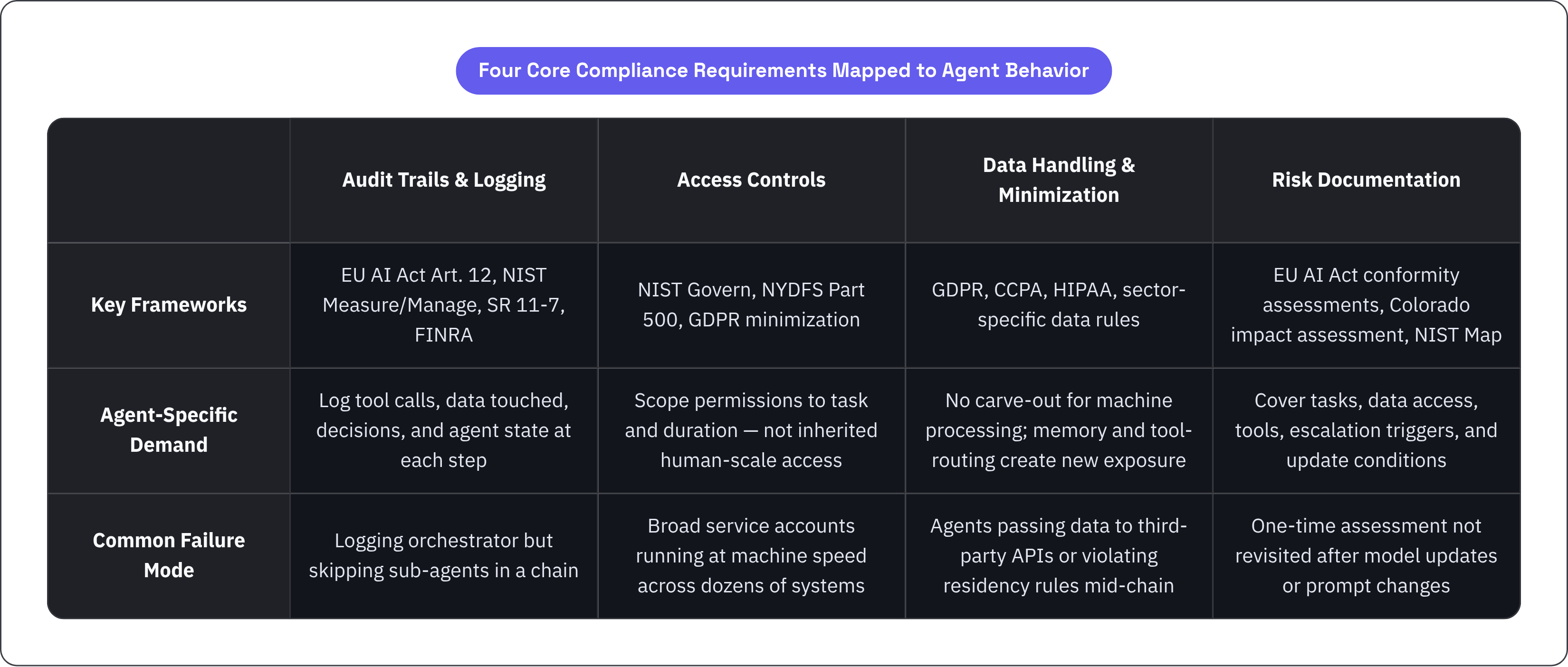
Strip away the jurisdiction-specific language across the EU AI Act, NIST's AI RMF, GDPR, sector rules, and state frameworks, and four requirements keep resurfacing. Different wording, same operational demands underneath, every time.
Audit trails and logging come first. Article 12 of the EU AI Act, the Measure and Manage functions in NIST's framework, SR 11-7, and FINRA guidance all require agent actions be logged in enough detail to reconstruct a decision after the fact. For an agent that means capturing which tools got called, what data got touched, what decision got made at each step, and what state the agent was in when it acted. A log covering the orchestrator but skipping the sub-agents in a chain satisfies nobody's traceability requirement, and an agent that behaves fine at launch can still drift over weeks through fine-tuning or context changes. Point-in-time logging misses exactly the failure mode regulators care about most.
Access controls are the second pile-up, and probably the messiest one in practice. Agents typically inherit whatever permissions their identity carries, often a human user's credentials or a broad service account, then act on those permissions at machine speed across dozens of systems at once. NIST's Govern function, NYDFS Part 500, and GDPR's data minimization principle converge on the same answer: agents should touch only what the task needs, scoped to how long the task takes. The human access model doesn't translate well. A person with database access might run a few dozen queries a day; an agent with the same access can run thousands a minute without breaking a sweat, because it doesn't have one. Only 44% of organizations have policies to secure agents, which means most are running human-scale permissions on non-human-scale actors. That's a forklift driving around on an intern's keycard. The badge still opens the door; nothing about the size of what walks through it stayed the same.
Data handling and minimization is the third. GDPR, CCPA, HIPAA, and every sector-specific data rule apply whether a human or an agent processes the data. There's no carve-out for "a machine did it," however tempting that line sounds in a postmortem. Agents introduce their own new failure modes here too: they retain context across sessions through memory, pass data between tools nobody explicitly authorized, or route a request to a third-party API as a routine step in finishing the job. Data residency rules in the EU, and in the countries that tightened privacy law in 2025 and 2026, get violated by accident constantly, just from an agent picking the wrong tool in a chain. OWASP's Top 10 for Agentic Applications, published December 2025 with input from more than 100 industry experts, identifies agent-specific data risks as a primary concern, which tells you how common this failure already is.
Risk documentation rounds out the four. The EU AI Act's conformity assessments, Colorado's impact assessment requirement, and NIST's Map function all ask for the same underlying thing: proof someone assessed the risk before deployment, and a process for reviewing it afterward. For an agent that documentation needs to cover which tasks it can do, what data it can reach, which tools it can call, when it has to escalate to a human, and how those boundaries get updated as behavior or environment shifts. A model update, a prompt change, a new tool integration: any one of these can justify a fresh assessment. This is an ongoing job that happens to wear a paperwork costume.
Where the NIST AI RMF and emerging agent-specific standards fit into compliance planning
NIST's AI Risk Management Framework, organized around core governance, mapping, measurement, and management functions, has become the default reference point for compliance conversations in the U.S., even though nobody is legally required to follow it. It shows up in procurement contracts, insurance underwriting questionnaires, and state legislation that cites it by name, which is a strange kind of authority for a voluntary framework to accumulate.
The framework's 2024 Generative AI Profile extended coverage to large language models and agentic systems specifically. NIST's Center for AI Standards and Innovation launched an AI Agent Standards Initiative in February 2026, about as clear a signal as a federal standards body sends that agentic systems now count as their own category of concern rather than a subset of generic AI risk. An AI Agent Interoperability Profile is planned for Q4 2026, so anyone doing compliance planning today should treat current NIST guidance as a draft in progress, not a finished rulebook to build a program around.
ISO/IEC 42001 offers a certifiable AI management system standard, genuinely useful for showing auditors and enterprise customers that governance maturity exists rather than being asserted in a slide deck somewhere. But certification under ISO 42001 doesn't substitute for EU AI Act compliance. The Act carries specific legal requirements that reach well past what the certification covers, so treat the two as complements, never substitutes. Getting ISO certified and assuming the EU box is checked is the kind of mistake that looks reasonable right up until an auditor asks one follow-up question you didn't prepare for.
OWASP's Agentic AI Top 10, released December 2025, is the first systematic attempt to classify risk in agentic applications specifically. Prompt injection ranks first in the broader OWASP LLM Top 10, and agent-specific problems like goal hijacking and rogue behavior inside an agent's own authorized scope are now formally named and categorized instead of waved off as edge cases nobody wanted to own.
None of these frameworks carry legal force by themselves. Regulators don't require NIST alignment or OWASP coverage by name, not yet anyway. But an organization that can point to a recognized framework it actually followed walks into an audit, or an enforcement conversation, in a far stronger position than the one improvising its approach for the first time in front of someone holding a subpoena.
How real-time monitoring and policy enforcement connect to what regulations actually require
Most compliance programs today get built around review after the fact: collect the logs, run a periodic audit, investigate once something's already broken. That model doesn't satisfy the EU AI Act's human oversight requirements, and it doesn't satisfy NIST's Manage function for high-risk systems either. Article 14 requires humans to hold real oversight of a system's operation, and that claim doesn't survive contact with reality if the first time anyone reviews what the agent did is three weeks after it did it.
A smoke detector works because it goes off while the fire is still small enough to put out with a glass of water. A fire report gets written after the building's gone, and all it does is explain what happened to people who no longer have a building. Most agent monitoring today resembles the fire report far more than the smoke detector, whatever the marketing promises.
Every framework in this piece, the EU AI Act, NIST, sector rules, state law, converges on the same underlying demand even when the language differs. Compliance for agents has to be a live, continuously checked property of the running system, reopened constantly rather than filed once a year and revisited only after the postmortem starts.