Monitoring Shadow AI Agents Inside Organizations
Autonomous agents operating inside approved apps pose risks traditional security tools can't detect.
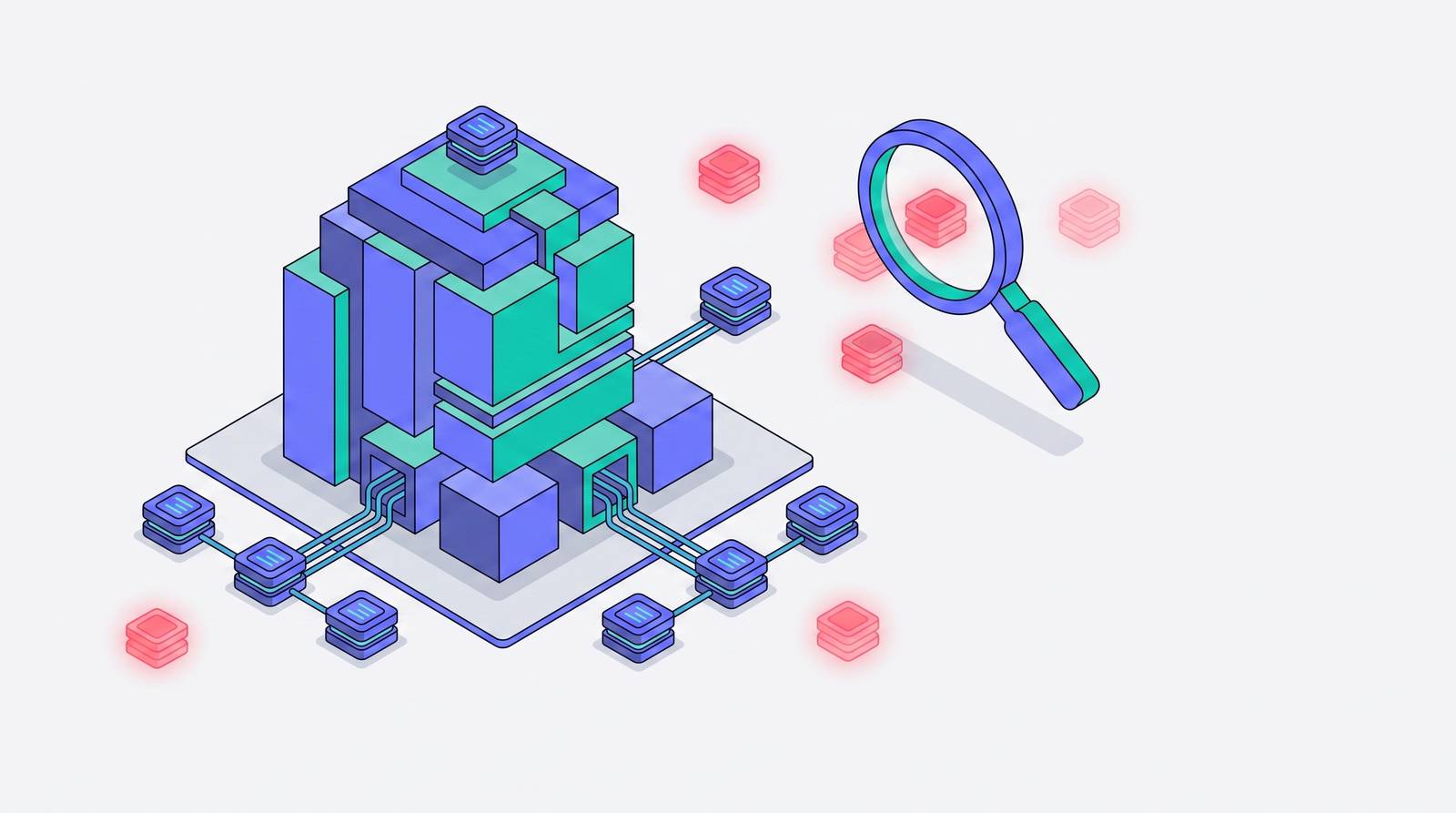
Shadow AI agents are not shadow IT. An employee installing Dropbox without IT's blessing is passive; an autonomous agent that reads the CRM, drafts outreach, fires API calls, and logs decisions acts continuously, at machine speed, on whatever access it has inherited. Discovery and real-time behavioral monitoring are the only things standing between sanctioned infrastructure and unsanctioned autonomous behavior running inside it.
Everyone Is Already Running Agents Nobody Approved
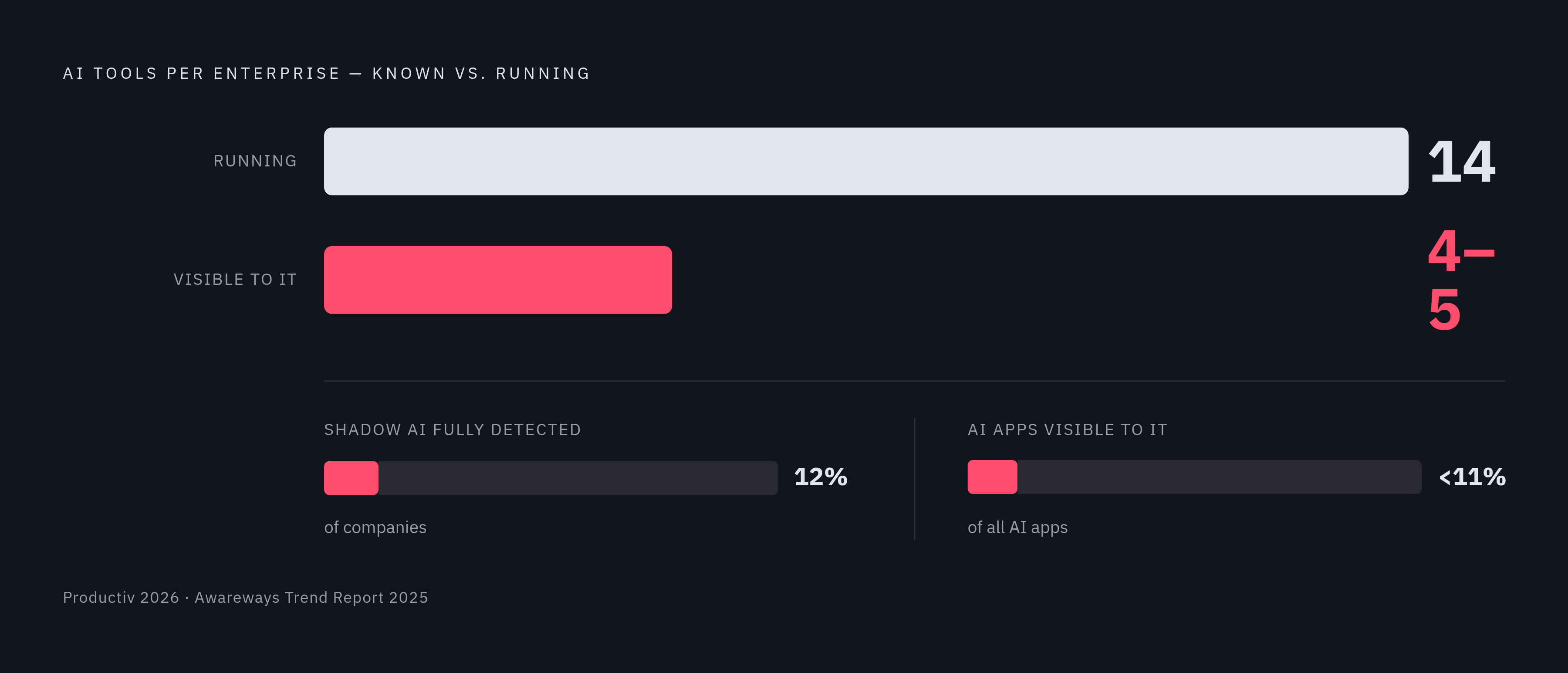
The most clarifying number in this space comes from Productiv's 2026 analysis: the average enterprise runs 14 distinct AI tools, and IT teams are aware of roughly 4 or 5 of them. That isn't a rounding error. That is a structural visibility gap, and it exists across company sizes and industries.
The breadth of adoption makes this worse. Eighty-one percent of employees and 88% of security leaders report using unapproved AI tools, according to a 2025 UpGuard survey spanning 500 security leaders and 1,000 employees globally. Security leaders are not exempt from this behavior; they are its most frequent practitioners. Sixty percent of users still access AI through personal, unmanaged accounts on managed devices, per Netskope's 2025 Cloud and Threat Report, which means the accounts themselves are invisible to corporate monitoring even when the hardware isn't.
The governance infrastructure to address any of this is largely absent. Sixty-three percent of organizations either have no AI governance policy or are still drafting one, per the IBM Cost of a Data Breach Report 2025. Only 12% of companies can detect all shadow AI usage. The smallest companies face this problem at disproportionate scale: organizations with 11 to 50 employees average 269 shadow AI tools per 1,000 employees, according to Reco AI's 2025 State of Shadow AI Report, while typically lacking any dedicated security staff to respond.
Scale alone is not the alarming part. Organizations have always underestimated how much unauthorized software their employees run. What changes the calculus here is the action-taking nature of agents: each unsanctioned tool is not a passive repository but an autonomous process with access, logic, and the capacity to act on both without further human input.
Why Your Existing Tools Are Looking in the Wrong Places
Traditional detection logic is built on a reasonable premise: unauthorized software has an unauthorized network footprint. Firewalls block suspicious domains. CASBs flag unapproved applications. Endpoint tools catch unauthorized installs. This model works adequately when shadow IT looks like shadow IT.
Agents frequently don't. Many live inside already-approved applications: a Copilot plugin inside Microsoft 365, a workflow automation inside Slack, a Google Workspace add-on an engineer built over a weekend. The host application is trusted. The domain is sanctioned. The CASB returns a clean result, and somewhere inside that approved surface, an agent is executing logic that no policy ever reviewed.
Less than 11% of AI applications in the workplace are visible to IT teams, according to the Awareways Trend Report 2025. That figure reflects not just adoption but the structural inadequacy of detection methods that treat application inventory as a proxy for agent inventory.
Browser extensions represent a particularly acute blind spot. More than 20% of enterprise users have a generative AI browser extension installed, many carrying privileged access to browsing data, per the LayerX Enterprise GenAI Security Report 2025. These bypass network monitoring and CASB tools entirely. The agent sits in the browser layer, beneath the tools designed to catch it.
The personal-account problem compounds this further. AI tools accessed through personal accounts generate traffic that looks, at the network level, like normal SaaS use. The CASB sees an approved domain; it cannot see the agent's behavior behind it.
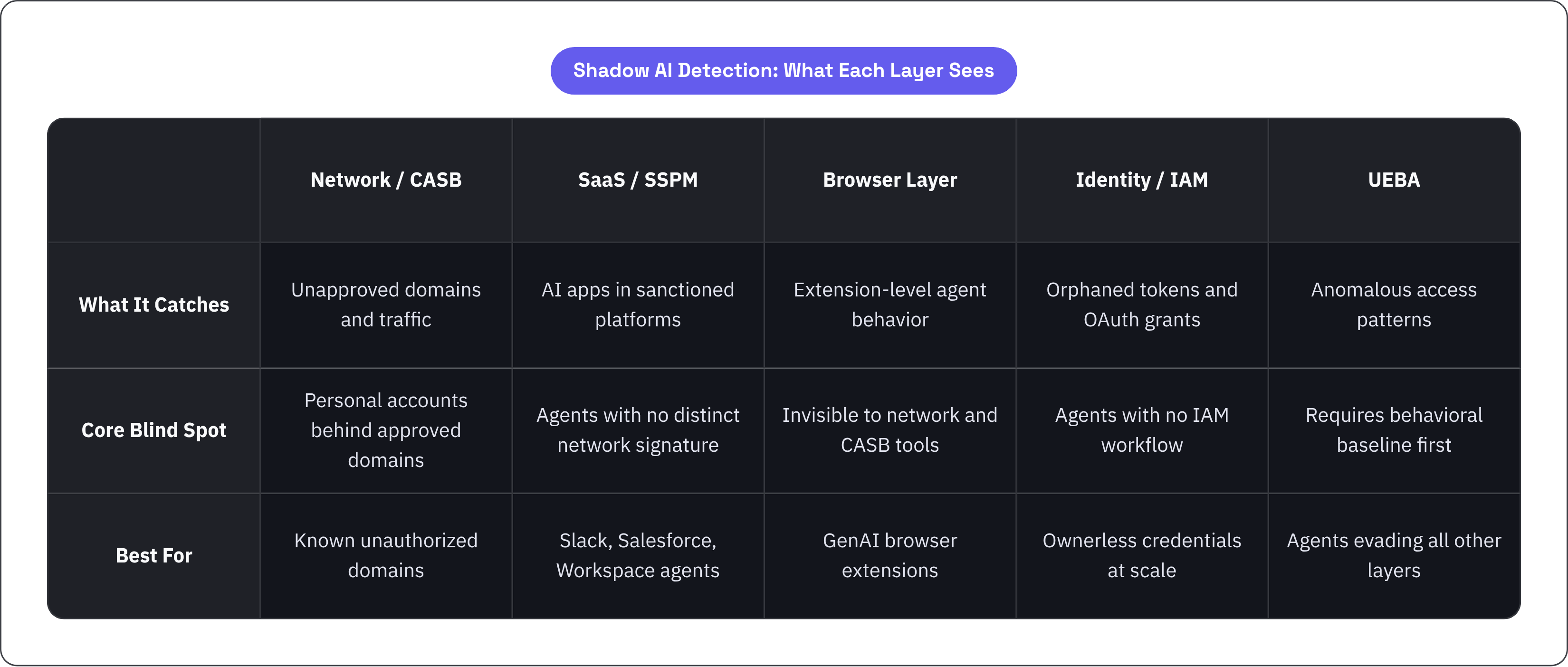
What effective detection actually requires is visibility into data flows, prompt content, and identity behavior simultaneously. No single layer of the stack provides all three. Discovery has to happen at network, SaaS, endpoint, browser, and identity layers concurrently, because any layer examined in isolation will produce a false sense of completeness.
Agents Create Identities Nobody Is Tracking
The machine identity problem predates AI agents, but agents have accelerated it dramatically. The average enterprise went from roughly 50,000 non-human identities in 2021 to 250,000 in 2025, per KPMG's Cybersecurity Considerations 2026, with an NHI-to-human ratio now exceeding 80 to 1.
Each deployed agent typically generates OAuth tokens, API keys, or service account credentials at creation. These are usually created by the employee who built the agent, outside any IAM workflow, with whatever scope seemed convenient at the time. More than 16% of organizations do not track the creation of AI-related identities at all, per a 2026 Cloud Security Alliance analysis.
Traditional NHI governance assumes predictable workloads and defined, stable permissions. Agents break both assumptions. They accumulate access across applications over time, often without deliberate intent on the part of the person who deployed them. The ownership problem is insidious: when an agent has accrued permissions across multiple systems, security teams frequently cannot determine who approved that access or who is accountable for the agent's behavior.
The practical consequences of this gap are documented. Attackers who compromised OAuth tokens tied to the Drift AI chatbot integration used by Salesloft accessed the Salesforce environments of more than 700 organizations, going undetected for days because the attacker's queries were indistinguishable from normal chatbot activity. The visibility gap was not the agent's existence but what the agent was doing with its access, and nobody was watching that layer.
Ninety-two percent of organizations agree that governing AI agents is critical to enterprise security. Only 44% have implemented any policies to do so, according to Omada Identity's State of Identity Governance 2026. That gap between stated priority and operational reality is where most of the actual risk lives.
What Agents Do in the Dark Before Anyone Notices
Shadow AI breaches averaged 247 days to detect in 2025, six days longer than standard breaches, and they disproportionately exposed customer PII and intellectual property, per the IBM Cost of a Data Breach Report. The gap is not incidental. Agents that operate continuously within sanctioned infrastructure, using legitimate credentials and approved access patterns, are genuinely difficult to distinguish from normal activity without behavioral baselines.
Prompt injection has emerged as a confirmed exploitation vector at enterprise scale. Critical CVEs were documented in Microsoft Copilot, GitHub Copilot, and Cursor IDE in production environments during 2025 and 2026, with CVSS scores reaching 9.8. Current detection methods catch an estimated 23% of sophisticated prompt injection attempts. The attacker's leverage is the agent's access scope; the agent becomes the weapon.
EchoLeak, demonstrated by researchers at Aim Labs in mid-2025, illustrated zero-click data exfiltration against Microsoft 365 Copilot. Copilot read a malicious email during background processing. A later, unrelated user query triggered the exfiltration. The user never took a deliberate action. The agent did.
Multi-agent architectures introduce cascade risk that individual agent governance cannot address. Galileo AI research published in December 2025 found that in simulated multi-agent systems, a single compromised agent poisoned 87% of downstream decision-making within four hours, faster than standard incident response timelines. When agents are chained, the blast radius of a single failure is not linear.
The nation-state dimension is no longer theoretical. Anthropic's November 2025 report detailed Chinese state-sponsored actors directing Claude Code to handle 80 to 90% of an intrusion operation autonomously, including reconnaissance, exploit development, lateral movement, and data extraction. The agents were doing what they were designed to do, within the access they had been granted, at a pace no human analyst could track in real time.
Across these cases, the pattern is consistent: the harm does not come from an agent being externally compromised in an obvious way. It comes from an agent operating within its normal access, executing behavior that no human ever reviewed or approved.
What Late Detection Actually Costs
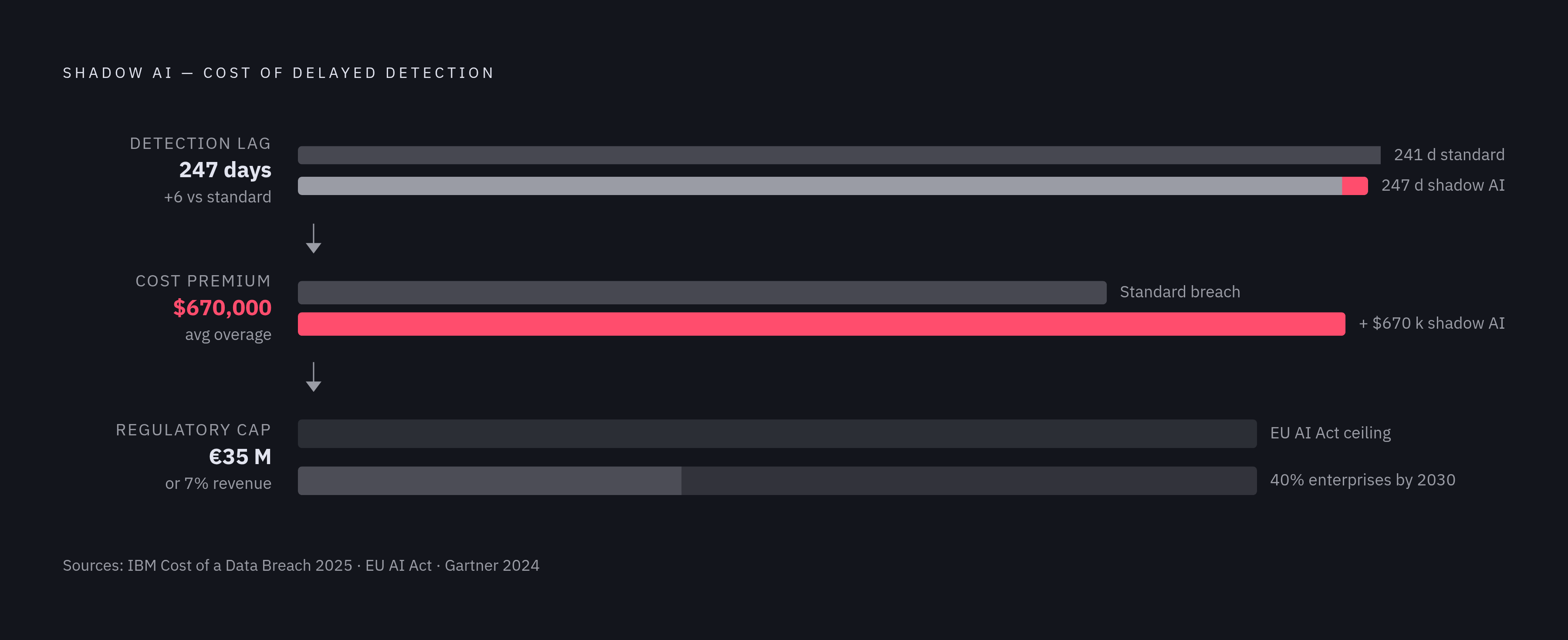
Breaches involving unsanctioned AI tools cost an average of $670,000 more than breaches without AI involvement, per the IBM Cost of a Data Breach Report 2025. One in five organizations has already experienced a breach linked to unsanctioned AI. This is history, not forecast.
Regulatory exposure now compounds financial exposure with hard deadlines. EU AI Act enforcement by the European Commission began August 2, 2026. Penalties for failures to meet high-risk AI obligations reach up to €15 million or 3% of global revenue; prohibited AI practices carry up to €35 million or 7%. Shadow agents that cannot demonstrate compliance with Article 19's six-month automatic log retention requirement for high-risk systems are not edge cases under this framework.
Industry-specific audit trail mandates add further specificity. FINRA and SEC require up to seven years of retention for trading and advice-related logs. HIPAA requires six years for healthcare AI records. Shadow agents typically produce none of these records because nobody designed them to.
Gartner forecasts AI governance spending will reach $492 million in 2026 and surpass $1 billion by 2030. Organizations spending that money reactively, in response to incidents, pay more than those who build proactive monitoring infrastructure beforehand. Gartner's November 2025 analysis of 302 cybersecurity leaders predicts more than 40% of enterprises will experience a security or compliance incident linked to unauthorized shadow AI by 2030. That is not an abstract risk curve; it is an actuarial table.
Finding the Agents Already Running in Your Infrastructure
Discovery requires accepting, first, that no single tool sees everything. Network traffic analysis, SaaS integration audits, browser-layer inspection, and identity and token inventories each surface different portions of the agent footprint. Treating any one as comprehensive produces a false inventory.
SSPM tools are useful at the SaaS layer, where they can surface AI apps integrated into sanctioned platforms without IT approval. Slack, Salesforce, and Google Workspace are common vectors precisely because the host application is already trusted; agents connected to these platforms inherit that trust while remaining invisible to app inventories.
The identity layer is often more revealing than the application layer. Auditing OAuth grants, API tokens, and service account credentials for AI-related patterns, particularly tokens with broad scopes created outside IAM workflows, surfaces agents that have no distinct network signature. An ownerless token with write access to three production systems is a finding regardless of whether anyone can identify the application that created it.
Browser-native security solutions provide interaction-level visibility that network-layer tools cannot reach, per the Cloud Security Alliance's May 2026 analysis. The browser extension blind spot is specifically a browser-layer problem; it requires a browser-layer solution.
UEBA can surface agents that evade all other detection: anomalous data access patterns, an identity querying systems it has never touched, at unusual hours, at unusual volume, are behavioral signals that have no dependency on knowing the agent exists in advance.
Among major platforms with current generative AI governance capabilities, Netskope, Zscaler AI Protect, and Palo Alto Networks Prisma SASE 4.0 cover meaningful portions of this surface area. Prisma SASE 4.0 extends coverage across more than 6,000 generative AI applications, per the Cloud Security Alliance May 2026 report.
The practical starting point for most organizations is narrower than any of this: map every AI-related OAuth grant and API token currently in the environment, identify which have no named owner, and treat ownerless tokens as the first remediation priority. Only 57% of organizations have an acceptable use policy for AI tools; fewer still have implemented access controls for AI agents or identity governance for AI entities. Technical discovery findings without an enforcement pathway produce reports, not remediation.
What Behavioral Monitoring Must Actually Do
Discovery produces a snapshot. Behavioral monitoring answers what agents are doing with their access right now.
The core concept is behavioral drift. An agent authorized to summarize customer emails should not be querying financial records. Monitoring must detect deviations from defined task scope, not merely verify that the agent holds the access it holds. That distinction separates a posture assessment from a runtime control.
Static API keys and broad OAuth scopes are structurally incompatible with this model. Contextual least privilege means permissions scoped to a specific task and continuously re-evaluated against that task's current execution context. An agent that needs read access to a document for five minutes should not retain that access for five months.
Effective logging captures every API call, every data access, every decision trigger. The purpose is not exclusively post-incident review; it is real-time anomaly detection. Logs that are only consulted after harm has occurred satisfy compliance requirements but do not prevent the harm.
Token hygiene operates as an ongoing operational practice rather than a one-time configuration: automated rotation on a 24 to 72 hour cycle, integration with enterprise identity providers via SAML or OIDC, and centralized secret management through tools like AWS Secrets Manager or HashiCorp Vault collectively reduce the window during which a compromised credential remains actionable.
Multi-agent environments require an additional architectural element that individual agent monitoring cannot substitute for: system-level circuit breakers. When agents are chained, a quarantine mechanism that can isolate a misbehaving agent before cascade failure propagates is not a redundancy; it is the primary containment control. The Galileo AI finding on four-hour cascade timelines makes this concrete.
Palo Alto Networks Prisma SASE 4.0 introduced dedicated SSPM capability for continuous, real-time insight into SaaS-based AI agents, copilots, and plugins, illustrating a broader market shift toward agent-specific runtime monitoring rather than retrofitting CASB controls that were never designed for autonomous behavior.
The distinction that matters most in practice: audit trails satisfy compliance requirements. Policy enforcement at the runtime layer prevents harm. Both are necessary; neither substitutes for the other.
Governance That Moves at Agent Speed
Shadow AI is growing at approximately 5% per month, per VentureBeat's analysis. Governance frameworks built on annual reviews or quarterly audits are not slow; they are irrelevant to that rate of change.
NIST's AI Risk Management Framework provides structural scaffolding through its four pillars: Govern, Map, Measure, Manage. These now function as procurement criteria in U.S. federal agencies and regulated industries. Their practical value is as a continuous operating cycle, not a one-time assessment. NIST acknowledged the autonomous agent gap explicitly in February 2026 with its AI Agent Standards Initiative through CAISI, with an AI Agent Interoperability Profile planned for Q4 2026. Standards are catching up. Organizations cannot wait for them.
The 44% of organizations where business units deploy AI without involving IT, per Delinea's 2025 research, reveals a problem that technology alone cannot solve. Shadow agents are not primarily a detection gap; they are an accountability gap. Who owns agent governance across product, engineering, finance, and sales? If that question has no answer, the governance framework has no enforcement surface.
Acceptable use policies need to address agents specifically and separately from general AI tool guidance. An employee using ChatGPT for drafting and an engineer deploying an autonomous agent with write access to the CRM represent categorically different risk profiles that a single policy cannot adequately govern.
The practical ownership model is simple: every deployed agent should have a named human accountable for its access scope, its behavior, and its audit trail. The Drift and Salesloft case is instructive not because the attacker was sophisticated but because accountability for the agent's behavior was diffuse enough that the access existed without clear ownership. When nobody owns the agent, nobody notices when the agent does something wrong.
The goal is not prohibition. Organizations that prohibit agent deployment without building sanctioned pathways will simply drive deployment further underground, compounding the visibility problem they were trying to solve. The actual objective is sanctioned deployment with genuine visibility: discovery, behavioral monitoring, and policy enforcement operating as a connected system, capable of letting agents operate at scale without forfeiting the ability to see and control what they do.