AI Governance and Compliance Certification Landscape
The EU AI Act imposes binding compliance with escalating penalties starting immediately.

The EU AI Act, Regulation 2024/1689, entered into force on August 1, 2024. It is the world's first comprehensive, legally binding AI framework. Everything else in this article is voluntary. This one carries fines.
The Act sorts obligations into four risk tiers: prohibited, high-risk, limited-risk, and minimal-risk. Prohibited uses, including manipulative techniques, social scoring, and biometric categorization by sensitive attributes, became enforceable in February 2025. High-risk systems, covering AI used in hiring, credit, healthcare, law enforcement, and critical infrastructure, carry the heaviest compliance burden: a mandatory conformity assessment under Article 43, a documented evidence chain covering safety, transparency, data governance, and technical standards, and primary provider responsibility for proving compliance before market entry.
General-purpose AI model providers faced obligations beginning August 2, 2025, including technical documentation, EU copyright compliance, and training data summaries. Models trained above 10²⁵ FLOPs are presumed to carry systemic risk and must undergo adversarial testing. The voluntary GPAI Code of Practice, published July 10, 2025, offers one path to demonstrate compliance for this tier.
Enforcement timelines shifted after the Omnibus deferral, with political agreement reached in May 2026. Annex III use-based high-risk systems now have until December 2, 2027; Annex I product-embedded systems until August 2, 2028. The penalty structure is not subtle: up to €35 million or 7% of global turnover for prohibited-practice breaches, up to €15 million or 3% for other high-risk violations.
U.S. organizations chronically underestimate the Act's extraterritorial scope. If an AI system's output is intended for use in the EU, the provider is in scope, regardless of where the system was built or is hosted. Every American company selling AI-enabled products into Europe, or running EU-facing operations, should have assessed scope yesterday.
The practical implication is architectural, not administrative. The Act doesn't regulate AI as an abstract capability; it requires documented, auditable governance processes at the system level. Every organization treating it as a checkbox exercise will find out exactly what that costs at their first conformity assessment, and not in a theoretical sense.
What the NIST AI RMF Covers and Where Organizations Are Actually Using It
The NIST AI Risk Management Framework organizes AI governance across four functions: Govern, Map, Measure, and Manage. It is voluntary, not legally binding, and the most broadly adopted AI governance framework in North America. CISO adoption sits between 57% and 67% according to Hitch Partners' 2026 Global CISO Leadership Report of more than 625 executives, higher than any competing framework.
Voluntary does not mean inconsequential. Colorado permits NIST AI RMF alignment to satisfy certain deployer obligations under state law; Texas offers it as an affirmative defense. Federal regulators including the CFPB, FDA, SEC, FTC, and EEOC have each referenced RMF principles in deployment guidance. A framework that began as voluntary guidance has quietly accumulated legal weight at the margins, and there is no obvious reason that trajectory slows.
NIST has been extending the framework's practical reach. The July 2024 Generative AI Profile (NIST-AI-600-1) acknowledged that the base framework was designed for a more static deployment environment. An April 2026 concept note introduced an AI RMF Profile for Critical Infrastructure, adding sector-specific operational guidance.
The more significant limitation is structural. The NIST AI RMF was architected before autonomous agents became a production reality, and it shows. Agents operating across trust boundaries over extended timeframes present a risk profile the current framework does not fully address. Two supplements are attempting to fill that gap: the Cloud Security Alliance's AI Controls Matrix, published July 2025, offers 243 controls across 18 domains, and the AAGATE reference architecture, published December 2025, extends the RMF toward agentic deployments. Neither is a comprehensive answer, and every organization deploying agentic systems at scale should be familiar with both.
For most organizations, the NIST AI RMF is the right internal operating structure: broadly adopted, increasingly tied to procurement signals and state-level safe harbors, and architecturally compatible with both ISO 42001 and EU AI Act evidence requirements. It needs active supplementation for anything that acts autonomously at machine speed. That caveat is not minor.
ISO 42001 as the Only Certifiable Organizational Standard and What Achieving It Involves
ISO 42001, published in 2023, defines how to establish, implement, maintain, and continually improve an AI Management System. If you know ISO 27001 for information security, the logic transfers directly: a management system standard that certifies the process, not the product. The distinction matters enormously in practice and gets lost constantly in procurement conversations.
Scope covers AI system inventory, risk assessment, control implementation, objective setting, performance evaluation, and supplier AI assurance. That last item is increasingly consequential. Every organization I've seen go through implementation discovers, midway through, that their AI supply chains carry as much risk as their internal deployments and have received a fraction of the scrutiny.
What separates ISO 42001 from every other framework in this article is that it is certification-eligible. A third-party auditor verifies implementation and issues a certificate, which makes compliance observable to customers, partners, and regulators in a way that an internal policy document simply cannot replicate. Microsoft's certification, framed as independent validation of their Responsible AI Standard and subject to regular third-party audits, illustrates how large providers use the standard to underpin customer compliance chains downstream.
Market adoption is accelerating faster than most compliance teams anticipated. By mid-2026, ISO 42001 was appearing in roughly 40% of EU enterprise AI vendor RFPs and approximately 25% of North American equivalents. Fortune 500 buyers began inserting "ISO 42001 certified or roadmap" clauses into vendor questionnaires through 2025. If you sell AI-enabled products or services to large enterprises, you will encounter this requirement; the question is whether you encounter it proactively or in response to a failed procurement.
Organizations with existing ISO 27001 infrastructure can reach compliance up to 40% faster than greenfield organizations, typically requiring six to nine months of implementation work before a certification audit becomes realistic. Greenfield organizations should plan for twelve to eighteen months. The longest-lead items are the AI risk register, per-system impact assessments, and supplier AI assurance processes, none of which can be meaningfully compressed. First-year costs, inclusive of gap analysis, internal audit, and certification body fees, generally run between $15,000 and $50,000.
One conflation that keeps surfacing in procurement conversations: ISO 42001 certifies that a management system is in place and functioning. It does not certify that individual AI systems are safe, ethical, or compliant with the EU AI Act. A high-risk AI system under the Act still requires a conformity assessment under Article 43. Every organization operating in the EU will frequently need both, and assuming one substitutes for the other is an expensive misunderstanding.
The Professional Certification Options and What Each One Is Designed to Test
With only 1.5% of organizations reporting adequate governance headcount (IAPP AI Governance Profession Report, 2025), and 23.5% citing lack of qualified professionals as a top implementation barrier, credentials have become both a hiring signal and an organizational readiness proxy. Three certifications currently matter.
IAPP AIGP
The AI Governance Professional credential, announced in March 2024, had surpassed 5,000 certified professionals globally by 2026. Four exam domains cover foundational AI governance concepts, applicable laws and standards including the EU AI Act and NIST AI RMF, governing AI development, and governing AI deployment and use. The exam runs 100 questions in 180 minutes, with roughly 30% scenario-based content. Pricing sits at $649 for IAPP members, $799 for non-members. Median U.S. salary for AIGP holders was approximately $151,800 in IAPP's 2025 data.
The AIGP is a generalist credential. It spans law, ethics, and operational governance across the full deployment lifecycle, making it the right fit for governance, policy, compliance, and legal roles that need coverage across frameworks and jurisdictions rather than depth in any single domain. It is also the most recognizable signal in the market, which matters for hiring managers trying to sort through a credential landscape that didn't exist three years ago.
ISACA AAIA
The Advanced in AI Audit credential launched in mid-2025, targeting IT auditors and assurance professionals. It carries a prerequisite of an active CISA, CIA, CPA, or equivalent audit credential. The exam runs 90 questions in 150 minutes, scored on a 200–800 scale with 450 as the passing threshold.
Domain weighting reveals where the credential's designers think audit risk actually concentrates: AI Operations and Monitoring accounts for 46% of the exam, AI Governance and Risk for 33%, and AI Auditing Tools and Techniques for 21%. That heavy weighting toward operational monitoring is a deliberate judgment that what AI systems do in production is more auditable, and more consequential, than what their documentation says they should do. That judgment is correct.
ISACA AAISM
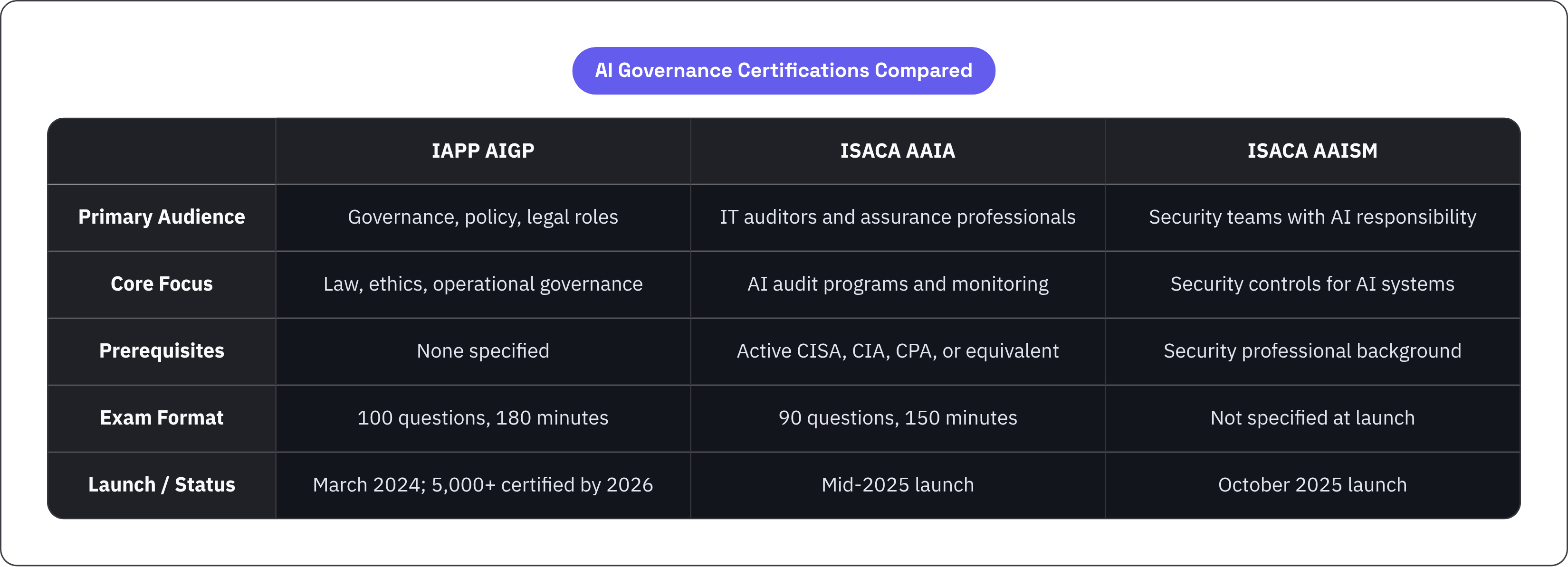
The Advanced in AI Security Management credential launched in October 2025, addressing a gap ISACA's 2024 State of Cybersecurity report had quantified: 60% of cybersecurity teams lacked AI-specific skills. It targets security professionals managing AI system risk rather than auditors or policy generalists. Where AAIA asks whether governance happened, AAISM addresses whether the security controls protecting AI systems are actually sound.
CompTIA, ISC², and AWS are each developing AI compliance and governance certification tracks. The credential landscape will expand through 2026 and 2027, probably faster than organizations can track it.
These three credentials are not interchangeable. AIGP fits governance and policy roles. AAIA fits audit and assurance functions building AI-specific audit programs. AAISM fits security teams with direct operational AI responsibility. Every organization hiring for "AI governance" as a monolithic function, without distinguishing between these roles, produces coverage gaps that surface at precisely the wrong moment.
How the Frameworks and Certifications Relate to Each Other in Practice
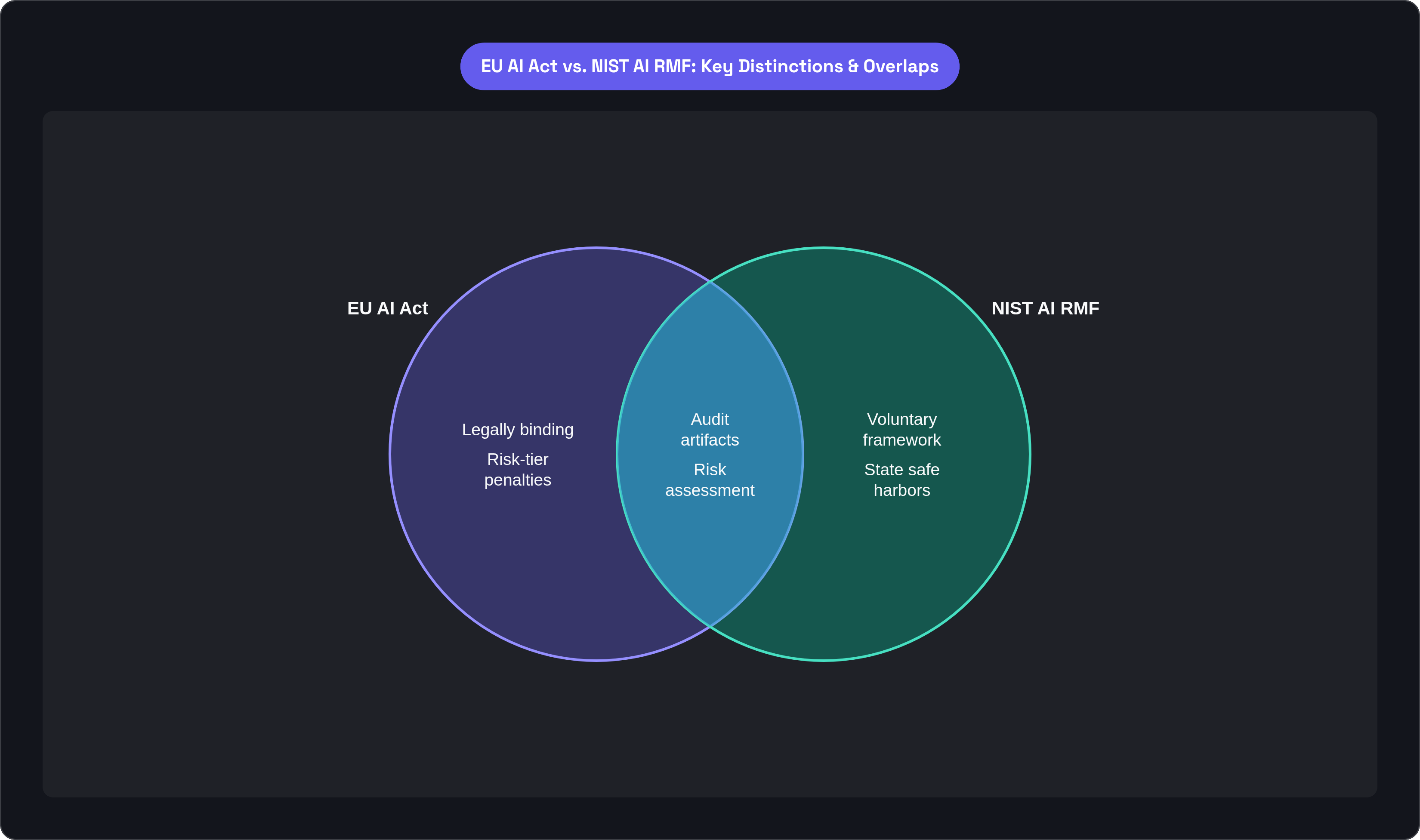
No single framework covers everything, and the overlaps between them are not accidental.
ISO 42001 implementation naturally generates the documented processes and controls that EU AI Act conformity assessments require. Organizations that build an AI Management System first will have a meaningful head start on their conformity evidence chain; the work is not duplicative, it is cumulative. The NIST AI RMF's four functions map coherently onto ISO 42001's management system structure, meaning organizations using both can maintain a single documentation corpus rather than parallel records. AIGP and AAIA credentialed staff are the people who operate these systems: the frameworks describe what to build, and the certifications signal who has the knowledge to build it.
The more interesting question is where the frameworks all break down simultaneously, because they do. Every major framework discussed here was developed before autonomous agents became a production deployment scenario rather than a research curiosity. The CSA AI Controls Matrix and AAGATE architecture are early responses, but neither provides comprehensive coverage of agents that inherit user permissions, act autonomously over extended timeframes, and traverse trust boundaries at machine speed. Runtime behavior monitoring is similarly underspecified; most frameworks concentrate on pre-deployment assessment and leave ongoing production monitoring largely to organizational discretion.
For organizations deciding where to start: assess EU AI Act scope first if any EU exposure is present, because it is the only obligation in this entire landscape with a real penalty structure attached. Use NIST AI RMF as the internal operating structure; it is broadly adopted and produces artifacts useful for both ISO 42001 and regulatory conversations. Pursue ISO 42001 when vendor relationships or procurement requirements make third-party certification commercially necessary. Invest in credentialed staff early, specifically AIGP for governance roles and AAIA for audit functions. The staffing gap is the most frequently cited implementation barrier, and it does not resolve on its own.
What Organizations Should Actually Prepare for as Audits Become Routine
The WEF Global Cybersecurity Outlook 2026 found that the share of organizations assessing AI tool security before deployment nearly doubled, from 37% in 2025 to 64% in 2026. Pre-deployment assessment is becoming baseline practice. The window to treat AI governance as a differentiator rather than a floor is narrowing.
What auditors look for across all frameworks converges on the same underlying artifacts: an AI system inventory documenting what systems are running, who owns them, and what data they touch; documented risk assessments per system; evidence of controls implemented and tested; logs sufficient to reconstruct AI decisions; records of human oversight mechanisms. The frameworks use different terminology, but they are requesting the same evidence. Every organization that understands this early avoids building redundant documentation systems for each framework they touch.
The hard part is not conceptual. It is producing evidence that governance actually occurred in production, not just on paper. Policy documents are easy to generate. Audit logs, decision trails, and control test results are not, particularly for organizations that didn't build logging infrastructure into their initial deployments and are now trying to retrofit it.
Agentic systems introduce a particularly difficult audit surface. An agent that inherits user-level permissions and acts autonomously across systems creates a sequence of decisions that must be observable, attributable, and reconstructable after the fact. The access it holds, the actions it takes, and the order in which it takes them all need to exist in logged form sufficient to answer an auditor's questions about what happened and why. Static AI deployments are tractable by comparison; agents operating at machine speed across trust boundaries are a categorically different problem, and no current framework has fully reckoned with that.
Audit readiness is an infrastructure question. Organizations that built continuous monitoring and audit logging into their AI deployments from the start will satisfy any framework with relatively modest marginal effort. Those attempting to reconstruct compliance retroactively, from scattered documentation and institutional memory, will struggle regardless of which certifications appear on their vendor profile.
The gap Gartner identified, 75% of organizations facing audits by 2027 against 18% with formal governance today, does not close through better framework literacy. It closes by building operational systems that produce evidence continuously, starting now, before the audit calendar makes the decision for you.