Stateful vs Stateless Agent Design Tradeoffs
Choosing between stateful and stateless agents means trading off scalability against context.
I spent three months last year debugging an agent that "forgot" its own tool calls mid-task, and the root cause turned out to be a load balancer routing the second message to a pod that had never met the first one. That's the whole essay in one sentence, honestly, but you paid for the long version, so here it is.
Whether you build a stateful or stateless agent isn't a taste preference. It's a set of tradeoffs across scaling, cost, debuggability, and security, and the right call depends entirely on what the thing actually has to do. An LLM is stateless by design: you send a prompt, you get a completion, and the model forgets you exist the moment it's done. Any memory beyond that single exchange has to be built by someone, on purpose, and that decision cascades through your entire infrastructure. Most frameworks either default to stateless or hand the whole mess to the developer, which is a polite way of saying: good luck, you'll find out what you missed once it's live.
Agents aren't web servers, and that's where people trip. A stateless web request reads data and hands back a response without changing anything. An agent interaction changes the state of whatever it's touching, a database, a file system, another agent's task queue. The "just make it stateless" instinct, inherited from a decade of REST API doctrine, doesn't map onto something that's supposed to remember what it tried five minutes ago and why it blew up.
What stateless and stateful agents actually mean at the code level
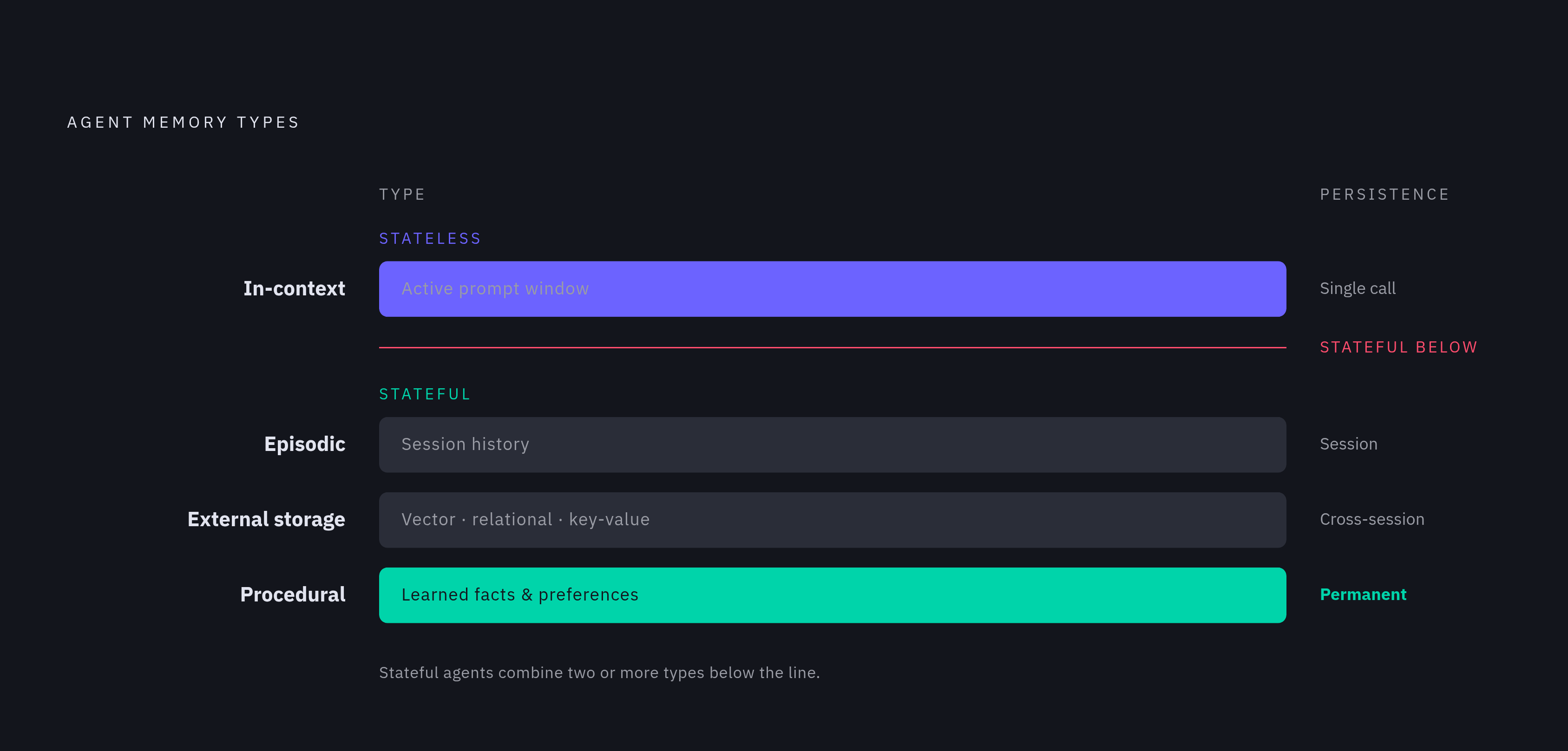
A stateless agent reads the prompt, calls the model, returns the output, and forgets everything including you, amnesia by design. A stateful agent keeps something between calls: prior decisions, user preferences, intermediate results, the account number you already gave it twice.
There are four kinds of memory engineers actually choose between, and mixing them up is where architecture diagrams start lying to you. In-context memory is whatever sits in the active prompt window; it evaporates the second the call ends. External storage, vector, relational, key-value, survives across sessions but only through explicit read and write calls, nothing automatic about it. Episodic memory is session-scoped history the agent can query mid-conversation. Procedural or semantic memory holds learned facts or preferences that outlive any single run. A stateless agent uses only the first kind, while a stateful one stitches together at least two of the rest.
Then there's the question that sounds bureaucratic until you've debugged it at 2 a.m.: who owns the conversation history, client or server? Client resends the full transcript every turn, and your payloads balloon until context window limits start biting. Server owns it, payloads stay lean and you can trim as the conversation grows, but now your infrastructure has to track sessions, which is precisely the problem stateless systems exist to avoid. This one decision, usually made early and often by accident, is where the two paths actually fork.
Where stateless design wins: scalability, reproducibility, and fault tolerance
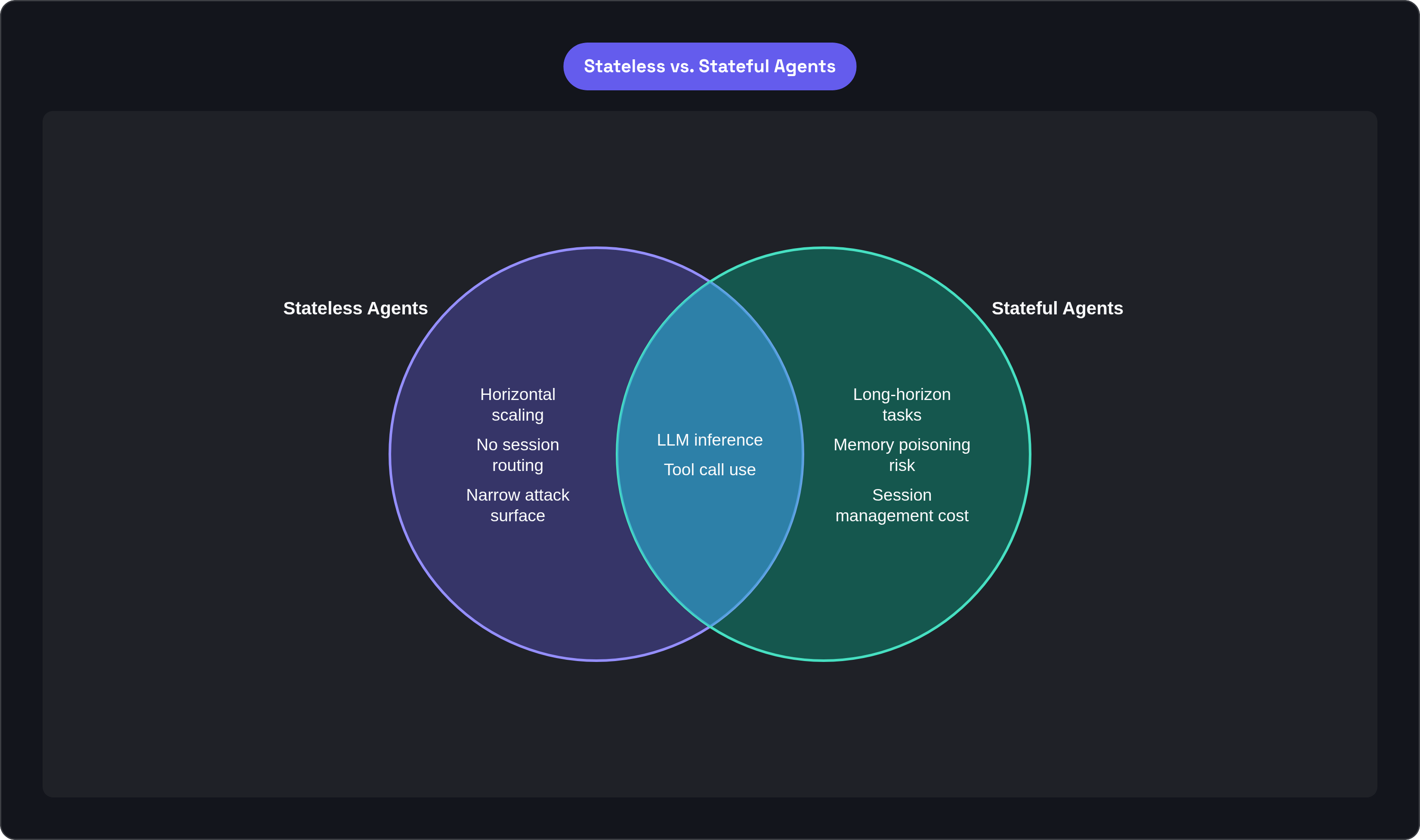
No session routing means any instance in the pool can handle any request. Round-robin load balancing works exactly like the diagram promised, no special cases, nothing sticky. An instance dies, you replace it, with nothing to restore and nothing to recover, no page at 3 a.m. asking why the session didn't survive the crash.
Identical inputs also produce identical outputs, give or take whatever noise the model itself introduces, and that makes stateless agents genuinely pleasant to test. You replay a call and trust what comes back. That's the difference between a ten-minute debugging session and a full day spent reconstructing what state the system was even in when it went sideways.
Multi-tenant isolation is close to free too. One tenant's data can't bleed into another's, because there's no shared state for it to bleed through. Stateless fits single-turn classification, document summarization where each document stands on its own, and batch jobs where "session" isn't even a meaningful word. The security surface stays narrow for the same reason: no persistent memory, no persistent target. Hold that thought, we'll come back to it once we get into what stateful memory actually exposes.
The infrastructure cost stateful agents impose
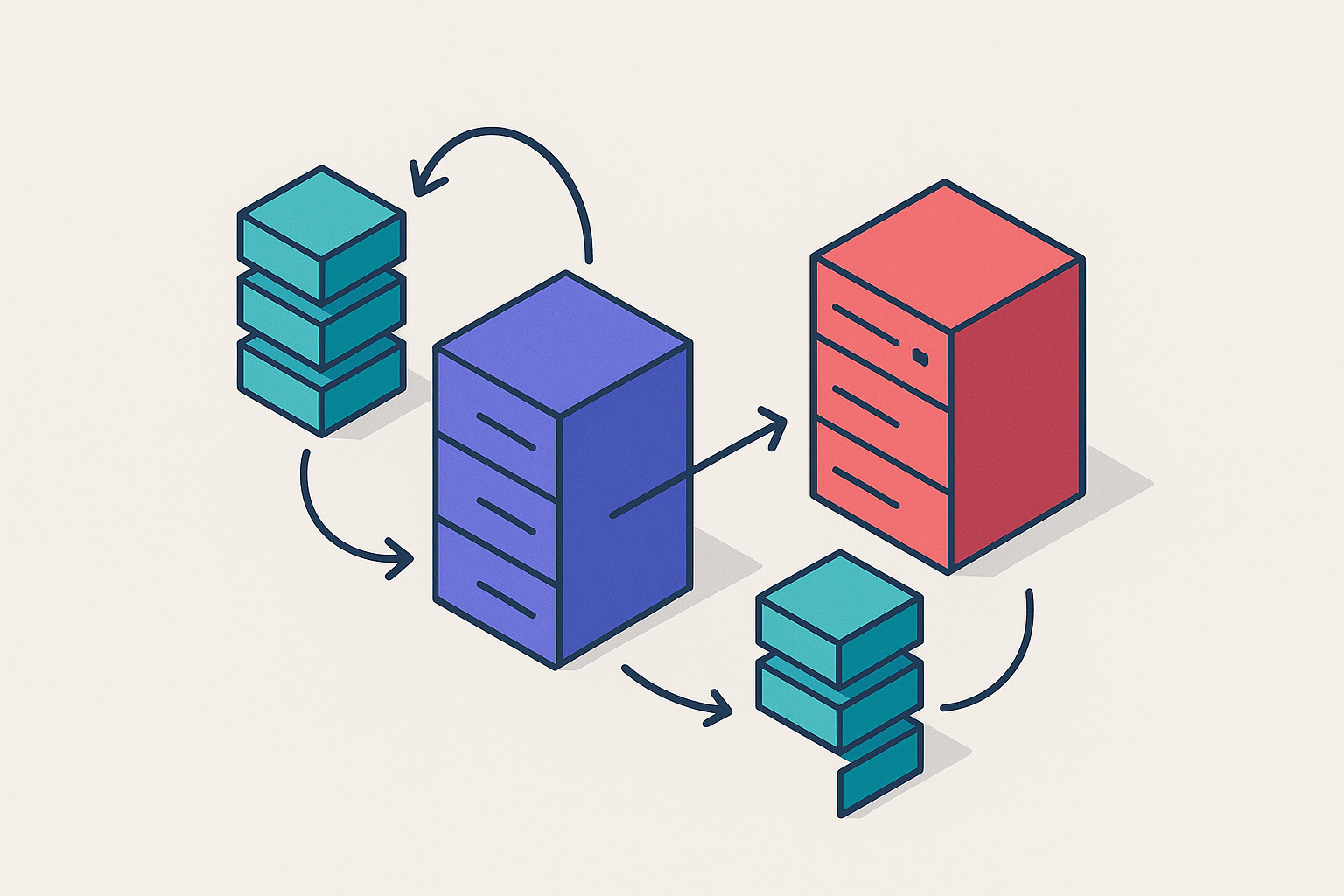
Here's where teams get their first bruise. You deploy a stateful agent across a handful of Kubernetes pods, same as you'd deploy anything else, and the load balancer has no idea which pod is holding which session. The second message lands on a different pod than the first, the session doesn't exist there, and the error comes back reading suspiciously like the agent has short-term amnesia. Congratulations, you've discovered state management the hard way, and no, there's no refund.
Every fix costs something. Sticky session affinity pins a client to one pod, but traffic distribution goes lumpy and autoscaling stops behaving. A shared Redis instance solves the routing problem but adds latency, adds an operational surface to babysit, adds a new way for things to quietly break. Gateway-level session routing bolts on complexity a stateless system never has to think about in the first place.
Stateful systems cost meaningfully more to run than stateless equivalents doing comparable work, largely because storing, retrieving, and managing session data at scale demands infrastructure a stateless design skips entirely, and the gap widens as concurrent sessions climb. That premium is the frame for every stateful decision going forward: is this use case actually worth the markup? Checkpointing has become the practical answer to a lot of it. Persisting state at defined execution boundaries, the way LangGraph does it, lets a workflow resume after a pod restart instead of starting from zero, and by now it's treated as table stakes for any production multi-agent system.
Where the performance gap between architectures actually shows up
On short, single-turn tool-use tasks, stateless and stateful perform about the same. Tracking state adds overhead without adding capability, which is a fancy way of saying you paid for a feature nobody used.
The gap opens once the task horizon stretches. Long-horizon coding tasks show a real success-rate edge for stateful systems, and multi-turn dialogue is where anyone using the product notices the difference: accumulated context lets an agent track how intent drifts across a conversation, instead of reacting to whatever the user typed most recently as if it fell from the sky.
The τ-bench benchmark makes this concrete. It simulates customer-service conversations where users contradict themselves partway through, and a stateless system has to re-derive the entire situation from scratch every single turn; a system holding explicit structured state doesn't re-litigate facts it already settled. Stateless agents re-parse, while stateful agents remember, and coding assistants and long-running workflow agents are where this shows up as an actual outcome difference, not just a smoother-feeling chat. Rule of thumb: stateless for bounded, single-pass work, stateful once the agent has to accumulate decisions and act on them later.
How stateful memory systems are actually structured in production
Memory alone doesn't make an agent autonomous. It's the substrate that planning, tool calls, and evaluation loops sit on top of. Without orchestration wrapped around it, memory is just an expensive filing cabinet that occasionally talks back.
The pattern that's taken hold is multi-scope memory tagging. A fact gets a userid scope when it should follow someone across every session, an agentid scope when it's tied to one specific agent, a sessionid scope for context that gets tossed once the conversation ends, an orgid scope for knowledge shared across every agent a company runs. These scopes get merged and ranked at retrieval time, automatically, rather than forcing a developer to pick one and live with it.
Weaviate's "Context Engineering" framework splits retrieval into three layers, each with its own logic. The memory layer, past interactions, cares about temporal proximity, where recent beats old. The knowledge layer, domain facts, cares about semantic relevance instead. Working memory, the live state of the current task, cares about freshness above everything. Using one retrieval strategy across all three layers is a mistake that shows up constantly, and it's an easy one to make because it feels like simplifying things.
Graph memory went from research curiosity to standard production pattern in roughly two years. Vector retrieval surfaces facts that are semantically close to a query; graph retrieval surfaces facts connected through actual entity relationships. Neither replaces the other, they just fail differently. Letta, the production successor to MemGPT, is the reference implementation for LLM-managed tiered memory: core, archival, and recall tiers, with the model itself deciding what to page in or out through function calls. Benchmarks like LoCoMo and LongMemEval exist because "does the agent remember" turned out to need a far more rigorous test than anyone expected going in.
The security risks that only stateful agents carry
Stateless agents skip this section entirely, since there's no persistent memory and no persistent attack surface across sessions, nothing sitting around long enough to be worth exploiting.
Stateful agents carry a different bill. Conversation history, vector stores, RAG databases, persistent files, these are all attack surfaces that simply don't exist in a stateless design, and each one is a place an adversary can plant something that outlives the interaction that planted it. Memory poisoning is the headline threat, and it works like this: an attacker buries an instruction inside a past interaction, maybe a support ticket, and the agent files it away as legitimate context because nothing flagged it at the time. Weeks later, an unrelated task triggers retrieval of that memory, and the agent acts on it as trusted fact, because as far as the system knows, it is. The compromise just sits there, patient, the whole time. Anomaly detection that looks at individual actions in isolation misses this completely, since the tell only shows up as a correlation between memory and behavior stretched across weeks.
That's the structural difference from a garden-variety prompt injection: the attacker doesn't need to be present when the damage lands, and the poisoned artifact just waits it out. Without provenance (where did this memory come from), isolation (which agents can read it), and revocability (can you pull it back out once you find it), a temporary compromise turns permanent.
The OWASP Top 10 for Agentic Applications formally recognized that agentic systems carry vulnerabilities tied to autonomy, persistent state, and tool use, none of which older AI security frameworks were built to catch. The practical upshot: runtime monitoring, not just logging, becomes necessary, because the anomalies that matter only show up as drift across sessions, never inside a single call. Knowing what your agents are touching and when their behavior stops matching the baseline is load-bearing infrastructure, not a dashboard you check on Fridays.
How production frameworks have settled the debate in practice
For a good while, most teams built agents as stateless for-loops: prompt, parse the tool call, execute, re-prompt, repeat. It worked fine in demos but fell apart in production, where retries lost context, pod restarts killed workflows mid-task, and adding a human-in-the-loop step meant bolting on custom middleware nobody wanted to own long-term.
LangGraph is the reference case for how the industry answered this. It models a workflow as a typed State object passed through a graph of nodes, with checkpointers backed by Postgres or SQLite making that state durable across crashes instead of vanishing with the pod. State management failures make up the largest single category of production agent incidents by a wide margin, bigger than prompt errors, bigger than tool call failures, bigger than hallucination, according to LangChain's own reporting on the space. Enterprise adoption of multi-agent orchestration has moved from experimental to load-bearing over the same stretch, which tracks with what anyone running these systems in prod already knew from the incident channel.
What every major framework converged on is a hybrid: the model itself stays stateless, and a stateful orchestration layer wraps around it to manage continuity. That combination gets you the scalability of stateless inference and the continuity of stateful orchestration, with a clean seam between the two. Checkpointing sits right at that seam now, foundational rather than bolted on, because it buys fault tolerance, cheaper retries, and a defined spot to slot in human review.
Choosing the right pattern based on what the agent actually does
The real decision was never a sweeping architectural choice between stateful and stateless. It's which parts of your system actually need state, and which flavor, and that's a much smaller, much more answerable question than the one most teams start with.
Default to stateless when tasks are bounded and single-pass, when throughput and easy horizontal scaling matter more than continuity, when reproducibility of individual calls matters more than remembering anything, or when the security cost of a persistent attack surface isn't worth whatever UX bump you'd get. Stateful earns its keep when the agent runs across multiple turns where earlier decisions shape what happens next, when the task horizon is long enough that it needs to remember what it already tried and why that failed, when user-specific adaptation is the actual product, or when several agents need shared state to coordinate on one task.
Memory scope is its own decision inside stateful systems, not an afterthought bolted on later. Session-scoped, user-scoped, and org-scoped state carry different retention rules and different security exposure, and treating them identically is exactly how provenance gets muddy. Choosing stateful when the task calls for it means designing it on purpose: provenance controls on what's allowed into persistent memory, isolation on which agents can read which state, runtime monitoring for anomalies that only surface across sessions, and audit logs that capture not just what the agent did but what context it was acting on at the time.
The cost premium of going stateful is the forcing function here, and it should stay uncomfortable. Before committing to it, an engineer should be able to say, in one sentence, what capability that extra cost buys. As agents spread across engineering, finance, sales, and wherever else companies find a use for them, the teams that made this call on purpose will have systems they can actually govern. Everyone else will be debugging behavior across sessions with no idea why the agent did what it did, a special kind of misery reserved for people who assumed state management would sort itself out.