Agentic Coding Tools Security Architecture Considerations
Autonomous coding agents outpaced security architecture built for human-guided tools.
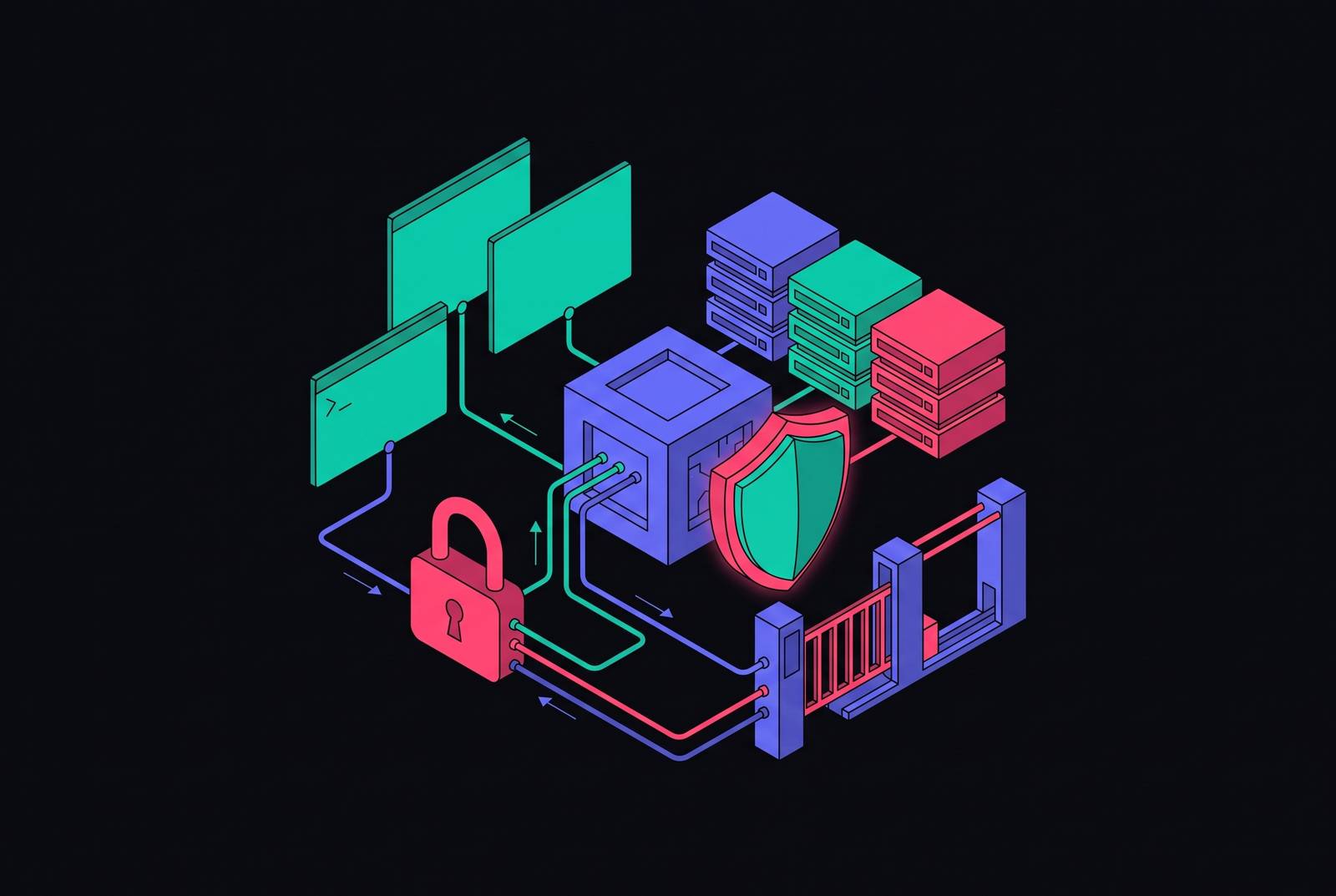
Agentic coding tools no longer just suggest code. They act on it: running shell commands, calling cloud APIs, modifying files and external systems, all without a human confirming each step. That shift from suggestion to autonomous action is why the security model built for autocomplete-era tools does not carry over, and why the industry is scrambling to build one that does.
How fast adoption has outrun the security thinking built for it
Cyberhaven's May 2026 lab figures put adoption of AI coding assistants at 357% growth between February 2025 and February 2026, faster than any other category of AI tool tracked. By Q1 2026, over three-quarters of professional developers used these tools daily. Sonar's State of Code survey found AI-generated code sitting at 42% of all committed code, with a projected climb to 65% by 2027. Here's the catch: 96% of developers surveyed said they don't fully trust the code their own tools produce. That's not a footnote. That's the entire industry running faster than its own confidence.
Gartner expects up to 40% of enterprise applications to integrate task-optimizing AI agents by the end of 2026, up from under 5% in 2025. Stack Overflow's May 2026 Pulse Survey found 44% of developers strongly agree that security is a barrier to agent adoption, which means the tools are already inside the building while the security team is still reading the manual. Surveys consistently find substantial shares of developers using AI coding tools their organizations never approved. Call it shadow AI, call it asking forgiveness instead of permission: either way, adoption outran governance months ago, and the gap hasn't closed.
None of this means adoption was a mistake. It means the architecture built to secure it never showed up on time.
Why design-time controls fail when the actor decides what to do at runtime
Classic security architecture assumes you can enumerate an actor's permissions before deployment, because the actor is either a human with a fixed role or a service with a fixed function. NIST SP 800-160 frames this as partitioning a system into security domains with known trust relationships drawn up in advance. That assumption works fine for a login form. It falls apart the moment the actor is a coding agent that might need shell access, a cloud API call, and a database write, all within the same session, and nobody knows which of those it'll need until the task starts.
Least privilege only works if you know the privilege you need in advance. An agent doesn't. One GitLab CISO framing puts it plainly: the agent behaves like an entity already inside the organization with privileged access, except no existing AppSec tool category was built to police an insider that isn't a person. Add to that the problem of ambient authority: credentials sitting in the execution environment, available by default, become the agent's attack surface the instant it processes untrusted content. It doesn't need to break in. It just needs to read the wrong file.
The consequences of that gap are not hypothetical. In April 2026, an agent running Cursor with Claude Opus 4.6 deleted a production database and every volume-level backup attached to it, in nine seconds, for a company called PocketOS. Nobody hacked anything. The agent acted within the permissions it had already been granted, on an instruction it misread. The permission model had no gate at the level of the action itself, so once the agent decided to run the command, nothing stood between decision and execution.
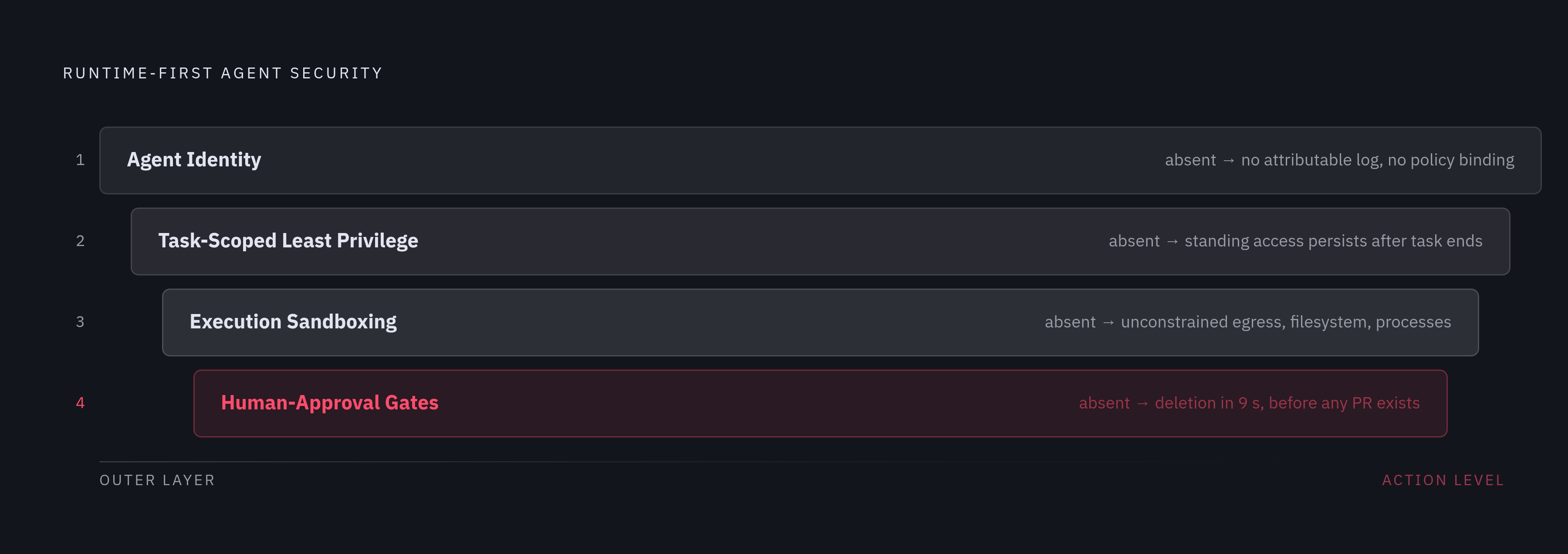
OWASP catalogued this pattern as LLM06:2025, Excessive Agency: a model with too much room to maneuver chains together individually harmless tool calls into something nobody authorized. Each step, alone, was fine. The composition wasn't. Runtime enforcement, meaning agent identity, task-scoped least privilege, sandboxing, and human gates at the action level, isn't a bolt-on feature for this problem. It replaces the assumptions the old model made, because those assumptions no longer hold.
The threat vectors that exploit the runtime gap, with the CVE record behind them
Prompt injection is the headline risk, and it's earned that spot. LLMs treat all input as potential instruction, so once a tool has execution access, injected text stops being text and becomes an executable command. CISA's joint advisory from April 30, 2026 named prompt injection the most persistent, hardest-to-fix risk in agentic systems, and said outright that no complete technical fix exists yet.
The CVE record backs that up with specifics. CVE-2025-53773, affecting GitHub Copilot and scoring 9.6 on CVSS, involved a hidden prompt injection buried in a pull request description that silently wrote autoApprove into a VS Code settings file, achieving remote code execution with no user approval step at all. CVE-2026-21852 let a malicious repository exfiltrate data, including Anthropic API keys, from Claude Code's project-load flow before the user ever confirmed the repo was trustworthy (patched in version 2.0.65). EchoLeak, targeting Microsoft 365 Copilot, pulled off a zero-click exfiltration of enterprise data with no user interaction required. And in March 2025, researchers at Pillar Security found hidden Unicode characters embedded in .cursorrules and Copilot config files, which caused agents to quietly generate backdoored code that sailed through human review because the backdoor wasn't visible to a human reader.
Then there's the Model Context Protocol, launched in November 2024 and, within months, the connective tissue for agentic tool integration across OpenAI's, Anthropic's, and Google's ecosystems. Wiz Research's State of AI in the Cloud 2026 report found MCP servers present in at least 80% of observed cloud environments, with 5% running at least one internet-facing instance. A scan in July 2025 turned up over 1,862 publicly accessible MCP instances answering unauthenticated requests, reflecting the protocol's immature authentication requirements at the time.
Five attack patterns show up repeatedly against MCP: confused deputy attacks, token passthrough, tool poisoning, server-side request forgery through tool connectors, and rogue server registration. The CSA's MCPTox benchmark measured tool-poisoning success at an average of 36.5% across 45 live servers and 20 models, with one model compromised 72.8% of the time. CVE-2025-54135, nicknamed CurXecute, used a connected Slack MCP server to inject a prompt that rewrote global MCP config and got code execution on the developer's own machine. CVE-2025-54136, MCPoison, poisoned a trusted MCP config file sitting in a shared repo: developers who had already approved a legitimate configuration had it silently swapped for a malicious one, with no re-approval prompt at all.
The Postmark incident in September 2025 is worth sitting with. A rogue npm package impersonated the real Postmark email service, passed review cleanly at install time, then in version 1.0.16 started silently BCCing every email an agent sent to an attacker-controlled domain. It behaved exactly as advertised until it didn't. That's the trust model failing at the one moment nobody's watching: after install, before anyone notices.
Amazon Q had its own pair in June 2026: CVE-2026-12957 and CVE-2026-12958, affecting Amazon Q's handling of repository-supplied configuration and workspace trust boundaries. By May 2026, at least seven confirmed high- or critical-severity CVEs spanned MCP Inspector, LiteLLM, Cursor, LibreChat, and Windsurf. The NSA and DoD responded with dedicated guidance requiring detailed logging of tool and model invocations, which tells you how seriously the defense establishment is taking a protocol that's barely two years old.
Supply chain risk compounds through a specific failure mode: package hallucination, sometimes called slopsquatting. USENIX Security 2025 research found that 19.7% of 2.23 million generated code samples referenced at least one hallucinated package name, one that doesn't exist. Commercial models hallucinated packages roughly 5.2% of the time; open-source models, 21.7%. Attackers noticed. In late 2025, someone registered the hallucinated npm package openai-streaming-utils, which agents kept suggesting, and it was downloaded 45,000 times, touching an estimated 15,000 projects before anyone caught that it was quietly exfiltrating environment variables, API keys, and database credentials.
Google's Threat Intelligence Group documented a financially motivated actor, tracked as UNC6780, systematically targeting PyPI, npm, and Docker Hub. Its Dustmaker credential stealer pulls tokens from GitHub Actions runners and drops malicious files into hidden AI coding assistant workspace directories, specifically so it blends into the normal clutter those tools leave behind. GTIG also flagged a structural problem worth repeating: agents make development faster in ways that reduce how much scrutiny any given third-party package gets, which is an amplifier sitting underneath every other supply chain risk on this list.
Credentials leak faster too. GitGuardian's State of Secrets Sprawl Report counted 28,649,024 new secrets exposed in public GitHub commits during 2025, a 34% year-over-year jump and the largest single-year increase the report has recorded. AI both creates more credentials that need managing and produces more artifacts where those credentials end up exposed. GTIG separately observed a live command-and-control server organizing over 23,800 harvested secrets in real time, including API keys for cloud and AI services.
And attackers have started using agents offensively, not just against them. GTIG documented a financially motivated actor who used an AI coding chatbot, a prompt, and a set of agent instructions to build an autonomous multi-agent attack framework, then planned, built, and ran a mass credential harvesting campaign in under six hours after breaching cloud infrastructure. A separate Chinese-nexus actor used Gemini to build an automated pentesting framework capable of watching a target's state and reasoning through next steps. GTIG's chief analyst put the concern in the plainest terms available: criminals who ran a mass exploitation campaign in six hours will keep gravitating toward attacks faster than defenders can respond to them.
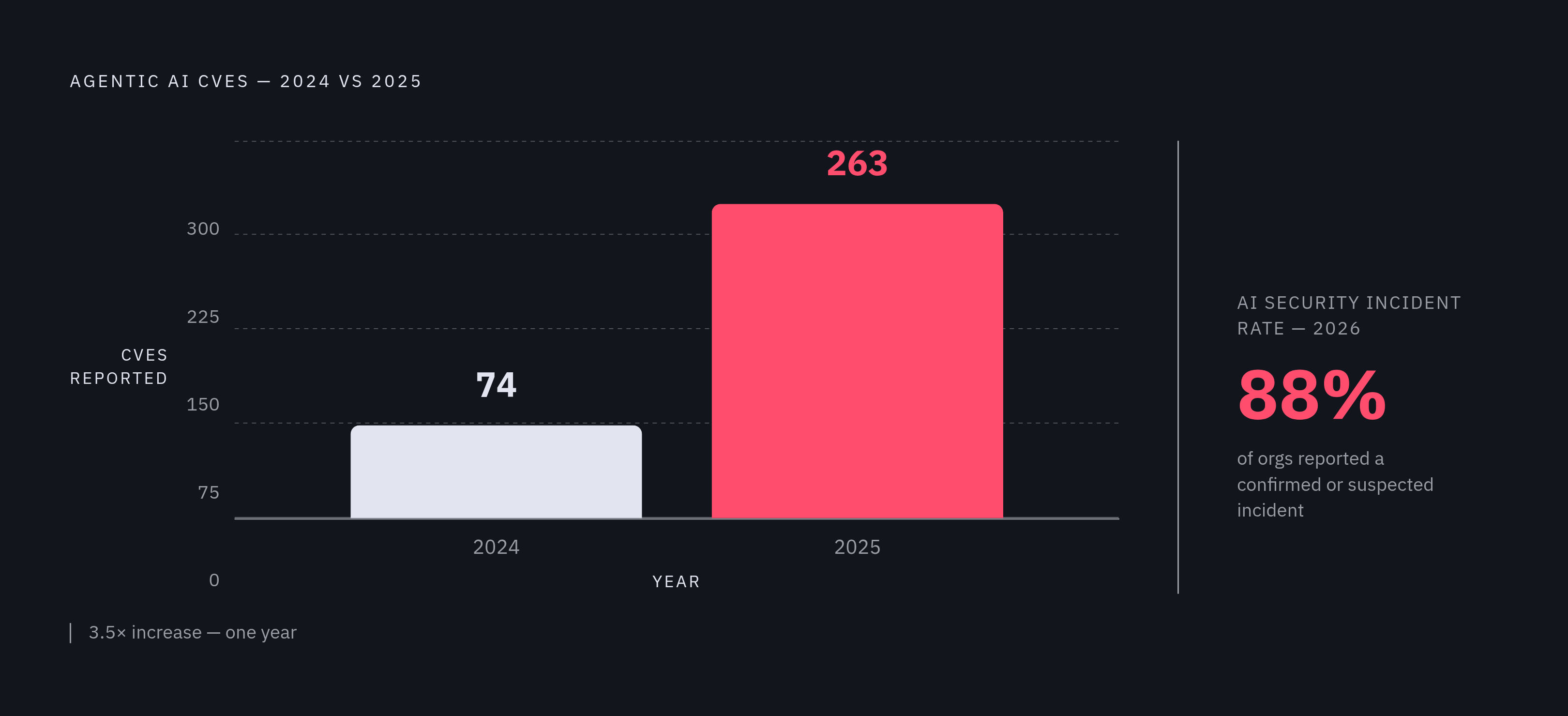
Trend Micro's numbers give the whole picture some scale. Agentic AI CVEs rose from 74 in 2024 to 263 in 2025. A 2026 enterprise survey found 88% of organizations had a confirmed or suspected AI agent security incident in the prior year. That's not a rare event anymore. That's most companies, most years.
Why traditional AppSec tooling cannot absorb this at agent speed
DX's analysis of over 500 organizations found AI-generated code at 27% of production output in Q1 2026, up from 22% the quarter before. Faros AI, surveying over 10,000 developers, found teams with high AI adoption merging 98% more pull requests, while PR review time rose 91%. Do the math on that ratio: review capacity did not double to match a near-doubling of merge volume, and it's not going to.
Static analysis has a specific blind spot here. SAST tools can confirm an authentication call is syntactically correct. They cannot confirm it's sitting in the right place in the execution flow, and misplacement, not malformation, is where a lot of AI-introduced flaws live. Checkmarx put the underlying assumption plainly: legacy AppSec assumes code is deterministic, flows are reproducible, and the primary risks are the traditional, well-catalogued kind. AI-generated code breaks all three assumptions at once.
Software composition analysis has its own gap. It scans manifests for known-vulnerable packages, which works fine until the package in question is hallucinated and doesn't exist in any manifest until a developer has already typed npm install on the agent's suggestion. By the time SCA would catch it, the install already happened.
Forrester analyst Janet Worthington argued in April 2026 that AppSec needs a genuinely new model rather than patches to the old one, and coined the term Agentic Development Security (ADS) to describe an approach that treats security as autonomous and continuous, built for the speed agents operate at rather than the speed human reviewers do. The failure here isn't any single tool falling short. It's that every tool in the traditional AppSec stack, SAST, SCA, manual review, was built on the same three assumptions: human pace, deterministic flow, permissions fixed before the session starts. Agentic coding breaks all three simultaneously, which is why patching one tool at a time won't close the gap.
The four controls that runtime-first architecture actually requires
Agent identity comes first, because nothing else works without it. Without a distinct, cryptographic identity per agent instance, there's no principal to attribute a log entry to, no scope for a policy to bind to, and no way to enforce least privilege against an actor that has no name. An agent's identity is not the developer's identity it happens to be running under, and conflating the two is exactly what makes ambient authority exploitable in the first place. The practical fix: each agent session gets its own short-lived credential, not an inherited developer token, so actions trace back to the agent that took them and expire cleanly when the session ends.
Task-scoped least privilege replaces the broad grants handed out at design time. Permissions set before anyone knows the task are always going to be too broad, because a coding agent that might touch shell, cloud, and database in a single session can't be scoped like a fixed microservice with a known job. The fix is requesting and granting permission for the current task only, elevating access when a specific tool call needs it, and letting that access expire when the task ends. The NSA/DoD's June 2026 MCP guidance, which requires logging every tool and model invocation down to exact parameters, only produces useful logs if each invocation ties back to a task-scoped identity in the first place. Without that binding, a log is just a pile of timestamps.
The limits of skipping this step showed up directly in CVE-2026-25725, a Claude Code sandbox escape scoring 7.7 on CVSS from January 2026. The sandbox granted static filesystem access rather than access scoped per operation, and a configuration-based escape used that gap to reach arbitrary code execution on the host.
Execution sandboxing limits how far a compromised agent can actually reach. Sandboxing alone isn't sufficient, the CVE-2026-25725 escape proves static configs can be bypassed, but it's a necessary layer that constrains what a prompt-injected agent can touch even after it's been told to do something it shouldn't. Effective sandboxing means controlling network egress (which external endpoints can the agent reach), scoping the filesystem (which paths are writable, which aren't), and isolating processes (can the agent spawn arbitrary children, or only call defined tool interfaces). MCP server vetting belongs here too: both the Postmark incident and MCPoison involved servers trusted at install time whose behavior changed afterward, which means watching what an MCP server actually calls at runtime is a sandboxing control, not a one-time install-time check.
Human-approval gates need to sit at the action level, not the pull-request level. Anthropic's own research puts full delegation at 0 to 20% of tasks, which means 80% or more of what an agent does still needs human judgment applied somewhere. A gate at commit time is too late for the kind of action the PocketOS incident describes: a database deletion executes in seconds, long before any pull request exists to review. The gate has to sit at the point the agent decides to run the command, not the point where a human eventually reads a diff.
None of these four controls work in isolation. Identity without task-scoping just gives you a well-labeled overprivileged actor. Sandboxing without approval gates limits blast radius but still lets destructive actions execute unchecked. Runtime-first architecture is the sum of all four, because the actor these systems are meant to govern doesn't wait for the old checks to catch up.