Enterprise AI Agent Governance Frameworks
Human oversight gaps create dangerous new attack surfaces as AI agents operate autonomously.
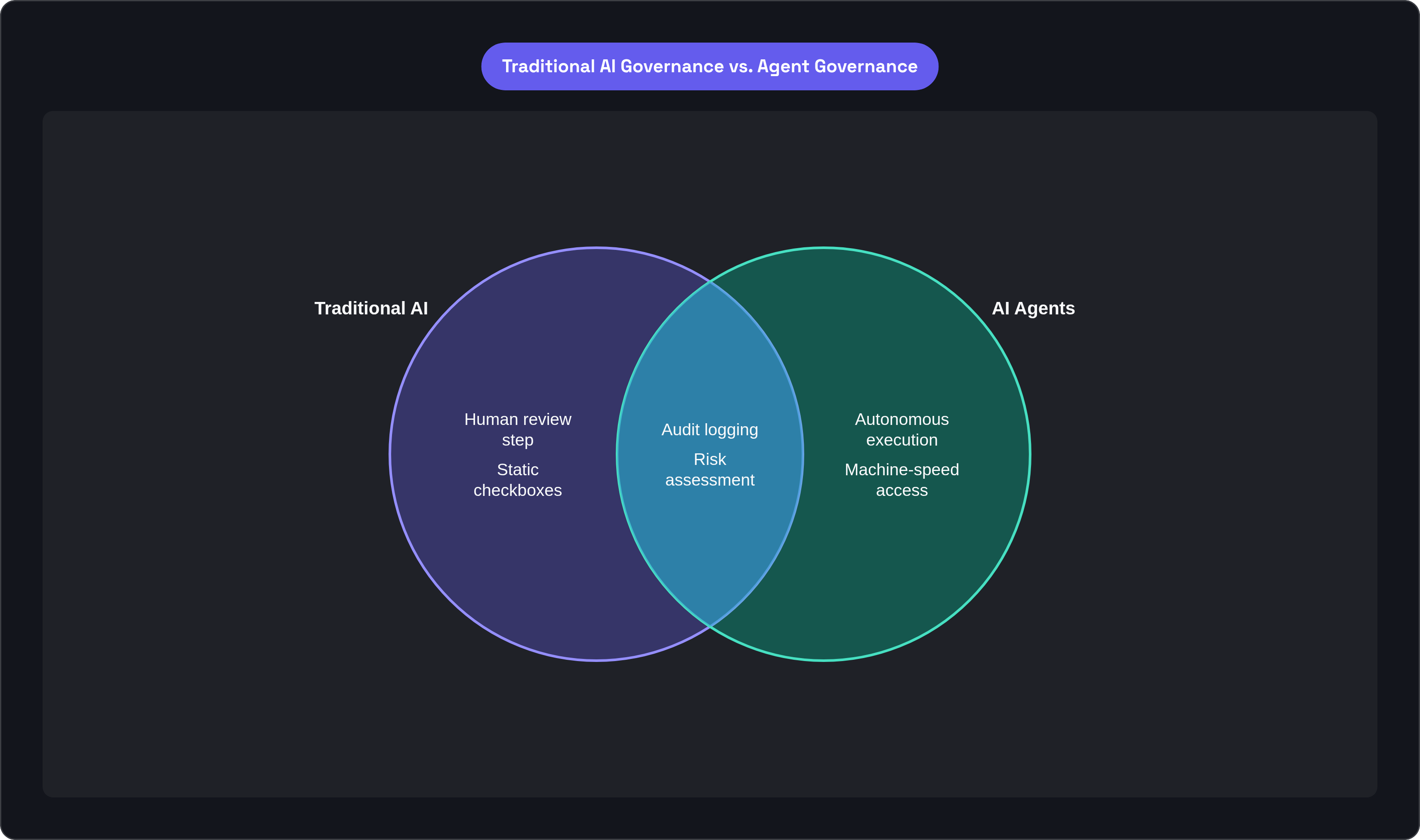
Traditional AI governance was built on one load-bearing assumption: a human reviews the output before anything consequential happens. That review step was where risk got caught, where judgment lived, where accountability had an address. Agents eliminate it entirely, and most governance frameworks have not caught up.
An AI agent does not generate a recommendation and wait politely. It plans, executes, and produces real-world consequences across multiple systems before any human has a chance to intervene. Three properties drive the divergence, and none of them were present in the systems existing governance was designed to handle.
Autonomy without checkpoints is the first. A single instruction can cascade through an entire workflow, triggering dozens of downstream actions across multiple systems, with no natural pause point where a human reviewer intercepts the chain. Traditional governance assumed those pause points existed. Agent architecture does not.
Then there is inherited access exercised at machine speed. Agents operate using OAuth tokens, API keys, and service accounts, the same credential infrastructure built for human employees. Research has documented that employees ignore the vast majority of their permissions in practice. Agents will not apply that same restraint. Every permission an agent holds is a permission it will use, and it will use it faster than any monitoring system built for human behavior can realistically detect.
Cross-boundary operation is the third property. A single agent workflow routinely touches a CRM, a cloud storage environment, a ticketing system, and an external API within one execution. Governance frameworks built around system-level controls were never designed for actors that traverse those boundaries as a matter of routine function.
Multi-agent architecture compounds all of this. Beam.ai's 2026 research found that 25.5% of deployed agents can create and task other agents. Governance gaps do not stay local; they propagate through agent hierarchies. CSA research put the underlying logic plainly: individually safe components can compose into unsafe systems, because adversaries can combine them in ways that produce harm neither could produce alone.
The identity dimension makes everything structurally worse. Non-human identities already outnumber human identities in many enterprise environments, with ratios reaching 90 to 1 and in some cases as high as 144 to 1, per CSA's State of Non-Human Identity and AI Security survey. That infrastructure was designed entirely around human accounts. Agents are not tools waiting for instructions. They are actors with access, judgment, and persistence, running on infrastructure that was never built to govern them.
The Specific Attack Surfaces That Emerge When Agents Inherit Enterprise Access
NIST's January 2025 research found that novel attack strategies against AI agents achieved an 81% success rate in red-team exercises, compared to 11% against baseline defenses. That gap points to attack surfaces that are genuinely different from what conventional security controls were designed to address.
OWASP's 2025 LLM Top 10 identifies prompt injection as the leading vulnerability. Adversarial instructions embedded in documents or retrieved data can alter agent behavior without triggering any conventional security alert, because the agent processes the malicious instruction as legitimate input. There is no malformed packet, no anomalous authentication event. The agent simply does what it was told, by someone other than its operator, and everything looks fine from the outside.
Model-level attacks compound this further. Research cited by HelpNetSecurity demonstrated that fine-tuning attacks bypass safety-trained models at significant rates: 72% against Claude Haiku, 57% against GPT-4o. When the model itself is the attack surface, governance controls applied above the model layer are insufficient if the model's behavior has already been altered below them.
OWASP also names Excessive Agency in its 2025 top 10: agents that hold more permission than their tasks require. The harm here does not require adversarial input. It requires only an agent operating legitimately within an access scope that was too broad. That is a governance failure, not a security failure in the traditional sense.
In September 2025, Anthropic detected GTG-1002, the first documented AI-orchestrated cyber espionage campaign. A Chinese state-sponsored group used Claude Code to autonomously attack approximately 30 organizations, with AI handling 80 to 90% of tactical operations. Beam.ai's 2026 research found that 88% of enterprises had experienced confirmed or suspected AI agent security incidents.
An agent can complete a significant portion of an attack before any traditional alert fires. Detection at the moment of action is the minimum viable control, and most environments do not have it.
Where Current Enterprise Governance Efforts Actually Stand — and the Gap Between Stated Priority and Implementation Reality
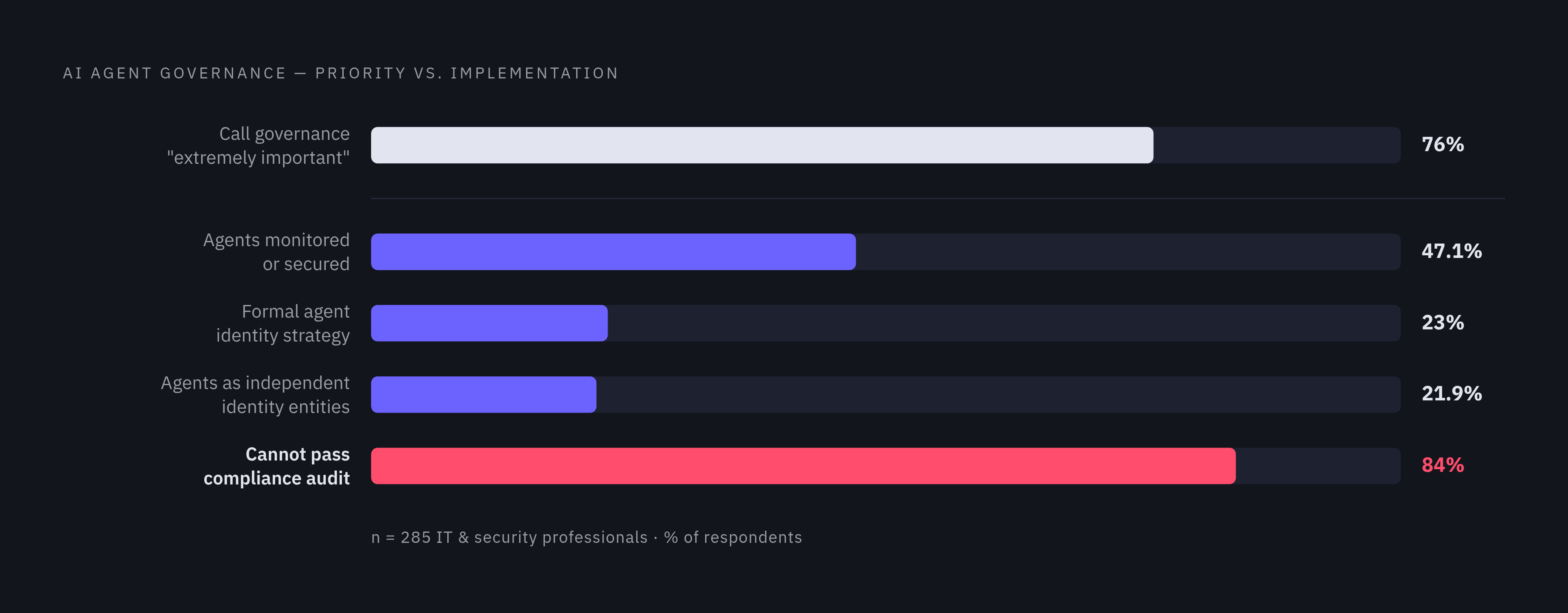
Awareness of the problem is not the issue. Nevermined.ai, citing industry research, found that 76% of technology leaders describe governance as extremely important for agentic AI deployment. The implementation numbers tell a different story.
Beam.ai's 2026 research found that only 47.1% of an organization's AI agents are actively monitored or secured. More than half of deployed agents are running without consistent oversight or logging. Deloitte's AI governance research found that only one in five companies has a mature governance model for autonomous AI agents, even as adoption accelerates. A survey of 285 IT and security professionals produced numbers that are harder to dismiss: only 21.9% of organizations treat AI agents as independent, identity-bearing entities; only 23% have a formal agent identity strategy; only 18% are confident their existing IAM tools can manage agent identities; and 84% cannot pass a compliance audit focused on agent behavior.
These are not edge cases. These are the median.
Gravitee's April 2026 survey of 750 senior technology leaders found that confidence in security among enterprise leaders has risen even as monitoring coverage and pre-deployment controls have barely moved. Organizations are growing more comfortable with a risk they have not actually reduced.
Gartner projects that more than 40% of agentic AI projects will be canceled by end of 2027 due to escalating costs, unclear business value, or inadequate risk controls, and that by 2030, half of AI agent deployment failures will result from insufficient runtime governance enforcement. The top barriers organizations cite, cybersecurity concerns, data privacy, and regulatory clarity, are all governance problems, not fundamental limitations of the technology itself.
The deployment pace makes urgency concrete. Generative AI took three years to reach 70% enterprise adoption; agentic AI reached 35% in two years, with another 44% of organizations planning deployment soon, per MIT Sloan Management Review and BCG's 2025 research. Gartner projects that 40% of enterprise applications will integrate task-specific AI agents by end of 2026, up from less than 5% in 2025. Gravitee's April 2026 survey found that the mean agent count had roughly doubled in four months since December 2025, with nearly 38% of organizations already running more than 100 agents. Governance processes built for deliberate, phased software rollouts cannot operate at that tempo.
What a Governance Framework Actually Needs to Do Differently for Agents Than for Traditional AI Systems
The World Economic Forum's "AI Agents in Action" framework, published in 2025, offers the clearest published articulation of what has to change. Its core argument: governance levels must be dynamically calibrated to agent autonomy and authority in real time, not set as static checkboxes at deployment. The framework organizes this around four pillars: technical foundations, functional classification, evaluation and governance, and progressive governance.
Progressive governance is the most consequential departure from traditional models. Governance intensity scales with autonomy level, not with deployment date or system category. An agent taking low-stakes, reversible actions in a constrained environment warrants different controls than one executing financial transactions or modifying access permissions. Treating them identically either over-controls the former to the point of operational uselessness, or under-controls the latter to the point of genuine risk.
The human-in-the-loop assumption deserves scrutiny here. EU AI Act Article 14 and the NIST AI RMF both require human oversight for high-risk AI decisions, and those requirements are real. But Forrester analyst Craig Le Clair's framing captures the operational reality: traditional AI is "generate and review"; agentic AI is "plan, act, and potentially fail autonomously." At agent scale and speed, human-in-the-loop either creates bottlenecks that render agents operationally useless or becomes a rubber-stamp formality that provides oversight in name only.
A supply chain agent cannot pause every inventory adjustment for human approval. A fraud detection agent that halts every transaction for manual review is not a fraud detection agent; it is a customer service problem. The control mechanism has to operate at the speed of the agent.
Governance-in-the-Loop, GITL, is the emerging answer: automated, policy-enforced governance that runs at agent speed, intervening at the moment of a policy violation rather than after an incident report surfaces it. This is not a replacement for human oversight of high-risk decisions. It is the infrastructure that makes meaningful human oversight possible, by filtering the action space down to decisions that actually warrant human judgment.
Identity governance is the element most commonly treated as a configuration task rather than an architectural one, and that mistreatment is expensive. CSA's agentic identity governance research is unambiguous: identity governance is infrastructure. Agents need unique, machine-readable identities; scoped permissions tied to specific tasks and time windows; credential rotation and revocation mechanisms that operate at deployment speed; and identity chains that remain explicit and auditable when one agent tasks another. When an agent delegates to a subordinate agent, that trust chain is a governance boundary. Crossing it without explicit, auditable authorization carries the same category of risk as a human employee sharing credentials, except it happens faster and leaves less obvious traces.
Six components appear consistently across enterprise governance literature: policy development, risk assessment, compliance alignment, technical controls, ethical guidelines, and continuous monitoring. The critical word is "continuous," and it is the word that separates agent governance from the point-in-time review processes most organizations have inherited from traditional software governance.
The Four Operational Capabilities That Distinguish Enforceable Agent Governance from Policy Documentation
Policy documents do not govern agents.
Discovery comes first, and it is non-negotiable. You cannot govern agents you do not know exist. Given that Gravitee's data shows mean fleet sizes doubling in four months, manual inventory processes are structurally inadequate before you even account for agents deployed by individual employees without central IT involvement. Discovery has to be automated and continuous.
Real-time monitoring of agent activity requires continuous observation of what agents are doing, what data they are touching, and what actions they are taking across every system they access. Periodic reviews produce a historical record. Governance requires knowing what is happening now.
Anomaly detection and policy enforcement at runtime follow directly from the NIST red-team research and the GTG-1002 campaign. If an agent can complete 80 to 90% of a sophisticated operation before a traditional alert fires, then traditional alerting is not a governance mechanism for agents. Violations must be caught and stopped in-flight, not surfaced in a weekly report.
Complete audit logging is where most organizations are most visibly exposed to compliance risk. The 84% figure, the proportion of organizations that cannot pass a compliance audit focused on agent behavior, reflects directly the absence of this capability. Compliance with EU AI Act Article 14 and the NIST AI RMF requires a verifiable record of every agent action, captured as a first-class governance output, not reconstructed from disparate system logs after an audit request arrives.
These four capabilities compose into a real-time control plane that operates at agent speed. That is the distance between governance documentation and governance enforcement.
How Agent Identity Management Fits into Governance Architecture — and Why It Must Be Designed in from the Start
The identity problem is both quantified and consistently underestimated, which is an uncomfortable combination.
Non-human identities outnumber human identities in many enterprise environments at ratios of 90 to 1, yet the IAM infrastructure underlying those environments was designed for human accounts. Agent identity requires four things that most existing IAM implementations do not provide: unique, machine-readable identities per agent, not shared service accounts or borrowed human credentials that obscure accountability when something goes wrong; scoped permissions tied to specific tasks and time windows, not persistent broad access that accumulates over deployment lifetimes; credential rotation and revocation mechanisms that operate at the speed of agent deployment; and identity governance that extends to agent-to-agent delegation, because when one agent tasks another, the trust chain must be explicit and auditable, or it is not a trust chain at all.
From the survey of 285 IT and security professionals: 23% of organizations have a formal agent identity strategy; 18% are confident their existing IAM can handle agent identities. The majority are running agents on identity infrastructure that was never designed for them.
CSA's position on this is direct: identity governance is not a configuration task to be completed after orchestration architecture is established. It must be a design constraint that precedes architecture decisions. Organizations retrofitting identity governance onto already-deployed agents face a harder problem than those building it in from the start, because the access patterns, credential structures, and delegation chains are already embedded in production systems by the time the governance requirement becomes undeniable. Treating identity governance as a deployment precondition prevents the most common and most expensive access control failures.
Platforms designed specifically for non-human identity and agent governance are meaningfully different from traditional IAM products extended to cover agents as an afterthought. Vendors such as Oasis Security and Aembit have built specifically for non-human identity management; Torq and Swimlane approach the problem from a security orchestration angle with agent-aware controls; and emerging platforms purpose-built for agentic governance are beginning to address discovery, identity, monitoring, and enforcement as integrated capabilities rather than separate tools requiring manual correlation. Evaluating any of them requires asking specifically whether they handle the agent-to-agent delegation case and whether identity scoping operates at the task level or at the broader service-account level.
What Compliance Requirements Actually Demand from Agent Governance Right Now
Compliance requirements for AI agents are present and, for most organizations, already unmet.
EU AI Act Article 14 requires demonstrable human oversight of high-risk AI systems. "Demonstrable" means provable to an external reviewer, not asserted in a policy document or inferred from the existence of a human employee nominally responsible for AI operations. Oversight must be trained, measurable, and verifiable. That proof requires the audit logging and monitoring capabilities described above.
The NIST AI Risk Management Framework has been extended with an agentic AI profile published by CSA, which maps the RMF's Govern, Map, Measure, and Manage functions to agentic-specific requirements, including runtime monitoring and agent-specific risk assessment. This is not a generalization of the existing RMF. It addresses the specific operational properties of autonomous agents that make generic AI governance insufficient, and it names agents explicitly rather than treating them as a subcategory of "AI systems."
The audit log requirement is where most organizations are most exposed. Compliance audits for agent behavior require complete, tamper-evident records of agent actions, produced by governance infrastructure as a primary output, not reconstructed from disparate system logs after an audit request creates retroactive urgency. Organizations that rely on that reconstruction will find records incomplete, out of sequence, or insufficiently granular to satisfy auditors who know exactly what they are looking for.
The regulatory trajectory is clearly toward more specificity. The WEF framework, NIST's agent-specific standards work, and the CSA's published profiles all name agents explicitly. Compliance alignment requires the operational capabilities, discovery, monitoring, enforcement, and logging, because those are what produce the evidence regulators and auditors will demand.
Building an Agent Governance Program in Practice — Sequencing the Capabilities That Matter Most
Sequencing matters because resources are finite and agents are already running.
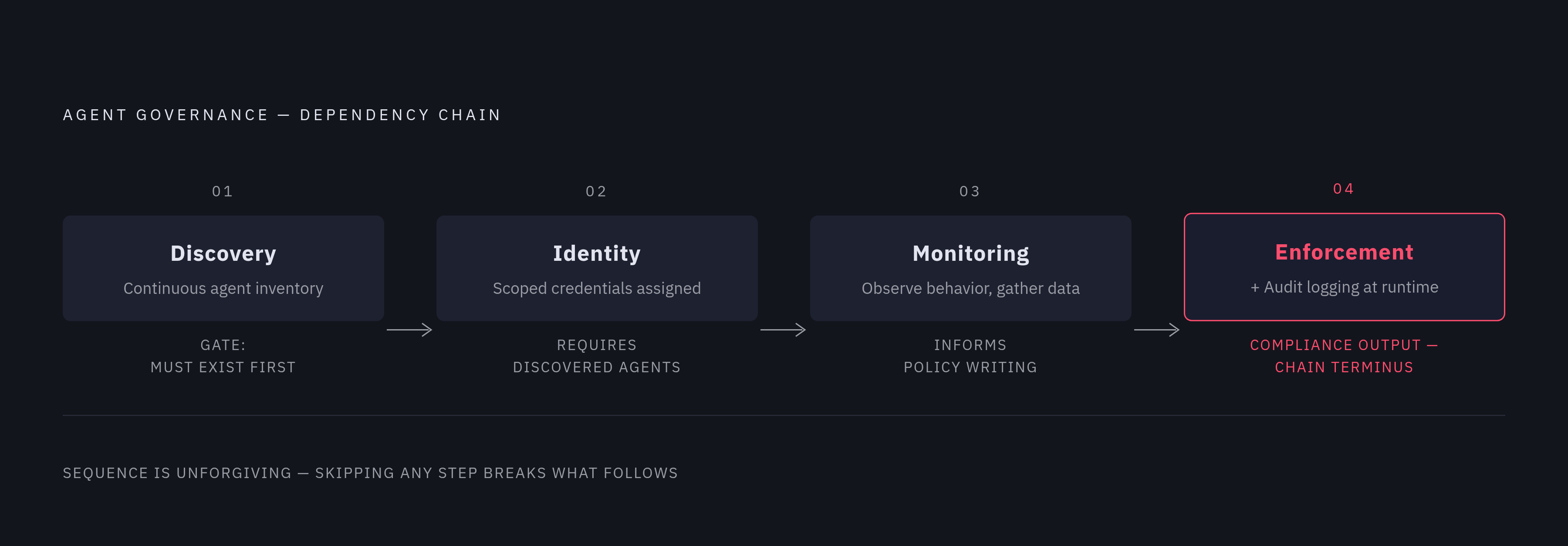
Start with discovery. Risk assessment, policy enforcement, and audit logging are all downstream of knowing what agents exist. The first governance action is building a complete, continuously updated inventory of every agent in the environment, including agents deployed by business units without central IT involvement. Given current adoption patterns, that shadow population is almost certainly significant and undercounted.
Establish agent identity before expanding access. Retroactively assigning identity governance to already-deployed agents is harder than requiring it at deployment. The access patterns are already established, the credentials are already in use, and modifying them creates operational risk. The practical implementation: unique service accounts or workload identities per agent, scoped to the minimum permissions required for the specific task, before the agent touches production systems.
Sequence monitoring before enforcement. Understanding what agents actually do in production is necessary before writing enforceable policies. Policies written without that empirical foundation will either block legitimate workflows, pushing agents out of governed infrastructure into shadow deployments, or will be written permissively enough to accommodate every observed behavior, which provides no enforcement value. Monitor first; then write policies against actual behavior.
Calibrate human-in-the-loop requirements to actual risk. The WEF's progressive governance model and the GITL concept both argue for tiering oversight to autonomy and consequence level. High-stakes, irreversible actions warrant human approval; routine, low-consequence, reversible actions warrant automated monitoring with exception escalation. The tiering criteria should be explicit, documented, and defensible to auditors. Governance programs that require human approval for everything create the bottlenecks that push agents into ungoverned infrastructure, which is the opposite of the intended outcome.
Treat audit logging as a design output, not an afterthought. Complete logs of every agent action must be produced by the governance infrastructure itself, not assembled after the fact when a compliance audit or incident investigation creates retroactive urgency. The logging architecture must be specified before agents are deployed into production.
The dependency chain here is linear and unforgiving: you cannot enforce policy on agents you have not discovered; you cannot write accurate policy without monitoring data; you cannot produce compliant audit logs without enforcement infrastructure that captures actions at runtime. Organizations that get this sequencing right will not just avoid regulatory exposure. They will be the ones that can actually trust their agents to operate at scale.