Agentic AI Architecture Patterns Overview
Five architecture patterns that determine which AI agent projects ship and which get cancelled.
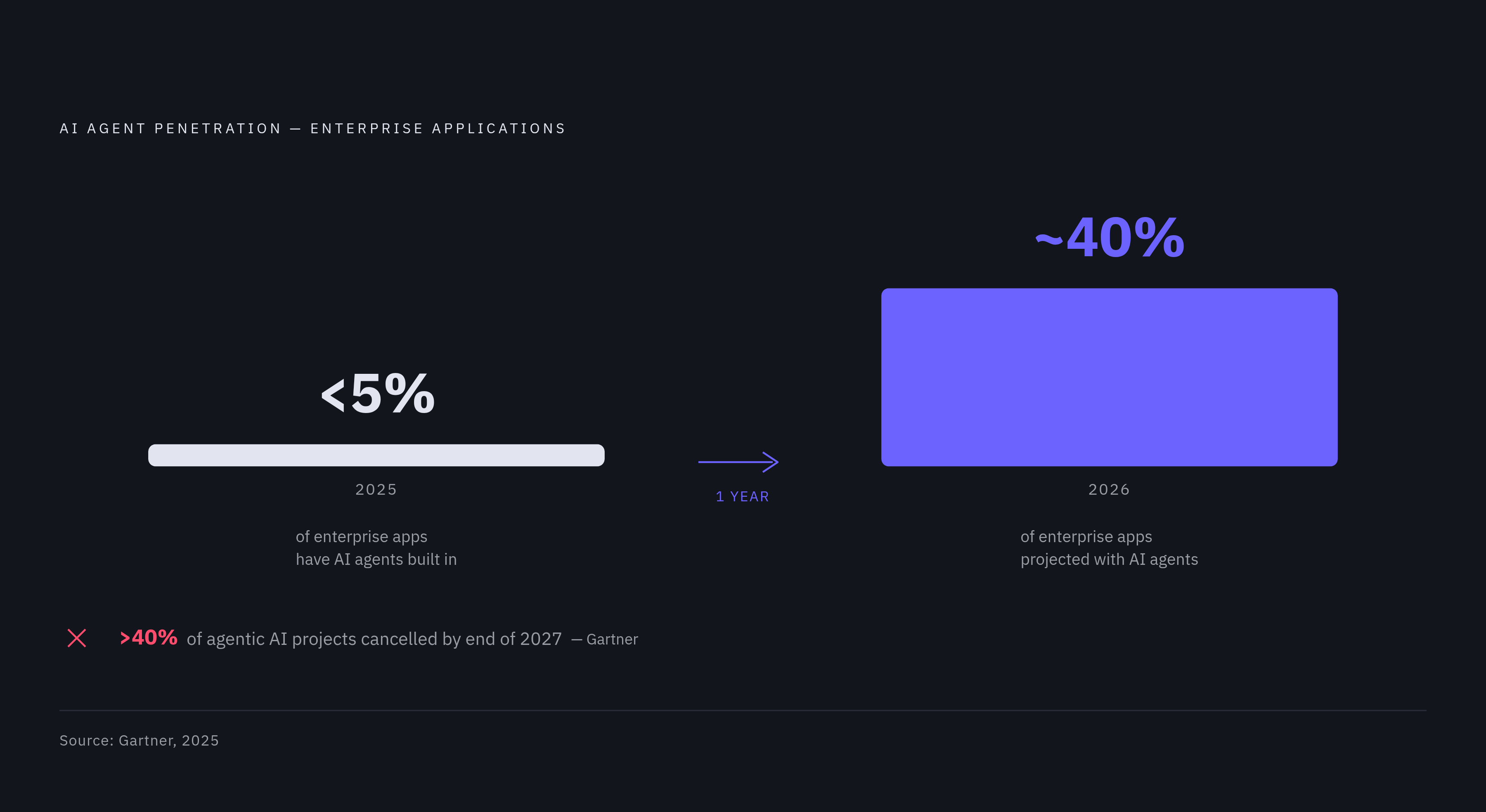
Gartner's own numbers tell you this is happening whether you're ready or not: by 2026, roughly 40% of enterprise applications will have AI agents built into them, up from under 5% in 2025. That's not a slow rollout, that's an architecture decision being made across thousands of companies right now, mostly by teams who inherited the pattern names from a research paper and never quite mapped them to what happens when the thing breaks in production. Gartner also projects that more than 40% of agentic AI projects get cancelled by the end of 2027, killed by cost overruns, unclear payoff, or risk controls that show up after the incident instead of before it. Funny how that works. The difference between the agents that ship and the ones that get shelved is almost always architecture, not model quality, and most people find that out the expensive way.
Why architecture patterns exist and what they solve
An agentic pattern is a structural decision, not a framework pick. It's the blueprint for how an agent reasons, acts, and recovers when it's wrong. Confuse that with a library choice and you'll spend a week debugging the wrong layer, which I've watched happen more than once.
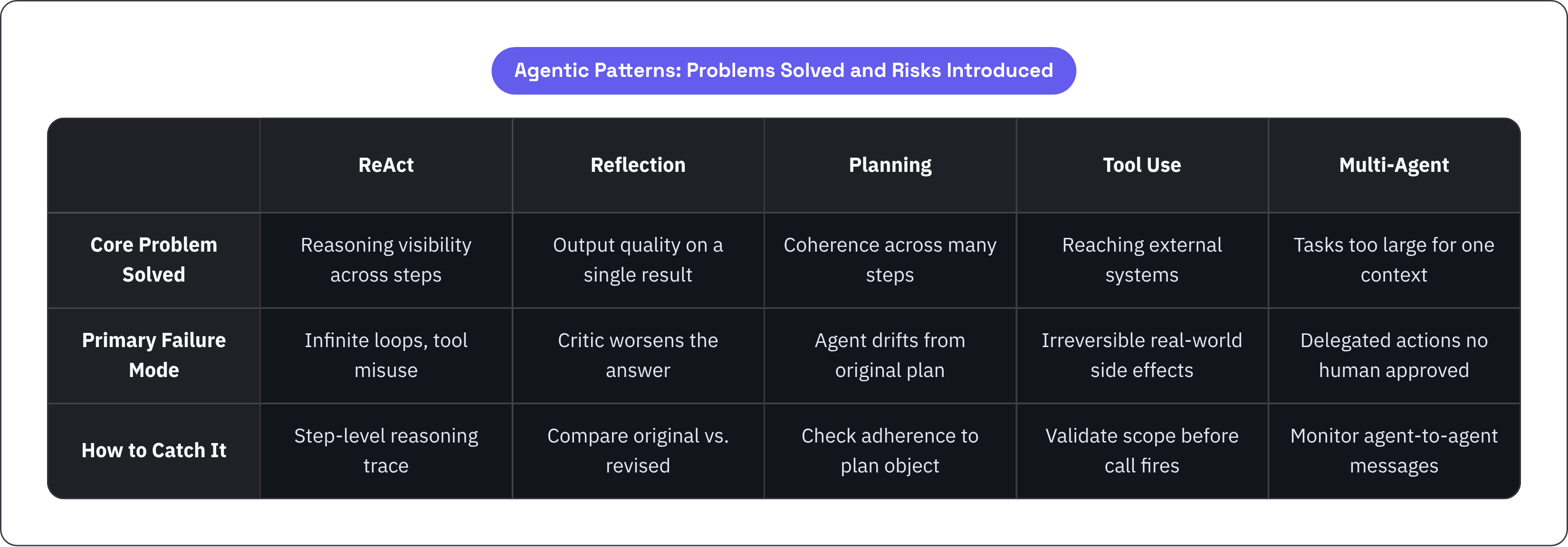
Each pattern solves a different failure mode. ReAct is about whether you can see the reasoning. Reflection is about whether the output is any good. Planning is about staying oriented over ten or fifty steps instead of one. Tool Use is about how far the agent can reach into the world, and multi-agent design is about splitting a job too big for one context window. Five separate problems, and they tend to show up in the same system at the same time, uninvited, like relatives during the holidays. Most production agents run two or three of these at once. The real design question was never "which pattern." It's which combination matches the specific ways your task is going to fail.
ReAct: the foundational reasoning loop
Yao and colleagues published ReAct in 2022. The finding was straightforward: an agent that writes down its reasoning between actions performs better and is easier to audit than one that jumps straight to output. Thought, then Action, then Observation, then repeat until done. Almost boring in its simplicity, and boring is usually a compliment in this line of work.
What holds the loop together across steps is the scratchpad, a running section of the prompt that accumulates every prior thought and observation for the task at hand. Without it, the agent has amnesia between steps. With it, you get a reasoning trace you can read, step by step, which matters enormously once you're trying to figure out why an agent did something strange three hours ago and everyone's looking at you.
The trace also shows you where things go wrong, in a specific and nameable way. Agents get stuck calling the same tool over and over with slightly different arguments, hoping one of them sticks, the way a search engine keeps rephrasing the same query nine different ways and getting nowhere. The fix is mechanical: deduplicate repeated calls, cap the number of steps, give the agent explicit permission to give up. None of that is glamorous. It's the difference between a bounded task and a runaway API bill, though, and finance will notice the bill before anyone notices the elegant architecture.
ReAct has a ceiling. It has no built-in way to judge whether its own answer is good, and no mechanism to back out of a wrong approach once it's three steps in. It just keeps going, which is its own kind of confidence.
Reflection: how agents evaluate and revise their own outputs
Reflection asks the agent to grade its own homework. Generate a first attempt, critique it, revise based on the critique, and loop again if the critique still isn't satisfied.
The research backing this moved fast. Shinn and colleagues' Reflexion (2023) and Madaan and colleagues' Self-Refine (2023) both showed the pattern working across different task types; Self-Refine reported roughly a 20% improvement across tasks ranging from dialogue generation to math problems, just by adding a critique-and-revise pass. Andrew Ng has pointed to Reflection as one of the core agentic design patterns worth building around, which tells you this moved from a research curiosity to something practitioners actually reach for.
There's a specific way Reflection backfires, worth naming because it's counterintuitive: the critic talks the generator into a worse answer than the one it started with. Call it reflection regression, or call it the world's most persistent backseat driver. Either way, the fix isn't to trust the revision by default; add a comparison step that picks the better of the two, original or revised, instead of assuming newer means better. Reflection improves a single output. It does nothing to keep an agent oriented across a long task with many outputs strung together. That's a different problem, and it needs a different fix.
Planning: maintaining coherence across multi-step tasks
Planning solves for what you might call cognitive entropy: an agent deep inside subtask four forgets what subtask one was actually for. The fix is to make the agent write an explicit plan before it starts executing, then check back against that plan at each step instead of improvising fresh every time. Sounds too simple to be a real architectural fix. The difference between a plan object and step-by-step improvisation is structural, though, not cosmetic, and you feel it the first time an agent wanders off mid-task.
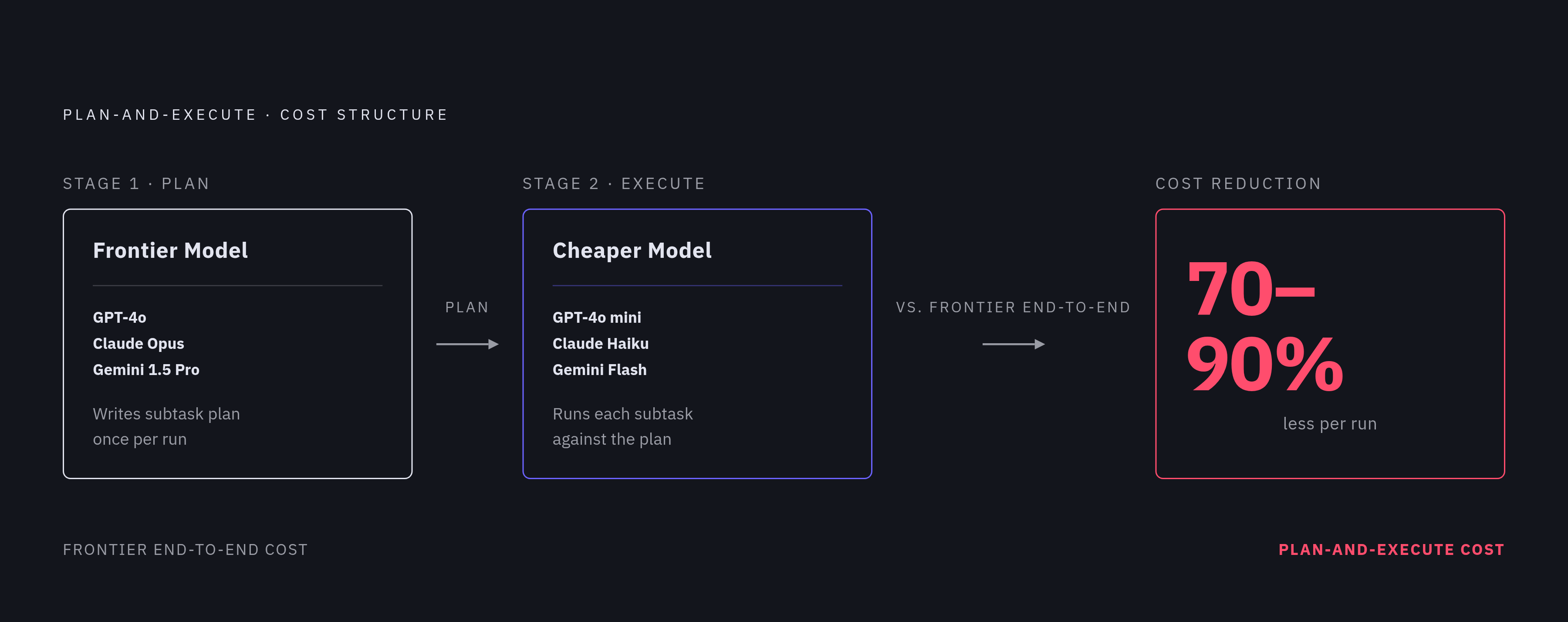
The Plan-and-Execute variant splits the job across two different models. A frontier model (something like GPT-4o, Claude Opus, or Gemini 1.5 Pro) writes the plan. A cheaper model (GPT-4o-mini, Claude Haiku, Gemini Flash) executes each subtask against that plan. Done well, this can cut per-run costs by 70 to 90% compared to running the frontier model start to finish. One of the rare calls in this whole space where you can point to a number and say: this is what the decision is worth.
A plan is only as good as what the agent executing it can actually do, though. A perfectly sequenced plan run by an agent with no tools is a to-do list nobody can act on.
Tool Use: extending what an agent can act on
Tool Use is the pattern where the model decides which tool to call, what to hand it, and how to read what comes back. Search engines, internal APIs, databases, code execution sandboxes, calculators, all of it counts as a tool from the agent's point of view.
This is where the risk profile changes shape entirely. A reasoning mistake in a ReAct loop produces a bad thought. A reasoning mistake that reaches a tool call can submit a form, write a bad row to a production database, or execute code that shouldn't run. The error doesn't stay contained in the model anymore, it reaches out and touches something real, and a lot of those touches don't undo cleanly. Ask anyone who's had to explain a deleted production table to their VP why "the model decided to" is not a sentence you want to say out loud in that meeting.
The tool definitions themselves are part of the agent's actual capability, not some backend detail buried in a config file. Deciding which tools an agent can call is a governance call as much as an engineering one. What's the agent allowed to do, separate from what it's technically capable of doing? No serious production system runs Tool Use without some kind of constraint layer around it. The only real question is whether that layer was designed on purpose or bolted on after something went wrong.
Multi-agent systems: distributing work across specialized agents
Push enough complexity into a single agent's prompt and it starts to buckle. Too many tool definitions, too many instructions competing for attention, and the agent's performance degrades in ways hard to pin on any one cause. Multi-agent systems solve this by treating agents the way you'd treat microservices: each one gets a narrow persona, a restricted set of tools, and one job.
That shift changes what engineers spend their time on. Less crafting the perfect prompt, more designing the protocol: how agents pass work to each other, how they validate what they receive, who arbitrates when two agents disagree. Gartner logged a 1,445% jump in inquiries about multi-agent systems between Q1 2024 and Q2 2025, and multi-agent architectures already account for 66.4% of the market. This is the default answer most organizations reach for once a single agent runs out of room.
Worth naming directly: the Hierarchical Supervisor model, where one orchestrator agent directs a set of specialized subagents and arbitrates their output, creating a command chain you can actually trace back through. It's the preferred shape in regulated industries and high-stakes workflows precisely because "who approved this" has a real answer.
The failure modes here differ in kind, not just degree, from anything a single agent runs into. Coordination overhead. Latency between agents passing messages back and forth. Conflicting outputs that need a tiebreaker, context that drifts out of sync across the system. There's also a governance problem that simply doesn't exist in a single-agent setup: each agent may carry different permissions, and an orchestrator can chain those permissions together into an action no human would have signed off on directly, if you'd shown it to them plainly.
Human-in-the-loop as an architectural primitive, not a fallback
Human-in-the-loop means the system stops at a defined checkpoint and waits for a person to say yes, particularly before anything irreversible happens. What matters is when that checkpoint got designed. A checkpoint built in at design time behaves completely differently from one bolted on after an incident report. One is architecture. The other is damage control wearing architecture's clothes, and everyone can tell the difference at 2am when the incident channel lights up.
LangGraph 1.0, which went GA in October 2025, treats human-in-the-loop as a first-class primitive baked into the framework, not an afterthought. Fair signal the production ecosystem has stopped treating this as optional. The pattern fits naturally next to Planning, too: the exact moment a plan shifts from written strategy to live execution is a natural point to stop and ask a human, especially once Tool Use means the next step touches something outside the model.
What it doesn't do is watch the gaps between checkpoints. An agent can behave strangely for the ninety seconds between two approval gates, and nobody finds out until the next checkpoint arrives, assuming it arrives before something's already gone sideways. That's a monitoring problem, and it lives at a different layer than HITL does.
How these patterns combine in practice and where the boundaries blur
Nobody running anything beyond a demo ships one pattern by itself. The real design work happens in how these things get stacked.
ReAct plus Tool Use is close to the default for anything that needs to touch the outside world: the loop gives you visibility, the tools give you reach. ReAct plus Reflection adds a quality check on top of each reasoning step, worth the extra latency when getting it right matters more than getting it fast. Planning plus Multi-Agent is the standard shape for long enterprise workflows: plan for coherence, agents for parallel specialized work. Planning plus HITL creates a natural approval gate right at the seam where the plan stops being a document and starts being actions.
The boundaries get messy fast once you look closely. Inside a multi-agent system, each subagent might run its own ReAct loop and its own Reflection cycle simultaneously, nested inside the larger orchestration. These patterns don't sit side by side in a flat list. They stack inside each other, like Russian nesting dolls that occasionally argue with one another. And once they're nested, tracing a weird output back to the one decision that caused it gets genuinely hard, because the misbehavior might have started three layers down inside a subagent's private reasoning loop that nobody's watching directly.
2025 research from MIT Sloan and BCG puts adoption at 35% already live and another 44% planning to follow. Most of them are making exactly these composition decisions right now, often without a clear inventory of what's actually running inside their own systems.
What pattern choice implies for visibility and control in production
Every pattern here drags its own specific risk into production. ReAct brings looping and tool misuse, both catchable at the step level if you're actually capturing the reasoning trace. Reflection brings regression toward a worse answer, catchable only by comparing versions rather than logging whatever came out last. Planning brings drift, where the agent quietly stops following the plan it wrote for itself; you catch that by checking adherence against the original plan, not by watching individual actions in isolation. Tool Use brings irreversible side effects that need validation against a permitted scope before the call goes out, not after. Multi-agent systems bring delegated actions no human ever directly signed off on, so visibility has to extend to what agents are saying to each other, not just what they're doing to outside systems.
Gartner projects that by 2030, half of enterprise AI agent deployment failures will trace back to weak governance and runtime enforcement, not to the models falling short. Good architecture alone doesn't close that gap. It gives you something worth enforcing, which is a different and smaller promise than most vendors are selling.
That same 2025 survey from MIT Sloan and BCG found 76% of respondents already describe agentic AI more like a coworker than a tool. Sit with that for a second: a coworker with API keys, database access, and the ability to act on both at machine speed, well past anything a human colleague could manage in the same stretch of time. That gap between human-scale access and machine-scale speed is the real thing every pattern in this piece is quietly trying to manage.
The same transparency that makes these patterns debuggable while you're building them (explicit reasoning traces, plan objects written out in full, defined protocols for how agents talk to each other) is exactly the surface runtime monitoring needs once the thing is live. Knowing every agent actually running inside your systems, watching what's approved to talk to what, catching a policy violation before it becomes an incident report: these aren't separate concerns bolted onto the architecture afterward. They're direct extensions of the same design decisions this piece just walked through. Understand why a pattern exists, and you already know what to watch for once it's running: what a ReAct agent should be allowed to loop through, which tools a subagent gets to touch, and which handoff from plan to execution needs a human standing in the way before anything moves.