Multi-Agentic AI Architecture Coordination Models
Enterprises are choosing multi-agent patterns before standards settle, locking in costly tradeoffs.
Multi-agent AI coordination is not a single architecture. It is a family of patterns, each with distinct tradeoffs in control flow, communication overhead, and governance surface, and enterprises are choosing between them right now, mid-market-formation, before coordination standards have settled. The AI agents market sits at roughly $7.84 billion in 2025 and is projected to reach $52.62 billion by 2030, per MarketsandMarkets, with multi-agent systems outpacing the broader market on growth rate. Enterprise AI agent adoption surged 327% in the second half of 2025 alone, per Databricks' State of Data and AI. Architecture decisions made under that kind of compression tend to calcify fast.
When One Agent Hits Its Ceiling
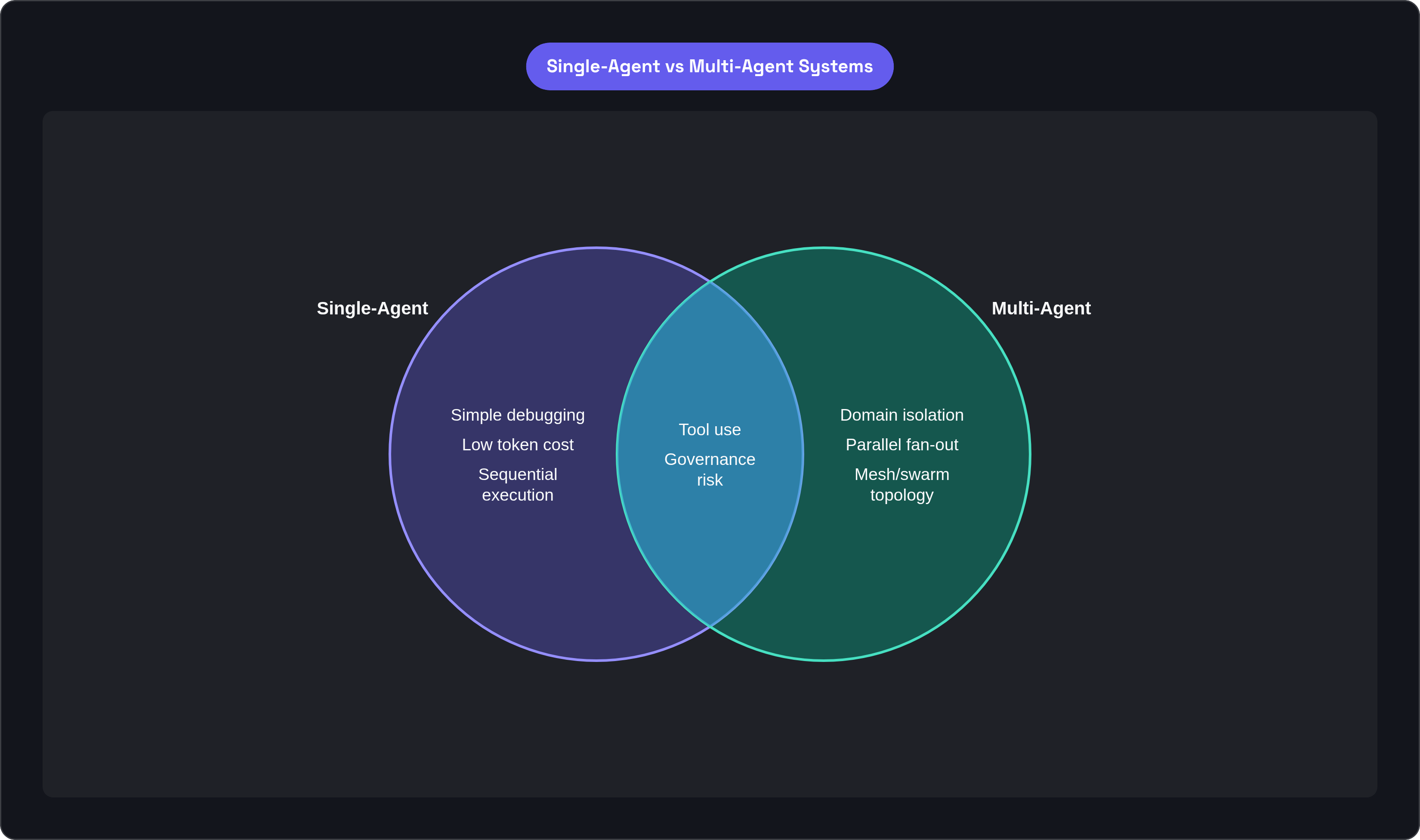
Single-agent systems still hold a 62% market share in 2025, and for good reason. One model, one prompt chain, one tool set, sequential execution: that setup handles a lot of bounded work. Document summarization, structured lookups, classification pipelines with known schemas. The architecture is simple, debuggable, and cheap.
Three specific failure modes push enterprises past it. The first is domain overload: a single model asked to hold deep expertise across finance, legal, ops, and product simultaneously degrades on each. You cannot fine-tune for everything without sacrificing something. The second is pipeline latency: a five-stage sequential workflow at eight seconds per stage produces forty seconds end-to-end, which is indefensible for any real-time customer-facing application. The third is governance complexity, which is arguably the most underappreciated. Routing all enterprise context through one agent with one permission set is a security posture, not a neutral technical choice, and it is a fragile one.
That said, multi-agent does not automatically fix any of those problems. A UIUC study found multi-agent systems consuming four to 220 times more tokens than single-agent counterparts under comparable conditions. Tran and Kiela (2025) argued, via the Data Processing Inequality, that single-agent systems should be more efficient for multi-hop reasoning under fixed token budgets; that argument has merit and should not be dismissed. Microsoft's Azure SRE team built toward multi-agent specialization and then reversed course after handoffs degraded reliability. Anthropic and Microsoft both recommend starting with a single agent and adding orchestration only when tool overload or access-control isolation forces the issue.
Multi-agent coordination earns its complexity when tasks genuinely exceed one model's reliable scope, when parallelism is structurally required, or when domain isolation is non-negotiable. Those are three distinct justifications. Enterprises using all three simultaneously to justify one architecture should think harder.
The Orchestrator-Worker Pattern and When Centralized Control Is the Right Default
The orchestrator-worker pattern places one agent in charge of the task plan. It delegates subtasks to worker agents, either sequentially or in parallel batches; workers execute and report back; the orchestrator maintains global state throughout. Also called the hub-and-spoke or supervisor pattern, it is the architecture that compliance-heavy industries land on almost reflexively, and for defensible reasons.
LangGraph's StateGraph and Microsoft AutoGen's GroupChat are the two most established frameworks for this pattern in production. Microsoft Semantic Kernel has refined it further for enterprise deployments with stronger tooling around memory and skill registration. These are battle-tested implementations, not whiteboard concepts.
The appeal is straightforward: every delegation decision flows through one node, which means the audit trail is clean, execution order is predictable, and failure attribution is unambiguous. If something breaks, you know where to look. For regulated industries, that property alone justifies the architectural overhead.
The real tradeoff is that the orchestrator is also a bottleneck. Under high concurrency, the central node becomes a throughput constraint and a single point of failure simultaneously. Where the pattern genuinely breaks is on open-ended tasks where the full plan cannot be specified upfront: the orchestrator's static task ledger becomes a liability when reality does not cooperate with the initial decomposition. For early-stage enterprise deployments where predictability matters more than scale, orchestrator-worker is the honest default.
Sequential Pipelines and Parallel Fan-Out as Complementary Execution Strategies
Sequential pipeline: each agent completes its stage before passing output to the next. This is appropriate when stage N genuinely depends on stage N-1's result, and inappropriate when it does not. The latency math is unforgiving, which is the forcing function for converting eligible stages to parallel execution.
Parallel fan-out flips the model: the orchestrator dispatches multiple worker agents simultaneously across independent subtasks, collects outputs, and aggregates. The practical decision rule is simple enough to state in one sentence: if stage outputs are independent, fan-out; if stage N requires stage N-1's result, pipeline. Most production systems mix both within a single workflow, using sequential logic where dependencies exist and fan-out where they do not.
The token cost implication connects directly to the efficiency caution raised earlier. Fan-out multiplies concurrent token consumption; the performance benefit of parallelism arrives with a cost that needs to be budgeted at design time, not discovered in a surprise infrastructure bill. McKinsey Digital analysis of enterprise AI pipelines found the average production pipeline runs four to six stages, with content generation and data processing pipelines running longer and decision-support pipelines running shorter. That range is a useful prior for scoping cost estimates before committing to a fan-out design.
Hierarchical and Federated Architectures for Multi-Domain Enterprise Deployments
When an enterprise's organizational structure is itself the problem, the architecture needs to mirror it. The hierarchical pattern does exactly that: director agents manage specialized agent pods (Finance, Legal, Ops, each deployed as a containerized microservice), and the AI layer maps onto the enterprise's domain structure. Google's Agent Development Kit, released in April 2025, implements this as an agent tree, with a root agent delegating to sub-agents that can themselves have sub-agents, integrated with Vertex AI and Gemini models.
The federated pattern is distinct. Domain agents operate with significant autonomy, coordinating through agreed protocols rather than through a shared orchestrator. It is closer in spirit to how federated identity or federated data governance works: each domain retains ownership of its stack, and interoperability is handled at the protocol layer rather than through a central control point.
The access-control stakes in both patterns are substantial. In hierarchical deployments, each agent pod should inherit access scoped to its domain: Finance agents should not hold Legal agent credentials, full stop. Federated coordination compounds the problem because agents from different organizational units or vendors may interoperate without a shared identity layer, making permission inheritance genuinely hard to trace at runtime. An estimated eleven to fourteen percent of enterprise agentic AI pilots reach production; the rest stall on identity, audit, and access-control gaps, not model capability.
Hierarchical is the right pattern for multi-tenant AI SaaS and organizations with strong domain separation. Federated suits consortiums or enterprises where domain teams have the mandate and the maturity to own their agent stacks.
Peer-to-Peer Mesh and Dynamic Replanning for Open-Ended Tasks
No fixed hierarchy. Agents share state and pass control to one another based on capabilities, with no predetermined execution order. This is the mesh, or swarm, pattern, and it is the most flexible coordination model and the hardest to govern in the same breath.
MultiAgentBench (Zhu et al., March 2025) tested topology choices across collaborative and competitive tasks and found the fully decentralized graph-mesh topology yielded the best task scores and planning efficiency, outperforming hierarchical and chain structures, though with moderate token consumption. That benchmark result is real. The production reality is that most enterprise teams limit swarm patterns to back-office workloads: observability is too limited and failure attribution is too difficult for anything customer-facing.
Dynamic replanning, as implemented in Microsoft's Magentic pattern (public preview since October 2025), takes a different approach to flexibility. A manager agent builds a task ledger of goals and subgoals and revises it continuously as new information arrives, rather than fixing the plan at the start. This makes it well-suited for research-style tasks and long-horizon workflows where the initial plan will not survive contact with reality. It also makes it genuinely difficult to audit, because the access scope required changes as the ledger changes, which means static policy rules set at deployment are insufficient by design.
Cemri et al. (2025) analyzed over 1,600 annotated traces across seven multi-agent frameworks and identified fourteen distinct failure modes across three categories: system design issues, inter-agent misalignment, and task verification failures (Cohen's kappa of 0.88). Failures in mesh and dynamic replanning systems follow predictable patterns tied to architectural choices. They are not random. Mesh and dynamic replanning earn their place for genuinely open-ended, long-horizon tasks; they are the wrong default for any workflow where auditability or consistent output quality is a hard requirement.
How Communication Protocols Shape Coordination Performance in Practice
Here is a question the architecture literature underweights: if you pick the right topology but the wrong protocol, does any of it matter? Per ProtocolBench (submitted to ICLR 2026), protocol selection in enterprise deployments remains largely ad hoc despite the range of available options including JSON-RPC, A2A, ANP, and ACP. Protocol choice can impact task completion time by up to 36% and introduce communication overhead of 3.5 seconds per handoff. In a multi-stage pipeline, that overhead compounds into a real performance problem.
Google's Agent-to-Agent (A2A) protocol and Anthropic's Model Context Protocol (MCP) represent the most serious current push toward standardization. Both attempt to give agents a common language for capability discovery and task handoff without requiring shared infrastructure. Neither has achieved universal adoption, which creates a specific enterprise risk: agents from different vendors or frameworks operating in a federated or mesh topology may interpret the same message differently. Protocol mismatch is a failure mode that does not surface in single-vendor benchmarks.
The implication is that communication protocol is not a secondary implementation detail. Enterprises choosing a coordination pattern should choose a communication protocol in the same decision because they are not separable choices, and the wrong combination can negate the benefits of an otherwise sound topology.
Matching Coordination Pattern to Use Case
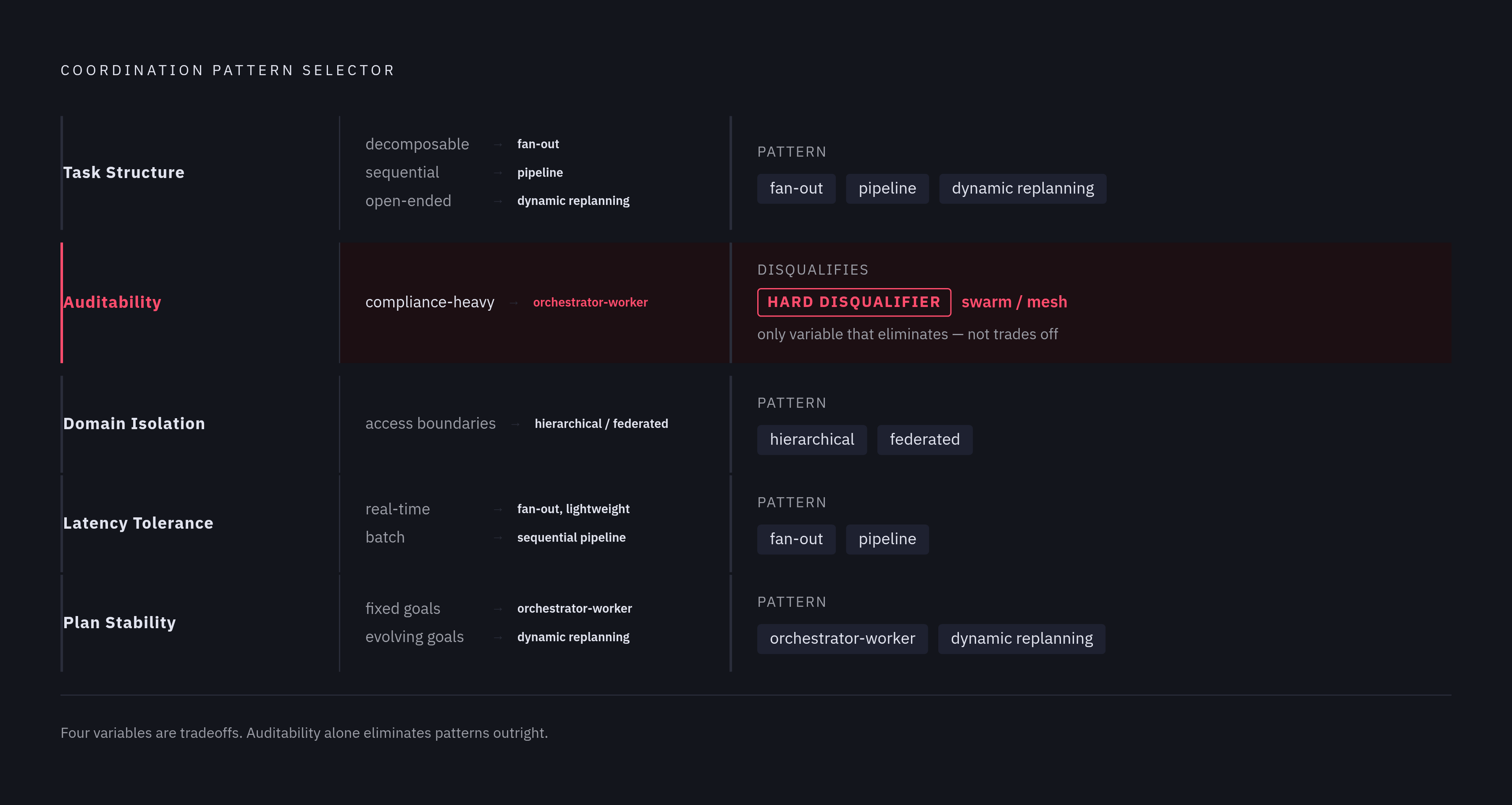
Five variables actually determine pattern fit, and most architecture discussions shortchange at least two of them.
Task structure comes first: decomposable independent subtasks call for fan-out, sequential dependencies call for pipeline, and genuinely open-ended goals call for dynamic replanning. Auditability requirement comes second; compliance-heavy workflows need a single control point and a complete delegation trace, which means orchestrator-worker. Swarm and mesh make audit reconstruction difficult enough that it should be treated as a disqualifying constraint for regulated workflows, not a tradeoff to be managed.
Domain isolation is the third variable: when access boundaries between business units require agent-level permission separation, hierarchical or federated patterns are the answer; an orchestrator-worker setup with a shared context store is a liability. Latency tolerance is fourth: real-time customer-facing workflows cannot absorb pipeline latency or protocol overhead, which pushes toward fan-out with a lightweight protocol, while batch back-office work can tolerate sequential execution. The fifth variable is plan stability: fixed, known goals suit orchestrator-worker or pipeline; goals that evolve as the agent discovers information require dynamic replanning.
Production systems typically combine two or three patterns within a single workflow. The governing question is not which one pattern to use but which combination, and which pattern governs which layer. Enterprise adoption has reached a large majority in at least one business function, but a small fraction of organizations successfully scale multi-agent systems. That gap is not a capability gap; it is an architecture and governance gap.
The anti-pattern worth naming explicitly: choosing the most sophisticated coordination model because it performs best on benchmarks, then discovering in production that benchmark performance on research tasks does not predict reliability on compliance-constrained enterprise workflows. Sophistication without fit is just expensive.
What Coordination Complexity Actually Costs You in Governance
The core problem with agentic systems at enterprise scale has nothing to do with model quality. Agents inherit human-scale access controls and act on them at machine speed. Access models built for humans, where employees routinely ignore the vast majority of their granted permissions, do not translate to agents that will exercise every available permission in their scope.
Coordination pattern determines governance surface, and the relationship is direct. In orchestrator-worker deployments, the orchestrator's permissions become the ceiling for every worker it delegates to, so scope creep at the top propagates everywhere. Hierarchical deployments build in domain isolation, but inter-pod communication creates lateral permission paths that are hard to enumerate without runtime monitoring. Mesh topologies have no fixed control point, which means no natural audit anchor: reconstructing what happened requires full message-level logging across every agent-to-agent exchange. Dynamic replanning changes the access scope required at runtime, making static policy rules set at deployment structurally insufficient.
Four things enterprises actually need at the governance layer, and most have at most two of them. Discovery: knowing which agents are running and what they have access to, not just the approved ones. Runtime monitoring: detecting when agent behavior deviates from expected patterns for its coordination role. Specifically, an orchestrator that begins making lateral calls it was never designed to make is a security event, not an anomaly to note and move on from. Enforceable policy controls: rules on what agents can and cannot do that apply at execution time, not just at deployment configuration, because runtime is when it actually matters. Finally, complete audit logs: a trace of every action across every agent, tied to the coordination pattern that produced it, usable for both compliance certification and incident investigation.
That covers the governance gap that coordination complexity opens, which is the gap where most enterprise agentic pilots stall.
The eleven to fourteen percent production success rate for enterprise agentic pilots is not a referendum on large language models. It is a referendum on whether enterprises planned the visibility and control layer at the same time they chose the coordination pattern. Those two decisions are inseparable, and treating them as sequential is how architecture work becomes a case study in what not to do.