ABAC vs RBAC for AI Agent Authorization
AI agents need authorization rules tied to action, resource, and context—not job titles.

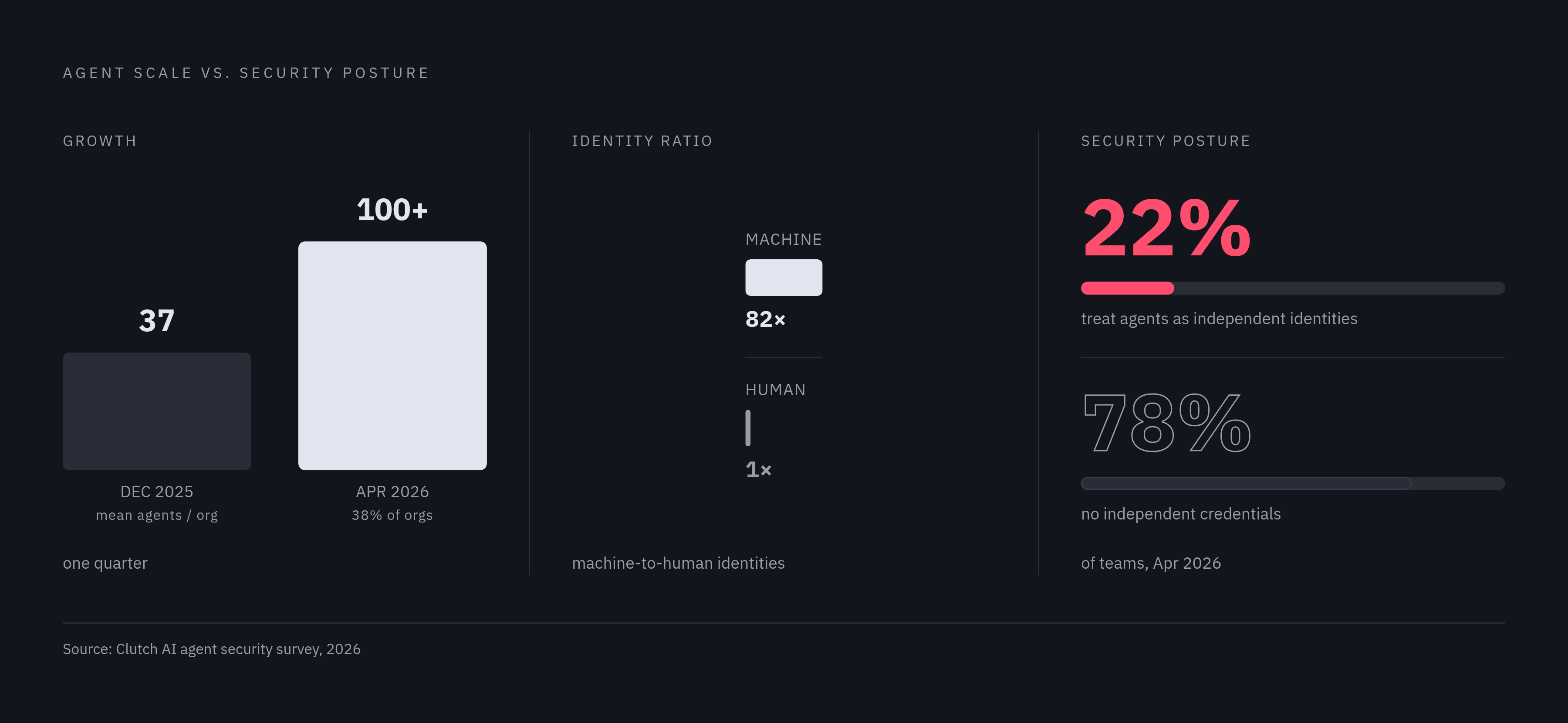
Enterprise software is about to be run by things that don't have a badge, a manager, or a fixed job description. Gartner projects that 40% of enterprise applications will embed task-specific AI agents by 2026, up from under 5% in 2025. Deloitte puts the number using agentic AI in some form at 75% of companies by 2028. Gravitee's State of AI Agent Security report found enterprise agent counts roughly doubled in a single quarter, from a mean of 37 agents per organization in December 2025 to nearly 38% of organizations running more than 100 agents by April 2026. Meanwhile Zscaler's ThreatLabz report clocked AI transaction volume growth at 83.3% year over year, and 88% of organizations in the Gravitee survey confirmed or suspected a security incident tied to this stuff in the prior year. The numbers aren't a warning sign. They're the current state of the industry.
How agents behave, and why that makes authorization structurally different
An agent doesn't log in, click around, and log off. It chains tool calls, hits APIs in sequence, spins up sub-agents to handle pieces of a task, and keeps acting long after the prompt that started it has scrolled off the screen. That changes the question authorization has to answer. It's no longer "does this user have access to this system." It's "is this agent allowed to take this exact action, for this specific human, on this specific resource, through this specific tool, right now, at this second." That question has to get answered continuously, not once at login.
Palo Alto Networks puts the current machine-to-human identity ratio in the enterprise at 82 to 1. Despite that, Gravitee's data shows only 22% of teams treat agents as independent identities with their own credentials; the rest still lean on shared API keys, which is a bit like handing every employee the same master key and hoping nobody loses it. Agents also tend to inherit human-scale OAuth tokens with full scope because the person who kicked off the agent happened to have it. Multi-agent systems make this worse: an orchestrator delegating to specialized sub-agents can pass along the original user's entire permission set at every hop, with no review of whether each sub-agent actually needs it.
Speed compounds the problem. Research from tianpan.co shows a single agent can run read-only analysis, propose a schema change, and execute a code deployment inside a ten-minute task. That's three very different risk levels compressed into the time it takes to make coffee. The clearest illustration of what goes wrong sits in CVE-2025-32711, known as EchoLeak, a zero-click attack against Microsoft 365 Copilot with a CVSS score of 9.3. A crafted email planted hidden instructions that Copilot picked up as context and acted on, no user interaction required, exfiltrating data on its own. It was flagged as the first known zero-click attack of its kind on an AI agent. That's a confused deputy exploited to trick a system into executing unauthorized actions under legitimate credentials, dressed up for the agent era: the target system sees a fully authorized call, because technically, it is one.
RBAC's design purpose and the limits of its design assumptions
Role-based access control is old, sturdy, and built on a fair assumption: define a role, attach a bundle of permissions to it, assign the role to a person, and access follows automatically. For decades that assumption held because human job functions are stable. An accountant is an accountant for years, not minutes. Working hours are bounded. A role is a decent proxy for what someone is allowed to touch.
RBAC's strengths aren't in dispute. It's easy to reason about. "Show me everyone with the admin role" is a one-line query, not a research project. It's cheap to author policy for, compared to what comes later. NIST's own framework lays out four levels of RBAC, flat, hierarchical, constrained (separation of duties), and symmetric (permission-role review), and each adds more expressive power. All four share the same core assumption: the access decision gets made at provisioning time, when the role is assigned.
guptadeepak.com's CIAM Compass research shows that assumption scales fine up to somewhere around 5 to 10 roles. Past that, maintenance costs climb and nobody can hold the whole role map in their head anymore. RBAC also has no built-in concept of "on behalf of this specific user" or "only within this team's queue." Context that shifts request by request simply doesn't exist as far as RBAC is concerned. That gap isn't cosmetic. kiteworks.com's compliance analysis shows HIPAA's minimum necessary standard, CMMC practice AC.2.006, and NIST 800-171 control 3.1.2 all require access limited to what a specific task actually needs. RBAC, structurally, can't deliver that at the level of an individual operation. It was never asked to.
Role explosion as a signal that RBAC has reached its limit with agents
The pattern repeats enough to set a clock by it. An incident happens: an agent did something it shouldn't have been able to do. The fix, every time, is "add more roles." Split support_engineer into tier1 and tier2. Add a read_only_agent role for the cautious cases. That buys maybe two incident-free cycles, and then there are forty roles, half of them overlapping, and nobody left on the team can explain what three of them actually do. Research from dev.to's engineering community describes this exact spiral.
Role explosion is the rash that shows up because an agent's real permission needs are a function of context, not a fixed job title. It's the rash that shows up because an agent's real permission needs are a function of context, not a fixed job title. Two failure modes occur specifically with agents. One is the over-privileged single role: give the agent one role broad enough to cover everything it might ever need, which defeats access control by design rather than by accident. The other is role thrashing, swapping roles constantly at each subtask, which floods audit logs with role-change noise and creates race conditions when multiple workflows run at once.
Gravitee's survey found that 27.2% of technical teams have already given up and reverted to custom, hardcoded authorization logic. That's not a workaround. That's a confession that the model broke and nobody found a clean way through it. Worse, when agents share credentials or route around the model entirely, accountability disappears. Gravitee also found 25.5% of deployed agents can create and task other agents. The chain of command for a single action might run four agents deep with no clean audit trail connecting them.
The concrete version of the failure looks like this: a knowledge assistant connected to an entire SharePoint instance, with no row-level controls, gets asked about company benefits and hands back executive compensation figures along with it. The role grants access at the category level. It has no mechanism to evaluate the specific record being requested. Role explosion is the visible symptom telling a team it's time to change the underlying model, not add another patch to the one that's already failing.
What ABAC evaluates and its match with how agents operate
Attribute-based access control asks a different question. Instead of "what role does this subject hold," it asks: given everything known about the subject, the resource, the action, and the environment right now, does this specific request satisfy policy. That's evaluated fresh, at request time, every time.
Four categories of attribute get checked simultaneously. Subject attributes cover team membership, clearance level, who delegated the task to the agent, and the identity of the invoking user. Resource attributes cover which team owns a given record, its sensitivity classification, its data class. Action attributes distinguish read from write from delete. Environment attributes bring in time of day, IP address, session risk score, and whether an emergency escalation flag is set. ABAC can express rules RBAC has no language for, like "this agent may write to this repository only if a prior code review approval already exists in the task context," a pattern tianpan.co documents in production agent deployments.
NIST codified all of this in Special Publication 800-162, the Guide to Attribute Based Access Control Definition and Considerations, which defines ABAC decisions as a function of subject, resource, action, and environment attributes. That cross-organizational fit matters for multi-tenant SaaS: the same agent class can serve dozens of customer organizations while each gets isolated, contextual access, without a separate role having to be hand-built per tenant. A production pattern that shows up repeatedly, documented by greennode.ai, pairs a broad "support-agent" role that sets the outer boundary (RBAC) with ABAC rules layered on top that restrict which customers, regions, or fields the agent can actually see based on compliance rules and live context. The credential itself can shrink to match: short-lived, task-scoped tokens instead of long-lived ones, something ABAC's runtime evaluation makes practical in a way RBAC's provisioning model never could.
ABAC's real costs, policy complexity, migration overhead, and the governance burden
None of this is free, and anyone pitching ABAC as a clean upgrade is skipping the invoice. ABAC evaluates each access decision independently. It doesn't natively track the chain of accesses that makes up a multi-agent workflow, and it can't easily flag when a series of individually authorized requests adds up to something that shouldn't have been allowed in aggregate, a limitation flagged in research posted to arxiv (2605.05440).
Policy bugs occur more often, too. Cisco's research on ABAC deployments found bug rates running 3 to 4 times higher than in RBAC systems, a direct consequence of the added complexity. Every new attribute or condition is more logic to test, maintain, and audit, and writing that logic takes real skill. Rego, the policy language behind Open Policy Agent, is an actual programming language with its own syntax and failure modes, not a configuration file someone fills in on a Friday afternoon, a point guptadeepak.com makes in its writeup.
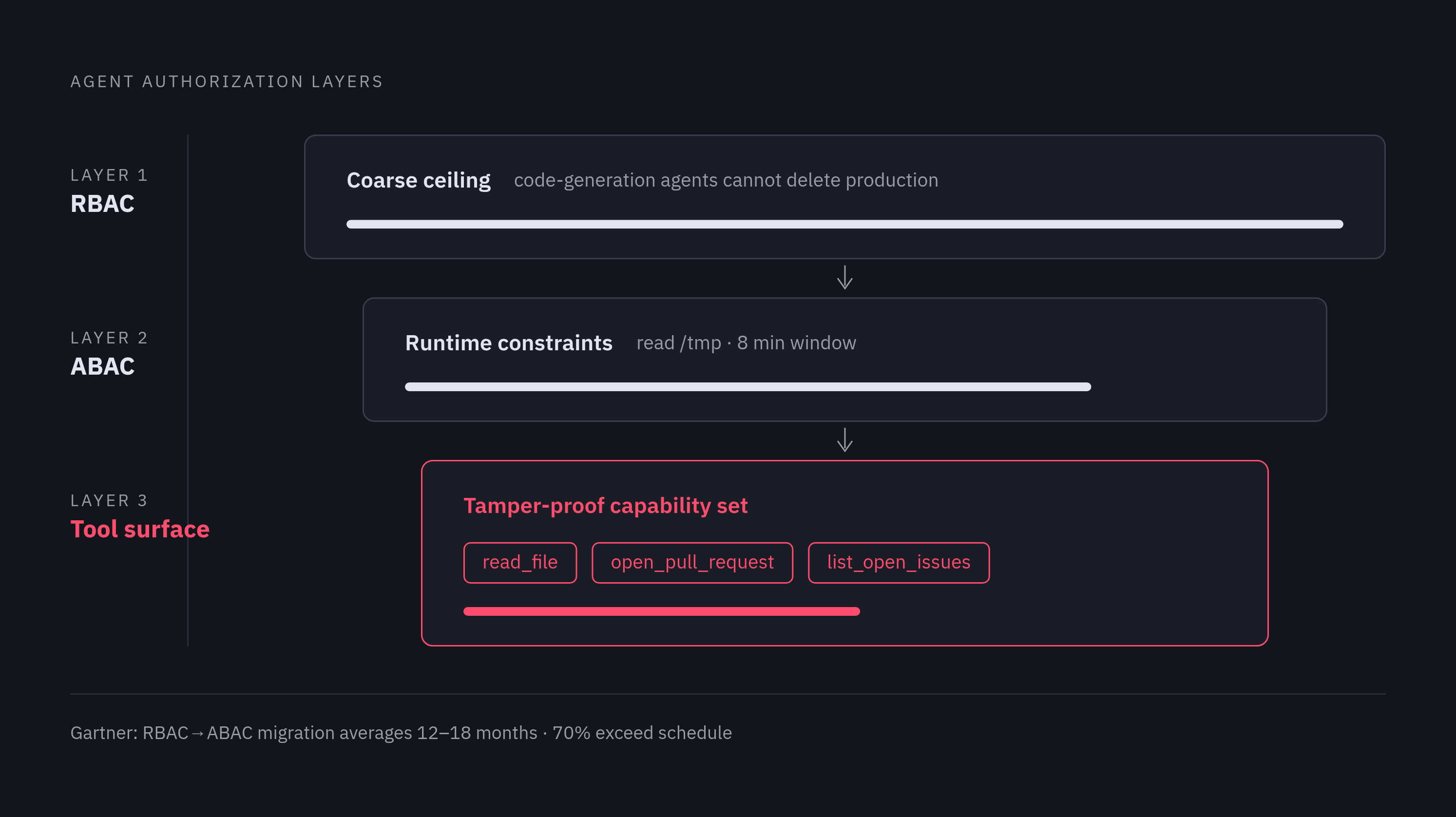
Migration cost is where the invoice gets uncomfortable. Gartner's research across more than 40 enterprise migrations from RBAC to ABAC, cited by promethium.ai, found average project timelines of 12 to 18 months, with 70% of those projects blowing past their planned schedule, and average costs for medium-sized enterprises reaching well into the millions. Attribute quality is the hidden dependency: when attribute data is inconsistent across cloud platforms, the policy engine starts making unreliable calls, and operations teams quietly start routing around it. An ABAC system nobody maintains is a harder system to audit than RBAC.
The good news is that performance isn't the bottleneck it used to be. One XACML policy engine benchmark, cited by knostic.ai, evaluated 10,000 access requests in about 10 milliseconds and processed 10,000 complex rules in under 300 milliseconds, beating baseline engines by a wide margin. That's fast enough for APIs and microservices running at production scale. In high-risk, highly dynamic environments, agent systems being the textbook case, the tradeoff pays off. It's overkill for a straightforward internal tool where the same twelve people have had the same roles for three years.
The production architecture that works: RBAC as boundary, ABAC as runtime enforcer
Most mature B2B systems running in 2026 aren't choosing one model over the other. guptadeepak.com's CIAM Compass research shows they're layering them, RBAC for the coarse structural boundary, ABAC for the fine-grained, context-sensitive decisions inside that boundary. RBAC sets the ceiling: fixed rules that hold no matter the context, things like "agents of type code-generation can never delete a production database." ABAC enforces the floor: constraints scoped to the specific task and moment, like "this agent, for this task, can read files in /tmp for the next eight minutes and then it's cut off," a division of labor that keeps the most critical constraints outside any agent's ability to override.
The design of the tool surface itself is a third layer. Narrow, single-purpose tools, open_pull_request, read_file, list_open_issues, beat a single do-everything tool like manage_github, because an agent whose tool set only includes read_file physically cannot delete a branch, no matter how a prompt tries to convince it otherwise. The capability simply isn't in its action space. tianpan.co's engineering research recommends defaulting every agent to read-only tools and adding write-capable ones only when a task explicitly requires it, revoking them the moment the task ends. Authorization context, in this model, lives on the server, in an authenticated session token the backend controls, not inside the agent's own context window, which prompt injection can rewrite at will.
ABAC is what makes a delegation chain actually operational instead of theoretical. Knowing that Agent A was authorized by User B to perform Task C is worthless if the access control layer can't evaluate that authorization at the exact moment Agent A requests a specific piece of data, a point kiteworks.com makes directly. Relationship-based access control, or ReBAC, models permissions as a graph, scales to billions of objects, and handles patterns like "Alice can edit Project X" that neither RBAC nor ABAC expresses cleanly on its own. Google's Zanzibar paper put ReBAC on the map, and open-source implementations like OpenFGA, SpiceDB from Authzed, and Permify have carried the pattern into production since. Most serious agent stacks end up composing all three: RBAC for org-wide policy, ReBAC for resource-level relationships, ABAC for the dynamic, compliance-driven decisions that change by the minute.
Runtime visibility and policy enforcement requirements once the authorization model is right
Picking the right model is a design decision. Enforcing it is an operational one, and they're not the same job. That distinction matters because 88% of organizations in Gravitee's survey reported a confirmed or suspected security incident despite having some form of access control already running. The model on paper and the model actually enforced in production are, evidently, two different things.
Static authorization checks, on their own, don't catch a supply-chain attack aimed at the agent's own infrastructure. CVE-2025-6514, with a CVSS score of 9.6, is an OS command injection and remote code execution flaw in mcp-remote, an infrastructure package used widely across deployments of agents built on a common protocol for connecting models to tools. CVE-2025-59536, scoring 8.7, is a code injection vulnerability found in a popular coding agent, Anthropic's Claude Code. Research published on arxiv (2607.05518) describes a campaign tracked as GTG-1002, state-sponsored, that used hijacked coding agents to carry out an estimated 80 to 90% of an espionage operation against roughly 30 targets, largely on autopilot. A Dark Reading poll found 48% of cybersecurity professionals now name agentic AI and autonomous systems as the single most dangerous attack vector they're tracking. IBM's 2025 data put the average cost of a shadow AI breach at $4.63 million, which runs $670,000 higher than the average cost of a standard breach.
None of that gets caught by a well-written policy sitting in a config file somewhere. It gets caught, if it gets caught at all, by runtime monitoring built to do four things. First, discover every agent actually running inside the organization, not just the ones that went through a formal approval process. Second, monitor all that approved AI traffic as it happens, not through a log review three weeks later. Third, flag anomalous behavior and policy violations the moment they occur, before whatever damage is in motion finishes happening. Fourth, keep a complete audit trail of every action an agent takes, including exactly which tool it called and which resource it touched. Get the authorization model wrong, and none of this matters. Get the model right and skip the monitoring, and the model was never really enforced.
Sources
- ABAC vs. RBAC for AI Agent Access Control: Why Roles Aren't Enough
- RBAC vs ABAC vs ReBAC: Choosing an Authorization Model, CIAM Compass
- RBAC Is Not Enough for AI Agents: A Practical Authorization Model - TianPan.co
- RBAC vs ABAC: Choosing the Right Authorization Model
- Authorization Propagation in Multi-Agent AI Systems: Identity Governance as Infrastructure
- greennode.ai