Agent Versioning Strategies for Production Agentic Systems
Agent behavior depends on four layers, and only a combined manifest tracks them.
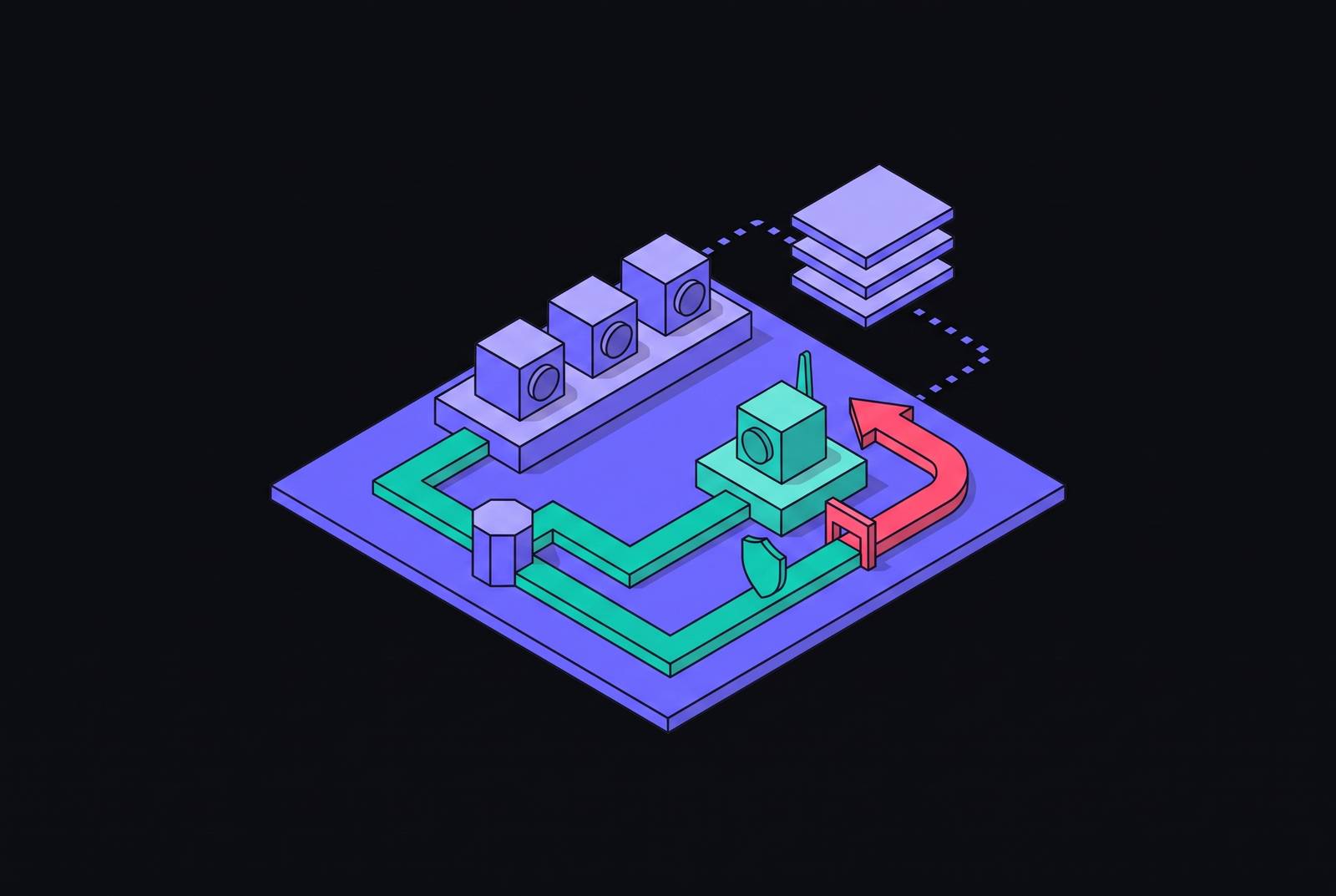
Production agent versioning is not just a way to label code releases. It must track code, prompts, model identifiers, and tool contracts independently, then govern their combination as one configuration. Without that shared record, a team can know exactly which code it deployed and still be unable to explain why its agent changed behavior.
Why agentic systems cannot be versioned the way traditional software is
When teams version a conventional service, they expect the release identifier to describe the software that determines its behavior. In the traditional model, code is the deployable artifact, and deterministic behavior makes version-gated promotion straightforward. The same input produces the same output. An agent breaks that expectation because its behavior also depends on instructions, a model, and the interfaces through which it acts. Any of those can change while the code stays untouched.
Non-determinism makes it harder for testing to close this gap. The same input may produce several outputs, some acceptable and some dangerous, so one test that passes does not guarantee that the agent will keep behaving the same way. Hosted model providers can also change behavior for safety, capability, or cost reasons, and eventually deprecate versions. Even a carefully pinned dependency can change over time, so the release record must cover more than the application repository.
The four layers that must be versioned independently
The code layer includes the application logic, orchestration, routing, and error handling. Git and standard CI/CD already give most teams a foundation here. Prompt templates have their own layer, which includes system prompts, few-shot examples, and chain-of-thought instructions. A prompt edit can change how an agent behaves without creating anything a static analysis tool would flag.
The model layer identifies the specific model called by the agent. It requires the full identifier string rather than an alias such as “latest” or “claude-sonnet,” whose underlying target can change. Tool contracts form the fourth layer, covering schemas, API endpoints, and response formats. They are dependencies in their own right. A change to an internal search index schema therefore changes the agent version even when nobody touches the agent’s code.
Together, these layers call for a manifest or composite identifier that records their exact combination. Each layer still receives its own revision. One formulation is customer-support-agent:ALV-2.3.1_PPV-4.1.0_MRV-gpt4-1106_TAV-1.4.2, with separate segments for the four layers. The string distinguishes a code release from the complete configuration deployed with it.
How failures actually propagate when any layer is left unversioned
Consider a case where Agent A calls Agent B, which then calls a tool. Agent A expects a response format produced only by v2 of Agent B. Rolling B back changes that contract, so A can break even though its own deployment is untouched. The failure crosses the release boundary. When the contract between agents is implicit, production becomes the place where the incompatibility is discovered.
A change in a shared document, UI field, or configuration file outside source control can leave a team unable to identify which revision caused a regression. There is no dependable baseline to restore. Model drift makes this harder to track because hosted APIs can change how an agent behaves without a new application release. Hallucinations, prompt injection, and tool-call failures may then appear as degraded outcomes rather than hard errors, leaving an apparently functioning system producing worse results.
What a coherent versioning strategy actually requires across all four layers
Teams need to manage dependencies across layers as well as keep each layer under separate version control. Deployed configurations need immutable records and reproducible baselines. Git-based source control and CI/CD still underpin the code layer, but every deployment artifact must also name the other three layers it uses. A code SHA alone is incomplete. A model upgrade needs its own evaluation and promotion cycle, with the full model identifier recorded in the manifest.
Prompts also need their own registry, where each change creates an immutable version and moves through labeled stages during promotion. The tooling ecosystem illustrates this pattern without prescribing one implementation. Langfuse provides prompt versions and labels, while MLflow’s Prompt Registry provides immutable versions and aliases. LangSmith creates a unique commit hash for each saved update and uses mutable labels as promotion pointers. PromptLayer provides release labels and approval flows.
Tool schemas need clear definitions and semantic versions, and changes to a response format must count as breaking changes for agents that depend on it. Containerized isolation and immutable infrastructure can reduce the blast radius when tool versions diverge. Protocols add another dependency to track. MCP uses YYYY-MM-DD identifiers for its protocol specification, while its Registry recommends semantic versioning for published servers, and A2A also brings its own versioning scheme. Liu et al.’s 2025 ACM FSE paper gives this broader problem an academic framing, arguing that classic software versioning cannot adequately manage these dynamic dependencies and proposing an extended semantic versioning schema.
The rollback problem and why forward-compatible schemas are the safest path
A user midway through a conversation expects continuity. Yet v2.1 may have created state that v2.0 cannot understand. Reverting code does not resolve that mismatch. The safest discipline is forward-compatible state schemas that retain all fields for at least two deployment cycles after their introduction, allowing the older version to read newer state without data loss or corruption.
The same difficulty extends across agent boundaries. Rolling back one agent’s output format changes its contract with every dependent agent, so recovery must account for both the component being restored and those dependencies. External actions raise the stakes further. When an agent updates a production rule or triggers a downstream action, the diff, justification, approvals, and rollback path must be auditable. An untraceable reversal is a second uncontrolled change.
Model providers make recovery less straightforward still, because deprecated versions cannot be pinned indefinitely. At the same time, provider security improvements may need rapid deployment even when ordinary promotion would take longer. A versioning strategy therefore needs a fast path for security updates that can bypass normal promotion cycles without abandoning the manifest record.
Deployment mechanics that contain risk during updates through staged rollouts, shadow testing, and blue-green patterns
Blue-green deployment is the easiest place to start. It maintains two full environments, with traffic routed to one while the other is idle, and switches between them at the router. Rollback becomes a routing change. This simplifies the mechanics of recovery, though it does not remove the state and contract problems that recovery must respect.
A model or prompt update first runs against an evaluation suite in staging, with outputs compared against a baseline, before traffic shifts in increasing increments while the team monitors anomalies. Shadow testing adds parallel execution without serving the candidate’s outputs to users. Production remains the user-facing version during the comparison. This is particularly useful for model upgrades whose output-format changes may be subtle.
The objection to evaluation gates is legitimate. Semantic evaluation, often performed by a separate LLM judging meaning and accuracy, makes the gate itself non-deterministic. Evaluation should be treated as a mandatory signal at the staging-to-production boundary, not as a traditional binary guarantee or a reason to dispense with testing. MLflow’s 2026 production agent guide extends that logic into runtime, advocating evaluation probes inside workflows for real-time auditability alongside offline analysis.
Organizational ownership is fragmented across the same layers as the versioning problem
The architecture also divides responsibility across teams. MLOps teams own model selection and serving, application teams own code and prompts, and security teams backfill policies around data access and tool usage. Platform teams then bring releases together, though they may not control the layers being released. The fragmentation is structural. These groups often have different release cycles, risk models, and terms for the same things.
A product manager’s prompt edit and an MLOps engineer’s model upgrade both change the same agent. Yet they may happen in separate systems, on separate timelines, without a shared artifact recording their interaction. Modular architecture sharpens this trade-off. Sub-agents that can be deployed on their own make it clearer who owns what, but give teams more contracts to maintain. The same MLflow guide describes how modularity allows individual sub-agents to be replaced or upgraded independently as underlying models change.
Cross-team coordination therefore extends beyond release scheduling to silent quality regressions, provider spend, tool failures, runaway agents, and compliance. No deployment tool settles those responsibilities by itself. Regulated environments make the limits especially clear. The EU AI Act mandates human oversight mechanisms for high-risk AI systems, so versioning cannot remain a purely engineering concern. A release record must meet the organization’s rules for oversight as well as fit how it deploys changes.
Why configuration governance — not just observability — is the missing layer above orchestration
Orchestration and observability solve important but narrower problems. Datadog, Grafana, and open-source monitoring stacks provide metrics, logs, and distributed traces that help explain what happened. They do not by themselves establish which governed configuration produced an action, whether it was authorized, or whether its changes were approved. A trace is not an approval record. Existing LLMOps and AgentOps platforms leave a gap around representing the whole system independently of its execution framework.
Agentic Configuration Management (ACM) provides a formal treatment of what deployment manifests and composite identifiers begin to approximate. Configuration describes the intended, versioned structure without tying it to any execution framework, while runtime is a specific run under specific conditions. The distinction gives provenance a stable reference. ACM’s experimental evaluation covers LangGraph, CrewAI, and the OpenAI Agents SDK, providing evidence that common governance semantics can support reproducibility, auditability, and interoperability across different execution abstractions.
Runtime monitoring and enforceable policy controls must be able to detect and prevent violations and supply evidence after them. This requires governance semantics tied to the versioned configuration. Operations must establish which agent version acted, under which approved configuration, and with what authority. Versioning consequently becomes part of compliance and auditability, rather than a naming convention attached to deployment.
What a mature multi-layer versioning practice looks like in a production organization
A mature practice makes the composite configuration the unit of governance. Every production deployment resolves to a code SHA, prompt version, full model identifier, and per-tool schema versions, regardless of which team initiated the change. Promotion labels can remain convenient mutable pointers, but the deployed record must identify the immutable versions beneath them. An unresolved alias leaves the record incomplete. Changes across all four layers pass through the same change-management process, including its defined security fast path.
That record then connects release decisions to operational evidence. Prompt registries preserve revisions, staged rollouts limit exposure, and semantic evaluation supplies probabilistic evidence before and during production use. Forward-compatible state schemas keep rollback viable. The governance layer ties what is seen at runtime to the approved configuration, while shared ownership makes clear who is responsible for the dependencies.
Teams can build toward this incrementally. A major-version-only discipline based on breaking inputs, outputs, or changes to the core tool set is a reasonable start, but it postpones prompt and model tracking. The destination is complete traceability across all four layers. Agents inherit human-scale access and act on it at machine speed, making configuration records essential to discovering which agent is doing what and detecting anomalous or policy-violating behavior. Security and compliance teams need more than proof that something happened. They need an audit record showing which version acted and whether it was authorized.