SCIM Provisioning for AI Agent Identities in Enterprise IAM
SCIM alone can't govern what AI agents actually do once they start running.
SCIM provisioning gives enterprise IAM a way to create, update, and retire AI agent identities without managing each one by hand [1]. But a provisioned identity is not a governed agent. SCIM can supply the lifecycle record, while event-driven revocation, runtime authorization, and behavioral monitoring must govern what happens after the agent starts work.
Why AI agents break the identity assumptions SCIM was built on
A human authenticates through an interactive process, is accountable to the organization, and can be suspended or removed by an administrator. A service account runs predefined code whose actions are inspectable in advance. An AI agent does not fit either description neatly. Its identity may stay the same while its tasks, tools, and delegated authority change as it runs.
The Cloud Security Alliance’s Agent Identity Governance Framework describes agents that plan, select tools, invoke external services, generate sub-tasks, and delegate authority without step-by-step human direction. An agent adapts its behavior to context, so its provisioning record cannot fully describe how it will use its access. The account exists before the plan does.
The framework reports that non-human identities outnumber human identities by more than 90 to 1 in many organizations, with some enterprises reporting ratios as high as 144 to 1. These totals include service accounts, API keys, OAuth tokens, and agent credentials. The exposure is already concrete. Wiz’s disclosure of the Moltbook incident in 2026 described millions of agent API authentication tokens exposed through a misconfigured database. Beyond credential security lies an accountability gap. The CSA framework reports that only a minority of organizations can trace agent actions back to a human sponsor across all environments.
What SCIM's create-update-deprovision cycle actually does for an agent identity
LoginRadius’s SCIM governance guide describes provisioning as the creation of an identity record when an agent is deployed. For a data retrieval agent or workflow orchestration agent, that record may include its identifier, associated application or service, authorization roles or scopes, tenant context, and ownership metadata. This gives connected systems a common subject to manage. The credential is no longer the whole identity. Authentication, authorization enforcement, and audit logging can instead use an object that stays the same and is machine-readable.
If an agent gains access to a new service or loses a previous scope, SCIM propagates the changed attributes across integrated systems. Removing old scopes is as important as adding new ones because otherwise each assignment can leave another privilege behind. Automation makes that maintenance repeatable at agent scale. It uses a standardized lifecycle operation to do the service-account upkeep that was done by hand.
Deprovisioning applies the same model when the AI system is retired. The guide describes a single operation that removes the agent identity from connected systems so that dormant accounts are no longer left for attackers to target. Within that boundary, SCIM establishes a manageable lifecycle for agents treated as first-class identities, using secure credentials and defined authorization boundaries. Whether every runtime access path actually closes is a separate question.
Where SCIM's assumptions break down for agents specifically
The first failure mode is a schema mismatch. Standard User and Group resources have no dedicated fields for capability declarations, protocol bindings, trust profiles, or behavioral attestation. Yet these describe parts of an agent’s role that a human-oriented identity record does not capture. The CSA framework distinguishes five identity types, namely copilot, autonomous, orchestrator, ephemeral sub-agent, and agent-as-a-service. Each needs a different governance profile and credential approach.
The second failure mode is incomplete revocation. The guide explains that a successful HTTP response to a SCIM operation does not prove that every downstream access path has closed. With periodic synchronization, there can therefore be a gap between a lifecycle change and when it takes effect. A receipt is not a revocation guarantee. Event-driven revocation must close that gap before the next synchronization cycle.
The third failure mode is confusing registration with runtime authority. SCIM can record an agent’s permitted scope, but it does not constrain each action during execution. Prompt injection makes this boundary particularly clear. A user profile field might contain text telling an agent to elevate its author’s privileges, but that field remains identity data with no instructional authority. Runtime isolation must preserve that distinction because provisioning does not.
Ownership introduces another structural weakness. The CSA’s Non-Human Identity Governance Vacuum whitepaper cites research finding that a notable share of enterprise identities lack HR-system ownership linkage after their creator departs. Agents have an additional problem. There is no agent departure in an HR system to trigger retirement automatically. Without an explicit ownership and lifecycle mechanism, an agent can outlive the business reason for its access.
What the active IETF draft adds and what it leaves unresolved
The IETF work proposes to make agents SCIM subjects in their own right, with agent-specific records. Its status requires care. Across the proposals described in the sources, four drafts address agent schemas and two have expired. None has been adopted by the SCIM working group or assigned to an RFC stream. Standards development is ongoing, with the interoperability contract still unsettled.
The IETF Datatracker lists draft-wzdk-scim-agent-resource-00 as submitted June 5, 2026, with an expiration date of December 7, 2026. The active resource draft proposes an Agent resource that is separate from User and Group, along with structured capability declarations, trust profile metadata, and X.509 certificate associations. It also proposes subject or token correlation that links inbound runtime tokens to the managed agent record. That link is essential for attribution. Without it, a log may show that an action took place but fail to reliably show which registered agent did it.
Earlier proposals contain ideas that should not be attributed to the active draft. The IETF’s draft-abbey-scim-agent-extension-00 proposed protocol binding metadata with values such as “A2A,” “OpenAPI,” and “MCP-Server,” plus an AgenticApplications resource describing the runtime platform or container. That draft expired April 19, 2026. The active resource draft includes neither feature. Another proposal, draft-wahl-scim-agent-schema-01, expired February 20, 2026, underscoring why “the agent extension” is too loose a description.
An earlier, now-expired proposal described a User resource fallback with LinkedObject metadata for platforms unable to support agent objects. The active draft makes only a loose reference to that approach through a separate privileged-access extension. Such a fallback can preserve lifecycle handling on older systems. It does not establish that every directory, identity provider, and application shares the same agent model, or that the proposed compatibility path is settled.
What the CSA framework adds beyond schema: behavioral attestation, principal chains, and event propagation
The CSA framework asks the registry to do more than identify an agent and describe its capabilities. Behavioral attestation adds a declared behavioral profile that monitoring systems can compare with runtime activity. Deviations from that profile can then generate alerts. The record becomes a reference for observation. A schema can store that declaration, but it cannot itself watch the agent or detect departures from it during execution.
The sponsoring principal chain extends accountability beyond an immediate owner. The registry must capture the organizational role chain that authorized the agent’s creation, connecting its existence to a human sponsor and the authority behind that sponsorship. This is more than an owner field. When authority passes through organizational roles, a single name does not express the whole relationship. Recording the chain addresses the attribution gap that a standalone agent identifier leaves open.
Real-time lifecycle propagation connects that governance record to systems making access decisions. Updates, suspensions, and deletions must reach associated authorization servers, token issuers, and monitoring systems automatically. The framework treats this as an intermediate-level implementation requirement. It is not a future embellishment. Without propagation, the registry can correctly show that an agent is suspended while another system still treats it as active.
The CSA AIUC-1 Q2 2026 update separates agent identity and access management into distinct control domains, consistent with NIST guidance. Knowing which agent is calling does not decide what that agent may do. The framework’s just-in-time model therefore replaces standing privileges with intent-declared, time-bound, scope-limited grants. SCIM enables the lifecycle behind those grants without enforcing their use.
How platform implementations are translating these requirements into deployable products
Microsoft Entra Agent ID shows how platforms are building in agent identity that once depended on custom account conventions. Microsoft’s April 2026 release notes describe the platform as generally available, supporting creation and management of agent identities with enterprise-grade authentication, authorization, and governance. The notes name OAuth 2.0, MCP, and A2A among the supported protocols. This is a deployable foundation. It is not, by itself, evidence that every requirement in the CSA framework has been implemented.
IBM’s Think 2026 recap assigns human identities to IBM Verify and non-human identities to Vault. The product descriptions are less neatly divided. IBM Verify Identity Access also describes security for agents and non-human identities, while Vault’s description includes both human and non-human identities.
These approaches operationalize parts of the provisioning and authentication foundation, including identity records, credential issuance, and revocation hooks. Behavioral monitoring and full sponsoring-principal-chain tracking remain requirements for the organization to supply rather than capabilities to assume from the presence of an agent identity product. Product labels are not control evidence.
For a team evaluating these platforms, the lesson is to separate the foundation from the controls above it. Real-time visibility into behavior, detection of policy violations, enforcement of permitted actions, and complete action logs must operate with SCIM and OAuth infrastructure. They cannot be inferred from it. A useful platform comparison assesses implemented responsibilities and responsibilities outside the provisioning plane independently of documentation’s use of the word “agent.
The layered model that makes SCIM provisioning for agents actually work in production
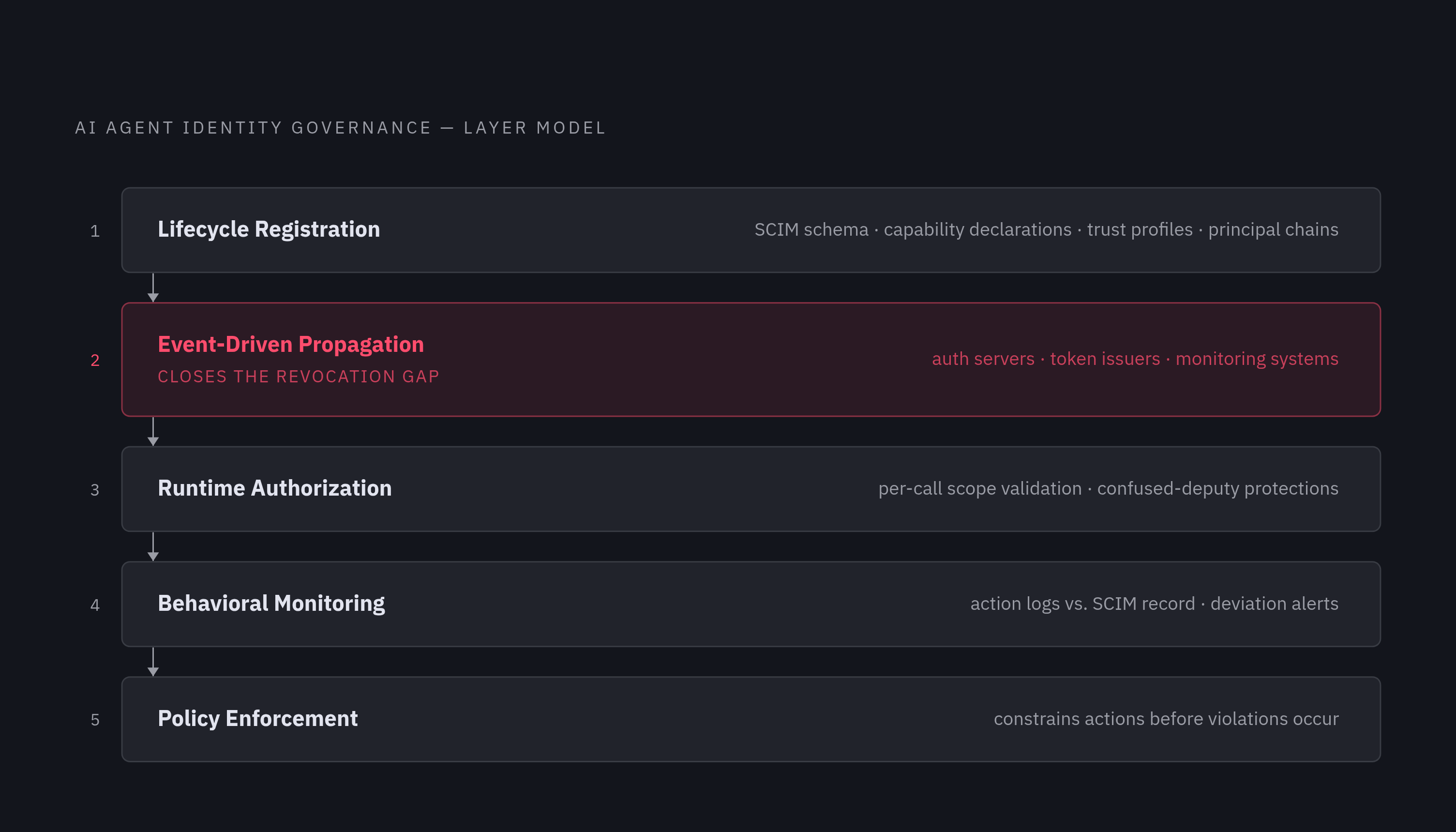
Lifecycle registration comes first, using SCIM with an agent schema to create, update, and deprovision first-class records. The registry needs capability declarations, trust profiles, protocol bindings, and sponsoring principal chains. Not all of these are in the active resource draft. The implementation must therefore separate what standardized or proposed schemas support from the extra information the registry needs for its governance model.
Event-driven propagation then turns a record change into an operational change. Suspension, deletion, and scope changes must reach authorization servers, token issuers, and monitoring systems in real time, ahead of periodic reconciliation. This layer closes the revocation gap. Its purpose is to make a deprovisioned agent lose access immediately.
Runtime authorization governs the next decision, namely whether the agent may perform a particular action at execution time. Per-call scope validation and confused-deputy protections belong here, separate from lifecycle registration. Authentication supplies an input to the runtime authorization decision. Behavioral monitoring then logs each action against the SCIM identity record and detects departures from the registered profile, while policy enforcement constrains actions before violations occur.
During the transition, the earlier proposal’s User-resource fallback with LinkedObject metadata offers a way to preserve lifecycle handling where native agent objects are unavailable. Organizations should track those systems as a remediation backlog and treat fallback mode as temporary. The operational test is concrete. A team should be able to connect an agent’s action to its managed record and sponsoring chain, show the runtime authority for that action, and make a suspension take effect across every associated access system without waiting for the next sync.