Checkov Alternatives for Infrastructure Policy Enforcement in Agent Pipelines
Agent pipelines need runtime policy enforcement where Checkov's static scanning cannot reach.
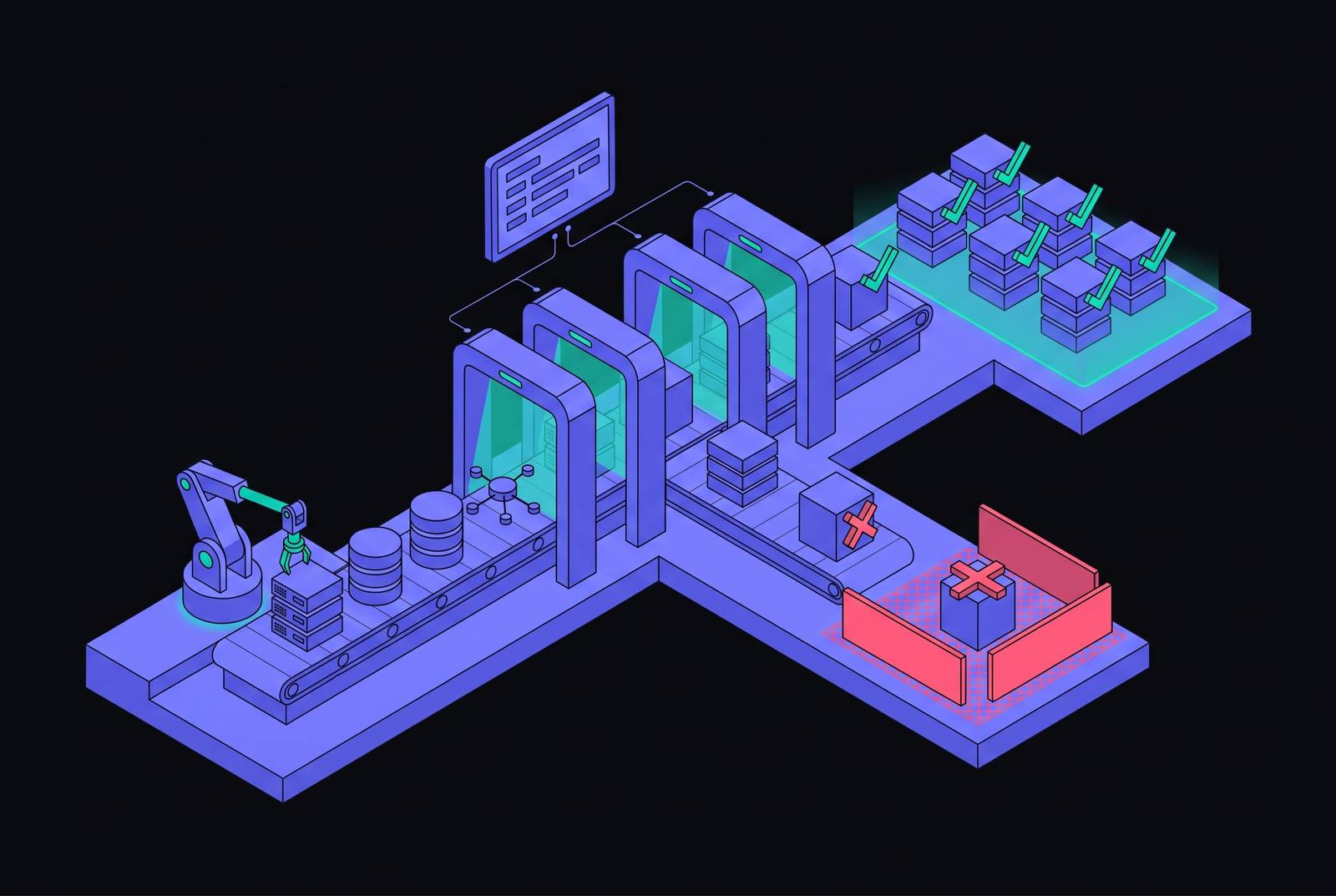
Evaluating Checkov alternatives for agent pipelines starts with a distinction between checking infrastructure code and controlling what an agent can do. A better scanner may improve the first without addressing the second. Layered enforcement places an external policy decision at the moment an agent calls a tool, backed by continuous visibility and audit.
Why Checkov belongs to a category that agent pipelines have outgrown
Checkov is a static infrastructure-as-code scanner that runs before deployment. It parses Terraform, CloudFormation, Kubernetes manifests, Helm, ARM, and Serverless files, then evaluates them against a policy library at pull-request or CI time. It examines declarations before infrastructure exists, rather than supervising actions after deployment. Its job ends well before runtime begins.
That distinction determines how its findings become enforceable. Checkov scans the declaration and flags a finding, but the pipeline stops only if its CI gate is configured to block the merge. The gate sits outside the execution engine. A developer applying locally, or an agent invoking a tool directly, can bypass that checkpoint entirely. Static scanning was built for humans committing code, with no check on agents invoking tools.
What changes when an agent, not a human, is the actor making infrastructure changes
An agent operating inside a pipeline can call tools, invoke APIs, and propose or execute applies as part of its reasoning loop. It need not submit a pull request and wait. When it inherits human-scale permissions and uses them at machine speed, a review checkpoint is no longer a dependable interception point. The path to action has changed.
Identity makes that change harder to trace. Agents often borrow an engineer’s credentials or share a service key, so an audit record identifies the credential and leaves the responsible agent unclear. Meanwhile, the agent both reasons about what to do and holds the means to do it. This is the confused-deputy problem in practical form. A misconfigured or manipulated agent can act on bad instructions without an external check separating decision from execution.
Prompting and system instructions can reduce bad paths through probabilistic guardrails. A hallucination or adversarial input can still produce a prohibited tool call. Multi-agent orchestration extends the problem because a downstream agent may act on an upstream agent’s instructions. Scanning the files that defined their environment cannot establish whether that instruction is permissible when executed. A better proofreader does not become a security guard.
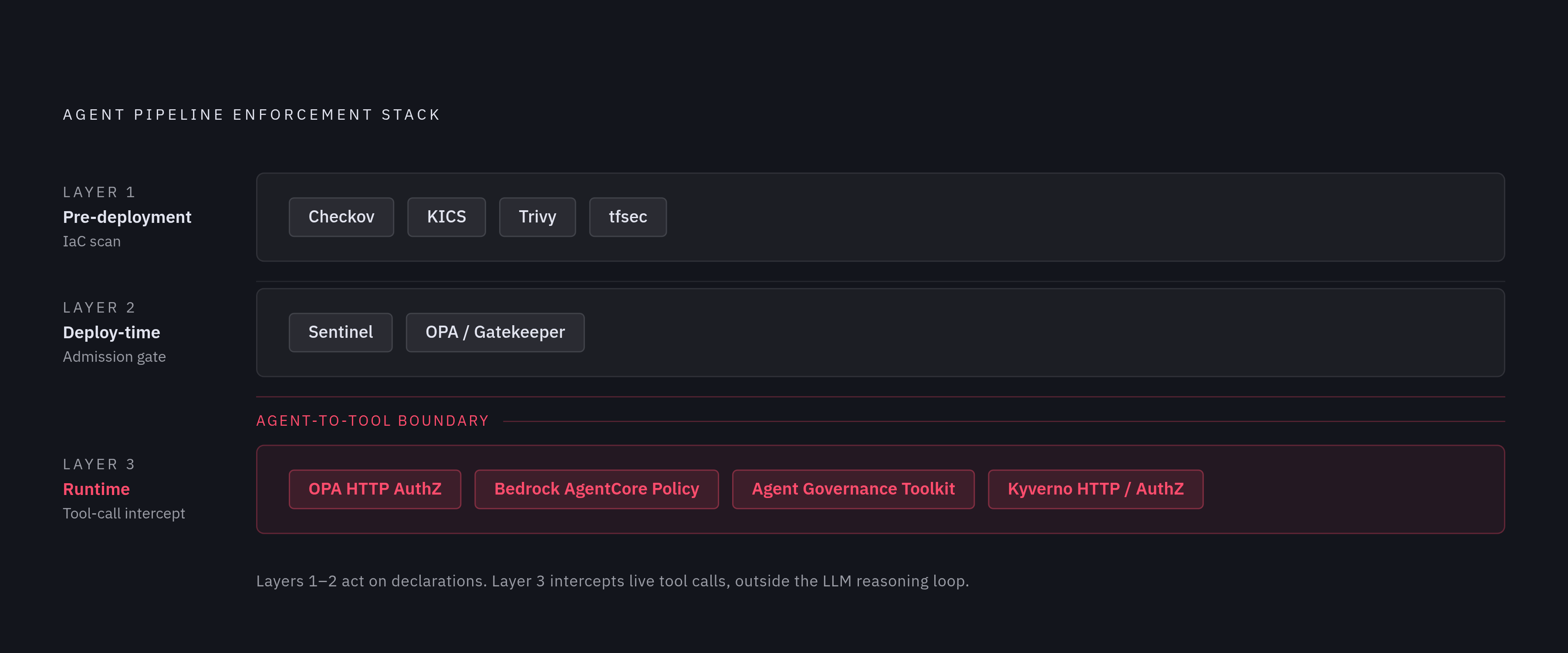
The three enforcement points in an agent pipeline and which category of tool covers each
Layer 1 checks infrastructure declarations before deployment. Checkov, KICS, Trivy, and tfsec occupy this category, catching misconfigurations before resources are created. Layer 2 moves the checkpoint to deployment itself. Sentinel governs the Terraform plan-to-apply transition, while OPA/Gatekeeper can govern Kubernetes resource admission. These controls block non-compliant changes on the execution path they govern, regardless of whether a person or an agent initiated them.
Layer 3 evaluates the agent-to-tool request before execution. Here, an external policy engine returns an allow or deny, so the decision does not depend on how the agent reads its own restrictions. OPA used for HTTP authorization, Amazon Bedrock AgentCore Policy, and Microsoft’s Agent Governance Toolkit belong at this boundary. The distinction is where the decision takes effect. A shared policy language does not make every integration enforce at every layer.
This map exposes a misleading sense of completeness. A fast pre-commit scanner, a comprehensive CI scanner, and a deploy-time admission controller provide three checkpoints, but cover only layers 1 and 2. Two inspections of a declaration do not create runtime authorization. No single tool works at all three enforcement points. For agent pipelines, layer 3 is the missing checkpoint that an alternatives evaluation must address.
Tools that improve on Checkov at layer 1 without closing the layer 3 gap
KICS from Checkmarx offers broad IaC platform coverage and writes all queries in Rego. Teams already using OPA can then use one policy language for scanning, admission, and API authorization. Its severity-mapped exit codes also simplify CI/CD gating without custom scripting. KICS has none of Checkov’s graph-based checks, which can matter when compliance depends on how resources relate to each other as well as what each declaration says.
Trivy from Aqua Security makes a different consolidation argument. It bundles IaC, container image, dependency, and Kubernetes scanning in one binary, reducing the separate scanners a smaller team must operate. After absorbing tfsec, its misconfiguration scanner covers Terraform, CloudFormation, Kubernetes, Helm, Dockerfiles, ARM, and Ansible. It runs locally on typical modules in less than a second, which makes it a good fit for pre-commit checks. However, it has fewer IaC-specific policies than Checkov and no graph-based cross-resource checks.
Snyk IaC fits teams already using Snyk for software composition analysis or container scanning. It covers Terraform, CloudFormation, Kubernetes, Helm, and ARM, while its Terraform plan scanner catches issues exposed by variable interpolation and module resolution. One dashboard and CLI can simplify security work across those domains. That remains a layer 1 improvement.
Tools that move enforcement to layer 2 by blocking applies before infrastructure is provisioned
HashiCorp Sentinel runs policies between Terraform plan and apply. Within that governed lifecycle, a violation can stop provisioning even when the initiating actor bypassed a separate CI scan. Its enforcement levels range from advisory logging to soft-mandatory decisions that authorized users can override and hard-mandatory decisions that no one can override. That last level creates an external constraint. An agent can have plan rights while a human role has approval rights, and a prompt cannot change who has those rights.
Identity still needs to be explicit. When an agent authenticates under its own identity instead of an engineer’s credentials, audit records can identify which agent acted. Sentinel’s trade-off is depth within Terraform/HCP rather than portability beyond it, because its proprietary policy language is tied to HashiCorp. It is included in all HCP Terraform plans, with the Free tier limited to 1 policy set and 5 policies. Essentials, Standard, Premium, and Enterprise have no limit on the number of policies.
OPA takes the portability side of that trade-off. Rego and its evaluation engine can serve Kubernetes admission, API gateways, and Terraform pipelines, while Conftest evaluates plan output, manifests, and other structured configuration against those policies. Conftest with Atlantis provides a no-cost path for teams without a managed IaC platform. Teams must write their own IaC policies, however, because OPA and Conftest ship with no built-in IaC rules.
Conftest running in a skippable CI step does not, by itself, move enforcement inside the provisioning path. Layer 2 becomes effective when a policy decision controls the apply or admission it governs. Even then, its scope remains bounded. An agent that calls a tool directly, outside that deployment path, still needs layer 3 enforcement.
Tools that enforce policy at layer 3 at the agent-to-tool call itself
The decisive principle is enforcement outside the reasoning loop. The agent proposes an action, but another component decides whether it can run. A system prompt is no longer the final authority. Separating intent from authorization at the tool boundary prevents an agent from using its permissions to execute bad instructions without an external check. This protection works only if requests must pass through that boundary and have no direct route around it.
Kyverno brings this model to Kubernetes-based agent pipelines. It uses YAML policies, avoiding a new policy language for operators already familiar with manifests, and graduated from CNCF on March 24, 2026. Nirmata published a concrete HTTP/AuthZ integration in April 2026. In that flow, the agent’s tool request goes to Kyverno for evaluation. ALLOW triggers tool invocation, while DENY blocks execution and returns a 403.
Kyverno’s authorization mode enforces limits externally, working differently from instructions that ask an agent to stay within bounds even when both set the same limit. Its Kubernetes focus also defines its limits. It is not a Terraform or general multi-cloud policy engine outside Kubernetes. That makes how well a tool fits the environment more useful than where it ranks overall.
AgentCore Policy places deterministic enforcement in a managed gateway for teams building on AWS. It intercepts agent-to-tool requests at runtime and evaluates them against Cedar rules outside the LLM reasoning loop. Policies can be written in plain language, without requiring teams to learn Rego. Enforcement built into the managed gateway spares teams the operation of a separate policy engine.
Microsoft released the Agent Governance Toolkit in April 2026 under the MIT license. Microsoft describes it as addressing all 10 OWASP Agentic AI risks with deterministic, sub-millisecond policy enforcement. The toolkit also includes automated governance verification, compliance grading mapped to the EU AI Act, HIPAA, and SOC 2, and evidence collection across those risk categories. Teams that want open-source, cross-language runtime enforcement get both that boundary control and help with governance.
These options address the same need in different environments and operating models. For requests routed through them, authorization happens before execution and outside the agent. An agent that skips a CI gate still faces this decision. The external policy also stays the same if someone persuades the agent to ignore its instructions. The control belongs on the action path.
Runtime visibility and audit as the enforcement layer that makes all the others auditable
A policy gate records a decision, but enterprises need a continuous account of agent activity. Even an agent with its own identity and gated tool access leaves broader questions to answer. Which agents are running, what have they done, and has their behavior deviated from expectations? Discovery, monitoring, and audit connect the enforcement points into an accountable system.
Discovery comes first because unknown agents escape governance. An enterprise needs to find agents across the organization, including those unknown to its security team. Monitoring then reveals patterns that individual policy decisions may miss. Unexpected tool-call frequency or access outside an agent’s normal scope can signal anomalous behavior even within defined permissions. That visibility also helps establish whether access grants inherited from human workflows are appropriate for machine-speed activity.
Compliance also calls for a full record of actions. The EU AI Act high-risk provisions effective August 2026, SOC 2, and HIPAA make auditability more than a record of successful gate checks. Purpose-built agent governance platforms address this broader control loop through continuous discovery, monitoring of approved AI traffic, anomaly and policy-violation detection, rule enforcement, and complete audit logs. They complement the enforcement architecture. Static scanning was never built to give that ongoing view.
How to stack these tools in practice given an existing Checkov investment
For a team with Checkov already deployed, keep it at layer 1 to catch misconfigurations cheaply and early while adding enforcement layers. KICS is an alternative when Rego unification is the priority, while Trivy suits consolidation across IaC, containers, and dependencies. Existing scanning work retains its value. The mistake is treating that investment as sufficient authorization for agent actions.
At layer 2, add Sentinel when Terraform/HCP standardization and hard-mandatory deployment blocking fit the organization. OPA/Conftest suits teams invested in Rego or needing policy portability across Terraform, Kubernetes admission, and API gateways. Kyverno fits Kubernetes-native enforcement with YAML-based authoring. Then add the tool-call boundary itself. Kyverno’s HTTP/AuthZ mode, AgentCore Policy, and the toolkit serve Kubernetes-based, AWS-managed, and open-source cross-language contexts respectively.
Policy-language lock-in deserves an explicit place in that decision. Checkov uses Python and YAML for custom policies, Sentinel uses HashiCorp’s proprietary language, and OPA or Kyverno can preserve portability across layers within their supported contexts. Add continuous visibility to discover agents, monitor traffic, detect anomalies, enforce rules, and produce audit logs. This makes the assembled controls auditable. It also lets access decisions draw on how agents behave as well as the permissions they inherited.
Checkov’s 1,000+ built-in policies, including graph-based checks, are still a strong reason to keep it. That depth answers how thoroughly a declaration can be inspected. It does not answer who can stop an agent’s next tool call. The goal is to close the layer 3 gap, and no IaC scanner, however feature-rich, was designed to do that.