Managed Agent Platforms vs Self-Hosted Deployment Models
How to choose the deployment model that survives compliance audits.
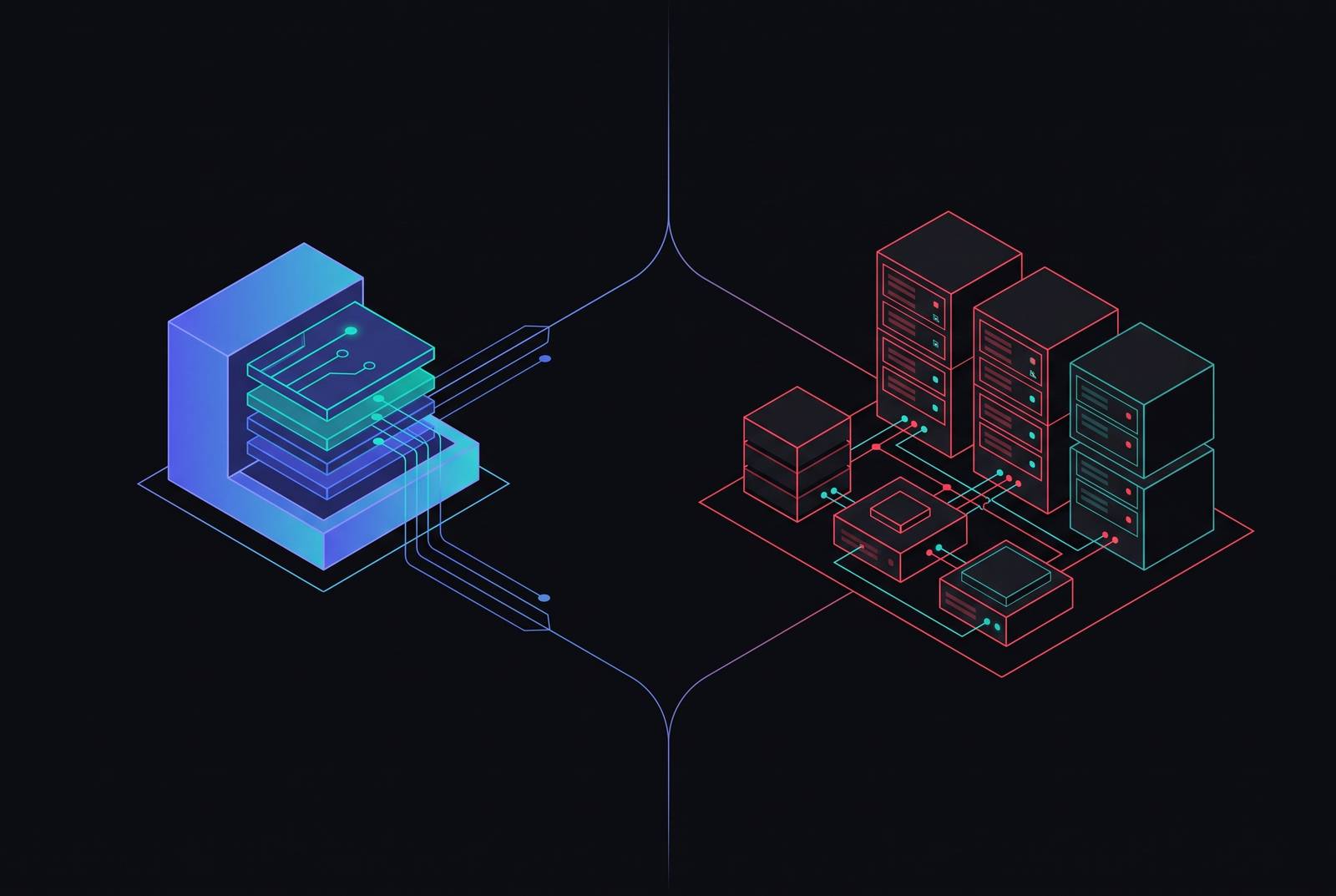
Gartner reports that 61% of large enterprises are running at least one production AI agent system as of 2026, up from 18% in 2024, a jump that happened faster than infrastructure thinking caught up pooya.blog. The question underneath all of this isn't whether to deploy agents. It's whether the deployment model chosen can survive contact with a compliance audit, a cost review, and a security incident, all in the same year. Managed Agent Platforms vs Self-Hosted Deployment Models.
The worst possible time to get this decision wrong
Nearly four out of five organizations say they're adopting agents sqmagazine.co.uk. Fewer than one in four have actually gotten a system to scale sqmagazine.co.uk. That gap, between "we turned an agent on" and "we have a deployment model that holds up under scrutiny," is exactly where most teams are stuck right now, and it's not a technical stall. Gartner expects more than 40% of agentic AI projects to be at risk of cancellation by 2027, and the reason isn't that the models don't work svitla.com paul-okhrem.com. It's that teams picked an infrastructure path before they understood what that path would demand of them later, and later has arrived faster than anyone budgeted for svitla.com paul-okhrem.com.
Only 21% of organizations have anything resembling a mature governance model for autonomous agents paul-okhrem.com. That number should sit uncomfortably next to the 61% running agents in production, because it means most of the enterprise agent population today has no adult supervision in any formal sense pooya.blog paul-okhrem.com. Agents don't just read data the way a human employee does. The deployment model isn't just an infrastructure decision. This decision decides whether governance is structurally possible afterward, or whether it becomes an expensive retrofit bolted onto a system that was never built to be watched.
What "managed platform" and "self-hosted" mean in 2026
The market has moved past the old binary of "build it" or "buy it."
Self-hosted itself splits into three distinct groups, and the differences affect vendor comparisons, cost expectations, and compliance obligations in ways the shared label obscures. A second group covers self-hosted or open-source agent platforms built for continuous-run, assistant-style use, distinct from the developer-framework category. A third group, platforms like Dify, Relevance AI, and Lindy, are technically self-hostable low-code tools that cut operational overhead while still letting a team run them on its own infrastructure if it wants to.
Managed platforms carry their own internal split too. Others bundle inference, orchestration, and observability into one full-stack runtime. And a third group sits in between: hybrid setups, like CrewAI AMP's enterprise tier, that offer on-prem or private VPC deployment for buyers who want the managed experience without the data ever leaving their own walls.
That last category is why the word "self-hosted" needs interrogation every time a vendor uses it. Some platforms call a private VPC deployment self-hosted. Others reserve the term strictly for full on-prem, no exceptions. A buyer who doesn't ask which definition a vendor is using is buying a label, not an architecture.
As a working rule: managed cloud fits repeatable, tool-heavy work that needs to ship fast. Self-hosted frameworks fit teams that need to own infrastructure and the data flow through it. Enterprise builders fit situations where auditability and access control are the whole point. Code-first runtimes fit agents that are a component inside a larger product, not a standalone tool. None of these four lanes is the "serious" one and the others training wheels; each has production deployments running at real scale today sqmagazine.co.uk. Four practical lanes confirmed in 2026 research (managed cloud workspaces, self-hosted agent stacks, enterprise agent builders, and code-first runtime frameworks) are used here to prevent false binary framing. In code-first frameworks such as LangGraph, CrewAI, AutoGen/AG2, and SuperAGI, developers control state, prompts, tools, and deployment. Pure SaaS orchestration layers let you bring your own LLM keys.
Managed platform capabilities and limitations
The pitch is simple: hand over the infrastructure and observability headache, and spend the saved time on agent design instead. The platform handles deployment, scaling, tracing, and keeping the thing running against whatever SLA got signed. Speed is the clearest, least arguable advantage here. First agent live in days, not weeks, with no Kubernetes cluster to stand up and no observability stack to wire together from scratch.
The numbers behind specific platforms make the shape of this concrete. Every tier, regardless of price, still requires the buyer to bring their own LLM API keys, since AMP's pricing covers orchestration and observability, not the inference itself spheron.network. LangGraph Cloud runs on LangGraph's own graph state machine, with checkpointing and durable execution built in, and it's already powering agents at Klarna, Uber, and LinkedIn, paired with LangSmith for tracing and evaluation at a Professional tier of $99 a month plus compute pooya.blog omidsaffari.com. Microsoft Agent 365 runs $15 per user monthly on its own, or comes bundled into Microsoft 365 E7 at $99 per user monthly pooya.blog omidsaffari.com.
The compliance artifacts these platforms produce automatically, SOC 2 reports, HIPAA documentation, GDPR audit trails, are not a nice-to-have. For a regulated buyer, that's the evidence an auditor asks for on day one, and generating it manually from a self-built stack is its own multi-month project.
The ceiling shows up in two places. Lock-in at the model layer is stickier than lock-in at the orchestration layer, because LLM pricing and capability shift practically every quarter. And the cost curve bends the wrong way as agent count grows: the first agent on a managed platform looks cheap, almost trivially so, but by the tenth agent, the team is maintaining a dependency on infrastructure it never actually owns. Governance features also vary sharply by pricing tier, and the entry-level plan is frequently missing exactly the access controls and audit logging that made the enterprise pitch compelling in the first place. AutoGen on Azure runs on a pay-per-token model, costing approximately $40–80/month at benchmark task volume pooya.blog.
Self-hosting requirements
The case for self-hosting rarely starts with cost. It starts with data sovereignty. Every prompt sent to a cloud API travels to someone else's servers, and even under an enterprise agreement, the buyer is trusting that provider's retention policy rather than controlling it directly. Self-hosting keeps the whole loop inside the perimeter, full stop. For healthcare networks, banks, telcos, and government agencies, this isn't a preference exercise, it's frequently the compliance floor: agents run on infrastructure the organization owns, using keys it controls, under a security model it wrote itself.
The framework choices each carry a distinct personality. LangGraph handles stateful workflows best, with a graph state machine that recovers gracefully from a failed node, and it completes 62% of complex multi-step tasks (the kind with eight or more steps, planning, and backtracking) in 2026 benchmark comparisons pooya.blog. CrewAI is built for role-based multi-agent teams and clears 54% on that same benchmark pooya.blog. SuperAGI offers a GUI-first, self-hosted option for teams that want less raw code exposure.
The inference-serving layer sits beneath the framework, and this is where a lot of self-hosting budgets go sideways from a decision made without enough information. vLLM has become the de facto standard for most self-hosted production work, thanks to its PagedAttention throughput, with SGLang as a credible alternative. TensorRT-LLM squeezes out the best raw performance on NVIDIA hardware but comes with a setup complexity that isn't for a team's first rodeo. Hugging Face's TGI is easier to stand up and, for typical short-prompt workloads, slower than vLLM, though TGI v3 actually outperforms vLLM on long-context tasks; TGI entered maintenance mode in December 2025, and Hugging Face itself now points new deployments toward vLLM or SGLang. Ollama remains a solid choice for local development, but it was never built for high-concurrency production traffic.
Model quality has genuinely closed the gap with closed-source frontier options.
None of this comes with governance attached, and that's the part vendors don't put on the landing page. LangGraph manages state. CrewAI manages roles. AutoGen manages conversation flow. Not one of the leading self-hosted frameworks ships with multi-tenancy support. If the plan involves separate customers running isolated agent environments, that isolation gets built by the engineering team, from nothing, because the framework simply doesn't do it. And reliability is not a solved problem either: a 2026 production analysis covering 6,259 deployed agents and 4.5 million runs found a 56.6% task success rate, meaning close to half of all production agent runs fail on some axis spheron.network. Retry logic and recovery design aren't an edge case to bolt on later. They're core engineering work, and in a self-hosted deployment, the team owns every bit of that failure surface alone spheron.network. Active frameworks confirmed in 2026 and their differentiated strengths are outlined below. Inference-serving options confirmed active in 2026 are outlined below. GLM-5 (744B) and Kimi K2.5 (1T) lead overall open-source model rankings on 2026 leaderboards, while for teams needing reasoning and coding without a massive model, GLM-4.7 355B scores 85.7 on GPQA Diamond and 73.8 on SWE-bench Verified alpacked.io.
The real cost comparison once hidden expenses are counted
Token pricing looks deceptively simple until it isn't. GPT-5.2, the flagship tier, runs $1.75 per million input tokens and $14.00 per million output tokens aisuperior.com. Run the math on a typical application processing a million tokens a day, split 500,000 in and 500,000 out, and GPT-5.2 costs around $236.25 a month, with the mini variant costing a fraction of that spheron.network aisuperior.com. Which means, at moderate volume, the choice of model inside the managed path swings the bill more than the managed-versus-self-hosted decision itself does spheron.network aisuperior.com.
Self-hosting has its own break-even math, and it only pays off past a certain volume. Against frontier closed-source pricing, self-hosting on reserved cloud GPU tends to break even somewhere around 2 to 5 million tokens a day. For full enterprise-scale deployments, the break-even point usually sits north of 500 million tokens a month spheron.network. Below those thresholds, self-hosting is simply spending more to get the same output, dressed up as independence.
And GPU cost is the smallest part of the real number.
Engineering labor is the cost nobody puts in the pitch deck. A "free" open-source model can quietly cost more than $500,000 a year once the engineering time to run it is counted spheron.network. Add the infrastructure sitting beneath all of it, a basic Kubernetes setup with GPU node pools, Prometheus and Grafana for monitoring, load balancing, and the monthly infrastructure bill is real money, but the engineering time to keep it healthy costs a great deal more than the infrastructure itself.
None of this makes self-hosting a bad decision. It makes it the wrong decision for a team choosing it purely to save money, because at moderate scale, it usually doesn't. Self-hosting is a control play, not a cost play, and it's a defensible one when compliance requires it outright or when genuine volume clears the break-even math. Start with what looks simple, API pricing at the token level. GPT-5-mini costs $0.125 per million input tokens and $1.00 per million output tokens, making it 14x cheaper on both inputs and outputs aisuperior.com. Self-hosting break-even thresholds from 2026 research are outlined below. Raw GPU costs represent only 30–40% of true infrastructure investment, so teams should plan for a 2.5–3× multiplier on GPU hardware costs svitla.com paul-okhrem.com. Running Qwen-2.5 32B or QwQ 32B on AWS g5.12xlarge with 4× A10G GPUs costs approximately $50,000 annually at continuous operation spheron.network. Llama-3 70B on p4d.24xlarge with 8× A100 GPUs reportedly costs around $287,000 per year at continuous operation. A minimum viable production AI team requires 1.5–2 FTE, costing $270K–$550K annually spheron.network. An enterprise-grade team requires 4–6 FTE, costing $720K–$1.5M annually.
Governance and security controls for each model
Most of this arrives as a surprise after the fact.
Managed platforms hand over real governance value out of the gate: SOC 2, HIPAA, and GDPR audit trails generated automatically, without anyone on staff writing a compliance report by hand. Enterprise tiers layer on SSO through Microsoft Entra or Okta, role-based access, and in some cases FedRAMP High, as CrewAI AMP's enterprise tier does. Scope is the catch. Those controls cover the platform's own surface, the login, the dashboard, the audit log of who touched what inside the tool. They do not govern what the agent does once it reaches outward, the tool calls it makes, the API side effects it triggers, the data it might leak through a call nobody was watching closely. That entire downstream risk sits outside the managed platform's audit trail, full stop.
Self-hosted frameworks offer even less on this front, by design rather than oversight. LangGraph tracks state. CrewAI tracks roles. AutoGen tracks conversation history. None of that is governance in the access-control sense, and none of the major frameworks handle multi-tenancy at all, so any team running isolated environments for different customers is building that wall themselves, brick by brick.
Key capabilities to evaluate in such a layer include per-agent identity with machine-to-machine authentication, scoped tool access, independent rotation and revocation, audit logs of every tool call, SCIM-driven role-based access control, and real-time policy enforcement.
A few named options confirm this layer is maturing fast, each with a different center of gravity. MintMCP Gateway combines a governed tool-connection layer with a separate Agent Gateway handling identity, permissions, memory, and monitoring, offers VPC or self-hosted deployment on request, and carries SOC 2 Type II and HIPAA compliance with signed BAAs, alongside OAuth 2.x brokering and two-layer monitoring that covers both gateway traffic and local non-MCP activity through Claude Code and Cursor hooks. Bifrost, from Maxim AI, is open-source under Apache 2.0, documents an 11-microsecond latency overhead at 5,000 requests per second, supports more than 23 LLM providers through an OpenAI-compatible API, and runs air-gapped where that's required, though teams evaluating it should confirm it covers SCIM-driven RBAC and per-agent identity at the depth an enterprise deployment actually needs.
None of these layers replace the deployment decision itself. Once that decision is made, they simply make it possible for someone to actually answer the question an auditor is going to ask eventually: which agent called which tool, with whose credentials, and who signed off on it. Tray.ai's "State of AI Agent Development Strategies in the Enterprise" survey found that 86% of enterprises require tech stack upgrades to properly deploy AI agents, and most are discovering this after choosing a deployment model, not before. Named options confirmed in research are outlined below. Obot Platform is an open-source MCP gateway from Obot AI, formerly Acorn Labs, and is part of a broader agent orchestration framework.