AI Agent Lifecycle Management in Production
Why AI agents need their own governance discipline, not borrowed software rules.
Traditional software runs on one dependable fact: it doesn't move unless a person moves it. A deployed application does what it did yesterday, and it stays that way until a developer changes the code, and that change goes through a ticket, a review, a deploy, a version bump. Patch cadences, change advisory boards, rollback plans, the entire discipline of software lifecycle management got built around that fixed point. Nothing shifts unless someone shifts it.
AI agents don't offer that guarantee, and treating them as if they do is where most of the trouble starts. A vendor updates the underlying model and the agent's behavior can change without anything being deployed on the customer's end. A connected data source changes shape, and the agent starts reasoning over different inputs than it did last week without anyone touching a config file. A permission granted for one task sits there active long after that task ends, because revoking it was never built into anyone's workflow. None of that gets logged as a change-management record. No process exists to catch it, so nothing triggers a review.
Non-determinism is the real core of it. Feeding the same input to the same agent twice can lead it to take two different paths, call a different tool, or skip a step it took last time, depending on context invisible from outside. Static governance, built for software that behaves identically every time, has no mechanism for tracking a system that doesn't behave identically even to itself. That's a design mismatch baked in from the start.
Agents are spreading fast, and the governance gap is already wide
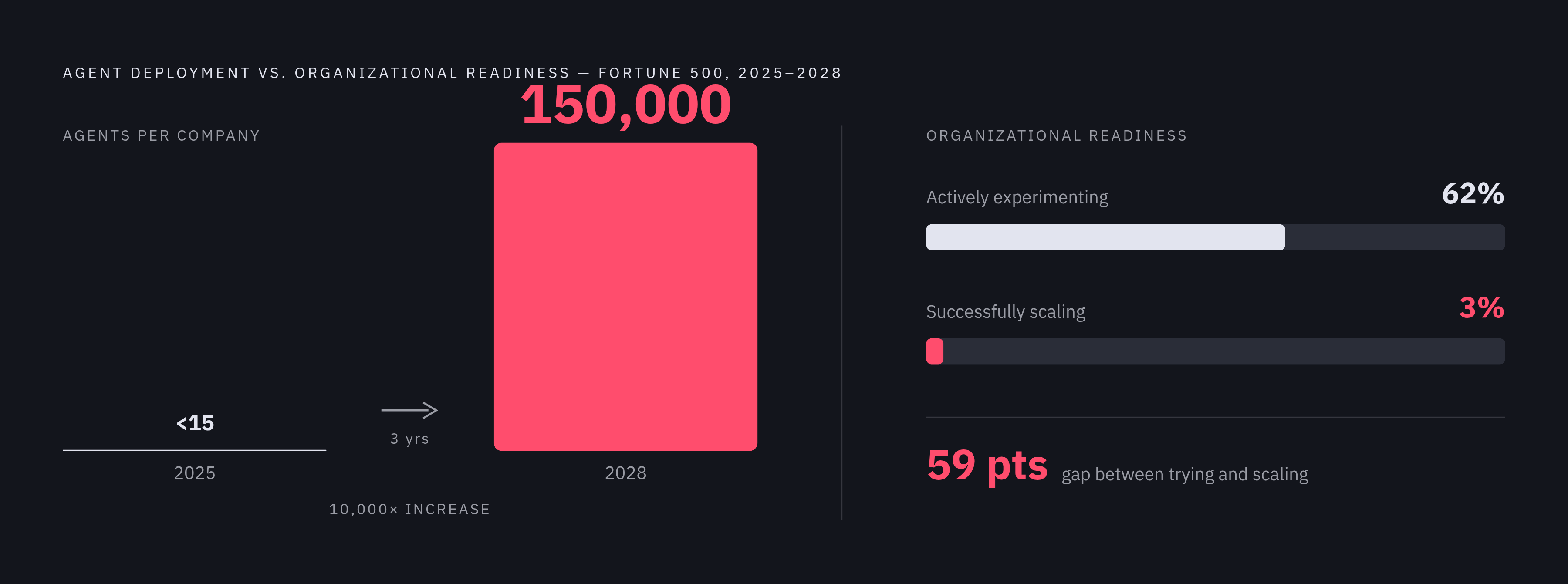
Scale is what turns this from an interesting problem into an urgent one. Gartner projects the average Fortune 500 company will manage over 150,000 agents by 2028, up from fewer than 15 in 2025. Gartner projects the average Fortune 500 company will manage over 150,000 agents by 2028, up from fewer than 15 in 2025, an explosion measured in orders of magnitude, compressed into three years. That's an explosion measured in orders of magnitude, compressed into three years.
Enterprise software is following the same curve from the inside. Agentic capability is projected to show up in roughly 40% of enterprise applications by the end of 2026, up from under 5% a year earlier. Vendors are shipping agents into products faster than buyers can build governance to receive them, and that sequencing problem, capability arriving before the guardrails, is shaping up to be the defining operational challenge of this decade of enterprise software.
The readiness numbers say the same thing from another angle. Only 17% of organizations have deployed agents so far, yet more than 60% expect to be running them within two years. A lot of companies are about to cross a threshold they haven't prepared for, and the harder problem sits one level above deployment: only 3% of organizations are successfully scaling agentic AI across multiple departments, even though 62% are actively experimenting with it. Getting one agent working in a sandbox is easy. Getting a hundred of them working safely across finance, sales, and engineering at the same time is a different discipline, and almost nobody has built it yet.
AI agent lifecycle management and how it differs from model management
Agent lifecycle management, ALM for short, covers an agent from the moment it's conceived to the moment it's shut off: planning, building, testing, deploying, monitoring, governing, optimizing, decommissioning. It sounds like a lot of stages because it is.
Model management and ALM ask different questions, and collapsing them into one thing causes an incident report later. Model management asks a narrow question: is the model performing as expected, is accuracy holding, is drift within bounds. ALM asks a bigger one: is the whole agent, its model, its permissions, its tool access, its position inside a business process, doing what it was actually built to do, safely. A model can score beautifully on its own benchmarks while the agent wrapped around it quietly overreaches its access, calls tools it shouldn't, or acts on stale data nobody refreshed. Model management will never catch that. ALM has to, or nothing does.
What ALM governs extends well past model weights, covering prompts, connected tools, memory, the data sources feeding the agent, the systems it integrates with, who or what can reach it, the audit trail it leaves, the evaluations run against it, how incidents get handled, and how it eventually gets shut down. It borrows its shape from how mature IT shops manage employee and service-account lifecycles, onboarding, periodic access review, offboarding, but speed is what separates the two. An employee lifecycle unfolds over months. An agent can move from request to production far faster than any employee ever could, which compresses every stage of that borrowed lifecycle and leaves no room for the tribal-knowledge shortcuts that used to paper over the gaps.
Bringing an agent into production: identity, access provisioning, and deployment controls
Every agent needs an assigned owner before it gets provisioned, and that owner has to be a person, not a team. Someone accountable for what the agent does, what it can touch, when it eventually gets retired. Skipping this step leaves the agent without a clear accountable owner, exactly the kind of thing nobody remembers to check on eighteen months later.
Before deployment, the governance questions are blunt: what can this agent access, what can it change, what can it trigger. An agent that summarizes public documentation carries a different risk profile than one wired into a payments system or a customer database. Applying the same template to both isn't caution, it's negligence wearing a caution's clothing.
Least privilege should govern the whole design, the same Zero Trust logic applied to agents that Microsoft has pushed for identity and network security generally. An agent gets access to what it needs to finish its assigned task, nothing broader, nothing kept around "just in case it comes up later." Before any of that access goes live, the agent needs behavioral testing the way an application goes through user acceptance testing: does it produce correct responses, does its logic hold under edge cases, does it actually respect the security boundaries it was given. Skipping this is the agent equivalent of shipping code straight from a laptop to production and hoping nobody notices.
Gaps between standard application monitoring and runtime monitoring
An agent can hand back a clean, well-formatted, entirely plausible answer and still have failed completely. It might have called the wrong tool to get there. It might have used context three versions stale. It might have repeated an action it already took, skipped an approval step it was supposed to route through, or technically finished the workflow without satisfying what the user actually needed. Standard application monitoring, tuned to catch failed requests and slow response times, waves all of that straight through: success code, acceptable latency, ticket closed. The failure that mattered is invisible in the dashboard, because the dashboard was never built to look for it.
Catching it takes a different kind of observability: distributed tracing across the full agent workflow rather than a single API call, token-level cost tracking so a runaway loop shows up before the bill does, visualization of the decision path the agent actually took, detection tuned for hallucination specifically rather than generic error rates, real-time alerting against thresholds built for agentic behavior rather than server uptime.
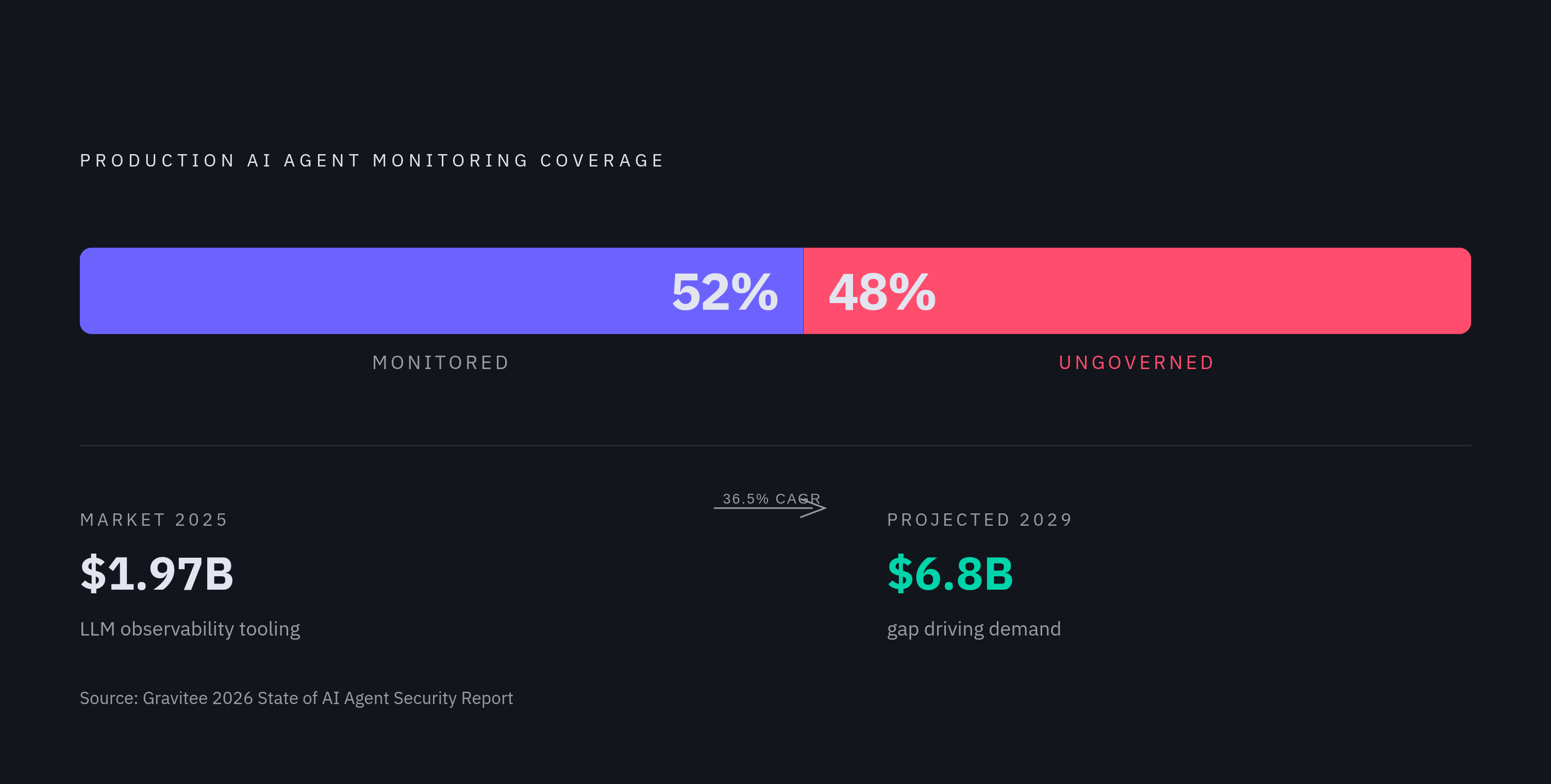
Coverage on this front is the number that should worry people most. Mean monitoring coverage across production agents is 52%, according to Gravitee's 2026 State of AI Agent Security Report. Nearly half of everything running is flying without instruments, and that's the single most urgent operational fact in this whole space. A market has formed around fixing it, unsurprisingly: the LLM observability tooling category reached $1.97 billion in 2025 and is projected to hit $6.8 billion by 2029, a 36.5% compound annual growth rate. Vendors are betting real money that closing this gap is worth paying for, and that bet looks safe.
Periodic recertification: why approved agents become ungoverned agents without it
An agent approved a year ago, with permissions nobody has revisited since, carries the same practical risk as an agent that was never registered. The paperwork says it's governed. Reality says otherwise, and reality wins every time.
Permissions accumulate quietly. An agent gets access for one task, the task ends, the access stays, because revoking it was never built into anyone's workflow. Left alone, agent access only ever expands. That's the exact failure pattern that plagued service accounts for decades, just moving faster now because agents get created and re-tasked far quicker than accounts ever did.
Skipping recertification causes an organization to recreate shadow AI from the inside, using its own approved, registered agents as the vector. The pattern is clear: the agent was legitimate at launch, went through the proper channels, got signed off, and then drifted out of governance later, quietly, through neglect rather than any single bad decision. IBM's 2026 Tech Leader Study puts a number on the size of the coming gap: surveyed CIOs and CTOs expect a 38% increase in agents deployed by 2027, while only 11% say they're fully prepared to govern that many. Recertification burden doesn't grow in a straight line with agent count, it compounds, and a review process that barely holds together at fifty agents falls apart completely at five thousand.
Decommissioning as an identity problem, not a product retirement
Retirement is the stage almost everyone skips. Organizations that have gotten reasonably disciplined about deployment and monitoring will still, routinely, have no formal process for what happens when an agent goes away: no defined step for revoking its access, rotating its credentials, or logging that the retirement even happened.
The mistake is confusing product retirement with identity retirement, a distinction that practitioners in this space draw explicitly. Turning off the interface, archiving the project, telling the team it's done, that's product retirement, and it's the easy part. Identity retirement gets skipped constantly, leaving API keys live, service tokens valid, third-party grants still authorized, all attached to an agent that as far as anyone's concerned doesn't exist anymore. It still exists. Nobody is watching it anymore, which is arguably worse than if it had never existed.
Call it the same failure that has haunted orphaned service accounts for years, wearing a new outfit, except agents get created and repurposed fast enough that the failure compounds at a rate service-account governance never had to handle. Organizations that get this right treat agent offboarding exactly like employee offboarding: permissions revoked explicitly, credentials destroyed rather than left dormant, the registry updated so the record matches reality. The fix isn't complicated. Remembering to do it every time, for every agent, at a volume about to get much larger, is the actual challenge, and it's the one most companies will fail first.
A production-grade control plane for agents, end to end
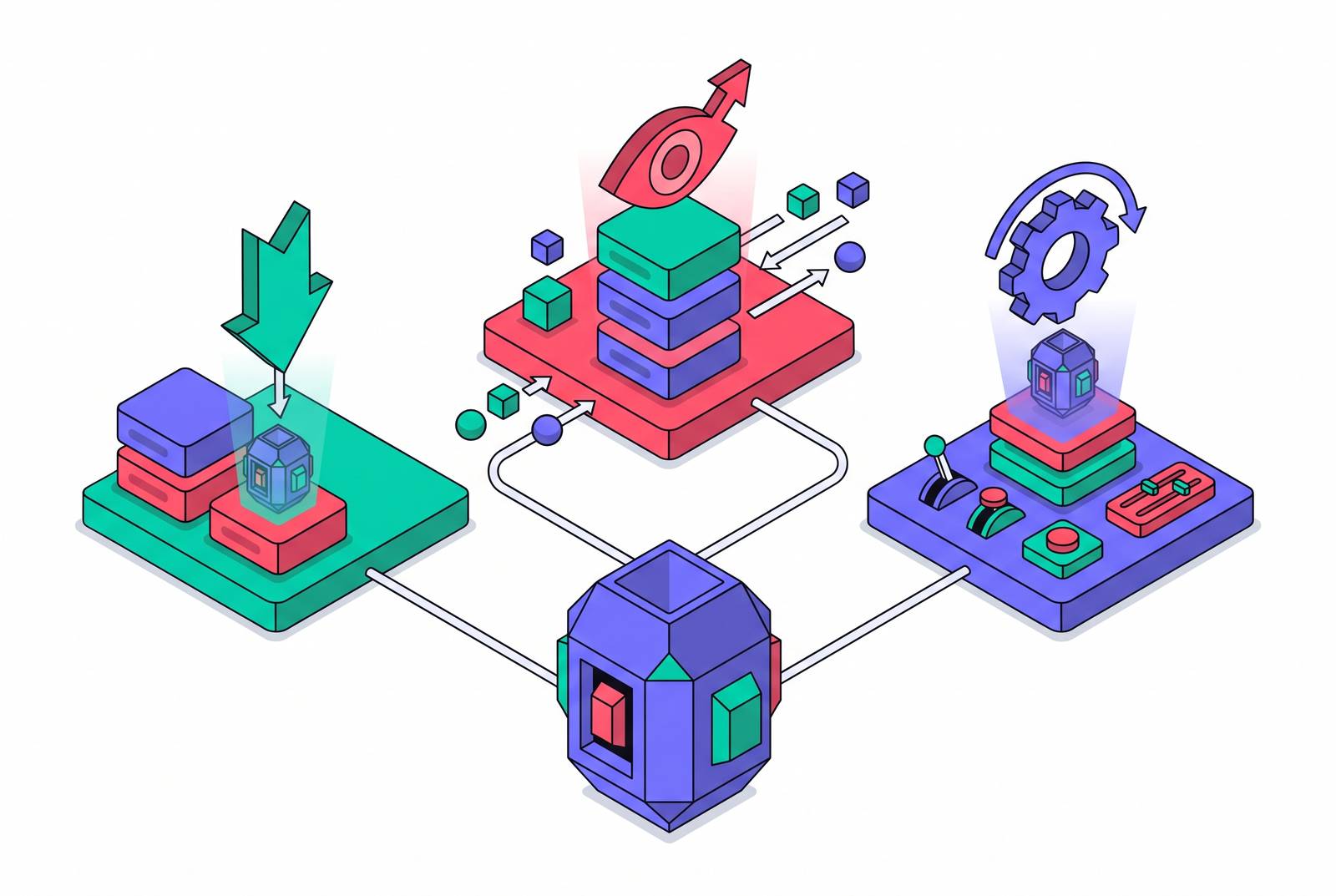
The control plane an organization needs rests on four domains that persist across the whole lifecycle: identity and ownership, access, guardrails, audit. Each has to apply at onboarding, through runtime, and out the other side at decommissioning.
Discovery comes first, because none of the rest matters if the organization doesn't know what it's governing. Agent sprawl is already the default condition inside most companies: dozens or hundreds of agents scattered across teams throughout the organization, many stood up by individual groups without anyone above them knowing they exist. The first real capability any control plane needs is total visibility, a live and accurate account of every agent running inside the organization.
From there, the control plane has to distinguish an agent behaving inside its approved scope from one drifting into anomalous territory or violating policy outright, and it has to do that at runtime, not as a forensic exercise three weeks after the damage is done. It blocks the action as it happens instead of merely recording it afterward. Most enterprise governance today produces excellent logs and weak controls, plenty of evidence appears after something breaks, while very little stands in the way of it breaking. The real security value sits upstream of that, in stopping the violation before it executes rather than writing a thorough postmortem about it. Agents move at machine speed. Governance that only works in hindsight was built for a threat that moves at the speed of a person, and closing that mismatch is the whole point of this discipline.