Secret Scanning and Leak Detection in AI Agent Codebases
Agents leak credentials before any commit, so scanning must move upstream.
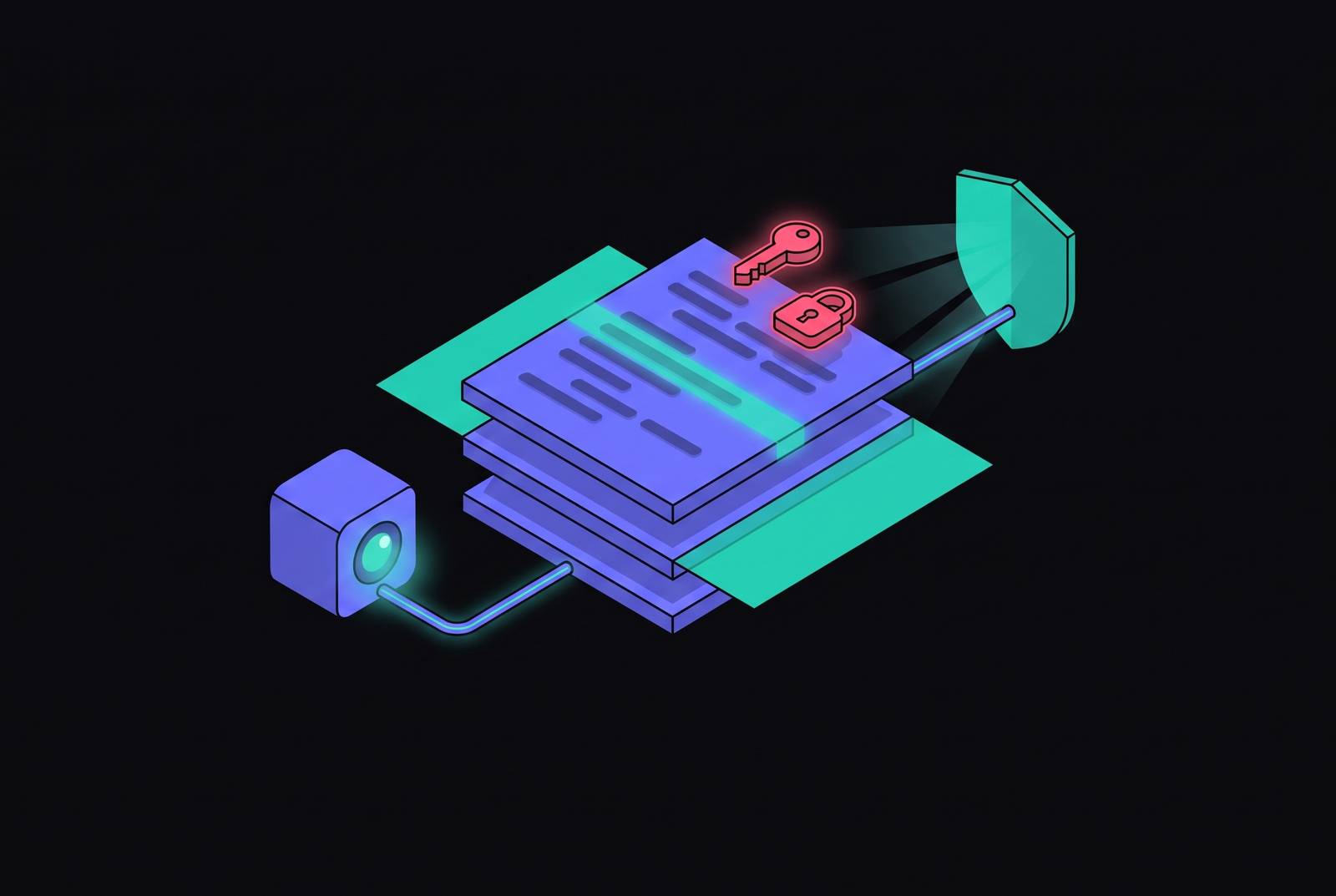
Secret scanning in AI agent codebases must protect more than the next commit. Agents can send credentials through prompts, configurations, and tool calls before a repository scanner has anything to inspect. Effective protection therefore moves detection into the live workflow, backed by scoped authorization and runtime monitoring. The repository gate still has a job. It just cannot guard every exit.
Why commit-time scanning no longer covers the full secret-leak surface in AI agent codebases
AI coding agents put new routes between local secrets and external systems. Agent configs, MCP tool settings, prompts, and live sessions sit upstream of the commit, outside the checkpoint on which traditional repository protection depends. The old sequence was relatively simple. A secret entered a file, the file entered a commit, and push protection could intercept it before it reached the repository. That sequence remains useful, but it no longer describes the whole exposure.
Sonar’s August 2026 analysis describes agents reading source files, configurations, and environment variables to build context, then transmitting relevant portions to a model provider. No commit is required for that transfer. A key included in prompt context can already be in provider logs while the working tree remains untouched. Qodo’s 2026 glossary adds that agents also generate MCP configurations, test fixtures, and tool settings, so the agent reading a dangerous file may have written it.
Sonar describes an example involving xAI Grok Build that makes the distinction concrete. The coding agent quietly uploaded entire Git repositories through a background channel. Separately, a model-turn request transmitted a canary API key and database password from a.env file verbatim and unredacted. Nobody needed to commit either secret. The failure was transmission before the repository checkpoint.
The four paths a secret takes from an agent session to a model provider
The first path is a file read incorporated into prompt context. An agent reads a.env file or configuration to understand the codebase, and its values enter the request sent to the model provider. Sonar describes how those values end up in provider and gateway logs, often in plain text. Keeping the file out of Git does not stop this route.
The second path takes a secret through an MCP tool call. The call can include tokens for services the tool is configured to reach, while server access can expose the agent to the server’s broader credential scope unless tool-level restrictions are added. The CSA Agentic MCP Security Best Practices Guide calls for authorization at the tool level. Access to the building should not imply access to every cupboard.
The third path is an injected agent configuration. Attackers can target files that shape the agent’s session rather than wait for a credential to appear in committed application code. The fourth path reaches secrets held by a CI runner, where an agent reads environment variables as instructions and actions execute within the runner’s credential scope. Here, the credential was never in committed code.
By the time push protection could intervene, the secret may already have traveled, and rotation cannot remove prompt history from logs the team does not own. Qodo describes the ChainDrop supply chain worm, disclosed August 4, 2026, as harvesting developer credentials and injecting agent configuration files. It weaponized the third path rather than merely demonstrating a hypothetical weakness.
Why MCP configurations are the highest-priority new leak location
MCP configurations concentrate credentials for the services an agent can call. That makes them different from a configuration file holding one application setting or one service connection. If one configuration is exposed, credentials for several systems can be exposed with it. Hardcoded values make that concentration particularly risky, and the notes on current practice identify hardcoding rather than environment references or secret-manager access as a common pattern.
The cause is not simply careless developers. The CSA describes an authorization framework that is optional, with OAuth used for remote HTTP connections and tool-level enforcement left to implementations. The protocol does not provide a standard mechanism that binds each agent to the specific tools it may invoke. So server-level access can give an agent much more access unless an operator adds per-tool controls.
The CSA frames agent identity and per-tool authorization as controls organizations must implement, and its guide calls for audit logging of tool invocations. A working connection alone leaves the narrow permissions an agent should have to be established separately.
Palo Alto Networks identifies MCP data access as a separate visibility and control problem requiring dedicated runtime controls. Static scanning can detect a token in a configuration, but it cannot decide whether a particular agent should use that token through a particular tool. Treating one as a substitute for the other leaves the most consequential permission decisions outside the defense.
What moving the detection checkpoint earlier actually means in practice
The architectural response is to place detection before each relevant transfer, starting while the secret is still local. Sonar argues that catching a secret must not depend on the model about to transmit it. A scanner built for this job should check files and prompts for known patterns and return a block-or-allow result. The agent can request the check without becoming the judge.
At write time, IDE scanning can flag a credential as it appears. Before context is sent to the model, prompt and file-read scanning can check it, while tool-call checks look for credentials passed through MCP invocations. These are distinct interception points. A scanner that watches the working diff does not automatically check everything an agent reads or every tool call it makes.
Pre-commit and pre-push hooks still protect the conventional route into version control. Repository push protection, history scanning, and pull-request review check what reaches the repository, and a quality gate can block a merge. Each placement has a different view. Moving one check earlier does not give it visibility into later CI output or previously published artifacts.
This brings detection before a commit or pull request. It is not a promise that all session activity is inspected locally or automatically blocked.
Prevent secrets from entering agent context, inspect the working diff, enforce repository gates, scan CI artifacts and logs, and keep a revocation playbook ready. An in-session code check strengthens that sequence. The other checkpoints are still needed, especially those that guard prompt transmission and runtime access.
What additional controls are needed alongside in-session scanning
A credential read from an existing file can leave through the first path without appearing in the current diff at all. Once it is in provider or gateway logs, a later scan cannot take it back. Prevention has to happen before the request leaves.
The ggshield April 2026 release targets this boundary with prompt scanning, tool-call protection, and post-action alerts for tool outputs containing secrets. A pre-execution check can interrupt a dangerous call, while a post-action alert identifies sensitive output after a tool has returned it. Neither should be confused with a repository check that happens later.
Detection also has limits beyond its placement. Known token patterns can miss unstructured secrets with no recognizable prefix, and Qodo notes that some 2026 scanners add a model layer to address them. Qodo’s guidance places review beside scanning for cases that require reasoning. The code-review layer has a separate job, examining how a value is used and where it may flow.
Published artifacts and CI runners create further gaps. A configuration inside an npm tarball persists after credential rotation, so the relevant control is excluding it before publication. CI-held credentials likewise need coverage in the runtime workflow, including checks of artifacts and logs, because committed source may contain no secret. These are locations an in-session scanner may never inspect.
Finally, the second path requires authorization as well as inspection. The CSA’s highest maturity level calls for per-invocation scoped tokens and real-time policy evaluation. A scanner may recognize a credential, but only an authorization layer can restrict which agent may invoke the tool that exposes or uses it.
Runtime visibility and agent governance as the enforcement layer underneath scanning
Secret scanning checks whether a credential is there. It does not establish who an agent is, whether the requested action belongs to its task, or whether its behavior has become unusual. Those questions require runtime visibility and governance. Without them, even when a scan finds a secret, the access model may still let an agent do far more than its task needs.
The CSA’s four-level maturity model progresses toward short-lived, scoped tokens issued by a centralized authorization service for individual invocations. At that level, the service evaluates the agent’s identity, task context, and requested tool and parameters in real time. Permission becomes specific to the action. That is a narrower grant than giving an agent access to an MCP server and relying on the server’s entire configured scope.
Visibility must also extend beyond approved deployments. Shadow agents run outside approved channels, putting credentials at risk without the scanning or policy controls that approved workflows have. An enterprise cannot place reliable checks in traffic it cannot see. Discovering those agents is therefore part of establishing where enforcement must operate.
Approved agents still need behavioral monitoring. Reading files outside the usual scope or invoking previously unused tools can precede credential exfiltration, even when each action looks ordinary in isolation. Runtime monitoring gives those actions context. Policy enforcement can then block an unauthorized invocation before it runs, just as secret detection checks for secrets before a prompt is sent.
An agent with tight permissions can still come across a hardcoded secret, while even a good scanner cannot narrow a broad permission grant. Both controls need a place in the workflow.
A practical checklist for hardening secret scanning across the full agent workflow
To put that architecture into practice, begin before the agent’s first request. Install write-time scanning, such as SonarQube for IDE, and remove hardcoded credentials from agent and MCP configurations in favor of environment references or a secrets manager. Establish per-tool RBAC. Require scoped, short-lived tokens for high-privilege calls, using the CSA maturity model as a roadmap.
During the session, check prompts and file reads before they are sent, and check MCP calls before they run. Keep the model from making these checks on its own. For an in-session code-change check, set up the GitHub MCP Server and optionally install the GitHub Advanced Security plugin. Ask the agent, “Scan my current changes for exposed secrets and show me the files and lines I should update before I commit”.
Before committing, use the hook layer to scan the working diff. Then enforce push protection and pull-request review, using a quality gate such as those available in SonarQube Cloud or SonarQube Server to block merges when secrets are found. Keep scanning CI artifacts and logs as the workflow proceeds. Before publication, check that agent configurations containing credentials are not included in the package.
If a credential may have entered agent context, treat it as compromised. Qodo recommends revoking it first, then rotating it in the secrets manager, scrubbing history, and checking access logs for use of the old key. Do not wait for evidence of a malicious commit. Exposure through a prompt or tool call is enough to trigger that response.
Test the workflow with fake credentials that are safe to invalidate. Place them in source, comments, JSON, YAML, environment files, generated patches, and test output, and test a prompt-injection file that tells the agent to ignore scanning. The control should withstand that instruction. Otherwise, the checkpoint is only a suggestion with better typography.
Qodo’s 2026 outlook anticipates scanning inside agent sessions before a file is saved, explicit human authorization for bypassing push protection, and review of secret flows into logs, prompts, and client code as expectations for 2027. The direction is clear, however. Protection is moving toward the moment an agent handles a secret, rather than waiting for the moment a developer commits it.