Agentic AI vs Traditional Automation Architecture
Agents handle complexity and variation where traditional automation breaks down.
How Traditional Automation Actually Works (and Where Its Logic Runs Out)
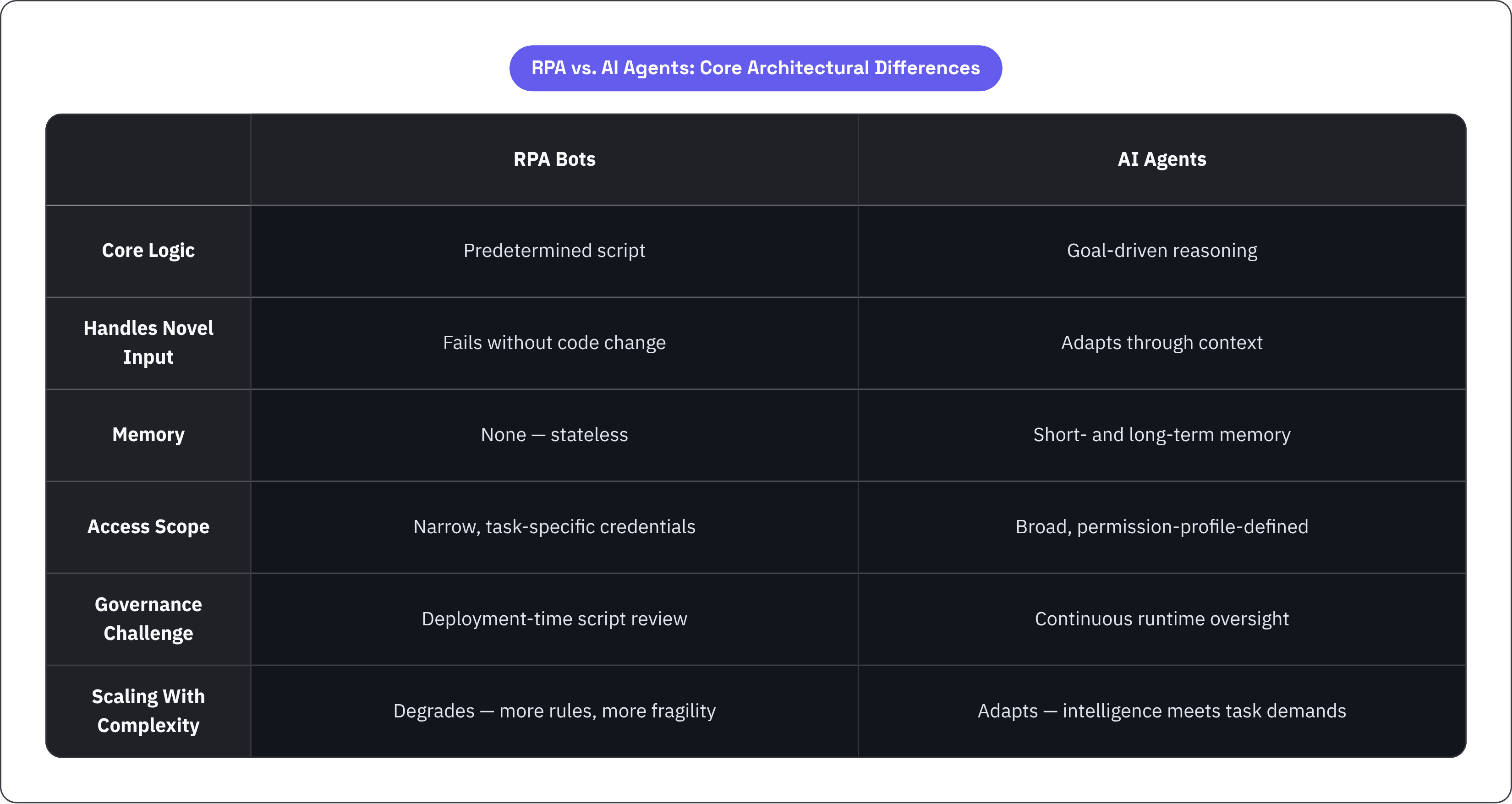
Robotic process automation does exactly what it sounds like: it automates a process by executing a predetermined sequence of steps. Input arrives, the bot follows its script, output is produced. The mechanism is usually UI scraping — bots interacting with application presentation layers the way a human would, clicking fields and extracting values — though API integrations are common as well. For structured, high-volume, repetitive work (invoices, data entry, form routing) this works exceptionally well. Fast to stand up, cheap to run, and entirely auditable.
The brittleness is structural, not incidental. Because there is no reasoning layer, no internal model of intent or context, any deviation from anticipated input breaks the process. Change a field label. Redesign a vendor's invoice format. Update an approval policy mid-cycle. The bot fails. Everest Group's 2024 survey found that fewer than 30% of RPA programs scaled beyond 50 bots, with maintenance costs as the primary constraint. Ongoing maintenance alone runs 15 to 20% of initial investment annually, and total cost of ownership often reaches three to four dollars in consulting and upkeep per dollar spent on licensing.
The ceiling becomes visible precisely when a process requires judgment: approval logic for edge cases, extraction from unstructured documents, handling of inputs the script author never anticipated. Those requirements are not outside RPA's quality threshold — they are outside its design boundary entirely. That distinction matters more than most organizations realize before they hit it.
The Internal Architecture of an AI Agent: Planning, Memory, Tools, and the LLM as Orchestrator
An agent is built from four components that have no real equivalent in RPA. A planning module that decomposes a goal into steps. Short-term memory that maintains active session context. Long-term memory that persists preferences, prior outputs, and historical interactions across sessions. A tool-calling layer that connects the agent to APIs, databases, code execution environments, and external services.
The large language model sits at the center of all of this, functioning as an orchestrator rather than a simple responder. It maps heterogeneous inputs (instructions, retrieved documents, tool outputs, memory states) to decisions about what to do next. It does not follow a script. It reasons forward from a goal.
Here is the caveat practitioners learn quickly and theorists routinely understate: LLMs are not inherently grounded. They hallucinate plausible but incorrect outputs, which is why serious production designs wrap the model in retrieval mechanisms and executable verification checks rather than letting it act on raw reasoning alone. I have watched otherwise careful engineering teams ship agent prototypes without this scaffolding, then spend weeks diagnosing why the thing confidently did the wrong thing. The model is powerful; unconstrained, it is also unreliable. Production-grade architecture accounts for this by design.
Multi-agent systems extend the model further. Specialized agents coordinate, delegate subtasks, and pass outputs between each other in structured sequences. Frameworks like LangGraph formalize this through directed-graph state management; Microsoft AutoGen enables chat-based, goal-oriented communication between agents. By 2025, multi-agent architectures commanded a majority share of the agentic AI market — a reasonable indicator of where serious enterprise adoption is concentrating, even if market taxonomy is still catching up to the implementations.
Why Agents Scale Differently Than Automation Scripts as Task Complexity Grows
RPA scales badly with complexity. More edge cases require more rules, longer scripts, more branching logic. The codebase grows fragile before the process grows sophisticated; at some point, the cost of extending the system exceeds the value it produces.
Agents scale in the opposite direction. The same planning-and-memory architecture that handles a simple task handles a complex one, because the intelligence adapts to task demands rather than being exhausted by them. A bot that routes invoices breaks when a new vendor format appears. An agent given the same goal can reason about the novel format, request clarification, or route the exception — without a single line of code being changed. Forrester research indicates that organizations using agentic frameworks report significantly faster time-to-deploy than equivalent RPA setups, a gap that reflects the architecture's native tolerance for variation rather than any specific implementation trick.
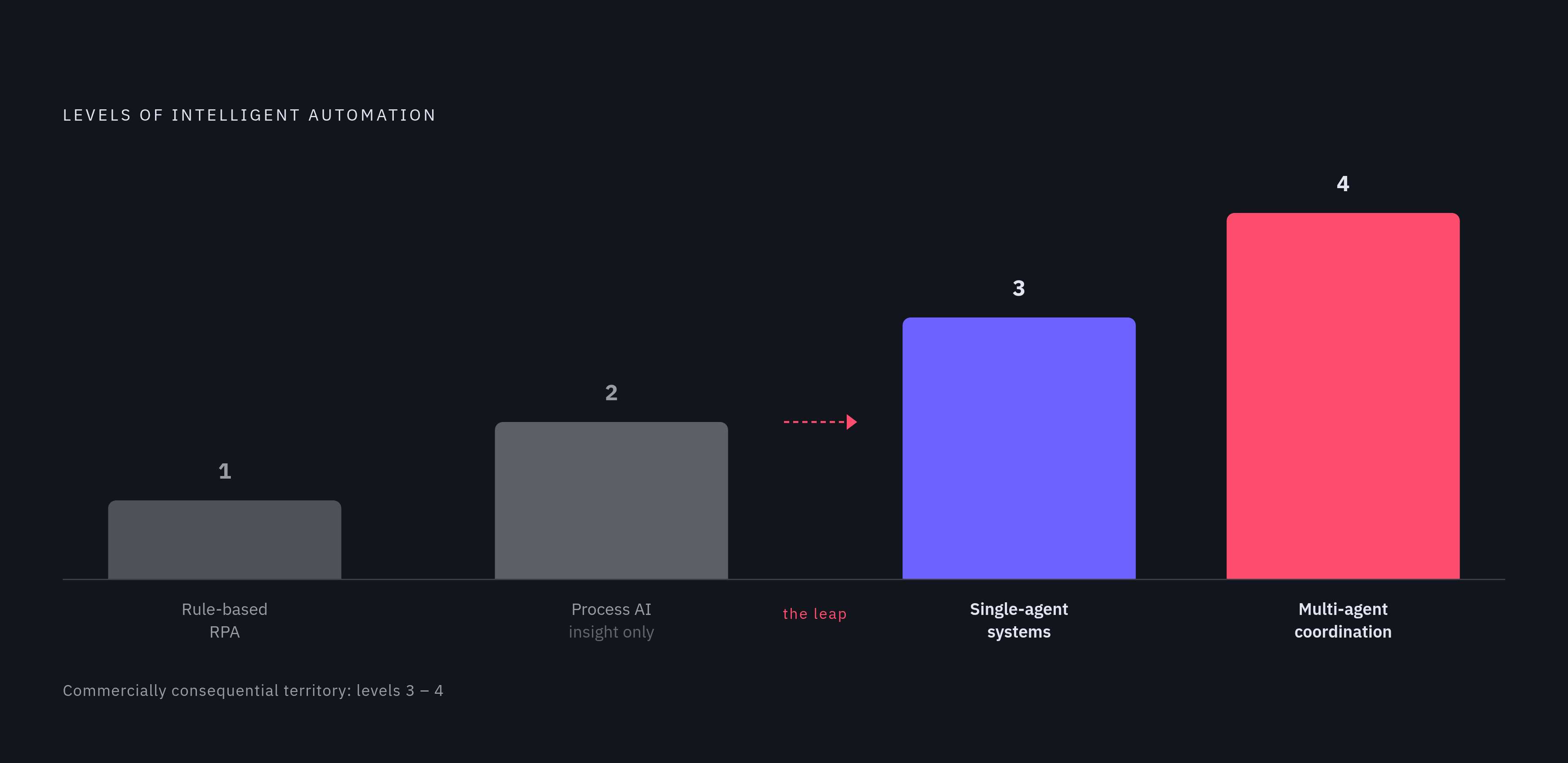
This scaling asymmetry explains a pattern now visible across enterprise deployments. RPA is being retained for stable, high-volume processes where its determinism is genuinely a feature. Agents are absorbing the work that sits above RPA's complexity ceiling. These are not competing tools so much as occupants of different positions on a maturity continuum: from deterministic rule-based automation, through process AI that produces insight without action, to single-agent systems, to multi-agent coordination. The practically and commercially consequential territory is the jump from level one to levels three and four. Most organizations are still figuring out how to make that jump without breaking something important — and a fair number are learning the hard way.
How Agents Interact with Permissions and Data Access in Ways Rule-Based Bots Never Did
RPA bots operate with narrow, task-specific credentials. Their access is bounded by what the script was written to do, which means their blast radius in the event of failure or misuse is correspondingly narrow. This is less a security feature than a side effect of how constrained the system is by design.
Agents do not work this way. They call APIs, query databases, invoke tools, and in multi-agent architectures, spawn subagents. The scope of what they can reach is determined by their permission profile, not by script-level constraints. Agents also operate at machine speed across multiple systems simultaneously, chaining many actions in a single session without pausing for confirmation. A human granted broad system access makes decisions at human pace. An agent with the same access profile is a categorically different risk surface, even if the permission level looks identical on paper.
Access models built for human users — role-based, relatively static, reviewed annually — were not designed to govern this. The gap shows up reliably when something goes wrong, and the post-incident forensics tend to reveal the same finding: someone gave the agent the permissions of a senior analyst and then treated it like a junior one.
Why the Pilot-to-Production Gap Is Largely an Architectural Governance Problem
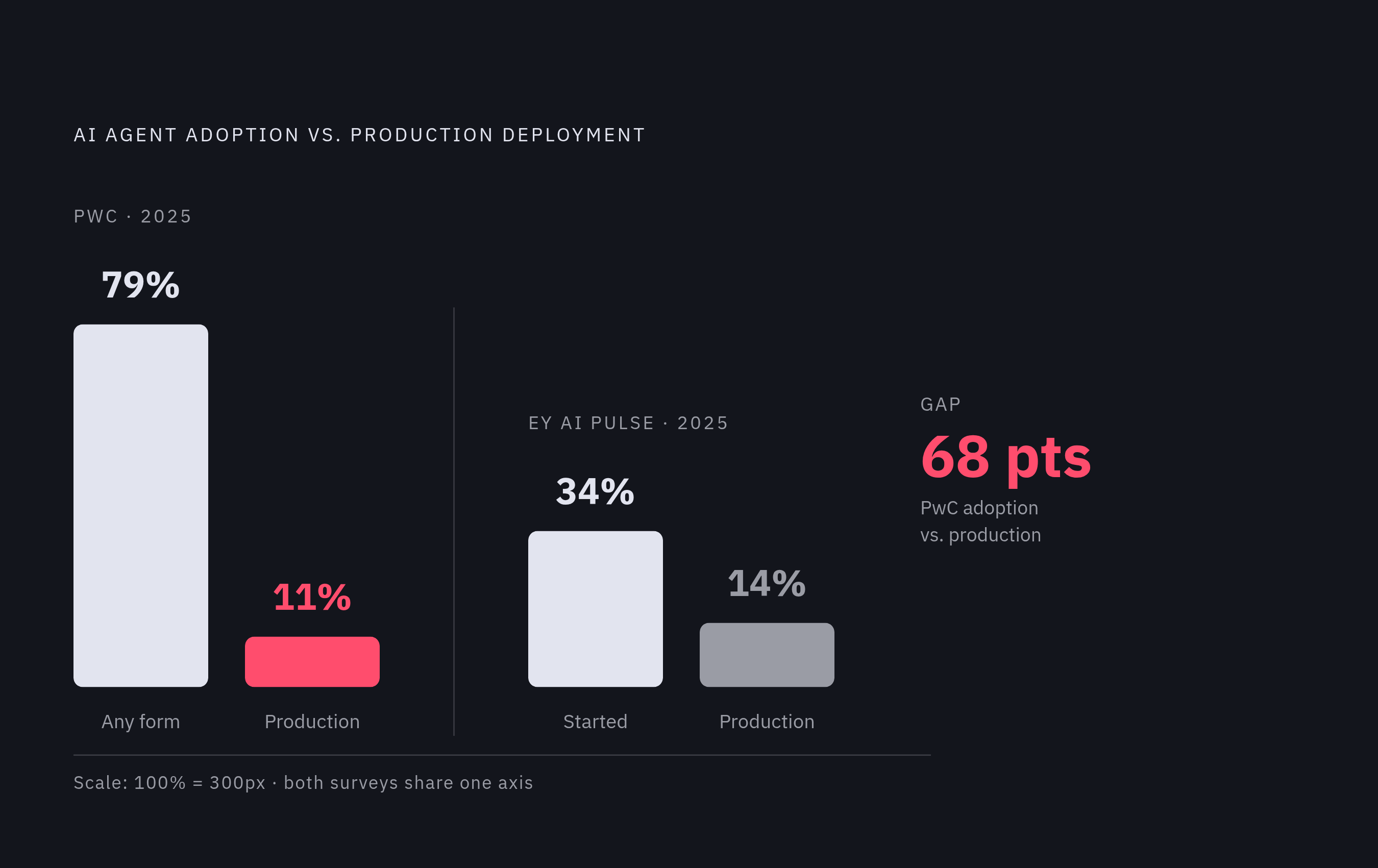
PwC's mid-2025 survey found that 79% of companies report having AI agents implemented in some form, but only 11% run them in production. EY's AI Pulse Survey tells the same story: 34% have started implementation, while only 14% report full deployment. The gap is large, persistent, and it is not a capability problem. Organizations are failing to build sufficient confidence in what those agents will do unsupervised, at scale, in consequential workflows.
The pilot-to-production transition exposes a specific structural difficulty. In a pilot, humans observe every action the agent takes. In production, agents operate across live data, real permissions, and workflows where errors have downstream consequences, sometimes expensive ones. There is no equivalent of the script review that validated an RPA deployment before go-live, because there is no script. Agent behavior emerges from reasoning in context, and that context changes with every session. Governance structures that worked fine for deterministic automation are looking at the wrong thing.
The audit challenge follows from this. Traditional automation produces a deterministic log: step X followed step Y because the script said so. Agent actions emerge from reasoning, making the "why" considerably harder to reconstruct after the fact. Organizations that have successfully crossed to production share a recognizable pattern: they treat runtime visibility and behavioral monitoring as first-class architecture requirements, built alongside the agent from the start, not retrofitted after an incident forces the question.
What the Architectural Shift Means for How Enterprises Need to Think About AI Oversight
RPA governance was primarily a deployment-time problem. Validate the script. Test the edge cases. Monitor volume. The deterministic logic meant that the system's behavior was, in principle, knowable in advance, which gave governance a comfortable place to stand.
Agent governance is a runtime problem, full stop. Because agent behavior emerges from context and reasoning rather than a fixed script, oversight must be continuous. What the agent does in one session is categorically different from what it did in the previous session, even with identical starting instructions. Gartner projects that agentic AI will autonomously handle 15% of day-to-day enterprise work decisions by the end of 2026, with the share rising sharply afterward. The scale at which unmonitored behavior compounds grows with every deployment.
The specific capabilities that matter are not mysterious: real-time visibility into what agents are doing across systems; behavioral anomaly detection that flags deviation from expected patterns; enforceable policy controls that constrain agent actions before violations occur rather than logging them afterward; complete audit trails that capture not just what happened, but what the agent reasoned. That last item is consistently the hardest to build and the first to get deprioritized when timelines compress. In my experience, "we'll add observability later" is the engineering equivalent of "we'll sort out the insurance after the trip."
Agent autonomy is the feature, not a side effect. Governance frameworks that fail to account for that property will encounter a ceiling analogous to the one maintenance costs imposed on RPA, except it will manifest as an organizational confidence problem rather than a technical one. The organizations actually reaching production and staying there are treating oversight as architecture from the beginning, not as something to layer on after the demo goes well and someone in senior leadership asks what happens when it goes wrong.