What Access Management as a Service Actually Covers
AMaaS handles login and permissions but only for systems you already know about.
The functional core: what AMaaS delivers
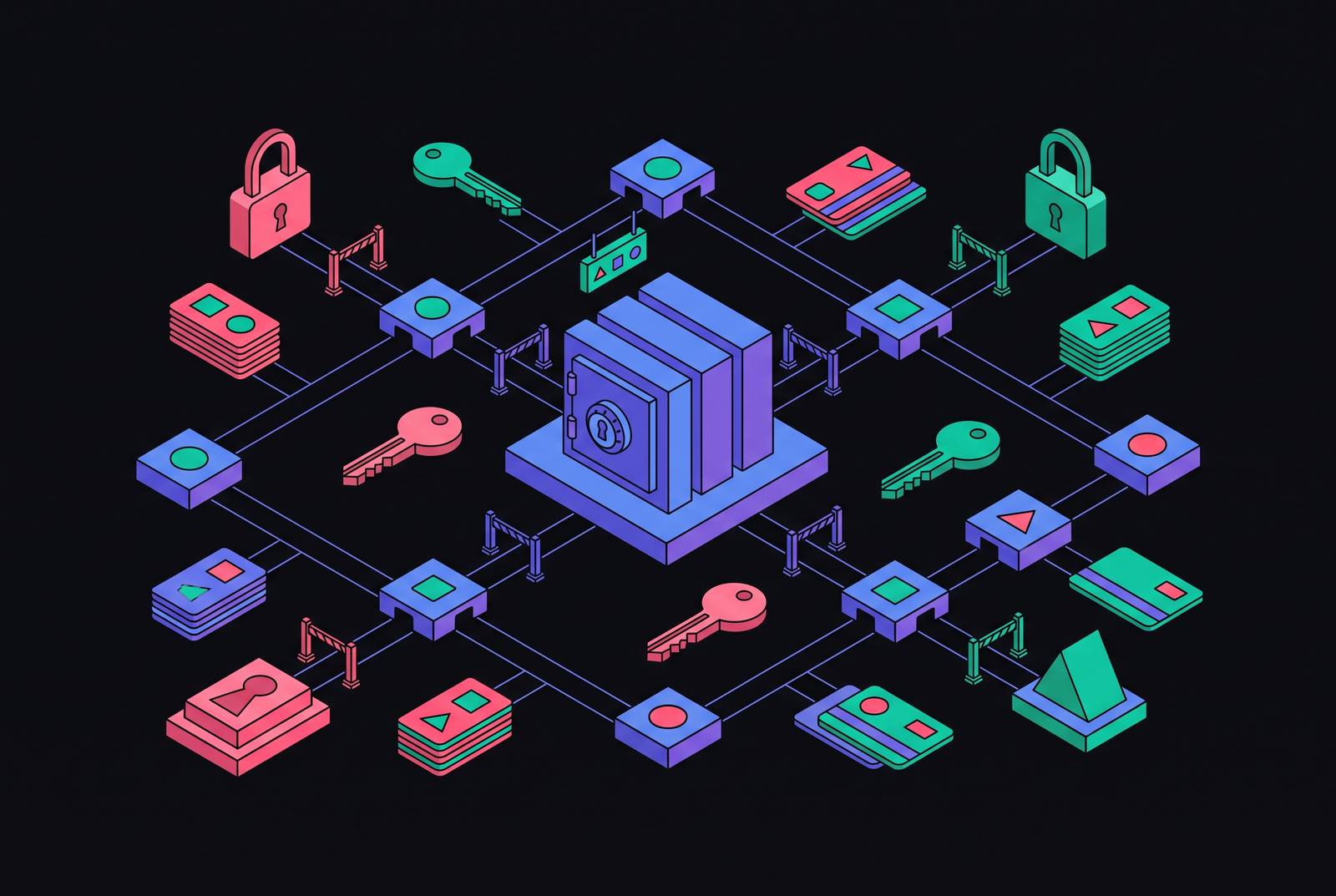
Authentication is what everyone notices first, so start there. Single sign-on (SSO) lets someone log in once and carry that session across every connected app, using federation standards like SAML and OIDC to hand off trust between systems. Multi-factor authentication (MFA) forces a second proof of identity on top of a password, and mature platforms now push passwordless options too, including biometrics and hardware keys, which make "forgot password" emails rarer.
Directory services form the central record of who exists, what credentials they hold, and what they're cleared to touch, usually wired into Microsoft Active Directory or Google Workspace. That record produces every access decision downstream of it.
Authorization decides what happens after login. Role-Based Access Control (RBAC) grants permissions by job title. Attribute-based models grant them by conditions instead: department, location, whether the device checking in is company-issued or someone's laptop at a coffee shop. Both are supposed to run on least privilege, meaning access to what's needed and nothing else, though that principle erodes fast without someone actively enforcing it.
Lifecycle management is where the real risk lives. Provisioning happens on hire, adjustment happens on role change, deprovisioning happens on departure, a pattern the industry calls Joiner-Mover-Leaver. When that automation disconnects from actual oversight, access debt piles up quietly: the employee who switched teams last spring but never lost the old team's file permissions, the contractor whose account is still live months after the contract ended. Nobody notices until an audit or a breach forces the question.
Compliance has shifted too. It's less about writing access policy now and more about proving the policy held under pressure. SOX, HIPAA, GDPR, and PCI DSS all demand evidence: certifications, revocation records, segregation-of-duties exceptions and who signed off on them. Buyers aren't just buying login screens anymore. They're buying paper trails.
Customer Identity and Access Management (CIAM) is a separate branch that handles external, public-facing identities: self-service signup, consent management, social login, mobile SDKs. It's built for scale and volume, for the tighter, smaller world of workforce accounts.
Privileged Access Management (PAM) usually gets bundled alongside AMaaS rather than built into it: credential vaulting, session recording, brokered access for the accounts that can do real damage if compromised. That bundling isn't an accident. Unit 42's Global Incident Response Report found that 66% of social engineering attacks target privileged accounts specifically. PAM sits exactly where attackers already point their effort.
What the managed-service layer adds beyond software licensing
Buying AMaaS means buying people who run the software. A base AMaaS engagement typically covers directory consolidation, SSO rollout across an initial application set, lifecycle automation, API integration, and the change-management and training work that goes alongside it.
That's a lot of labor most internal IT teams would rather not staff for permanently. Optiv positions its AMaaS offering as covering up to 40% of the access controls defined by NIST, framed explicitly as "Phase 0" of a Zero Trust journey rather than the finished building. No hardware to rack, no internal team patching platform versions at 11pm on a Friday: that burden shifts to the provider, along with vendor relationships and platform-specific expertise that takes years to build in-house.
None of that widens what the system can see, though. Signing a service contract doesn't stretch the lens to cover identities the system was never pointed toward. The managed layer only governs what somebody, at some point, configured it to look at, and that's the ceiling before the sales deck closes.
The market pressure making AMaaS adoption urgent right now
Identity has become the attack surface, full stop. Netwrix research found credential theft rose 800% and ransomware attacks rose 179% in 2025. Failure to enforce MFA contributed to 17% of cloud breaches. The global average cost of a data breach hit $4.4 million in 2025, a figure that gets a CFO's attention without much translation.
Regulation piles weight on top of that. SOX, HIPAA, GDPR, and PCI DSS all require proof of access control, and the bar for what counts as proof keeps climbing. Market size reflects the pressure directly: access management is estimated at $25 billion in 2026, projected to hit $65 billion by 2033. PAM alone hit an estimated $3.6 billion in 2024, growing at 23.3% annually, among the fastest-moving corners of the category.
Cloud adoption tore down the old network perimeter, so identity became the new one by default, not by design. Third-party involvement in breaches has grown substantially as supply chain and partner access expanded. Supply chain and partner access has become a significant vector, and that happens to be exactly the category of external identity AMaaS is supposed to be governing.
The structural ceiling: AMaaS only governs what it already knows about
A traditional AMaaS system enforces policy on the apps, accounts, and identities that IT already registered with it. Anything outside that inventory doesn't get weak protection. It gets none, because the system never learns it exists.
Three blind spots occur regularly, visible in shadow SaaS, unmanaged OAuth grants, and a third pattern detailed below. Shadow SaaS is the app an employee signed up for with a personal email address, never routed through procurement, never touched by IT. Unmanaged OAuth grants happen when a marketer clicks "allow" on a scheduling tool asking for access to Google Workspace, a grant that now lives entirely outside IAM's field of view. Machine-to-machine credentials, the API key a script uses to shuttle data between two systems overnight, get authenticated but not governed by anyone in particular.
The tools aren't broken so much as outdated for the world they now operate in. They were built before self-service SaaS adoption became the default way employees bring new software into a company, and coverage hasn't caught up, a point Nudge Security's 2026 IAM guide makes directly. Manual provisioning and offboarding gaps get worse the more cloud apps a company runs, because each one tends to run its own identity model, independent of whatever central IAM system claims to be in charge. Password fatigue is a symptom of the same root cause: wherever SSO doesn't reach, people reuse passwords, and one leaked credential turns into a master key for doors nobody meant to leave connected.
Buying more of the same tool won't fix any of this. Closing the SaaS identity gap takes real visibility into what's happening outside the registered inventory, not tighter locks on what's already inside the fence.
Non-human identities: the coverage gap AMaaS was not built to close
Non-human identities, meaning APIs, bots, IoT devices, and third-party integrations, are on track to outnumber human users by more than 3 to 1 by 2026. That ratio is either already here or close enough that arguing about the exact date misses the point.
Service accounts, API keys, machine workloads, automation scripts, AI agents: none of them log in and out the way a person does. They authenticate continuously, running in the background, doing work at machine speed while nobody's watching a screen. Three traits separate them from human accounts structurally. Their credentials sit unrotated for long stretches. Ownership is often unclear or simply absent, with nobody's name attached when something breaks. Lifecycle controls are inconsistent at best; there's no reliable Joiner-Mover-Leaver equivalent for a service account that just keeps running indefinitely.
Attackers noticed this before most defenders did. Ransomware operators harvest service account credentials just as readily as an admin's password, while most PAM tools still treat privileged access as fundamentally a human-admin problem. AI agents sharpen the issue further. Enterprises went from a handful of experimental agents to hundreds running code generation, incident triage, and customer operations across 2025 and 2026. Microsoft, Okta, and Google all shipped agent identity primitives during that stretch, and OWASP published its NHI Top 10 in response. The gap between adoption and governance is stark: 91% of organizations using AI agents report having identity governance in place, yet only 10% have substantive governance frameworks actually implemented. Call it a canyon with a rope bridge nobody's load-tested.
Agents and service accounts inherit human-scale access permissions and then act on them at machine speed, a mismatch the access models built for people were never designed to handle. AMaaS covers the human identity perimeter well. Non-human identity governance needs its own purpose-built control layer, and most organizations haven't drawn that line yet, let alone built the fence along it.
Zero Trust as the governing architecture AMaaS plugs into
IAM is the foundation Zero Trust gets built on: continuous verification, least-privilege access, session-level authorization, no user or device trusted by default no matter where the connection originates. NIST SP 800-207 lays out the core premise: access decisions get re-evaluated continuously throughout a session. Static, perimeter-style authentication doesn't map to how access actually plays out anymore.
AMaaS earns its place here by enforcing exactly the controls Zero Trust asks for, on registered identities: SSO, MFA, RBAC, lifecycle automation. Optiv's own framing holds that its offering is Phase 0 of a Zero Trust journey, covering roughly 40% of NIST's access controls. Calling that a real starting point is also a clear signal that it is not a finished architecture.
The plug stops where the identities go unregistered. Zero Trust's "never trust, always verify" premise is supposed to apply to every identity touching the environment, including the non-human ones AMaaS never registers or watches. Closing that gap takes runtime monitoring and enforceable policy: continuous verification of what an agent or service account is actually doing, checked well after authentication happens as well as at the login gate.
Reading the vendor landscape when evaluating AMaaS scope
PeerSpot's rankings list the top-rated IDaaS/IAMaaS platforms as Microsoft Entra ID, SailPoint Identity Security Cloud, Okta Platform, Omada Identity, and Ping Identity Platform. Okta Platform holds a strong user rating among that group. Microsoft Entra ID carries the largest mind share, particularly dominant anywhere Microsoft already runs the show. SailPoint is the name enterprises reach for when governance and compliance reporting matter most, while CyberArk and BeyondTrust lead specifically on privileged access. Mid-market and specialist options round out the remaining tiers.
No single platform leads across every pillar at once, and buyers who assume otherwise are the ones who get surprised later. Workforce SSO and MFA, identity governance, privileged access, customer identity, and non-human identity governance each have their own frontrunners. Map that fragmentation before signing anything, not after. NHI and AI agent governance in particular is still an emerging category, not a mature one: major platforms shipped agent identity primitives across 2025 and 2026, but purpose-built tools covering discovery, runtime monitoring, behavioral anomaly detection, and enforceable policy for non-human actors are newer and distinct from the established AMaaS players.
Four questions cut through most of the vendor noise. Does the platform see anything beyond its registered inventory, or only what's already been plugged in? How does it handle service accounts and API keys, not just human logins? Does it enforce policy in real time, or only log activity after the fact? And what's its actual coverage model for AI agents and automated workflows, versus a slide deck that mentions the term once and moves on?
Treating AMaaS as a complete identity security program leaves gaps that appear in an incident review, usually at the worst possible moment. Treating it as the human-identity foundation of a larger, layered program sizes it correctly from the start.
What an accurate AMaaS evaluation requires
Start with an honest count. AMaaS governs registered identities, so any evaluation has to begin by mapping how many identities in the environment are actually registered against how many are quietly operating outside the system's view.
Four coverage dimensions matter, and flattening them into one is the mistake most evaluations make. Human workforce identities are where AMaaS is strongest, genuinely reliable territory. External and customer identities get picked up through CIAM, but that takes deliberate integration work, not a default setting. Privileged accounts need PAM, since AMaaS's base offering doesn't close that gap on its own. Non-human identities and AI agents sit outside AMaaS's native scope entirely, requiring a separate governance layer built for runtime visibility and enforcement, not an afterthought bolted on later.
Meeting 40% of NIST's controls through AMaaS is a genuine milestone, and it deserves to be treated as one. But compliance framing isn't coverage framing, and the remaining exposure lives precisely in the identities the service was never built to see.