Machine Identity Management Outside the AI Agent Context
Enterprise operations depend on machine identities long before AI agents arrive on the scene.
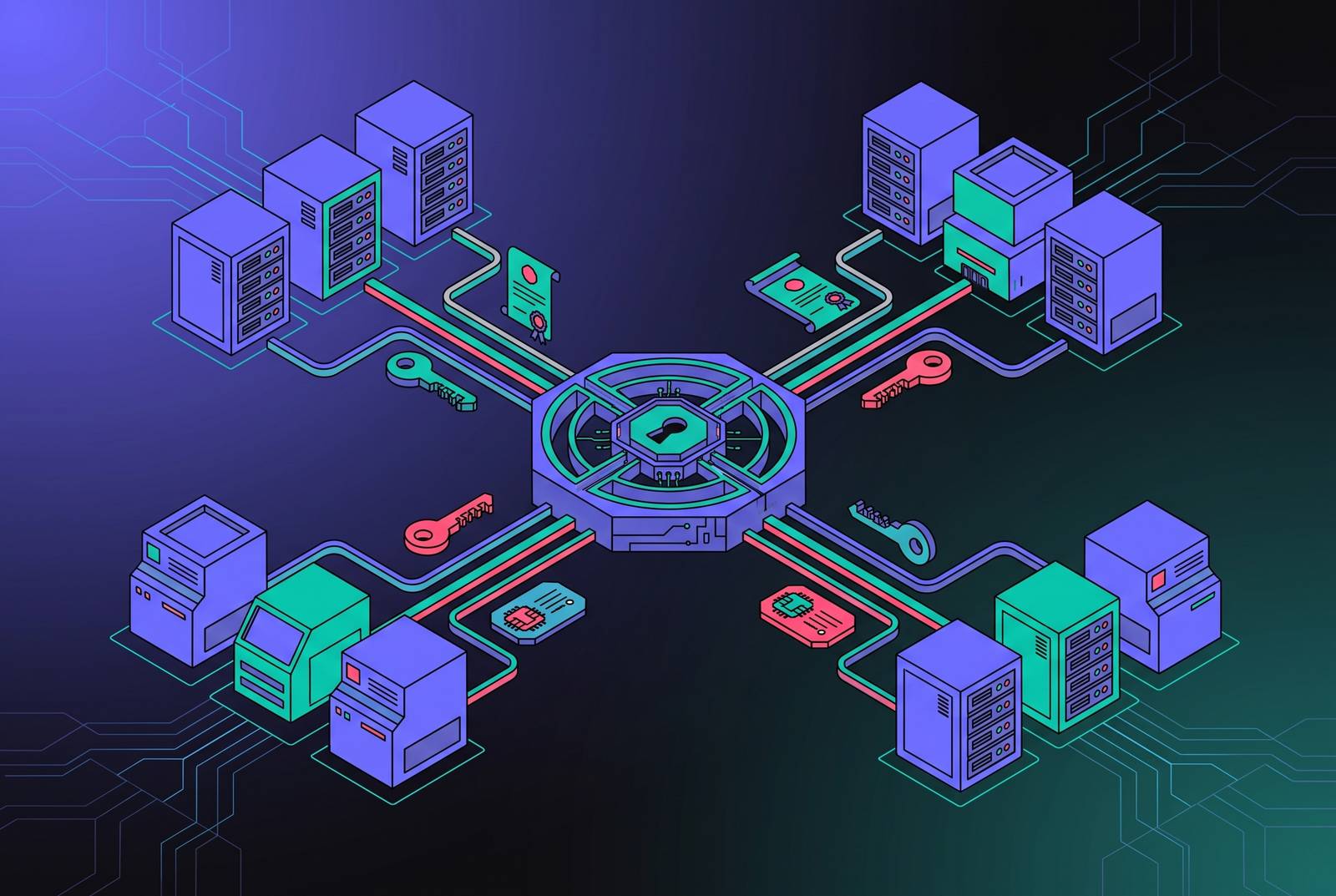
Machine identity means the credential a piece of software, a server, or a device uses to prove it is what it says it is. Not a username and password. A certificate, a key, a token, a secret, something cryptographic that one machine hands to another as proof. This field existed years before anyone started talking about AI agents, and it runs on infrastructure most people never think about until a certificate expires and takes down a production system at 2 a.m.
The taxonomy has four main categories. X.509 digital certificates are the most common, used for SSL/TLS authentication, the thing that makes a browser trust a server. SSH keys and certificates grant privileged access to servers and network gear. Code-signing keys authenticate software and other executable artifacts before anyone runs them. API tokens and secrets enable service-to-service communication without requiring a human credential. Public key infrastructure issues and checks the certificates that make the whole system work, and everything above depends on it staying upright.
Every credential type shares the same lifecycle demand. Issue it from a source everyone trusts, store it somewhere secure, track where it lives, and replace it before it expires or gets stolen. Machine identity management covers all of it, certificates, secrets management, workload identity, and the access governance that decides what a non-human identity gets to touch. Calling it certificate management is like calling a hospital a pharmacy. Technically there's overlap. It undersells everything else going on in the building.
How many machine identities organizations are actually managing
CyberArk, at the time it announced its Venafi acquisition in May 2024, put the ratio of machine identities to human identities above 40 to 1. By its Q1 FY2025 earnings commentary, that number had jumped to 80 to 1. No typo, no rounding difference. A doubling in about a year.
Obsidian Security notes the ratio runs past 100:1 in many enterprise environments and approaching 500:1 in some sectors. Every microservice, every container, every serverless function needs its own credential to talk to anything else, and a multi-cloud setup multiplies that again, since each platform brings its own tooling and its own rules on top.
The number that matters is what sits behind the ratio. It's the direction. Manual tracking, the spreadsheet-and-tribal-knowledge approach that worked fine when a company had a few hundred certificates, does not survive contact with tens of thousands of them. Hiring more people to babysit spreadsheets doesn't fix a problem that scales exponentially while headcount scales in a straight line. That mismatch alone explains nearly every governance failure covered below.
Where machine identities are used before AI enters the picture
None of this needs an AI agent to justify it. These are today's enterprise operations, running right now, in nearly every company with a network.
Employee devices authenticate to Wi-Fi and VPNs using certificates instead of passwords, per Sectigo and Keyfactor. IoT devices carry unique certificates for authentication, secure firmware updates, and encrypted connections, and because plenty of those devices can't be updated by hand, provisioning has to happen on its own. DevOps pipelines issue certificates as part of the build and deploy process itself, so secrets never sit hardcoded in a script waiting to be found. Kubernetes clusters spin up certificates for workloads that live and die within minutes, using mutual TLS so services check each other without a shared password. Zero trust architecture depends on all of this: every connection gets checked regardless of where it started, and a working machine identity is what makes that check possible in the first place.
Industrial and operational technology present a harder version of the same problem. PKI systems built for slow-growing enterprise networks buckle when asked to manage millions of industrial devices with wildly different lifespans, some barely powerful enough to run a certificate check at all. Automotive makes the case concrete. DeviceAuthority notes that when a car changes hands, ownership transfer means provisioning a new certificate to the vehicle and every connected app tied to it, automatically, with no grace period. Nobody waits three days for a new owner's app to sync up. The car has to know who's driving it the moment the keys change hands.
SPIFFE/SPIRE, a Cloud Native Computing Foundation project, has become the open standard underneath a lot of this: short-lived cryptographic identifiers called SVIDs, continuous attestation, workload identity for containers that doesn't rely on a static, long-lived credential. This isn't confined to software companies, either. Corsha landed a sole-source IDIQ contract from the US Defense Logistics Agency in 2026 for zero-trust connectivity across critical operational systems, a signal, per Mordor Intelligence, that machine authentication now matters in defense and utilities and manufacturing just as much as it does in a SaaS company's cloud stack.
Four governance failures that appear across organizations regardless of industry
The first failure is simple: nobody knows what they have. A 2023 Ponemon study found 61% of organizations have no clear inventory of their machine identities, and a separate Ponemon-Sullivan study cited by Mordor Intelligence found 53% still assess PKI health using manual or ad hoc methods. Gartner Director Analyst Steve Wessels called machine IAM "the least mature part of most organisations' IAM programs," citing gaps across discovery, visibility, and monitoring tools, per ITPro. Nobody governs a fleet of credentials they haven't counted, and that's the whole failure in one sentence.
The second failure is ownership, or the absence of it. Research published as "The Human-Machine Identity Blur" (arXiv:2503.18255, 2025) found security teams hold 53% of machine identity ownership, development teams 28%, platform teams 14%, and everyone else 5%. Split ownership like that means split accountability, which functionally means none at all. The same research found 56% of leaders say IAM teams are directly responsible for only 44% of the machine identities in their own organization. Spreading responsibility across IT Security, IT Operations, Networking, DevSecOps, and Risk/Compliance sounds thorough on an org chart. In practice, thorough distribution just means nobody answers the phone when something breaks.
The third failure is secrets sprawl, and it's the one most governance reports undersell. GitGuardian's State of Secrets Sprawl 2026 report counted 29 million new hardcoded secrets in public GitHub commits during 2025, a 34% jump year over year and the largest single-year increase on record, per The Hacker News. Secrets scatter across repositories, config files, CI/CD pipelines, container images, and developer laptops, with no owner, no rotation schedule, and no reliable count of how many copies exist anywhere. The 2022 Uber breach traces back to exactly this: a hardcoded credential sitting in a PowerShell script. An attacker who lands on a developer's machine goes looking for secrets in code repos and environment variables, and a secret found there grants access that survives a password reset and shrugs off multi-factor authentication, because it was never a password to begin with.
The fourth failure shows up as an outage. DigiCert's Trust Pulse Survey from July 2025 found 45% of enterprises experienced certificate-related downtime in the previous year. A certificate expires on a server nobody remembered existed, and the outage cascades outward into a service disruption nobody planned for, per Keyfactor. CyberArk found 94% of security leaders worried their organizations aren't ready for shorter certificate lifespans, a fair worry given what's coming next.
All four failures share one root cause. Machine identities got provisioned by hand, tracked in a spreadsheet or not tracked at all, and owned by no one in particular. That held up fine at a few dozen certificates. It collapses completely at a quarter million, and no amount of good intentions changes the arithmetic.
Why the CA/Browser Forum's 47-day certificate mandate changes the operational math
In April 2025, the CA/Browser Forum approved Ballot SC-081v3, originally proposed by Apple, with 29 votes in favor and none against. All four major browser vendors, Apple, Google, Mozilla, and Microsoft, backed it, per ssl.com. The ballot phases in a shrinking maximum lifespan for TLS certificates over roughly four years, reaching a 47-day cap by 2029. First impacts land in March 2026, and the domain control validation reuse window shrinks alongside it, eventually requiring significantly more frequent revalidation as the reuse window narrows alongside the shorter certificate lifespans.
Here's why the number matters more than it looks. An organization that renews certificates once a year can survive a manual process, even a clunky one, because a human being can absorb one bad afternoon a year. At a 47-day cycle, that same organization renews roughly seven to eight times a year, per certificate. Multiply that across tens of thousands of certificates and manual renewal doesn't get slower. It stops being the same kind of problem. No amount of running the same manual process faster, or throwing more staff at it, actually closes that gap.
CyberArk's survey data, gathered while the industry was still debating a 90-day proposal (the eventual mandate turned out tougher), found 81% of security leaders expected shorter lifespans to make existing certificate headaches worse, and roughly three-quarters used the word "chaos" to describe what's coming. The logic is straightforward: shorter lifespans force organizations toward automated Certificate Lifecycle Management, because manual steps are exactly what introduce errors at scale. Mordor Intelligence lists shortening certificate lifespans and automated renewal requirements as a structural driver of the machine identity management market, worth an estimated 3.6 percentage points of market CAGR over the next two to four years.
March 2026 is close. The 53% of organizations still leaning on manual or ad hoc PKI processes are staring down the steepest operational risk of the group, simply because their processes can't scale with what's coming. It's because the math simply stopped working in their favor, and no amount of effort scales linearly against a problem that just went exponential.
The controls that constitute a working machine identity program
Discovery comes first, and it has to run continuously, not sit as a one-time audit filed away and forgotten. Automated scanning across cloud accounts, on-prem infrastructure, and CI/CD pipelines finds every certificate, SSH key, API token, and secret in the environment. Nobody manages what they can't see, and given how fast containers spin up and disappear, yesterday's inventory is already stale today.
Automated certificate lifecycle management follows directly from that inventory. Issuance, renewal, and revocation tie into infrastructure-as-code and deployment pipelines, cutting out the manual step that breaks the moment volume climbs past what a person can track by hand. Given the 47-day mandate, this stops being optional for any organization running a meaningful number of certificates. It becomes table stakes, full stop.
Secrets management needs a centralized vault, not credentials scattered across source code and config files. Rotation happens on a set schedule, automatically, and policy governs access to any given secret rather than whoever happens to know which file it's hiding in. HashiCorp Vault's collaboration with IBM Cloud on machine identity and secret management, announced in August 2024 as IBM's acquisition of HashiCorp was pending, points to where this is heading: one platform spanning on-prem and cloud, instead of separate tools bolted together for each.
Workload identity handles the dynamic case, containers and microservices that live for minutes at a time. Short-lived, automatically rotated credentials, with SPIFFE/SPIRE as the open standard, mean the credential expires along with the workload it belongs to. No static key sits around after the container it authenticated for is long gone.
Policy enforcement and monitoring close the loop. Defining what each machine identity can actually do, scoping exactly what a credential can touch rather than just issuing it, matters as much as issuance itself. Anomalous credential use needs catching in real time, not discovered three weeks later buried in a log file nobody read. Audit trails showing which machine touched what, when, and with which credential matter for compliance, and matter even more when something breaks and someone has to trace it back.
None of it works without clear ownership. The fragmented split noted earlier, security at 53%, dev at 28%, platform at 14%, everyone else at 5%, is a gap that needs closing, not a quirk to shrug off and route around. Vendors active in this space include DigiCert, Venafi, Sectigo, Keyfactor, AppViewX, GlobalSign, HashiCorp, Thales, AWS, Microsoft, IBM, and Symantec, per WiseGuyReports. Keyfactor expanded its certificate lifecycle management across AWS workloads, including EC2, EKS, and IoT, through a September 2024 partnership. Thales struck a strategic partnership with Microsoft in March 2025, integrating CipherTrust Cloud Key Management with Azure and Entra for cloud-based machine identity and PKI services. IBM introduced machine identity management as its own dedicated discipline within its IAM portfolio in November 2025, a sign the category has matured enough to earn a line item on a roadmap instead of a footnote.
Post-quantum cryptography as the longer-horizon forcing function
NIST finalized its first three post-quantum cryptography standards in August 2024: ML-DSA (FIPS 204), ML-KEM (FIPS 203), and SLH-DSA (FIPS 205). Anyone building machine identity infrastructure today needs to design around the fact that these algorithms will need swapping in eventually. Bolting on whatever's standard right now and hoping it holds is not a strategy, it's a delay tactic.
Crypto-agility is the term for the alternative: the ability to swap cryptographic algorithms across every machine identity in an organization without tearing down and rebuilding the identity infrastructure from scratch. Organizations that bake specific algorithm assumptions into their certificate workflows are setting themselves up for a forced mass re-issuance event down the line, the cryptographic equivalent of discovering every lock in the building needs replacing on the same afternoon.
Mordor Intelligence lists post-quantum readiness and crypto-agility as a market driver too, a smaller one, estimated at 1.8 percentage points of CAGR over a four-plus year horizon. Smaller than the certificate lifespan mandate in the near term, but structurally unavoidable over the long one. And the two connect directly: migrating certificates to post-quantum algorithms requires knowing which certificates exist in the first place. The inventory work covered earlier is the foundation of PQC readiness. It's the prerequisite for it. Any organization evaluating a CLM or PKI platform right now should ask whether that platform supports algorithm agility and has a stated roadmap for post-quantum migration, because locking into a platform that can't make that transition is a liability that compounds for years, quietly, until it doesn't.
How the MIM market reflects where organizations are in building these programs
Every driver named above, the 47-day certificate mandate, secrets sprawl, fragmented ownership, post-quantum migration, points to the same underlying condition. Organizations manage more machine identities than they can see, using tools that were never built for this volume. The market's growth reflects real, measurable demand. It's a readout of how far behind the operational reality most programs actually sit. Vendors consolidating certificate lifecycle management, secrets management, and workload identity into single platforms, IBM folding MIM into its IAM portfolio, Thales partnering with Microsoft on cloud-based PKI, Keyfactor expanding across AWS, aren't chasing a trend. They're responding to a math problem that's gotten worse every year since 2023, with no natural ceiling in sight.
The AI agent conversation will only bolt another multiplier onto numbers that were already unmanageable by hand. But the discipline itself, the inventory, the automated lifecycle management, the crypto-agility, wasn't invented for AI. It was built, slowly and unevenly, to handle a machine-to-human ratio that went from a rounding error to the dominant fact of enterprise identity in the space of a couple of years. Whatever comes next just inherits that foundation, cracks and all.