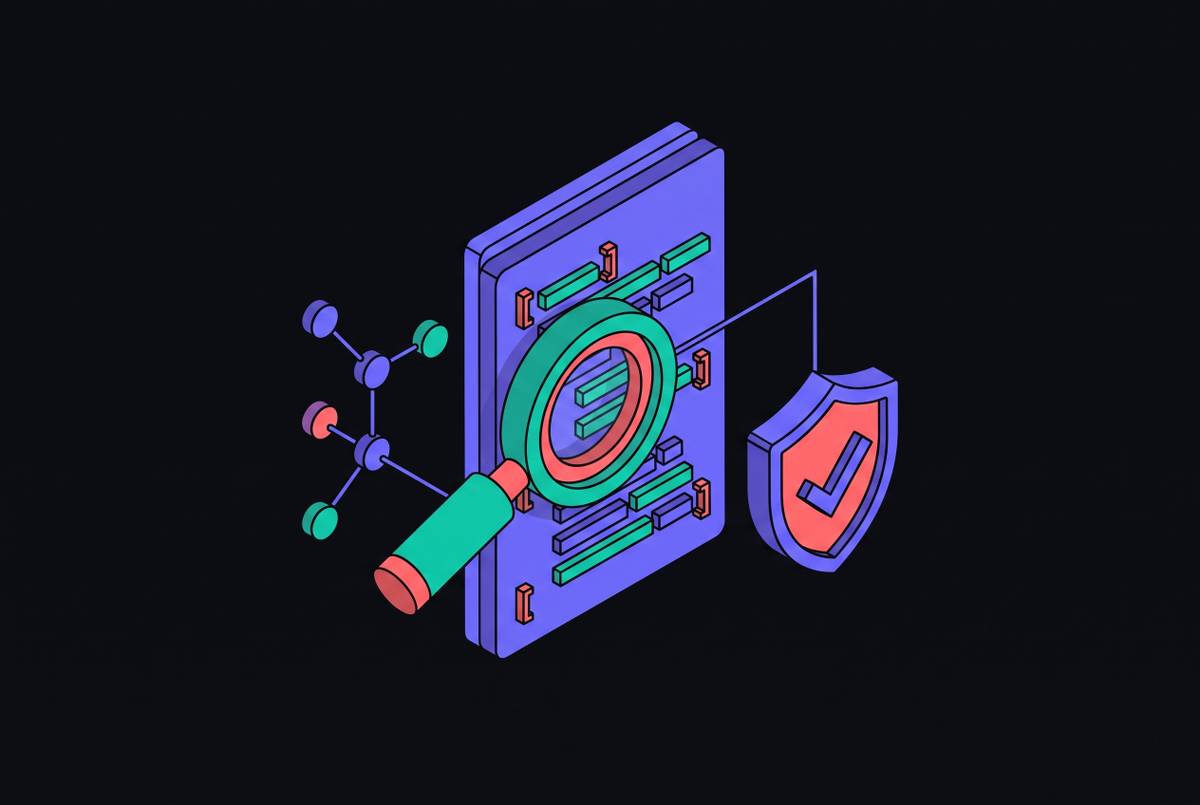
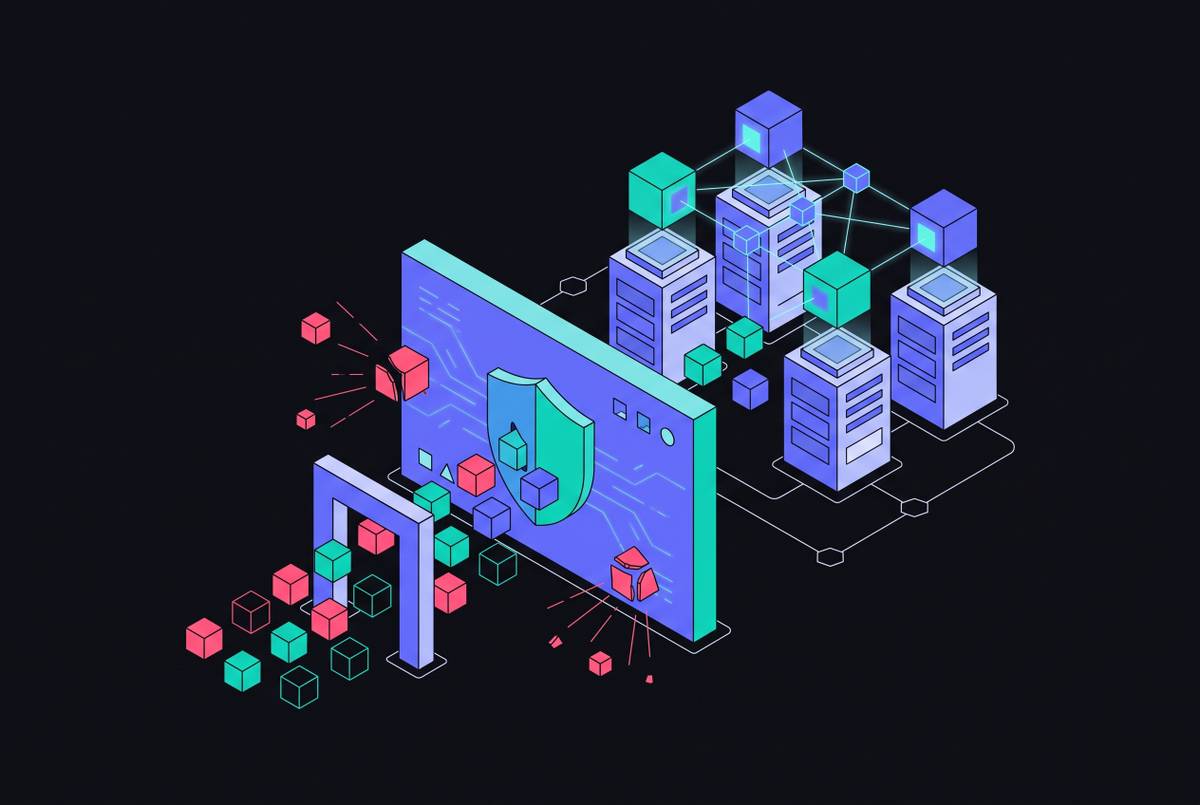
Static Analysis Integration in Agent CI/CD Pipelines
Securing agent CI/CD requires analyzing both code and agent dependencies separately.
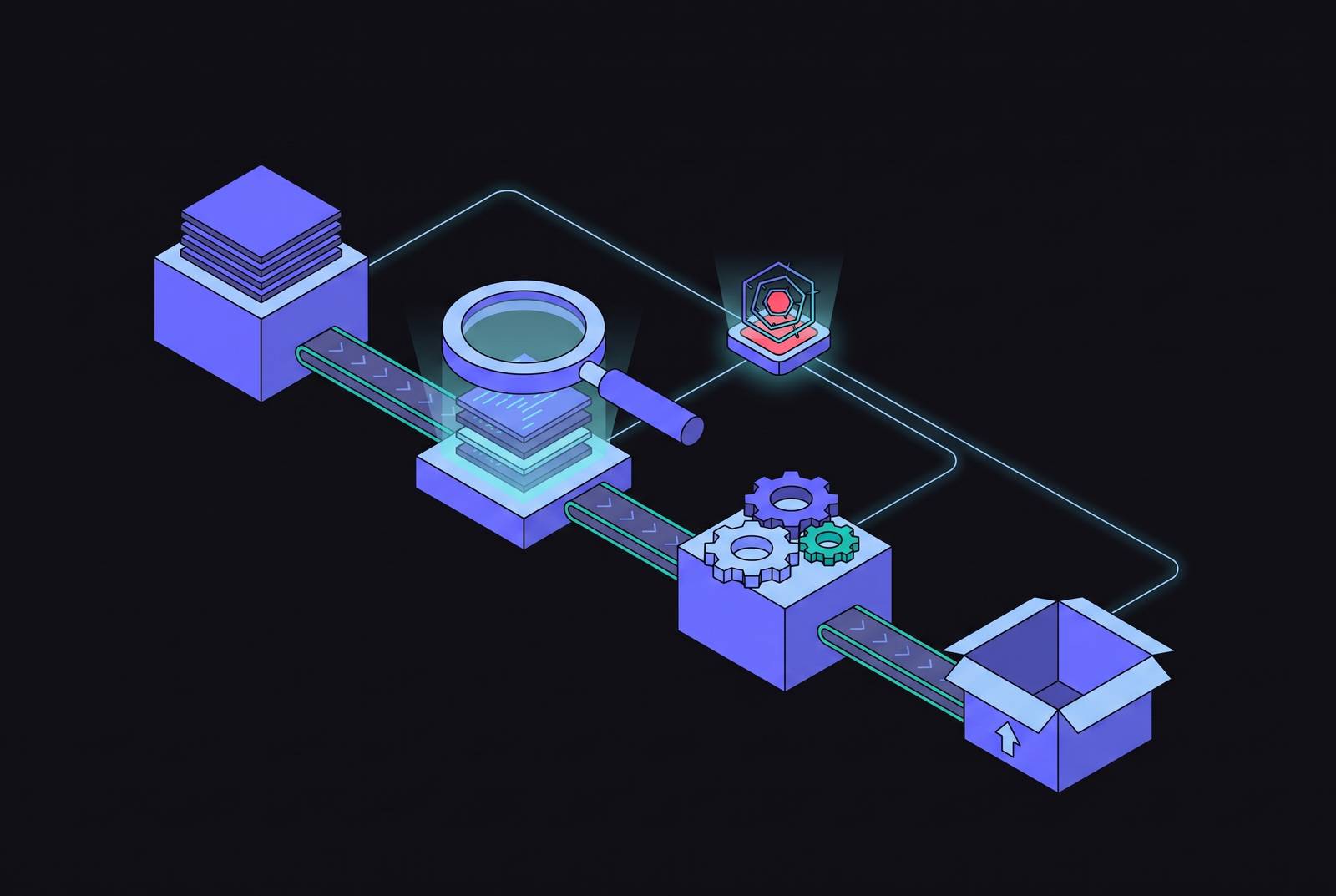
Static analysis integration in agent CI/CD pipelines requires two distinct tracks, one for vulnerabilities in code and another for the dependencies and permissions of agent programs. Neither can substitute for the other. To bring both tracks into the pipeline, teams must run them before deployment, then use their findings in runtime monitoring and policy enforcement.
Why agent CI/CD is not just CI/CD with AI bolted on
Conventional pipelines handle code and compiled binaries, but agent pipelines also have relationships that shape what the software can decide and do. A prompt configures an agent, a model interprets its inputs, and tools give it ways to act. Memory can shape later turns, and handoffs can pass control to another agent. Those relationships are part of the program, even when traditional pipeline tooling cannot see them.
GitHub Agentic Workflows made this difference concrete in its technical preview in February 2026. Developers describe automation goals in Markdown files in .github/workflows/, using YAML frontmatter for configuration and a natural-language body. A coding agent executes those goals on triggers including issue creation, PR comments, new discussions, and scheduled intervals. The pipeline therefore becomes both an LLM-interpreted runtime and a deterministic script executor. It is simultaneously a software delivery system and an autonomous decision-making system, and that dual nature demands two distinct analytical tracks.
The two tracks defined: code scanning and agent-program analysis
Track one applies Static Application Security Testing, or SAST, to the code that implements agents. Its job is to catch conventional vulnerabilities before merge, including injection flaws, insecure dependencies, hardcoded secrets, and misconfigurations. Adding a model does not give SQL injection a free pass.
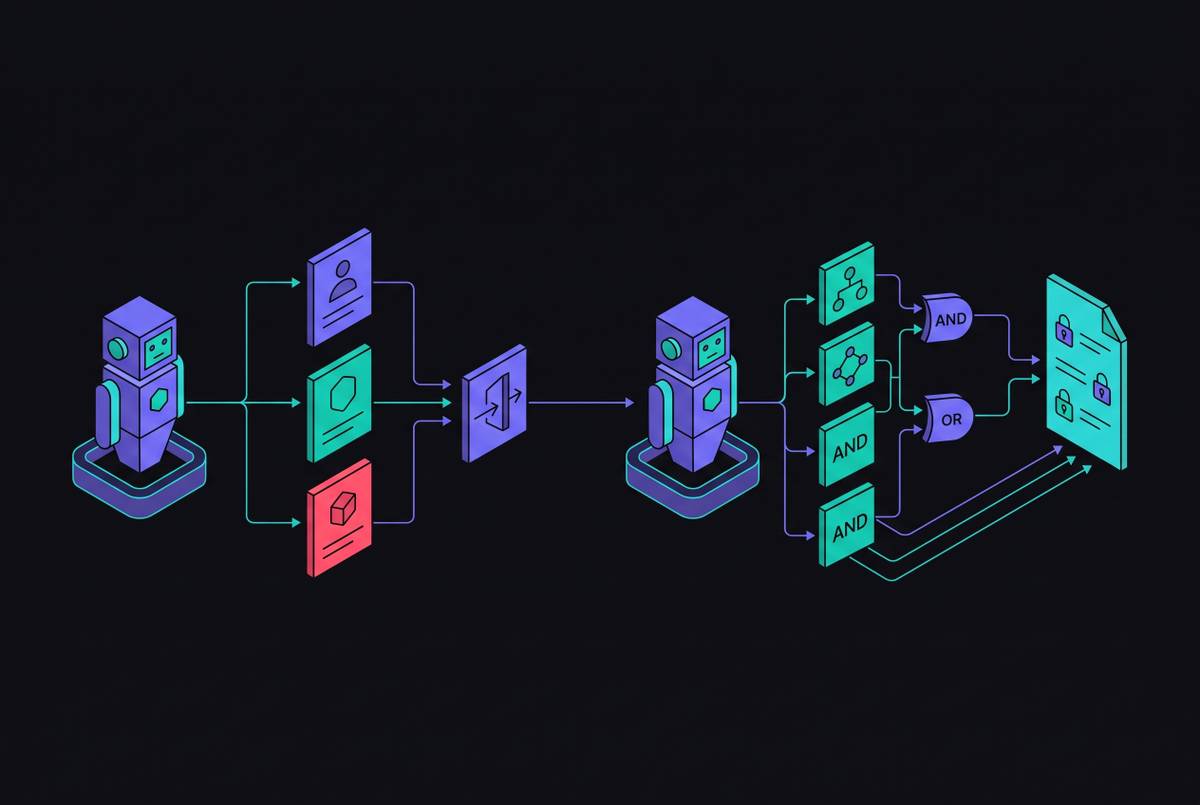
Track two analyzes the agent program as an artifact with its own dependency structure. It examines prompt-to-model bindings, tool registrations, memory read/write paths, and handoff policies. These relationships belong to the agent framework’s meaning. AgentFlow makes that distinction tangible through an Agent Dependency Graph, or ADG, which represents agents, prompts, models, capabilities, memory states, and control policies as connected entities. Where track one asks whether the code contains an injection flaw, track two asks whether an agent can reach a tool it should never use. A clean result on either track leaves the other question unanswered.
Why traditional SAST struggles on track one even before agents are involved
The familiar track already has an attention problem. Wadhams et al. (ASEW '24) identify widespread false positives as a primary usability barrier to SAST, together with poor output, time-consuming setup, and a lack of native pipeline support. A finding must reach a developer in a form that supports action, or detection does little practical work.
When genuine findings arrive mixed with spurious ones, developers learn to treat scans as noise. People then have to get past their distrust of earlier warnings before they look at what the next one says. Agent pipelines start with that same problem. They also tend to produce more code, faster, with a higher defect rate, adding review demand to a gate already struggling with noise. The consequence is an attention bottleneck, with more output competing for the same human judgment. Simply attaching the existing scanner to a faster source of code does not make the existing process adequate.
How AI-assisted remediation addresses track one without removing developers from the loop
AI-assisted remediation changes the workflow so that it proposes and checks fixes as well as sending warnings. The useful pattern is to automate the tedious tier of violations while reserving final approval for developers. This does not make every finding correct or every proposed patch safe. Instead, it gives the pipeline a repeatable way to test a proposed change before asking a person to approve it.
Parasoft’s November 2025 description illustrates the mechanics. A developer pushes a branch, static analysis flags violations, and an AI agent proposes and applies fixes. The agent then reruns analysis to check that no new violations appear, iterating until the batch is clean. Developers review and approve before merge. Reanalysis is the important distinction from naive AI code generation, because it checks each fix rather than treating generated code as its own evidence of correctness.
The workflow also commits every AI-generated fix to source control, creating a traceable record of what changed, why, and whether it was verified. That record matters for compliance in regulated environments, but delivery of the findings matters too. Wadhams, Reinhold, and Izurieta report positive developer reactions to structured, real-time SAST feedback delivered through familiar issue-tracking software. Together, these mechanisms make remediation easier to review without removing the reviewer.
Why track one tools are structurally blind to track two risks
Even a well-run remediation loop operates within the scanner’s view of the program. A host-language abstract syntax tree, or AST, captures how source code is structured. It does not, by itself, capture what an agent framework means by a prompt, a tool registration, or a memory argument. An agent constructor can look like an ordinary function call while establishing dependencies that determine what the agent can observe and do.
Track two must trace an agent’s access to information, its propagation through prompts or memory, and its use to trigger tools or other agents. This is a taint-style question, tracing potentially unsafe input toward a consequential action. Answering it requires understanding the agent’s role alongside the possible calls between functions. Frameworks further obscure those relationships behind decorators, tool wrappers, workflow nodes, dynamically registered functions, plugins, and remote MCP tools.
AgentFlow’s evaluation on 5,399 real-world agent programs across five frameworks recovered richer agent entities and dependencies than existing AST-based tools. It also found taint-style prompt-to-tool risks that those tools missed altogether. Model Context Protocol, or MCP, supplies another concrete example of this semantic gap. A cross-language framework for detecting protocol-induced credential and PII leakage found leakage in more than one in ten analyzed MCP servers. Those risks depend on protocol behavior that host-language SAST would not flag, making analysis of MCP server implementations a distinct CI gate.
The new attack surface that track two must cover: prompt injection into the pipeline itself
When an agent runs inside CI/CD, untrusted content can reach a system that holds workflow secrets and has code write privileges. Agentic Workflow Injection, or AWI, names the resulting attack category. Issue bodies, pull-request descriptions, and comments enter agent prompts or other inputs that the agent reads. The agent can then convert that content into attacker-influenced behavior through its tools or downstream workflow logic. The boundary being crossed is between information the agent should read and instructions it treats as authority.
Snyk analyzed “Clinejection,” in which issue-driven prompt injection was chained with GitHub Actions cache poisoning. The chain broke into a downstream release workflow and made it possible to publish packages without permission. In a separate case, Microsoft Threat Intelligence found a prompt injection pathway in the Claude Code GitHub Action that gave access to workflow secrets under specific conditions. Anthropic issued a mitigation following responsible disclosure. These incidents show why the content consumed by a pipeline agent belongs within the security analysis of that pipeline.
The distinction is not whether a workflow file contains obviously malicious code. A conventional scanner can inspect that code without determining whether poisoned context will manipulate the agent that reviews or acts on it. Track one checks how the code is written, but the attack can travel through how the agent reads an input. Track two must recover that path from untrusted content to privileged action.
The emerging tooling layer purpose-built for track two
Purpose-built tools address different parts of this problem, and the tooling layer is still early. CLAWAUDIT (2026) audits the agent runtime layer itself for security vulnerabilities. Across held-out advisories, it raised recall by a large margin over the baseline approaches. Its contribution is to reduce false negatives in agent-specific vulnerability classes that standard SAST can miss.
TaintAWI focuses on Agentic Workflow Injection. It constructs an Agentic Workflow Dependency Graph, or AWDG, to trace taint from untrusted event context into privileged pipeline operations. Applied at scale across thousands of LLM-augmented GitHub Actions workflows, it yielded confirmed exploitable instances. The graph gives the analyzer a representation of the route from event input to pipeline authority. That directly addresses the attack class illustrated by Clinejection.
MTGuard (2026) addresses MCP tool use through lifecycle-aware static–dynamic co-analysis. Its design explicitly recognizes that static-only defenses limit effectiveness and robustness against agents induced into malicious or unauthorized tool actions.
AgentFlow’s ADG supports another important output, an Agent BOM. This is a structured inventory of prompts, models, tools, and memory, serving as the agent-program equivalent of a software BOM. Cisco AI Defense has also published its own open-source AI BOM scanner that scans source code. The shared premise is that track two needs to produce both an inventory and a vulnerability list. Findings show what is wrong, while an inventory shows how the agent is put together where those problems arise.
How the two tracks interact and where static analysis alone hits a ceiling
The two tracks become more useful when their outputs connect to the delivery path. A code finding needs build and deployment lineage to show which artifact has the flaw. An agent-level finding needs runtime linkage to show whether the vulnerable path actually executes.
A Pipeline Bill of Materials, or PBOM, addresses it by tracking lineage across commit, build, deployment, and runtime. That lineage complements the Agent BOM. One follows the artifact through delivery, while the other maps the agent’s internal dependencies. Together with the remediation audit trail, they give runtime monitoring the context needed to interpret an alert.
Even with those connections, static analysis cannot ensure that prompt injection will be stopped. Traditional regex-pattern approaches are insufficient because LLM prompt injections are non-deterministic and can evade static pattern matching. Baqar et al. also argue for standardized, publicly available benchmarks and datasets for evaluating CI/CD agent decision-making. Without them, teams cannot reliably compare track-two tools or tell which gaps are still there. The honest claim for static analysis is therefore that it supplies essential pre-deployment evidence with limited coverage of future behavior.
What organizations need to add above the two static analysis tracks: runtime visibility and policy enforcement
Once agents run, security controls must keep up with how fast they act and cover all that they do. Agents can inherit human-scale permissions and use them at machine speed. A pre-deployment gate cannot constrain that behavior in the same way as a control applied when an action occurs. To control that behavior as it happens, organizations need real-time visibility, anomaly detection, and policies they can enforce, along with records they can use to investigate violations afterward.
Baqar et al. frame this layer through Policy-as-Code, including OPA/Rego, Cedar, and Sentinel. They also treat trust tiers and human override rates as explicit pipeline parameters. This makes the boundary of autonomy part of the architecture. The platform that runs this layer must be able to find running agents, monitor approved AI traffic, spot anomalous behavior and policy violations, and keep complete audit logs of what agents do. Visibility shows what happened, while enforcement is needed to prevent disallowed behavior.
The practical integration is to implement both static gates and carry their outputs forward as structured artifacts, including the fixed codebase, Agent BOM, and PBOM. Those artifacts feed a runtime layer that enforces policy in real time and traces alerts back to the responsible build and agent dependencies. Without runtime enforcement, the two gates still leave room for the kind of behavior shown by Clinejection. Static analysis establishes what an agent is built to do, but production controls must govern what it actually does.