GitHub MCP Permission Scoping for Autonomous Coding Agents
Layering credentials, tools, and gateways prevents agents from crossing unintended boundaries.
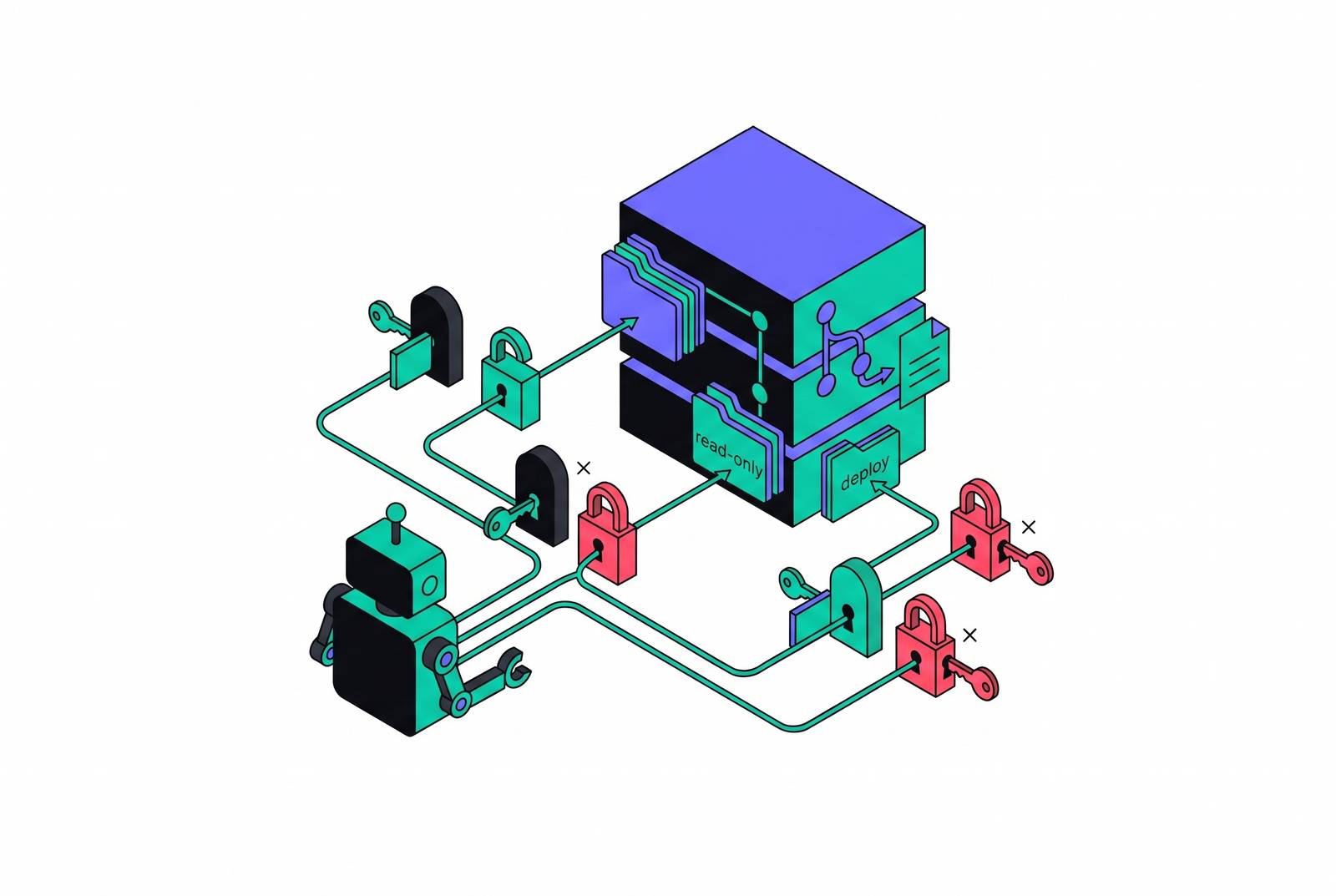
GitHub MCP permission scoping for autonomous coding agents requires more than a restricted token. Safe deployment depends on a chain of controls over credentials, repositories, exposed tools, and the paths through which agents act. Each layer fills a gap another leaves open, while runtime monitoring and audit records that are kept over time show whether the boundaries hold.
Why GitHub MCP agents inherit human-scale access and why that is the root problem
The credential handed to it may reflect a human user’s responsibilities across many repositories, exceeding the narrow task assigned to the agent. Human access models assume people can mentally separate projects, recognize implicit boundaries, and pause when something looks wrong. Agents do not supply those safeguards. Treating human-designed access as safe for autonomous use is a category error.
MCP sets a standard for how agents call external tools and get data, but it does not enforce those permission boundaries by default. The integration takes trust for granted, so the credential sets the limits of access. Speed compounds the mismatch. A misconfigured agent can keep calling tools until stopped or until its session ends, faster than a human approval loop can intervene. What looks like generous access for a person becomes a large operating area for software that does not know where the unwritten fences are.
What the Invariant Labs incident shows about default scoping
Invariant Labs reported an attack in which a Claude Desktop agent read a prompt injection in a public GitHub issue through MCP. Reading the issue was permitted. The injection then tricked the agent into opening a pull request against the public repository that leaked data from a private repository. Opening that pull request was also permitted. Each operation was allowed, but together they crossed a boundary the task gave the agent no reason to cross.
The undefended boundary lay between public and private project contexts. The agent treated both as one workspace because its credential reached both. A single PAT or OAuth grant covering several repositories creates that same structural condition, although it does not by itself establish that an attack has occurred. Access to more repositories or package registries lets the potential blast radius spread beyond the task at hand.
Claude Desktop’s default per-call approval flow would have stopped this sequence. Users can turn off that brake for convenience, though, which removes the built-in pause between what the agent decides to do and its next operation. Access should be constrained before execution rather than depend on approval prompts remaining enabled. A public issue should not become a bridge into a private project simply because both are available to the same user.
How token type determines the blast radius before any other control is applied
The credential sets the outermost authorization boundary. Classic PATs, identified by the ghp_ prefix, use coarse OAuth categories and apply across the repositories the user can access. A token issued for one task can therefore have organization-wide reach when its owner does. Narrower tool configuration does not erase that authority from the credential, leaving it available through any path that avoids those restrictions.
Fine-grained PATs, identified by github_pat_, offer more than 50 granular permissions and a repository selector. Permissions can be left without access or granted read or read-write access where supported, with a small number supporting an admin level and some limited to a single access level. For agents, “Only select repositories” is the decisive setting. It limits repository reach to the names explicitly selected when the token is created, bounding what a prompt injection or leaked credential can access.
OAuth occupies an intermediate position through dynamic negotiation. The practical recommendation is a fine-grained PAT scoped to one repository wherever the workflow permits it. Classic PATs are the loosest choice and should not be issued for agent workflows.
The gap that fine-grained PATs open in the MCP server's OAuth scope filtering
GitHub MCP Server automatically hides tools outside a classic PAT’s OAuth scopes. Fine-grained PATs use a different permission model and do not return the X-OAuth-Scopes header, so that filtering is skipped. The API still rejects calls when the token lacks the needed permissions, but the agent sees tools it cannot use.
This is a design constraint. Native behavior alone does not provide both repository-scoped fine-grained tokens and automatic OAuth-based tool trimming. To close that gap, teams need explicit tool-exposure configuration rather than an assumption that a narrower token will clean up the menu.
Scoping which tools the agent can see and invoke at the MCP server layer
Tool exposure controls what the agent is offered, while credential scope controls what GitHub will authorize. Those are separate decisions. A read-oriented workflow may need issues, pull requests, and file contents without needing tools to push, merge, or delete. The recommendation is to expose write tools only when the assigned task explicitly requires them. Removing an unnecessary tool also removes it from the surface that injected instructions can direct the agent to invoke through that server.
For general coding workflows, destructive actions including delete_repo, delete_branch, force_push, and delete_release, as well as secret-reading tools, should stay out of the advertised tool list. Branch targeting needs its own boundary. Tools should not permit write or delete operations against main, master, prod, or release branches unless that is the explicit, reviewed purpose of the workflow. These examples establish a principle of minimal exposure. GitHub still authorizes each operation against the upstream identity, so server configuration complements the token.
Why a gateway is the layer that makes all the others enforceable
Server restrictions only govern traffic that reaches that server through the intended route. A direct MCP connection can bypass gateway policy and centrally managed tool restrictions, although the credential’s GitHub permissions still apply. The path is part of the boundary.
A gateway makes the agent’s tool inventory smaller than the human user’s upstream permissions at the protocol layer, rather than leaving that decision to individual clients. It also provides a place to inspect repository names, branch names, issue text, and server responses before a call completes. Allowed tools still need constrained inputs and outputs. Argument-level and response-level filters act where an allowed operation could move data outside the project it belongs to.
To make that enforcement dependable, teams should inventory approved and personal clients, treat ungoverned paths as unsanctioned until audited, and block direct client-to-server routes. Otherwise, separate connections produce fragmented secrets, inconsistent policy, and limited visibility, complicating revocation and investigation. Unusual tool sequences, out-of-scope repository requests, and abnormal call frequency can be assessed before an action completes.
What audit logs prove and where they fall short without full path enforcement
A gateway log records only the activity routed through it. That distinction defines what the record can prove. If approved clients and personal configurations can reach GitHub around the governed route, the logs describe only part of the agent population. Path enforcement therefore establishes the coverage on which any claim of accountability depends.
A pre-commit or startup scan can catch a class of problems without creating a persistent history of agent behavior. That is useful, but it is not a durable audit trail. For regulated workflows, the record must identify the agent and credential, the tool and arguments, the repository, the outcome, and the time of each action. It needs enough fidelity to reconstruct the sequence.
The enterprise standard described here is an action ledger with transactional integrity in which every agent action is hashed and logged in a durable, tamper-evident store. A session log that can be trimmed or lost does not provide the same foundation. The record should also be queryable for compliance workflows as well as security investigations. Complete coverage means every approved client and path passes through the gateway, every tool call is recorded, and the resulting history supports reconstruction of who did what and when.
The debate over whether model alignment or hard infrastructure controls should bear the weight
Alignment aims to make the model behave better, including how it responds to material that misleads it or tries to attack it. That is a valuable defense. But prompt injection comes through the data the model handles, so the model is part of the data plane under attack and cannot serve as an independent authorization boundary. Better judgment does not reduce the permissions attached to a credential.
The strongest objection to tight infrastructure scoping is operational. Per-session, per-task fine-grained tokens require changes to access provisioning, workflow initiation, and the separation of interactions with external tools. Most existing infrastructure was not built for that precision. The objection deserves more than a breezy instruction to use least privilege, as if access administration were a checkbox with excellent manners.
Broad, persistent credentials leave a demonstrated route from hostile public content to private data exposure, as the Invariant disclosure showed. Per-call human approval adds a defense, but users can turn it off for convenience. Alignment can help alongside infrastructure controls because it can improve how the model behaves, while infrastructure limits what it can do when it is tricked. Teams can configure those boundaries today without waiting for a model to become an infallible custodian of every implicit project rule.
Running the four control layers as a sequence, not a checklist
Teams should issue fine-grained PATs for the minimum repository set the workflow needs, avoid classic PATs, and treat organization-wide token reach as a finding to remediate. Next comes tool-surface exposure. The MCP server should show only the tools the task needs, hide destructive and secret-reading operations by default, and block protected-branch writes unless they have been explicitly reviewed. This closes the visibility gap that the fine-grained token leaves open.
All approved MCP traffic should pass through one gateway, with direct paths blocked, argument and response filters applied, and credential rotation and logging centralized there. Each call needs identity, arguments, and outcome recorded durably, while unusual sequences, repository access, and call rates need assessment during execution. The audit trail becomes authoritative only when every path is governed.
For each layer, the practical test is whether an attacker controlling only what the agent reads could cause an action outside its intended scope. A crafted issue, malicious dependency, or poisoned package gives the test its input without giving the agent any more authority. If that input can escape the task boundary, a control is missing or misconfigured. Across Claude Code, Codex, and other agents, a portable deny-first policy should preserve exclusions when another agent joins the workflow.
Discovery comes before that sequence can be trusted. Teams cannot scope agents they have not found or audit traffic they do not intercept. Discovering every agent inside the organization supplies the starting inventory for permission decisions, monitoring, enforcement, and audit. The defensible deployment is the one whose visible activity and governed activity are the same set.