API Key Rotation Strategies for Autonomous Agent Pipelines
Agents need credential rotation built for their own mechanics, not borrowed from human systems.
In December 2024, attackers got into U.S. Treasury systems, including the Office of Foreign Assets Control, the Office of Financial Research, and the Office of the Treasury Secretary, using a single compromised API key tied to BeyondTrust's Remote Support SaaS product. The key was revoked on December 5, but anomalous activity had shown up on December 2, so one static credential sat open for roughly three days inside a system a human team was actively managing. An autonomous agent pipeline routinely holds five or more such credentials at once, each with its own expiry clock, and none of them get checked by a human before use. That gap between the two scenarios is the subject here: why rotation policies built for human-managed services fall apart the moment they're applied to agents, and what actually holds up instead.
Rotation, as most teams practice it, assumes a workload that has visible edges. A web server picks up a new database password the next time it opens a connection. A CI job grabs fresh credentials at the start of each run and discards them when the run ends. The assumption baked into both cases is that there's a clean moment, a connection attempt, a job start, where an old credential can be swapped for a new one without anything breaking mid-stream. Agents don't offer that moment. They accumulate credentials across multiple services on independent expiry schedules, they hold those credentials in memory for the full length of a run instead of fetching them task by task, and they move through multi-step workflows that have no natural pause where re-authentication fits cleanly. Rotation policies written for the first kind of workload get applied to the second kind by default, mostly because nobody rewrote them. It is a structural mismatch, and it plays out through three specific mechanical properties of how agents hold and use credentials, each of which breaks a different assumption rotation depends on.
Three mechanical properties of agent pipelines that make standard rotation dangerous
Mismatched expiry portfolios are the first problem. A single agent can hold tokens for a dozen services simultaneously, each issued on its own schedule and each expiring at its own time, with no unified signal telling the pipeline when any one of them is about to go stale [2][1]. The agent manages a portfolio of credentials with separate lifecycles rather than one secret with one expiry date, so there is no single rotation event to plan around. Any rotation cadence applied at the pipeline level, say, rotate everything every 90 days, will be out of sync with at least some of those credentials at any given moment, because a calendar doesn't know the agent's actual schedule of API calls.
Credential persistence in process memory is the second problem, and it's arguably the one doing the most damage quietly. Many AI SDKs demand credentials at initialization, so the secret gets loaded once and sits in the running process for as long as that process is alive, sometimes hours, sometimes days. When a vault or secrets manager rotates that credential in the background, the agent doesn't notice. It keeps using the copy it loaded at startup, because nothing in its execution path tells it to check again. Portnox frames the underlying risk in blunt terms: the credential is the agent. Whoever holds that key inherits every permission the agent has, in full, with no second check standing in the way.
No natural re-authentication boundary is the third problem. A human developer knows when a task starts and can log back in without losing anything. An agent in the middle of correlating logs, querying metrics, and drafting a postmortem has no equivalent stopping point. If you interrupt it to force re-authentication, the pipeline can lose state or produce inconsistent output. If the interruption is skipped, the agent keeps running on a credential that may already be stale or revoked. A crashed service trips an alert immediately. An agent running on expired credentials looks completely healthy from the outside, like a security camera that's still plugged in but has its lens taped over.
Why the silent failure and sprawl consequences are worse at agent scale than at human scale
These three mechanical properties don't just make rotation inconvenient. They compound into failures that are both faster to exploit and slower to notice than anything a human-managed system produces. Agents amplify both ends of that equation at once: the speed at which a stolen credential gets used, and the time it takes anyone to realize a legitimate credential has quietly stopped working.
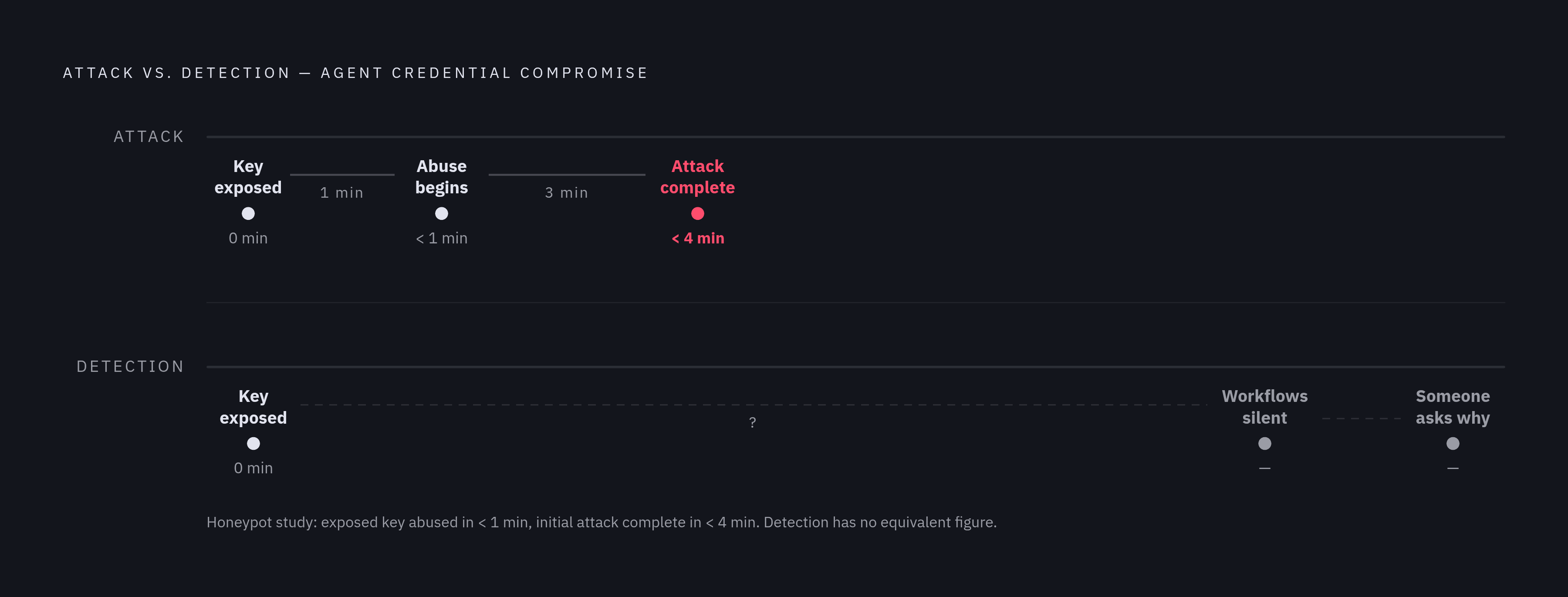
Start with the silent failure side. When an OAuth access token expires mid-operation, API requests just start failing, with no crash and no alert. The agent process keeps reporting healthy. The orchestrator sees nothing wrong. Underneath that calm surface is the real cause: workflows like bug triage, ticket creation, and notification routing just stop producing output. Without monitoring built specifically to catch this, the failure can run for hours before anyone notices, and the way teams usually find out is indirect: someone asks why bug reports haven't turned into tickets in a while, or why the Slack alerts channel has gone quiet. A credential quietly going stale doesn't.
Now the exploitation side, which moves at the opposite speed. In one honeypot study, attackers found and began abusing an exposed key within a minute of exposure, and they finished the complete initial attack in under four minutes. A credential compromise in an agent pipeline doesn't stay contained to one service either: an orchestration agent commonly holds credentials for several downstream agents, so a single leak can propagate across every system those downstream agents touch, a cascade pattern that traditional application security tooling was never built to watch for.
Governance hasn't caught up to either side of this. SANS Institute survey findings, cited by Kiteworks, show credential hygiene problems growing in step with agentic AI adoption, with only a minority of organizations treating AI agents as equivalent to human insiders for governance purposes, even as those same organizations expect malicious use of agents to raise their data theft risk. Forrester has warned that at least one publicly disclosed breach driven by agentic AI should be expected before the end of 2026, which reads less as speculation and more as a date already circled on the calendar.
Just-in-time credential provisioning as a solution to the mismatched expiry problem
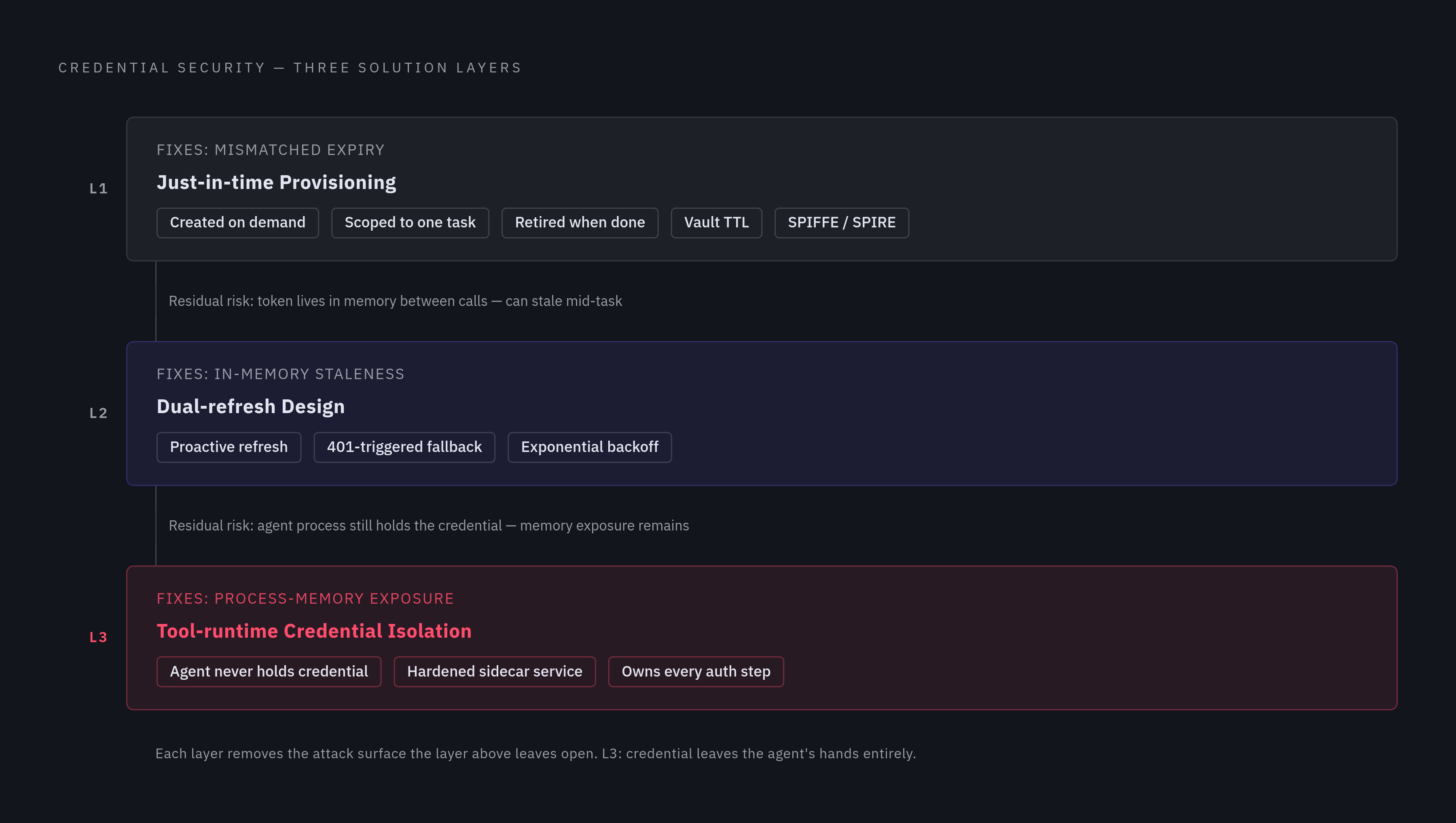
The cleanest fix for mismatched expiry portfolios is to stop handing agents long-lived credentials. Just-in-time provisioning replaces a standing secret with a credential created on demand, scoped to one task, and retired the moment that task finishes. The agent asks for access, an identity orchestration layer issues a short-lived token sized to the job, and the credential expires on its own once the work is done. Each credential's lifetime is set shorter than any task it could plausibly be used for, so nothing sits around waiting to expire unpredictably, which removes the mismatch at the root.
Akeyless points to the HashiCorp Vault model as a working example of this pattern already in production: instead of a permanent credential sitting in a config file, the vault issues a short-lived secret on request, carrying a TTL that expires automatically once the work tied to it is finished. At the architectural end of the same idea sits workload identity through SPIFFE/SPIRE, which Akeyless identifies as one of the more secure approaches for service-to-service authentication in cloud-native systems, because it removes static keys from the picture entirely instead of just rotating them faster. Pairing JIT with a session-boundary rule tightens it further: when an agent's session ends, rotate every credential that session touched, so a compromise discovered after the fact can't be replayed against a key that's still technically valid.
None of this is free to set up. JIT provisioning is genuinely hard to retrofit onto a pipeline that was built around static secrets, and a fair number of third-party APIs still don't support the identity federation needed to issue scoped tokens on request. The practical path is partial adoption: apply JIT first to the highest-privilege credentials, cloud provider keys and production database access, and expand coverage from there as the surrounding infrastructure catches up. Even partial coverage removes the blast radius on the credentials that matter most. The investment pays off fastest there. For pipelines that can't get there yet, the question becomes how to manage long-lived credentials safely in the meantime.
Dual-refresh and proactive token management for pipelines that cannot yet eliminate long-lived credentials
For teams still running on longer-lived credentials during a transition period, the practical fix for in-memory staleness is a dual-refresh design, one path that anticipates expiry and one that catches whatever slips past it, so the agent never has to stop mid-task to fix its own authentication.
Proactive refresh handles the anticipated side: renew a token once a meaningful portion of its remaining lifetime has elapsed, well before expiration would cause a failure, so the agent picks up a fresh credential without any interruption to whatever it's doing. Reactive refresh handles everything proactive refresh misses: when an API call fails with a 401 or an equivalent authentication error, the pipeline triggers an automatic credential refresh and retries the original request, rather than letting that failure propagate up as a broken workflow. Pair both with exponential backoff and jitter on retries, because a pipeline running many agent instances on a shared rotation schedule can otherwise produce a thundering-herd problem, all of them hitting the refresh endpoint at once.
Calendar-based minimums still have a place here, just not as the whole plan. Akeyless specifies distinct rotation cadences for high-security environments versus standard ones, and those cadences function as a floor, not a substitute for the proactive refresh happening inside that window. Dual refresh fixes staleness, not scope, so an agent can be fully up to date on a credential's validity while still holding far more privilege than its tasks require. An agent that dutifully refreshes a broad-access key on schedule is still carrying more privilege than most of its tasks require, because refreshing a credential on time says nothing about whether that credential should have been that powerful to begin with. Both JIT and dual-refresh share a remaining weakness regardless of how well they're implemented: the agent process itself still holds the credential, in memory, at some point during execution. Closing that gap requires taking the credential out of the agent's hands.
Tool-runtime credential isolation as the answer to the process-memory exposure surface
The pattern that removes the process-memory exposure surface completely is one where the agent process never holds a credential. In tool-runtime credential isolation, a separate hardened service owns every authentication step on the agent's behalf. The agent calls a tool, the tool authenticates to the target API, and the actual credential never crosses into the agent's memory space at any point in that exchange.
So a compromised agent process can no longer hand an attacker much. Under JIT provisioning, a compromised process still momentarily holds a live, if short-lived, token. Under tool-runtime isolation, there's nothing in that process worth stealing, because the authentication step happens somewhere the agent never touches. The agent requests an outcome, a currency conversion, a database query, a ticket created, and the intermediary layer decides how to authenticate that request without ever exposing the mechanism to the thing that asked for it.
That separation matters most at the exact moment an agent pipeline is most exposed: when something inside it has already been compromised and the only question left is how much an attacker can reach from there. A static key sitting in Treasury's vendor software took three days to contain after detection, and that was a single credential inside a system people were actively watching. An agent pipeline holding five or more credentials, each refreshed on its own schedule, running inside a process no one is staring at in real time, doesn't get the benefit of that kind of attention by default. A compromised agent leaks nothing under tool-runtime isolation, but without it hands over the keys to everything it touches.