MCP Server Wiring for Multi-Tool Agent Pipelines
Transport and server boundaries determine whether multi-tool agents work reliably.
Connecting tools to an AI agent through MCP is easy to demonstrate and harder to make dependable. Understanding, debugging, and controlling a multi-tool pipeline beyond a prototype depends on transport, server boundaries, gateway placement, and identity propagation.
Why MCP exists and what it actually standardizes
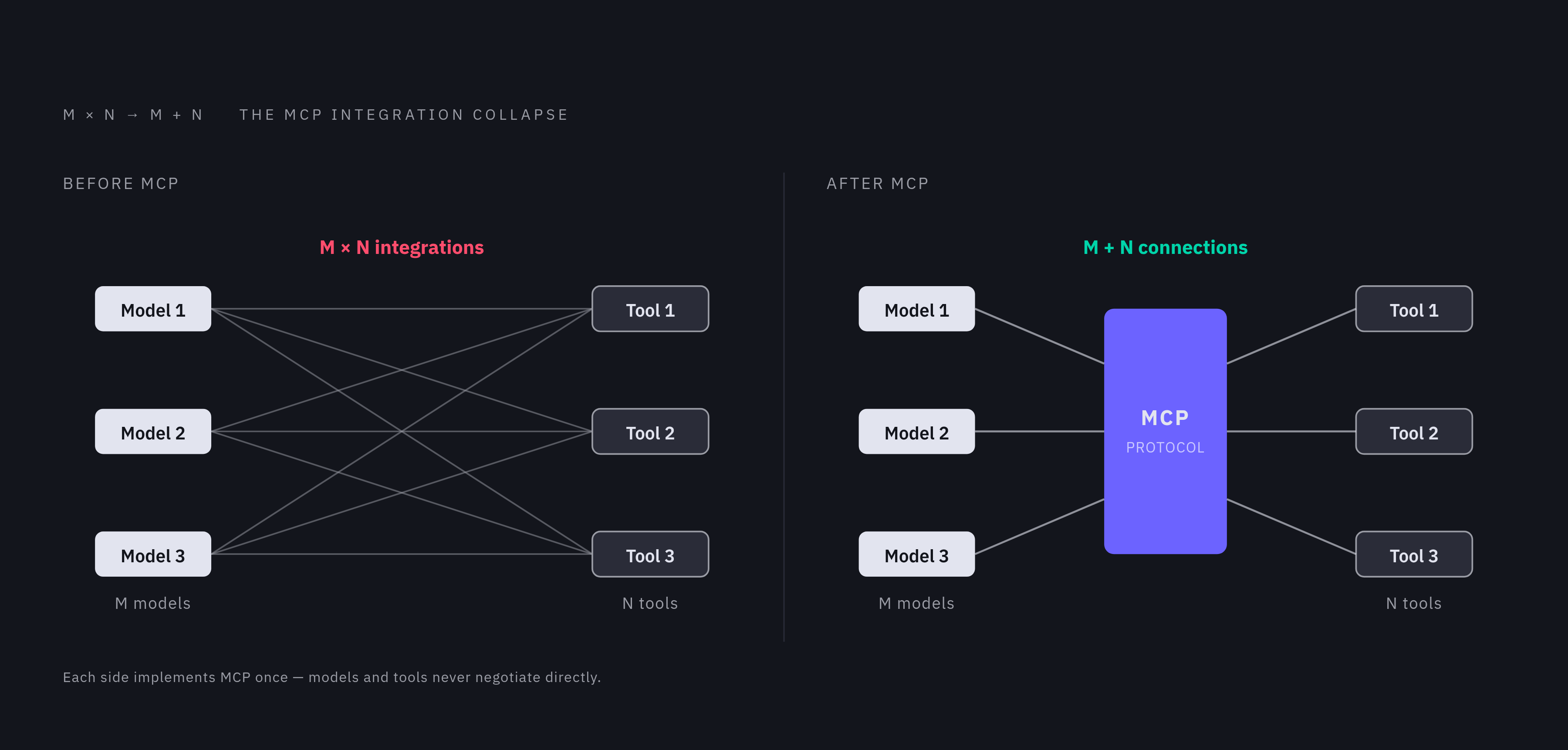
Before MCP, to connect M models to N tools, teams had to build M×N custom integrations. MCP replaces that arrangement with an M+N model in which each side implements the protocol once. Built on JSON-RPC, the protocol defines three primitives, namely Tools for executable functions, Resources for readable data, and Prompts for reusable templates. These give applications and capability providers a shared language without prescribing the architecture around them.
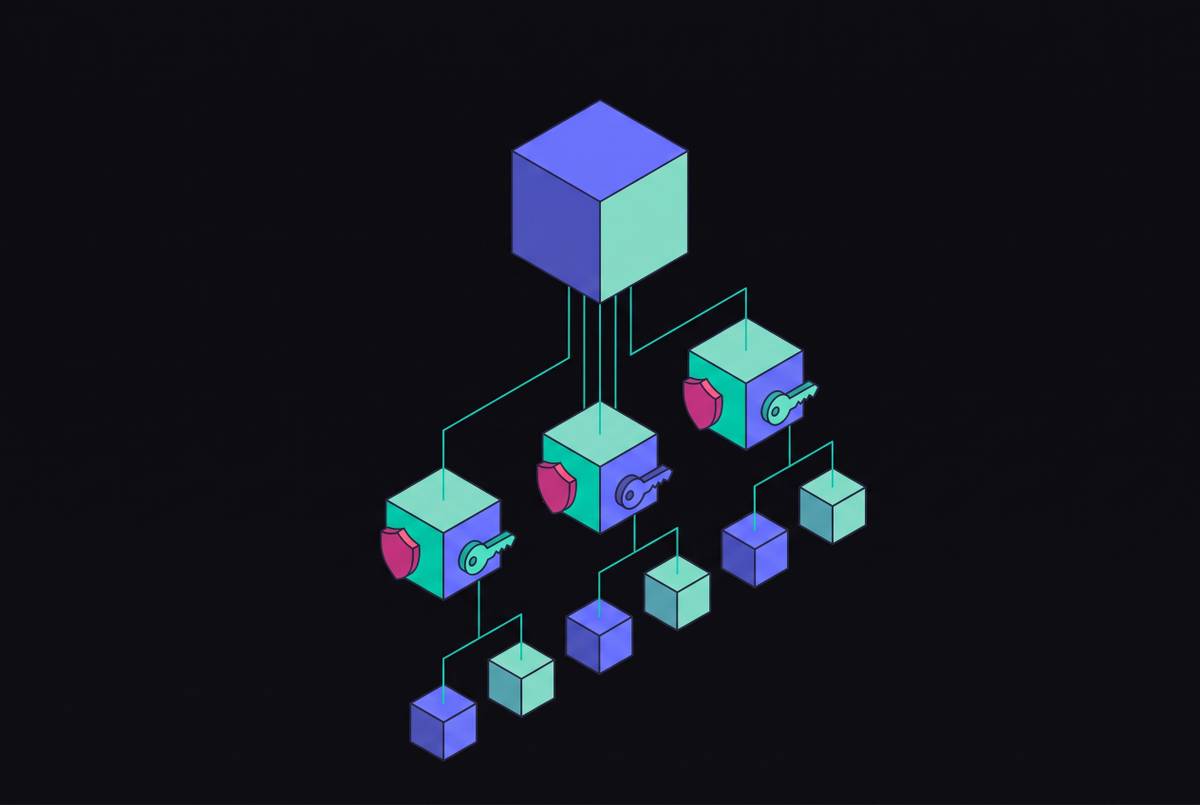
The application a user touches, such as Claude Desktop, VS Code, or Cursor, is the host. Inside it, a client manages communication with a server, the lightweight program exposing capabilities. Each connection has its own dedicated client. A host connected to several servers therefore maintains isolated, one-to-one channels rather than one shared conversation with every tool provider. That distinction becomes important when several agents need access to the same capabilities.
Transport choice as the first load-bearing architectural decision
With stdio transport, the client and server communicate on the same machine in a one-to-one arrangement. The server process dies when the agent disconnects. That is sufficient for a single developer, but it cannot support the shared-server arrangement in which a Manager agent delegates to a Worker agent that needs the same tools and state. Process lifetime becomes an architectural constraint.
Streamable HTTP changes that relationship because the server persists across connections and is reachable over the network. Many agents can share one server in N:M topologies, so each server can serve more than one agent. For shared multi-agent orchestration and production deployment, it is the required choice. But before this, stateful sessions made it harder to deploy through standard load balancers and needed session affinity for horizontal scaling. The network transport had removed one constraint while leaving another in place.
The 2026-07-28 MCP specification removes protocol-level sessions, the initialize handshake, and the Mcp-Session-Id header. Any request can now reach any server instance behind a standard load balancer. Servers can now run on ordinary web infrastructure. Amazon Bedrock AgentCore already supported MCP server hosting before this revision and benefits from these stateless improvements.
The same revision puts method and tool names in Mcp-Method and Mcp-Name headers, allowing gateways to route and authorize without parsing the JSON-RPC body. Meanwhile, the transport Working Group is building .well-known metadata endpoints for discovering servers and their authentication requirements. That work would let agents query a domain rather than depend on a hardcoded server list, a prerequisite for more autonomous coordination.
Server topology: how to organize tools across one or many servers
Once transport permits the intended connections, tool partitioning determines what decisions the agent must make. The recommended limit is a handful of tools per server, with larger collections split across several servers. A coherent surface keeps the choice manageable. Server boundaries are therefore not merely deployment conveniences, because they shape the capabilities the agent encounters together and the steps it must assemble.
Granular tools expose separate operations such as fetch, parse, validate, and write. The agent must chain those operations correctly each time, so it can finish one step and fail to finish the next. Composite tools instead expose one entry point while the server orchestrates the sequence internally. This reduces token usage and partial-state errors. It also makes behavior more predictable and auditable by moving a known procedure out of repeated model deliberation and into server-side execution.
In a data stack, the server category also determines what the agent can know. Warehouse servers such as Snowflake, Databricks, and ClickHouse expose schema and SQL execution, but tables alone do not reveal which data is trustworthy. Catalog servers such as Atlan, OpenMetadata, and DataHub supply metadata, lineage, ownership, and definitions, but usually cannot execute operations. Pipeline servers such as Bruin explain how data is produced, allowing an agent to trace a number to its source and change its computation.
Useful setups often use at least two server types together. A warehouse alone can produce confident but wrong queries when an agent faces hundreds of tables without context. The topology must give the agent enough context to distinguish a query that runs from a query that returns the intended answer.
The context window tax that grows with every server added
Splitting tools across servers helps keep them organized, but on its own does not cut their context cost. In a pipeline that preloads schemas, tool definitions re-enter the model’s context on every call so it can choose the next tool. This is a recurring tax. Each added server competes with conversation, retrieved documents, reasoning, and the response for a finite context window.
The scale can be substantial even before useful work begins. GitHub MCP definitions alone can occupy tens of thousands of tokens, while Playwright MCP and other servers add thousands more. These are illustrative magnitudes. A small number of servers can consume a large share of the available context through descriptions alone. As tools grow in number, engineers need to deal with their context cost now, beyond a promise to tidy the configuration later.
MCP Tool Search arrived in January 2026 as a protocol-level response, deferring definitions when their size would exceed a context-window threshold. The model searches for tools. Cloudflare takes a related approach with its Code Mode pattern, exposing its large API through just two MCP tools, search and execute. Both approaches separate the breadth of available capabilities from the amount of description loaded into each model call.
Gateway placement and what a centralized control plane makes possible
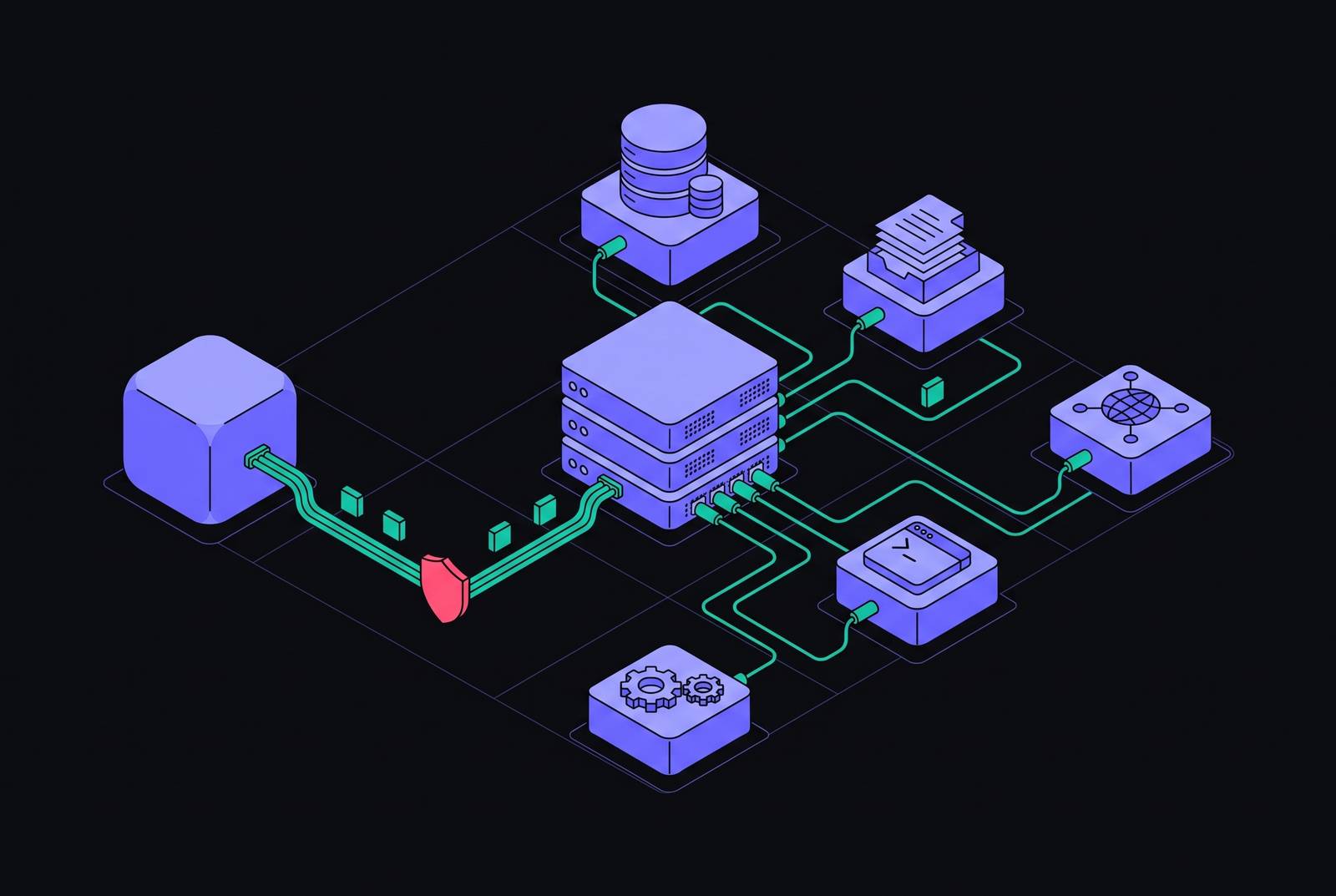
When each AI tool connects directly to each MCP server, credentials, visibility, and enforcement are spread across many separate paths. A hub-and-spoke gateway gives agents one place to address instead. It validates identity, applies constraints, injects trace IDs, and routes requests to the appropriate backend. The gateway does not replace MCP, but governs the access that MCP standardizes.
Central credential management addresses the sprawl of personal access tokens, integration tokens, and API keys otherwise required across servers. The gateway can manage those credentials and issue organization-wide or per-user keys downstream. It can also expose only tools an agent is authorized to see. That is access control. A definition omitted from a prompt is different from a tool made unreachable by infrastructure.
The stateless revision makes this placement compatible with ordinary HTTP routing because authorization can use the request headers. For observability, the specification reserves traceparent, tracestate, and baggage in request _meta, requiring W3C formats when those values are present. Their presence is not mandatory on every request. The revision also deprecates protocol-level Logging in favor of OpenTelemetry for structured observability, making the gateway a natural point to collect and emit signals.
Microsoft’s Agent Governance Toolkit is an open-source runtime governance layer that includes an MCP Security Gateway for tool execution. It illustrates the separation between exposing capabilities and controlling their use. The same gateway pattern supports agent visibility, approved-traffic monitoring, anomaly detection, policy enforcement, and action audit logs. Those controls belong where tools run because the protocol does not set the organization’s governance rules.
Identity propagation and why anonymous tool calls break accountability
The gateway can enforce meaningful policy only if it knows whose action it is evaluating. Most deployed MCP pipelines instead hide tool calls behind an agent service account, leaving the server unable to identify the originating user, workflow, or agent instance. Attribution stops at the shared credential. Without propagated identity, gateway policy falls back to IP-based or service-account-level access control, losing the distinction the centralized control plane was meant to preserve.
That loss becomes more consequential when agents inherit permissions designed for people. Human access models assume relatively infrequent, deliberate actions, while agents can make thousands of calls in a session. Permission scope alone does not constrain that pace. A useful audit trail must connect execution to its originating context, rather than merely establish that some authorized service sent the request.
The revised specification strongly recommends OAuth 2.1 with PKCE for HTTP-based remote servers and requires RFC 8707 Resource Indicators so tokens cannot be redeemed at the wrong server. It also deprecates Dynamic Client Registration in favor of Client ID Metadata Documents. Authorization servers should include the iss parameter under RFC 9207, and clients must validate it when present before redeeming an authorization code. These checks tighten the authorization chain. An embedded authorization server can issue and validate tokens against providers such as Okta, Entra ID, and Google, connecting verified identity to the workflow context needed for compliance and incident response.
The security threat surface that wiring decisions create or close
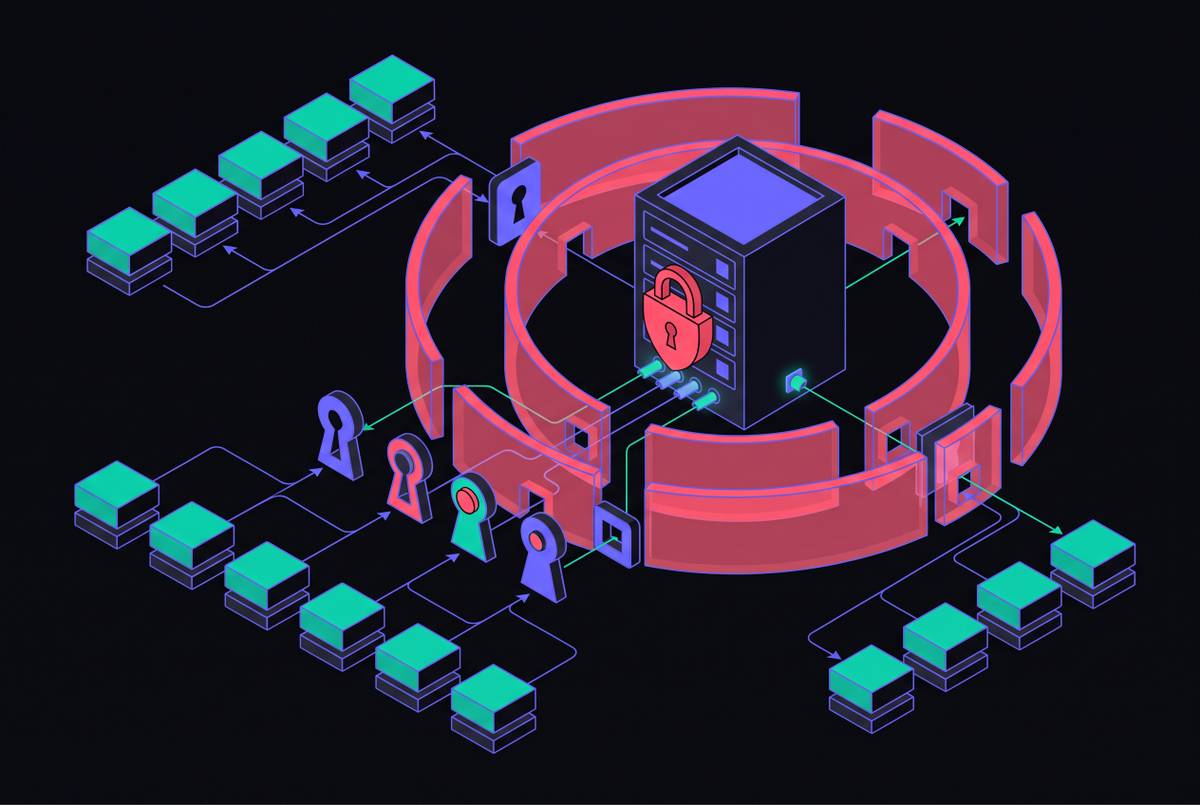
MCP gives tool descriptions directly to the model, lets anyone host a server, and has no built-in policy checkpoint before tools run. Its openness is also its attack surface. Prompt injection places hostile instructions in data the agent reads, such as a file, web page, or database row. Tool poisoning instead manipulates a tool’s description or behavior to lure the agent into unsafe actions. The OWASP Top 10 for Agentic Applications (2026) classifies tool poisoning under ASI04, Agentic Supply Chain Vulnerabilities.
Tool descriptions are especially hard to deal with because they sit in context the user usually cannot see. The person authorizing the session may never see the instructions influencing the agent. Better instruction-following is not automatically a defense. Malicious metadata exploits that capability by presenting an unwanted action as something the agent ought to do.
By February 2026, the Sandworm_Mode campaign had used npm typosquatting to target Claude Code, Claude Desktop, Cursor, VS Code Continue, and Windsurf. Malicious packages mimicked popular utilities and installed rogue MCP servers. Those servers used prompt injection to collect SSH keys, AWS credentials, and npm tokens, while separate HTTPS, GitHub API, and DNS tunneling channels handled network exfiltration. A package installation became a tool connection, and that connection became an instruction source.
The architectural defenses address different parts of that chain. Gateway allow-lists remove unauthorized tools from the reachable surface. Enforcing OAuth with Resource Indicators stops tokens from being abused across servers. Behavioral monitoring checks for calls that pass authentication but break the agent’s policy. A valid credential is not a certificate of good intentions, so identity checks and runtime scrutiny serve distinct purposes.
Where MCP's current boundaries sit and what the agent-to-agent future requires
MCP connects agents vertically to tools and data, but it does not set out how agents should coordinate horizontally with each other. Google created the Agent-to-Agent Protocol, A2A, for that coordination and task delegation. It reached v1.0 in March 2026 and v1.0.1 in May 2026, and both protocols are now governed by the Linux Foundation. They are complementary. Sharing tool access through MCP does not, by itself, establish how agents negotiate responsibility for a task.
The 2026 MCP roadmap nevertheless envisions servers evolving into autonomous agents that negotiate, delegate, and coordinate without a central orchestrator. The necessary peer-to-peer negotiation mechanisms do not yet exist in the protocol. Tasks, formalized as SEP-1686, provide a foundation through long-running asynchronous operations with creation, progress, completion, failure, and cancellation. Important lifecycle gaps remain to be closed. The roadmap identifies retry semantics, result expiry policies, and dependent task-chain management as prerequisites for practical agent-to-agent communication.
For builders today, the lesson is to establish gateway-enforced identity, allow-listed tools, stateless deployments, and W3C Trace Context propagation before coordination becomes more autonomous. These choices provide boundaries and attribution that remain useful when execution spans more participants. Deferring them makes the eventual migration harder. Teams that build the control plane now can extend it as coordination primitives arrive, rather than replace the wiring beneath a running system.